






Most marketing data pipeline failures are silent. A platform deprecates a metric. A connector stops updating. The dashboard keeps serving whatever data it last received. No alert fires. The data team finds out when a stakeholder questions a number, and by then the gap in the historical record is permanent.
The problem compounds at scale. A marketing stack across ten platforms means ten API update cycles, ten schema conventions, ten sets of field names to normalize. Each one is a potential point of failure that the data team owns. Most engineers don't lack the ability to build a marketing pipeline; they lack the time to maintain one while platforms keep changing underneath it.
AI makes the foundation problem harder to ignore. Models and agents act on whatever data they're fed. A pipeline that returns stale or inconsistent data doesn't produce an error; it produces a confidently wrong output.
The solution is a data hub built specifically for marketing data. With a marketing data hub as the core of your architecture, you can depend on fresh, quality data while still having the flexibility to move data to and from pretty much anywhere without wasting time on schema updates or rebuilds every time you change a destination.
This guide gives data teams a practical framework to build a marketing pipeline that works.
What makes marketing data pipeline management different
A general-purpose ETL pipeline moves data that it wasn't designed to handle, whereas a pipeline solution purpose-built for marketing gives you everything marketing data needs: managed API connections, consistent metric definitions across platforms and historical continuity through schema changes.
Fragmentation
Marketing data lives across dozens of platforms. Each one stores data in its own format, with its own field names and logic. A small brand running Google Ads, Meta, LinkedIn and TikTok, and pulling data from its CRM and email, is already managing six separate data schemas before adding any offline data.
This siloed data impacts collaboration. Without a pipeline that standardizes formats and aligns logic across sources, there is no single source of truth. The marketing analyst exports from Google Ads and applies their own definition of a conversion; engineering pulls from the warehouse and applies a different one.
Any reporting built on unresolved fragmentation is comparing numbers that were never measuring the same thing. That's a data integration challenge the pipeline has to solve before anything else.
API volatility
Platforms update their APIs regularly, and they rarely notify you when something changes. When that happens, the connector breaks and the feed stops updating, but nothing flags it. The dashboard keeps displaying the last data it received, which could be days or weeks old, and everything looks normal.
A recent example is Meta's deprecation of its Page Insights API metrics in November 2025. Teams that weren't actively monitoring their connectors had no way of knowing their data had stopped updating. By the time the gap was spotted, campaigns had already been running on stale data for weeks.
The implication is that your entire marketing department runs on stale data, and the decisions made during that time can't be undone.
Naming inconsistency
Every platform has its own terminology for the same concepts, and the differences matter more than they appear.
Google, Meta and LinkedIn all report "clicks,” but they measure different things. Google counts a click when someone clicks the ad itself. Meta counts a click on anything in the post: the image, the link, the page name, the comments button. LinkedIn's definition shifts depending on campaign type.
Because all three use the same label, a pipeline without a normalization step combines them into a single total. Any budget decision made on that number is based on inaccurate data.
Getting alignment on definitions before building solves this. As Dan Mandle, SVP of Data Science at broadhead, puts it, “We made sure everyone agreed on what counts as a conversion. No more debates about definitions.”
Historical data requirements
Marketing reporting depends on being able to compare performance over time. Those comparisons only hold up if two conditions are met: the data was captured and stored at the time it was produced, and the measurement methodology hasn't changed since.
When a platform shifts its attribution window or retires an API version in favor of one that structures data differently, the historical record and the current record stop measuring the same thing.
The numbers sit side by side in the same report, but they were produced by different measurement logic, so the comparison is meaningless.
So, what should you include in your marketing data pipeline architecture to resolve these issues?
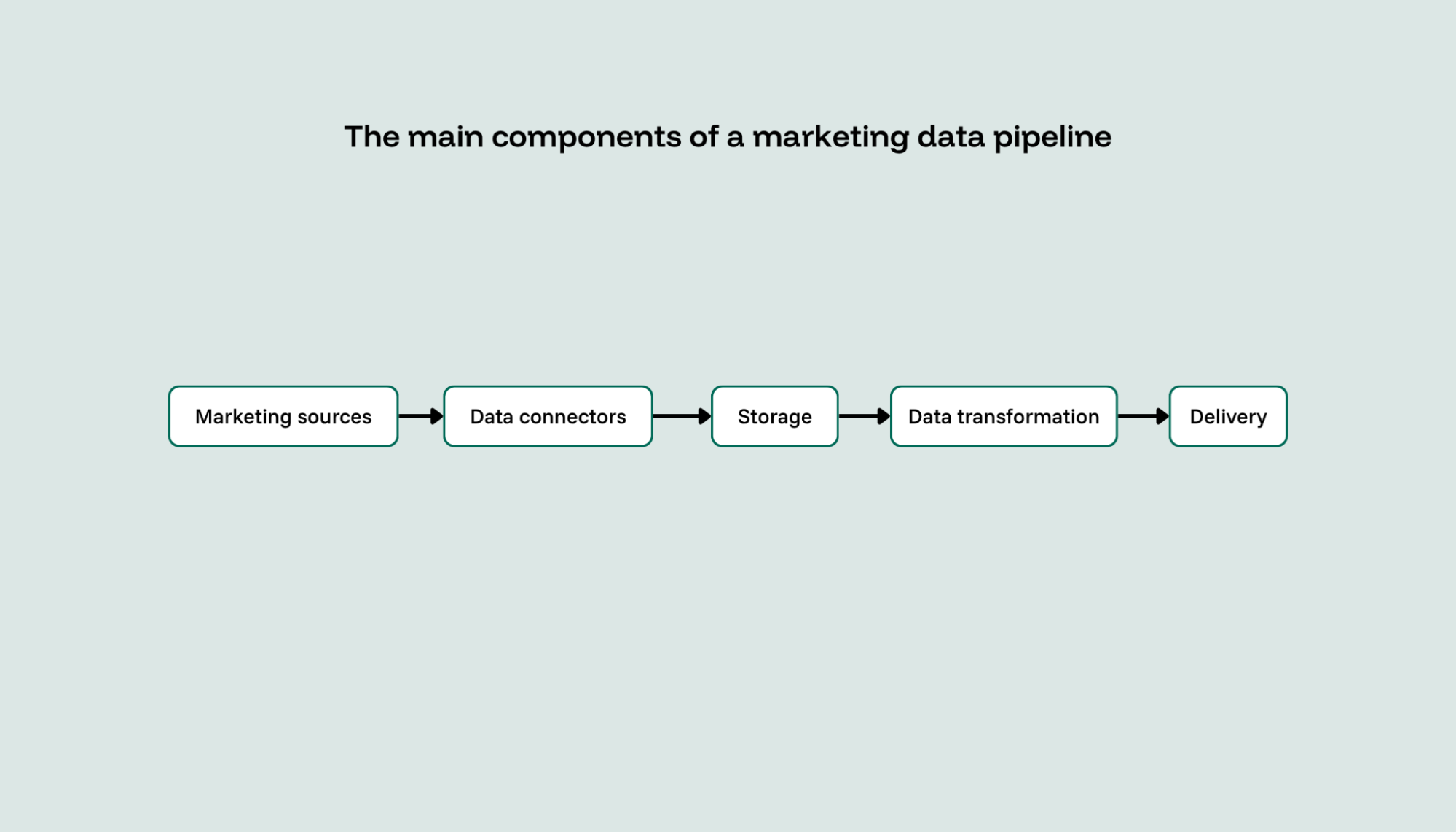
The five components of a marketing data pipeline
Here are the building blocks that you need.
1. Sources
Data sources are every platform your marketing team uses to run campaigns or track performance. Google Ads, Meta, LinkedIn, your CRM, email tool, website analytics. Before you start building connectors and designing storage structures, you need to know what your sources are. It lets you start with a clear, complete picture of your data landscape.
2. Connectors
Connectors are the extraction layer of ETL. They are the bridge between a platform's API and where your data is being stored. Connectors fetch data from the platform at set intervals. Each time it runs, it pulls whatever new data was generated since the last time it checked and moves it into storage. The schedule matters because it determines how fresh your data is at any given moment. This is important for marketing teams who need data that’s updated daily to generate actionable insights.
3. Storage
Once data has been extracted, it needs to be stored. A lot of data teams use a cloud warehouse, the central component of the modern data stack.
A warehouse stores data from different platforms in one place. It also preserves that data over time. Platforms don't retain your data indefinitely and often apply methodology changes retroactively. Your storage solution might be the only record of what the data looked like at the moment it arrived.
If it’s not designed to retain data long enough, version schema changes and preserve raw records before transformation, historical comparisons become impossible.
4. Transformation
The data transformation component is where raw data gets cleaned, standardized and made usable. Transformation resolves naming inconsistencies, standardizes formats, removes duplicates, flags incomplete records and structures data for reporting and analysis.
If transformation doesn't happen, or happens incorrectly, every report, dashboard, budget decision and AI model built on top of the pipeline works from data that wasn’t properly standardized.
5. Delivery
Delivery is the final step in the pipeline: getting clean, transformed data to the people and tools that need it.
For some teams, that might mean pushing it to analytics tools like Looker or Tableau for reporting, to an activation platform for audience targeting, to an AI workflow or agent that needs marketing context to make decisions or making it directly accessible to marketing analysts for ad hoc queries. The people who need the data and the format they need it in are decisions that have to be made at this stage. Delivery tooling determines how well that works in practice.
Step-by-step: How to design your pipeline architecture
Here’s a technical sequence your engineers can use for designing a pipeline architecture that's maintainable at scale.
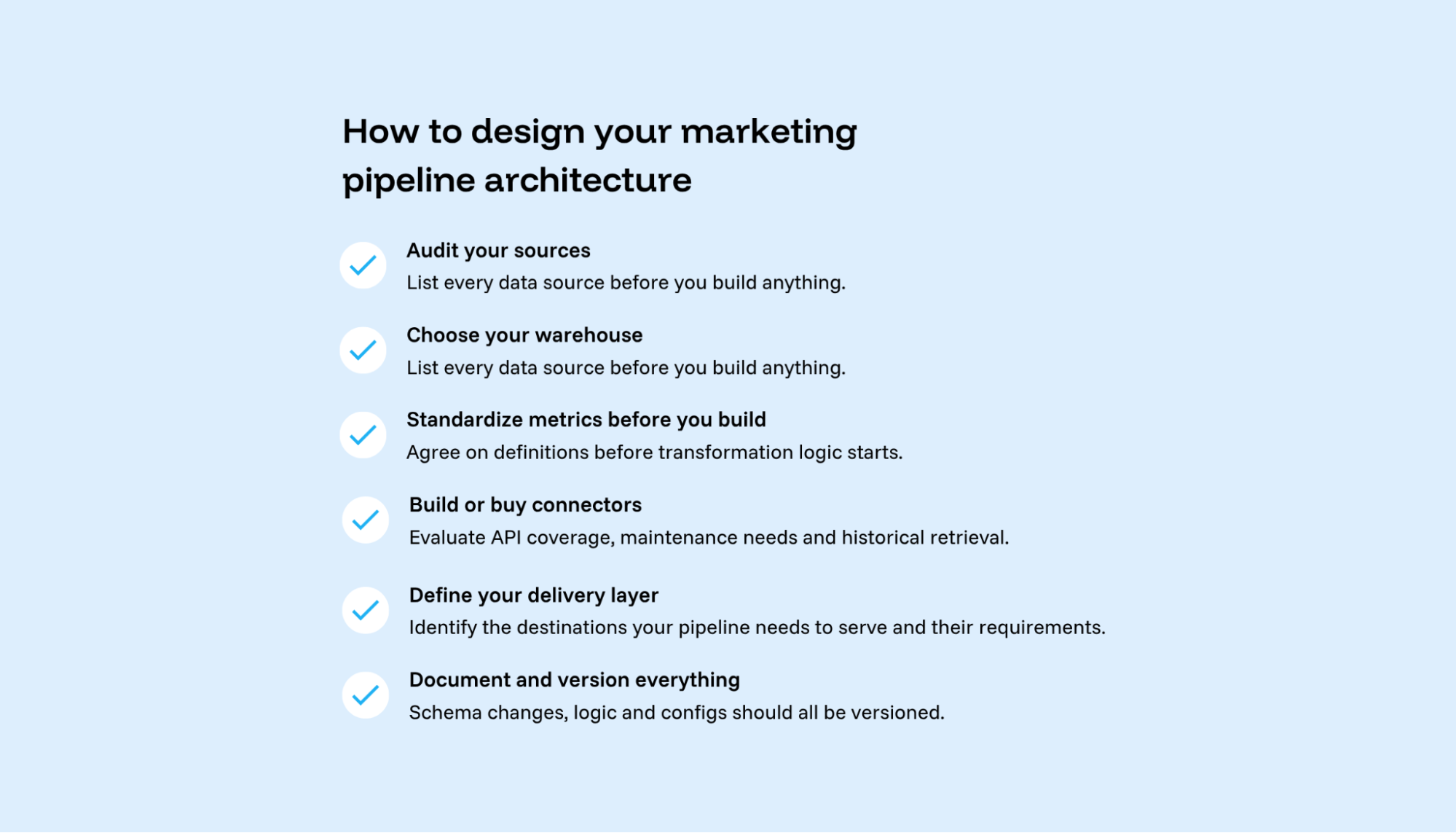
1. Audit your sources
List where your marketing data comes from before you build anything. For each source, capture what data it produces, whether it has a reliable API or requires manual exports, how frequently it updates and who owns it. Every source discovered after the pipeline is built has to be retrofitted.
2. Choose your warehouse
The warehouse determines which connectors work with it natively and how incoming data needs to be structured. It also affects cost. Different storage systems charge differently for compute, data scanned or infrastructure. Those differences affect how the pipeline should be designed to keep costs manageable.
3. Standardize metrics before you build
For every metric you plan to report on, document what each platform actually measures when it reports that metric. Then decide which definition your pipeline will treat as the standard and what adjustment each platform's data needs to match it. Most teams only need to define this logic once. The right tool supports automatic data transformation so the work happens at setup rather than repeatedly.
4. Build or buy connectors
Evaluate each connector against three criteria: API coverage for the platforms you need, capacity for ongoing maintenance when APIs change and support for historical data retrieval.
5. Define your delivery layer
Determine what destinations the pipeline needs to serve (BI and reporting tools, warehouses, activation platforms, AI workflows), what schema each requires and what SLAs each consumer expects. Design this before you build, as destination requirements often determine transformation logic upstream.
6. Document and version everything
Treat your pipeline like code. Everything from schema changes to transformation logic and connector configs should be versioned.
Build vs. buy your marketing data pipeline
Building your own pipeline makes sense if your data sources are proprietary with no existing connectors. It also makes sense if your security requirements prevent third-party tool access, or if you have a dedicated engineering team with the long-term capacity to maintain connectors as platforms change.
Building a single connector takes between 50 and 100 hours of engineering time before it's functional. After that, every time the platform updates its API or changes its data structure, an engineer has to go back in and fix it. That maintenance work is ongoing and unpredictable. Across 10+ platforms, this compounds fast.
A marketing data hub handles all of that by design, so the data team isn't rebuilding infrastructure every time a platform updates its API.
For most marketing teams running campaigns across five or more platforms, with limited engineering resources and a need for fresh data, the case for a marketing data hub is stronger. A data hub extracts, transforms and stores all your marketing data, giving you a central, governed, unified source of truth. It also stores raw imported data and exports marketing data to your warehouse, BI tools or other destinations, or sends modeled data to AI workflows or activation platforms.
|
Build vs. buy a marketing data pipeline |
||
|
Build |
Buy |
|
|
Best for |
Proprietary sources with no existing connectors; strict security requirements; dedicated engineering team with maintenance capacity |
Campaigns across 5+ platforms; lacks deep data engineering resources; fast time to insight |
|
Time to deploy |
Months: 50–100 hours per connector, before ongoing maintenance |
Days to weeks: connectors are pre-built and vendor-maintained |
|
Ongoing maintenance |
Your team owns every API change, schema update and connector break |
Vendor handles API changes; schema changes preserved without data loss |
|
Data normalization |
Custom logic required per source |
Built-in normalization before data reaches your warehouse |
|
Historical data |
Dependent on your implementation |
Preserved through schema changes by design |
|
AI readiness |
Depends on how transformation and schema design were implemented; inconsistent definitions surface as AI input problems |
Normalized, consistently defined data is AI-ready by default |
|
Costs |
High upfront engineering cost; compounds at 10+ platforms |
Predictable subscription cost; lower TCO at scale |
When evaluating a marketing data pipeline, the criteria that matter most are connector breadth, historical data support, normalization capabilities, warehouse compatibility and how the vendor handles API changes on your behalf.
How to audit your current marketing data pipeline
Most pipeline problems show up in the same places. These questions will tell you which ones apply to yours.
- How much of your team's time goes to reactive maintenance (connector breaks, schema changes, API updates) versus building new capability?
- Can you compare performance across channels and campaigns reliably?
- If two people on your team pull the same report independently, do they get the same number?
- If your campaign structure changes mid-quarter, does your historical reporting break?
- If an AI workflow or agent were querying your marketing data today, would the definitions and schema be consistent enough for it to produce reliable outputs?
If one or two answers are uncomfortable, the pipeline has maintenance gaps. If three or more are uncomfortable, the pipeline needs to be redesigned.
Power Digital is a useful benchmark for what that looks like in practice. After rebuilding their pipeline, report build time dropped from days to under an hour, manual work was reduced by 75% and analysts could access and activate data without raising a single engineering ticket.
Ready to build your pipeline?
A well-designed marketing data pipeline shifts the data team's role. Instead of owning every connector break, every API change and every schema migration, you own the analytical layer: the definitions, the models, the outputs that actually drive decisions.
Funnel is a marketing data hub built to handle the infrastructure work: managed connectors, built-in normalization and historical continuity through schema changes. The data team gets a reliable foundation to build on rather than a pipeline to maintain.
See how Funnel handles marketing data ingestion.
FAQ
How long does it take to build a marketing data pipeline?
Building in-house takes three to twelve months, depending on the number of sources and the complexity of your transformation logic. That estimate doesn't include ongoing maintenance. Each connector takes 50 to 100 hours to build before API changes, schema updates and platform deprecations add to the workload. A managed marketing data hub deploys in days to weeks because connectors are pre-built and maintained by the vendor.
What tools do I need for a marketing data pipeline?
At minimum: a connector layer, a storage destination (typically a cloud data warehouse like BigQuery, Snowflake or Redshift), transformation logic and a delivery layer to BI or downstream tools. A marketing data hub consolidates most of this into one managed layer.
What's the difference between a marketing data pipeline and a general-purpose data pipeline?
A general-purpose pipeline moves data from one place to another. A marketing data pipeline does that, but it also normalizes metrics that platforms define differently, keeps connectors stable when APIs change and preserves historical records through schema updates so reporting stays consistent over time. Generic data pipeline tools don't remove that complexity; they just hand it to your team.
How do you handle platform API changes in a marketing data pipeline?
One approach is building monitoring into the pipeline so breaks surface immediately, with someone assigned to fix them. The other is using a managed connector layer where the vendor handles API changes on your behalf. Teams without either in place end up with data gaps. The Meta Page Insights API deprecation in November 2025 is a recent example. Teams without active monitoring lost weeks of data before they noticed the feed had stopped updating.
How do I keep historical marketing data intact through schema changes?
Preserve raw source-level records before transformation, version your schema changes and ensure your storage layer retains data at the time it was produced. Retroactive platform methodology changes mean your warehouse snapshot is often the only accurate historical record.