






Data transformation is the process of validating and preparing raw data for analysis. For marketers, it’s the bridge between a fragmented mess of spreadsheets and reliable business insights.
Not getting transformation right is one reason why marketers are currently swimming in data but starving for insights. Because every ad platform uses its own naming conventions and internal taxonomies, your sources rarely speak the same language. One platform might report spend in "USD" while another uses "$." If you try to build a dashboard with this raw data, it breaks. Or worse, it provides incorrect numbers that lead to bad investment decisions.
In this guide, we explore why transformation is the secret sauce for modern marketing analytics. We dive into real-world examples of data harmonization, compare transformation to data cleaning and show you how to automate these steps within an ETL workflow or in a marketing intelligence platform. By the end, you’ll know how to stop the manual spreadsheet gymnastics and start driving ROI with trustworthy data.
What is data transformation, and why does it matter in marketing?
Data transformation is the process of modifying data to fit a particular purpose or context. This can involve cleaning, standardization, or aggregation, all aimed at enhancing data quality and usability for more accurate analysis. Data transformation can be manual or automated.
For marketers, data is notoriously fragmented; social platforms, CRMs and web analytics tools all use different schemas, date formats and naming conventions. Without an automated transformation layer, marketing teams are forced into manual cleanup work. They’re spending time fixing spreadsheet errors and chasing missing values.
Automated transformation ensures data integrity and preserves historical performance, regardless of how often platform APIs or schemas change.
A marketing data transformation example
Think of your ad performance data from TikTok. Perhaps you’d like to visualize the key performance metrics from the last 6 months. When quickly reviewing the raw data, you notice some broken cells due to missing values or incorrect data.
If you were to send these raw data values on to your visualization software, your final dashboard would likely be broken in one or more places. In order to avoid this, you need to transform data in order to remove those broken values from the raw data, or to ensure that the data is accurately sent through.
Data transformation vs. data cleaning
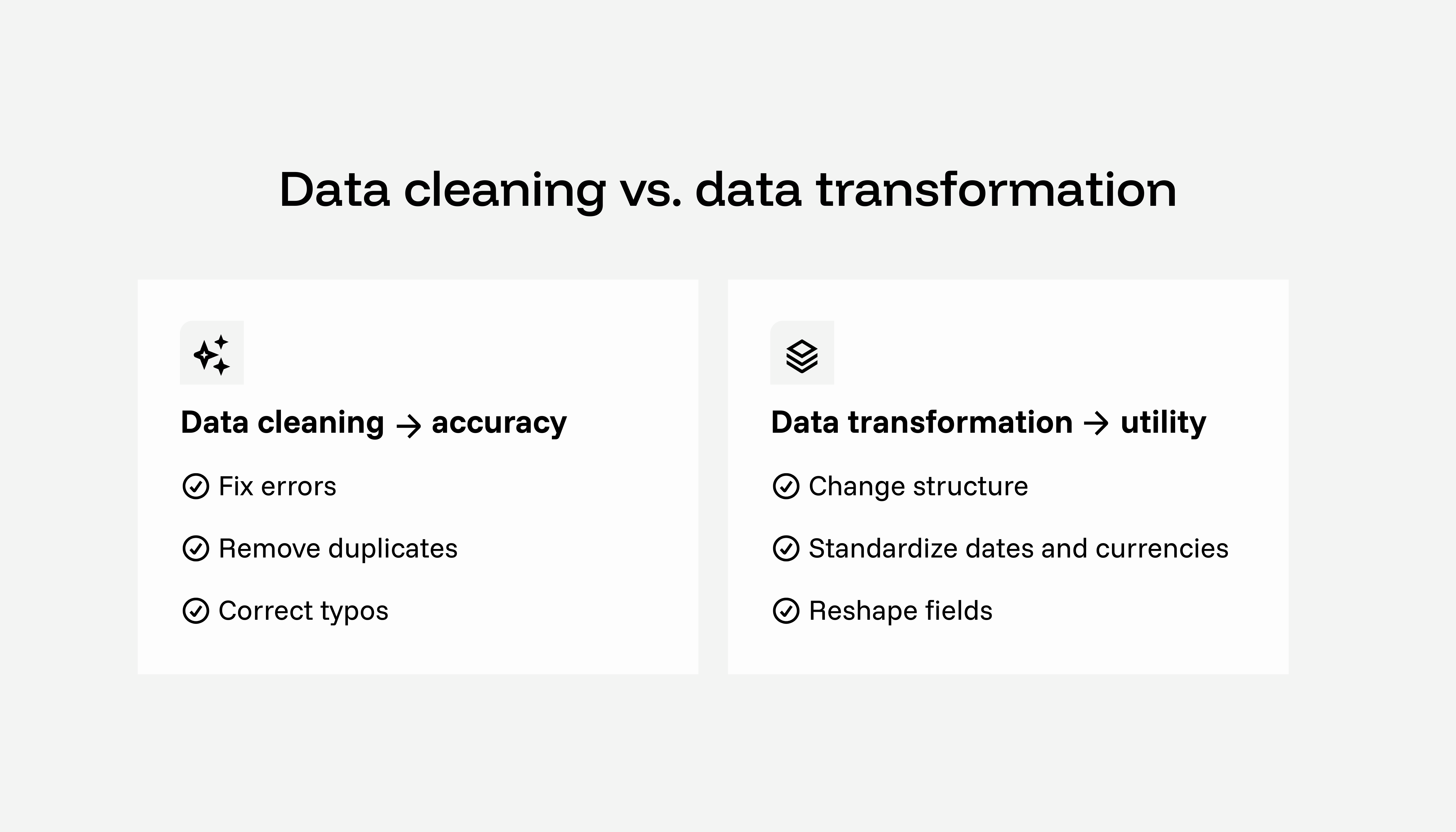
It’s easy to confuse these two, but they serve different purposes:
- Data cleaning is for accuracy: Fixing errors, removing duplicates and correcting typos.
Why data transformation is so valuable
So, why all the fuss about this data transformation idea? Well, for starters, it’s a critical step in broader, more detailed data analysis and maintenance. However, it’s also common sense for modern digital marketers who are running comprehensive campaigns across many different platforms.
To effectively carry out the data transformation process, a robust data transformation tool is often required. These tools can automate many of the tasks involved in improving data quality, like cleaning and standardizing data, making the process more efficient and less prone to error.
Even Facebook and Google, two of the most popular digital advertising platforms, treat data differently. Whether it’s cross-device conversions, clicks, UTM parameters, attribution and more, it can be extremely difficult to directly compare performance results between the two platforms using their standard raw data sets.
Instead, marketers need to integrate and transform this unstructured data so that the various parameters and metrics align. This is a process also known as data integration or data mapping. Data integration allows you to make easy comparisons between platforms, as well as use the combined data to gain higher-level insights from the broader campaign ecosystem.
Beyond ensuring that all of your advertising sources are “speaking the same data language,” it is often worth thinking about the types of data transformations that are useful on a global scale, literally.
Data transformation makes global campaigns easier to analyze
Running campaigns across international boundaries introduces complexities that raw data cannot solve on its own. To get an accurate picture of global performance, you need to apply specific transformations:
Currency normalization
If you’re spending in GBP, EUR and JPY but reporting in USD, you need to transform those values. It’s crucial to use historical conversion rates (the rate at the time of the spend) rather than just the current daily rate to ensure your ROI calculations are accurate.
Time zone alignment
Global product launches often happen simultaneously. For example, a launch at noon in London is 7 a.m. in New York. Without transforming the time zone data into a single standard (like UTC or your headquarters' local time), comparing "hour-one" performance across markets becomes impossible.
By standardizing these variables, transformation allows you to stop looking at isolated regional pockets and start analyzing your global campaign ecosystem as a single, unified entity.
Sending transformed data to your target destination
Let’s also not forget one of the most common reasons we see data transformation being implemented. As we covered previously, Looker Studio is one of the most popular visualization services on the market.
One of its main limitations, however, is that it can only pull data from a single source. Because of this, we see many of our clients start out their data journey (before joining forces with Funnel) by pulling everything into a massive Google Sheet where they apply a series of data transformations. After all, Looker Studio is great at making visualizations, but it's simply not built for transforming and cleaning your data.
For larger organizations, a cloud data warehouse can be a more scalable solution for storing and transforming data. These platforms offer the advantage of high-capacity storage, computing power and distributed processing capabilities. The data warehouse makes it possible to transform data on large datasets in real-time, ensuring that your transformed data is always up-to-date and ready for analysis.
Types of data transformation
Marketing data isn’t analysis-ready out of the box because each platform uses its own field names, formats and definitions, which is why simple questions like “What did we spend?” can yield different answers across sources. With data transformation, you turn raw data exports into a consistent dataset you can understand in tools like Looker, Google Sheets or BigQuery.
The following transformation techniques aren’t an exhaustive list that a data team might use, but they’re what you’ll see in almost every modern marketing data workflow.
|
Technique |
Purpose |
Example |
|
Translation & mapping |
Align fields across platforms |
Meta “Amount spent”, Google “Cost”, TikTok “Spend” → Spend |
|
Standardization |
Align formats and units |
Dates → YYYY-MM-DD (plus one timezone + currency rule) |
|
Structural reshaping |
Change structure for analysis |
US_Search_Brand_Spring → Country / Channel / Category / Season |
|
Integration & aggregation |
Unify sources, then summarize to reporting level |
Merge EMEA/NA/APAC accounts → one Spend and a rollup view |
|
Enrichment |
Add business context |
Join paid media → CRM opportunities to report pipeline by channel |
|
Classification |
Group into strategy buckets |
Campaigns → Brand / Non-brand / Retargeting |
|
Binning |
Turn numbers into ranges |
Spend → $0–$500 / $500–$2k |
|
Smoothing |
Reduce short-term volatility |
ROAS → 7-day moving average |
|
Feature engineering |
Create predictive signals |
CRM stage + pricing views + depth → Lead Quality Score |
|
Normalization |
Scale values for fair comparison |
Logins + revenue scaled before creating a health score |
|
Indexing |
Speed up filtering and queries |
Index Date / Campaign_ID / Email_Address |
1. Translation and data mapping
This type of data transformation involves aligning naming conventions and fields across different platforms so you aren’t comparing apples to oranges.
When to do it: It’s the first step after extracting data.
Example: Mapping Meta’s “Amount spent,” Google Ads’ “Cost” and TikTok’s “Spend” into one canonical field called Spend.
2. Standardization
You need your data to speak the same language, which means aligning dates, time zones, currencies and naming conventions so your analysis isn't undermined by formatting quirks.
When to do it: Address this early; otherwise, you’ll end up with split totals and broken reports before you even begin.
Example: Lock all dates into a YYYY-MM-DD format, sync everything to one reporting time zone and apply a documented exchange-rate rule to convert spend into a single currency.
3. Structural reshaping (including splitting and pivoting)
Sometimes, data arrives in a way that’s impossible to filter. But reshaping it, like splitting strings or pivoting tables, extracts the specific details buried inside long URLs or messy layouts.
When to do it: Use this when you need to turn UTMs, campaign names or URLs into functional reporting fields.
Example: Take a string like US_Search_Brand_Spring and break it into four distinct columns: Country, Channel, Category and Season.
4. Integration and aggregation
This is where you merge disparate sources into a single dataset so you see the big picture. You’re basically summarizing granular data into the high-level views leadership actually needs (by region, channel or brand).
When to do it: When you need a unified view across various accounts without the headache of conflicting totals.
Practical application: Merge your EMEA, NA and APAC ad accounts so you have one definition of "Spend" and one clear view of marketing-attributed revenue.
5. Enrichment (adding business logic)
Ad platforms only see half the story, but enrichment joins your marketing data with your CRM or internal product systems to show the full customer journey.
When to do it: When the conversation moves past "clicks and impressions," and you need to report on actual business outcomes.
Example: Connect paid media data to CRM opportunities. This allows you to track pipeline and revenue by channel using your company’s specific definitions for MQLs and SQLs.
6. Classification (generalization)
Raw data is often too granular for strategy. Classification groups those thousands of line items into manageable categories.
When to do it: Post-integration, once you realize your reporting is too busy to help you make budget decisions.
Example: Group your hundreds of individual campaigns into broader buckets like Brand, Non-brand and Retargeting.
7. Binning (discretization)
Sometimes, continuous numbers (like exact spend or age) are more useful when grouped into a range because it makes trends and segments easier to interpret.
When to do it: When you are building customer segments for forecasting or reading the results of an experiment.
Example: Bucket your customers by value (Low, Mid-tier and VIP), or group daily spend into ranges like $0–$500 and $500–$2k.
8. Smoothing
Daily marketing data is notoriously noisy. Between weekend dips, holiday spikes and tracking glitches, it’s easy to panic over a one-day drop. Smoothing filters out this volatility to reveal the underlying direction of your performance.
When to do it: Use smoothing late in the process to monitor trends.
Example: You can apply a 7-day moving average to your ROAS or CAC to prevent the team from reacting to weekend dips or one-day spikes.
9. Feature engineering (signals for prediction)
Raw data points, like timestamps or clicks, rarely show the big picture. Feature engineering is the process of combining those points into "signals" that represent human behavior. You are essentially summarizing messy data into clear variables (features) so a model can predict outcomes like lead quality or churn.
When to do it: Only once your dataset is stable and integrated; predictive signals require consistent definitions to work.
Example: Don't just track web visits. Combine CRM stages, pricing page views and session depth into a single Lead Quality Score to identify users who are really ready to buy.
10. Normalization
When you analyze variables with massive scale differences, like "Total Spend" in the thousands versus a "Click-Through Rate" that's a small decimal, the big numbers will naturally drown out the small ones. Normalization scales everything down to a shared range (usually 0 to 1) so data can be compared fairly.
When to do it: Before building any weighted scores or lead-quality models or running clustering algorithms (like segmenting customers).
Example: If you’re creating a "Health Score" for accounts based on both Logins (1-100) and Revenue ($0-$1M), you scale both so they each contribute equally to the final 0-100 score.
11. Indexing
Think of an index like a table of contents for your data. Without it, the database has to scan every single row (a "full table scan") to find what you're looking for. Indexing creates a map so the database can jump straight to the relevant records.
When to do it: Use indexing when your datasets get large and your dashboards or SQL queries start to feel "heavy" or slow to load.
Example: Add an index to the columns you filter by most often, such as Date, Campaign_ID, or Email_Address, to reduce query time.
How data transformation works inside an ETL workflow
In a traditional ETL workflow, transformation occurs before data reaches your destination. Data is pulled from your sources, then cleaned, formatted and reshaped so it fits the expectations of your warehouse or reporting tool.
Because transformation happens upstream, any changes to platform fields or reporting requirements mean going back into the pipeline to update that logic. Sometimes, that's tweaking a script. Other times, it's reconfiguring connectors. Either way, the pipeline becomes something you have to actively maintain. And if you didn't keep the raw data you need, you may have to re-extract or backfill historical data just to apply new definitions consistently. Ultimately, marketing becomes dependent on technical teams and can slow down new reporting requests.
How an integration-first approach powers your transformation
An integration-first approach separates storage from transformation. Rather than reshaping data during ingestion, data is collected and stored in its raw state.
_%20where%20transformation%20happens.png?width=4960&height=2834&name=ETL%20vs.%20load-first%20(ELT)_%20where%20transformation%20happens.png)
Transformation sits on top as a non-destructive layer, so the original data is never overwritten, and you can update logic at any time without re-fetching from source platforms. With a marketing intelligence platform like Funnel, built-in field mapping automatically aligns metrics like "cost" and "clicks" across hundreds of platforms, keeping your reporting historically consistent even when platform schemas change.
Ready to build a data foundation that actually moves at the speed of marketing?
Modern marketing requires the flexibility to iterate. By adopting an integration-first approach, you gain raw data on demand and the autonomy to transform it for any destination without engineering delays or lost historical context.
FAQs
What are the benefits of data transformation for marketing?
Consistent, well-structured data means fewer hours spent on manual cleanup and less time waiting on engineering fixes. When your reporting is reliable, budget decisions happen faster, campaign performance is easier to compare across platforms and teams spend more time on strategy instead of troubleshooting spreadsheets.
What’s the difference between data cleaning and data transformation?
Cleaning is accuracy: fixing duplicates, broken rows or obvious errors so your numbers are correct. Transformation is utility: standardizing formats like dates, currencies and naming conventions so data is comparable across different sources.
Should I transform data before or after loading it?
An integration-first approach is generally better for marketing. By storing raw data first and applying transformations as a non-destructive layer, you keep your historical data intact. If a platform restates its numbers or you need to change a definition later, you can do so without losing the original context.