







Walk into the quarterly business review at a sophisticated marketing organization and you can predict the conversation.
The marketing mix model (MMM) slide shows brand is underfunded. Attribution shows paid search is hitting its ceiling. An incrementality test points to a third opportunity that nobody in the room formally owns. Everyone agrees the analysis is sound, but the budget doesn’t move.
For years this was diagnosed as an execution problem. The insights were clear, but the organization moved too slowly. That diagnosis has quietly stopped being accurate.
Modern measurement does not produce a single answer. It produces several defensible answers at once, all of them directionally correct and mutually incompatible. The hesitation in the room is not slowness. It’s what happens when an organization is asked to choose between competing claims to enterprise value, knowing that one of them will pay for the other with budget, influence and control of the narrative.
The numbers behind the stall
According to Harvard Business Review Analytic Services, 87% of marketers say MMM is important to their organization. Only 28% say their organization is very effective at converting those insights into timely and impactful action. TheIAB and BWG Global State of Data 2026 report finds that up to 75% of marketers consider their current measurement approaches insufficient on speed, accuracy or trust.
The conventional reading is that the industry is still climbing the maturity curve. Once more organizations adopt MMM, attribution, incrementality testing and unified data infrastructure, the gap will close.
But at the moment, it is not closing. Among the organizations with the most sophisticated measurement stacks, the action problem is at least as visible as it is among the laggards. That is the clue: The constraint is not the model, it’s what the model now demands.
Modern measurement has become a pressure system. It surfaces the brand-versus-performance trade-off, the short-term-versus-long-term trade-off, the channel-owner-versus-business-outcome trade-off, and it does so faster and with more authority than the organization can metabolize. The constraint is no longer seeing the signal. It is choosing between signals that are all directionally right and mutually incompatible.
Measurement is now a mechanism for redistributing power
The subtle outcome of better measurement is what it does inside the organization once it works. Whomever owns the number owns the strategy but the one who loses budget loses influence. The team whose channel the model deprioritizes is not just losing spend; it is losing standing in the room, share of voice in next year's planning and eventually headcount.
This is why measurement now triggers political resistance in a way that older, friendlier dashboards did not. A team can argue with a metric. It is much harder to argue with a calibrated, cross-method view, especially one that everyone else can see. The fight moves from interpretation to control. The real question modern measurement asks is not what is true; it is whose claim to enterprise value gets funded this quarter, and at whose expense.
Where measurement actually breaks down
Measurement does not break in the model. It breaks at the moment a trade-off becomes unavoidable.
Watch what happens in any meeting where measurement contradicts the plan. Teams question whether the models are reconciled. Someone asks whether the findings capture seasonality. Another person suggests validating before making any significant changes. Everyone agrees in principle that the data is valuable. Nobody commits to a specific action before the room clears.
Viewed through an older lens, this is an execution problem. Read honestly, it is something else. It is what happens when a measurement system surfaces a trade-off that an organization is not structurally able to resolve. Acting on the data means choosing a loser. Someone's channel loses budget. Someone's KPI moves. Someone's roadmap is rewritten mid-cycle. The hesitation is not a velocity failure. It is what a system does when it cannot agree on which internal claim to enterprise value gets sacrificed for which.
Triangulation removes the wiggle room
The natural response to model disagreement has been to push for more sophisticated measurement. If MMM, attribution and incrementality each say something different, surely there must be a way to reconcile them.
There is: it’s called triangulation. Instead of picking a winner, modern measurement combines the methods so each one corrects for the others' blind spots. MMM provides the strategic, channel-level view. Attribution sharpens that picture down to specific campaigns and tactics. Incrementality testing checks whether the lift the models infer is actually causal. Platform data adds directional detail.
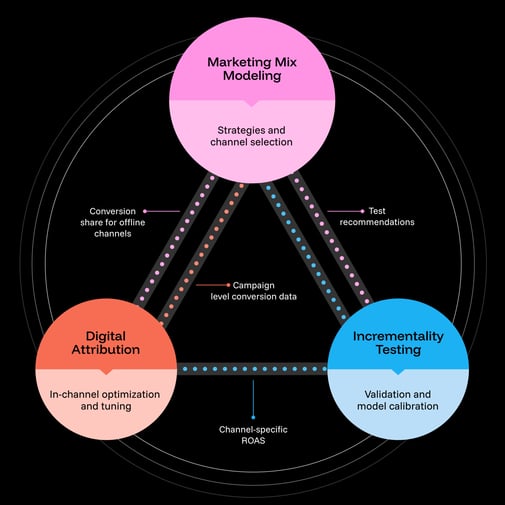
Used together, these methods produce one reconciled view of performance rather than three competing dashboards. Agentic AI now automates the calibration and retraining work that used to require a dedicated data-science team, which means the approach is no longer exclusive to organizations with that kind of in-house capacity.
The point is not that triangulation eliminates conflict. It eliminates the interpretive wiggle room that used to absorb it. With a calibrated number on the table, the most familiar form of resistance is gone. Teams can no longer fall back on “we are still reconciling the models” or “let's wait until attribution catches up.” The local metric a team used to point to does not contradict the calibrated view; it sits underneath it.
What remains is the strategic decision itself: whether to fund brand at the expense of performance, whether to chase short-term efficiency or long-term equity, whether to defend a channel that the data says is no longer earning its keep. Better measurement removes the cover for indecision. It does not create the willingness to act underneath it.
Why most organizations stall on the trade-off
Functional incentives outweigh enterprise value
Even in organizations with unified reporting, teams optimize locally. Performance often owns paid across channels, but the wider org still splits along functional lines: SEO and content cover organic, brand owns the top of the funnel and PR works the earned side. Each function answers to its own scorecard, and those scorecards reward local performance rather than the cross-cutting trade-offs that actually move enterprise value.
So when measurement points to reallocation, whether between channels, tactics or stages of the funnel, the response is rarely action and more often debate. Teams dispute definitions, argue that the model breaks down in their segment (long B2B sales cycles, low-volume markets, offline-heavy categories) and find reasons to wait. The measurement system produces a clear signal. The organization negotiates with it because acting requires choosing whose claim to enterprise value gets funded, and the people defending those claims are the same people the organization relies on to deliver them.
Budgets are not fluid pools waiting to be optimized
Budget cycles are designed for predictability, not responsiveness. By the time a quarterly plan is approved, the budget is already mentally spent. Teams have made commitments, hired against projections and built roadmaps around the numbers they were given. When measurement suggests reallocation mid-cycle, it does not feel like optimization to the team losing budget. It feels like a loss, and not only of money. It is a loss of standing in a system where budget is the visible proxy for strategic relevance.
Some hesitation is rational
Not all delays are failures. Acting on conflicting signals can destroy real value. Resetting a paid-media learning phase to chase a model-implied reallocation can erase efficiency gains that took months to build. Pulling brand spend mid-cycle may look right in next quarter's MMM and wrong in next year's revenue. The honest test is whether the hesitation is calibrated to actual risk or whether it is the path of least political resistance dressed up as caution. In practice, the two are easy to tell apart: rational caution gets followed by a planned action once new evidence arrives. Political delay does not.
What AI actually changes (and what it does not)
AI is reshaping which decisions remain for humans to make. Bidding is already algorithmic. Machine-learning optimization loops run continuously without human input, and channel-level budget shifts are increasingly automated. This removes latency from decisions humans were never well-placed to make quickly.
It also concentrates the decisions that remain, and those are the politically expensive ones: cross-channel trade-offs, brand-versus-performance horizons, short-term revenue against long-term equity. These calls depend on context, risk tolerance and strategic priorities. They cannot be automated, and they become more politically charged as automation strips out the easier work around them. The question AI surfaces is not how to make decisions faster. It is who has the authority to make the uncomfortable ones, and whose claim to budget the organization is willing to override when the data tells it to.
Unified data removes informational asymmetry

Unified data infrastructure is necessary. Without it, models conflict, reports break and organizational trust in measurement erodes before any insight can be acted on.
But here is what unified data actually does when it works: it removes the informational asymmetry that teams used to rely on. When everyone in the organization is looking at the same numbers, the team that used to own a dashboard no longer owns the narrative around it. The underperforming channel can no longer hide behind a local metric. The overfunded function can no longer point to a different version of the truth. The strategic misalignment that existed before unification still exists. It just can no longer be argued from a position of selective evidence. Unified data does not align organizations. It exposes them, and the exposure is itself a redistribution of power.
The quiet resistance to measurement

When measurement surfaces an uncomfortable finding, organizations do not typically reject it outright. That would be too visible. Instead they question the methodology:
“Does the model account for seasonality?”
“Does this include offline impact?”
“Can we reconcile the attribution and MMM numbers before we make any decisions?”
These are not always bad-faith questions. Methodology matters. But in many cases they function as delay tactics that buy time before an organization has to choose between two parts of itself.
Measurement is not resisted because it is unclear. It is resisted because acting on it requires the organization to reassign budget, influence and standing across teams, and most organizations are not built for that conversation.
What the strongest organizations actually do
The organizations that outperform are not the ones with the most sophisticated models. They are the ones that have built the political and structural capacity to act when measurement makes trade-offs visible, and to absorb the redistribution of influence that follows.
Someone has the authority to redirect budget across teams. Not marketing in general, but a specific role with the explicit remit and the political cover to take spend away from one function and give it to another based on what the measurement system says. In many organizations this is the CMO. In others it sits with a marketing effectiveness lead or a chief growth officer. What matters is that the authority is named and that the person holding it is protected from the consequences of using it.
Allocation moves more fluidly than annual planning suggests. The total budget does not need to shift; the allocation within it does. Monthly or bi-weekly redistribution dramatically changes how actionable measurement becomes, without forcing the organization into chaotic re-planning or destabilizing the platform-level learning that running paid media depends on.
Senior incentives sit at the enterprise level. When the leadership team is measured on revenue, margin and growth rather than channel-specific proxies, cross-channel trade-offs become easier to call. Functional KPIs survive lower down, but they no longer determine which way the senior team votes when measurement forces a choice.
Decision velocity is tracked deliberately. Not the accuracy of the forecast, but how quickly the organization moves from insight to action and how often it does so without overcorrecting. Time from measurement to budget shift, frequency of reallocation, velocity of experimentation. These metrics make organisational responsiveness visible, which is the first step toward improving it.
Six practical steps for organizations that want to act
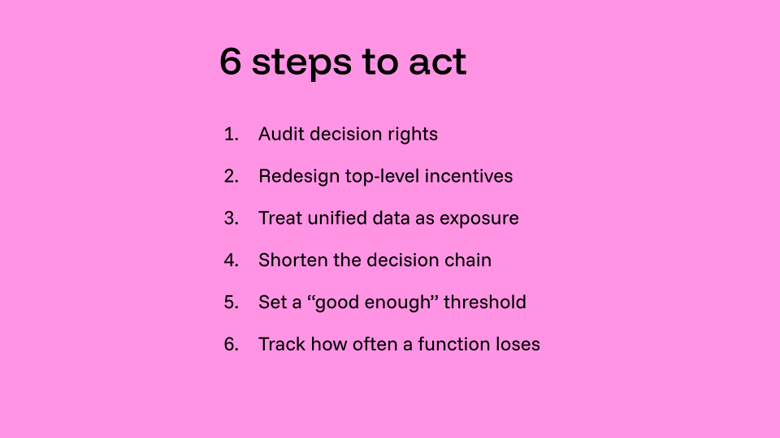
These are mechanisms for surfacing, making and surviving forced trade-offs. They are not a maturity checklist.
1. Audit your decision rights, not your dashboards.
Map what actually happens when data contradicts the existing plan. Who has the authority to act? Who currently owns the narrative around the numbers, and who would lose that ownership if reporting were unified? Who loses budget when the call goes against them, and what consequences do they face for accepting it? That is the real measurement maturity assessment.
2. Redesign incentives at the top first.
Channel-level KPIs are not the problem; senior compensation tied to channel-level KPIs is. The leadership team has to be measured on the outcome that the trade-off is being made for, not on the inputs each leader is defending.
3. Treat unified data as an exposure event.
When you consolidate reporting, expect it to surface misalignment that was previously distributed across dashboards. Have a plan for what happens when it does. The risk is not that unified data will be wrong. The risk is that it will be right, and the organization will not be ready for the conversation it triggers.
4. Shorten the decision chain.
Fewer approvals, clearer ownership and a shorter path from insight to call. Measurement only creates value if action can follow within a timeframe that is still relevant to the decision it informs.
5. Set a “good enough” threshold and act on it.
One of the most effective delay tactics is demanding that all measurement approaches agree before any action is taken. Set a standard for confidence and act on it while continuing to refine the models in parallel. Triangulation makes this easier: the calibrated view is usually the standard.
6. Track how often a function actually loses.
How quickly does your organization respond to a clear measurement signal? How often does budget shift mid-cycle? How often does a function in the marketing org accept a reallocation it would have argued against six months ago? Those numbers tell you more about your effectiveness posture than your attribution model does.
The gap that will define the next three years
By the end of this decade, the divide in marketing effectiveness will not fall along the lines of who has better data or more sophisticated models. Both will be broadly available. The divide will be structural.
On one side: organizations that have built the political infrastructure to redistribute budget and influence based on what the measurement system tells them. On the other: organizations that have excellent dashboards and quarterly reviews where everyone nods and nothing changes.
The data will keep getting clearer. The models will keep improving. And the trade-offs they surface will keep getting harder to avoid. The organizations that outperform are not the ones with the cleanest measurement. They are the ones with the discipline to act when measurement removes the cover for not acting, and with the political capacity to absorb the redistribution of power that follows.
That is what marketing effectiveness in 2026 actually means. Not better measurement. Better decisions, made under uncertainty, by people willing to absorb the downside. In a system designed to surface conflict, agreement is just another form of delay.
For the practical playbook on closing this gap, including the measurement stack, the readiness criteria and the operational mechanisms underneath, read Funnel’s full guide: The Future of Marketing Effectiveness in 2026.
Sources
Interactive Advertising Bureau (IAB) and BWG Global. State of Data 2026: The AI-Powered Measurement Transformation, February 2026. https://www.iab.com/insights/2026-state-of-data-report/
Harvard Business Review Analytic Services, sponsored by Google. Bridging the Marketing Mix Modeling Actionability Gap, March 2026 (survey fielded September–October 2025, n=547 HBR audience members in marketing roles). https://hbr.org/sponsored/2026/03/bridging-the-marketing-mix-modeling-actionability-gap
Snap and eMarketer. Media Measurement Survey, September 2024 (fieldwork June–July 2024, n=282 US marketers). https://www.emarketer.com/content/just-1-5-marketers-confident-last-click-attribution
WARC and Gain Theory. How improving your marketing measurement strategy can drive revenue growth. https://www.warc.com/newsandopinion/opinion/how-improving-your-marketing-measurement-strategy-can-drive-revenue-growth/en-gb/6696
MarTech (Constantine von Hoffman). 75% of marketers say their measurement systems are falling short, February 2026. https://martech.org/75-of-marketers-say-their-measurement-systems-are-falling-short/