






You’ve probably asked it before:
“Can we break this down by campaign?”
It sounds like a reasonable request. If marketing mix modeling (MMM) can tell you what’s working, why wouldn’t you want that insight at the campaign, ad set or even keyword level?
But that’s where things start to go wrong.
Marketing mix modeling isn’t built to answer granular questions. It’s designed to show how marketing efforts across multiple channels contribute over time and measure their impact on real business outcomes. Push it down to campaign-level detail, and the model’s reliability starts to fall apart.
Instead of forcing more detail out of a single model, you need to use the right methods together. A triangulated approach is your secret weapon to solving the MMM granularity gap. You gain big-picture accuracy with the level of detail you actually need to make decisions.
Why teams want granular insights from MMM
The pressure for more detail usually comes from a few directions at once. People across the business push for more detail because they expect MMM to go deeper than it can.
Finance and leadership want accountability
When the marketing budget is seven or eight figures, “paid social is broadly working” isn't a satisfying answer. CFOs and finance teams want to know which parts of that marketing spend are earning their keep, and they want it in a format they can audit.
That's a fair question. It's just not one MMM is designed to answer.
Platform reporting has raised the bar
Most digital marketing teams spend their days in Google and Meta dashboards that update daily and break down performance by ad set, creative and device.
Once you're used to that level of detail, it's natural to expect the same from every marketing measurement tool. But MMM isn't a platform dashboard. It focuses on how channels contribute over time, not how individual campaigns perform day to day.
Teams start expecting MMM to do it all
Somewhere along the way, MMM became the tool meant to make sense of everything. Which is appealing, because nobody wants five disconnected dashboards telling five different stories. But that framing misrepresents what MMM actually does.
Underlying all of this is a simple misunderstanding: MMM is seen as a universal measurement solution. It's comprehensive, it touches all channels and it feels authoritative.
But scope is not the same as granularity. The two are very different things.
What is MMM designed to measure?
Marketing mix modeling is a statistical approach that analyzes the relationship between marketing activities and business outcomes over time. It's built for strategic questions, not operational ones.
Marketing mix modeling answers questions like:
- How much has TV contributed to sales over the last year?
- How do paid search and paid social interact to drive revenue?
- If we move 20% of the advertising budget from display to online video, what should we expect?
- How long does it take for our brand spend to show up in revenue?
Here’s what it's not designed for:
- Which campaign performed best last week?
- Should we pause ad set B?
- Is this keyword still worth bidding on?
This distinction matters because the model works by identifying patterns across time. It needs enough consistent marketing data to separate the signal from the noise.
At a channel level, for example, total paid social spend versus total sales, that signal is usually strong enough to work with. The relationships are relatively stable, the data quality is high and the model has room to do its job.
But at a campaign level, that foundation starts to fall apart.
A good example of MMM’s strengths and limitations in action is the story of Tallink Silja Line. The ferry operator found that traditional attribution wasn't showing them which channels were worth prioritizing. Their team was running dozens of online and offline channels across three markets and struggling to understand which were responsible for driving bookings. Google Analytics was heavily crediting paid search while suggesting Meta wasn't converting at all. They knew that wasn't true, but couldn't prove it.
Marketing mix modelling gave them the channel-level view they needed. Not which Meta campaign was working, but whether Meta as a channel was contributing and how it interacted with paid search across the full customer journey.
That insight alone changed their approach to marketing budget optimization. Despite cutting ad spend by 16%, they grew revenue from paid digital by 26%.
Used correctly, MMM is a powerful approach to marketing measurement. The moment you push it further, into campaigns and ad sets, the same model that produced those insights starts to break down.
Why the MMM granularity trap leads to unreliable results
The MMM granularity trap happens when you push a model designed for high-level insights into answering low-level questions. The outputs still look like outputs: numbers, charts, confidence intervals. But underneath, the model is on shaky ground.
Here's why.
Incomplete data leaves gaps in the picture
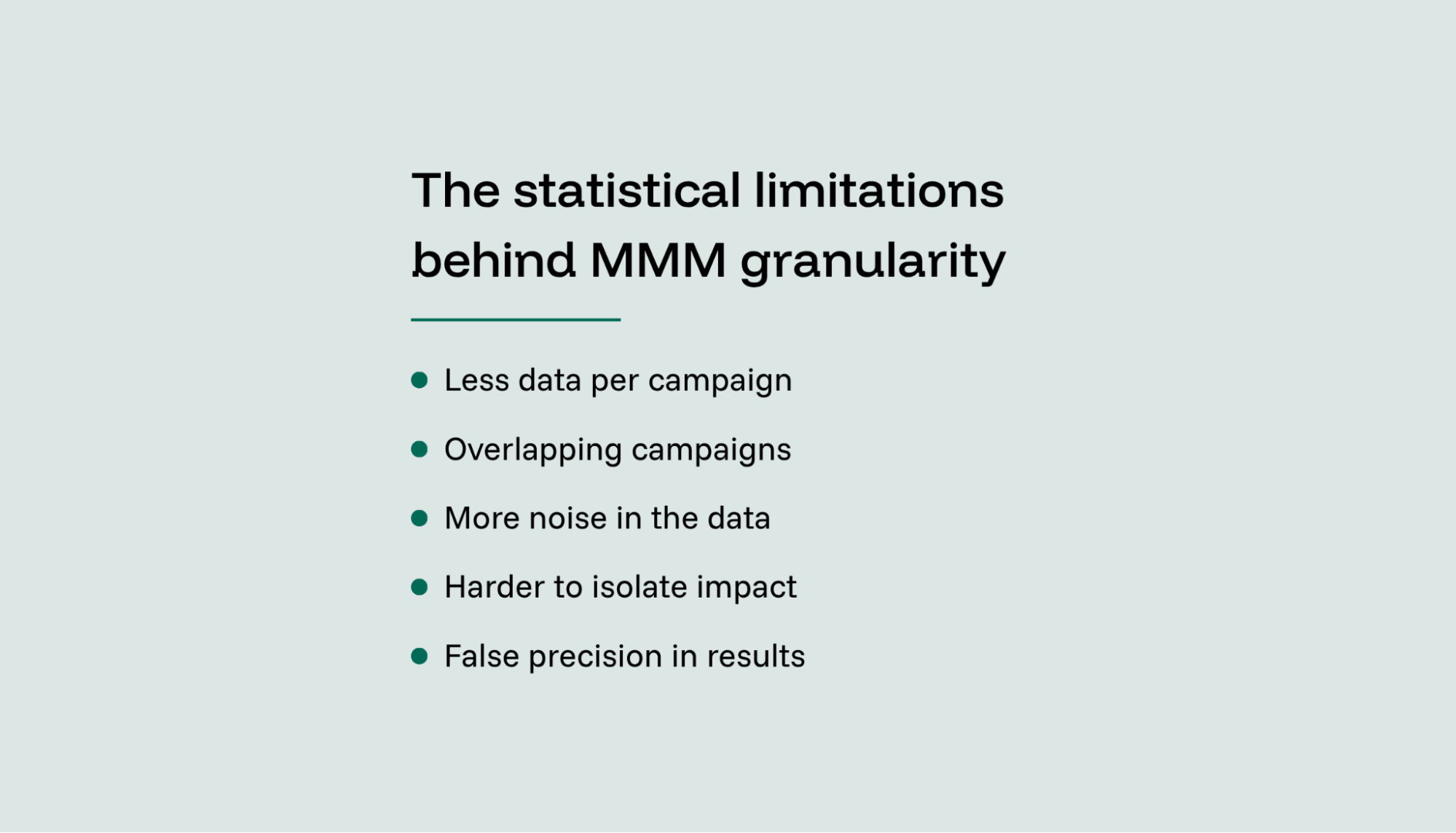
Marketing mix modeling relies on patterns in historical data. It needs to observe how changes in spending affect results across enough high-quality data to establish a real relationship.
At a channel level, this usually works. Always-on marketing channels like paid search generate steady, consistent data, and the model has enough to work with.
But at a campaign level, poor data quality is often unavoidable. A campaign that runs for six weeks simply doesn't generate enough data points for the model to estimate its contribution with any confidence. The math requires a sample size that the campaign never produced.
Too many things are happening at once
Marketing campaigns can overlap, target similar audiences and compete for the same attention during the same weeks. One campaign might amplify another, or they might cannibalize each other.
But because MMM has no clean way to separate impact, it's difficult to know what caused it. Was it the new campaign? The one already running? A combination of both? Seasonality?
Marketing mix modeling can detect that something shifted, but separating the individual contributions of overlapping campaigns is statistically very difficult. The more campaigns you try to isolate, the more the model has to guess.
More noise, less signal
Smaller datasets are more sensitive to random variation. Things like a seasonal blip or a competitor promotion barely register in aggregate data. But they can appear meaningful at the campaign level.
At that point, the model isn't identifying real patterns. It's trying to make sense of messy data. And it will produce outputs regardless, because that's what models do.
False precision
This is the part that catches modern marketing teams out. Campaign-level MMM outputs can look very specific and insightful. For example, Campaign A contributed 12.4%, versus Campaign B, which contributed 8.7%. The numbers appear precise, they come with charts and they feel credible.
But if the underlying data were thin and overlapping, those figures aren't reliable enough to act on. You can make decisions based on them, but you'd be mistaking the appearance of precision for the reality of it.
Accuracy with MMM depends on the conditions for which the model is built.
Granular insights require different measurement methods
If MMM isn't the right tool for campaign-level questions, what is?
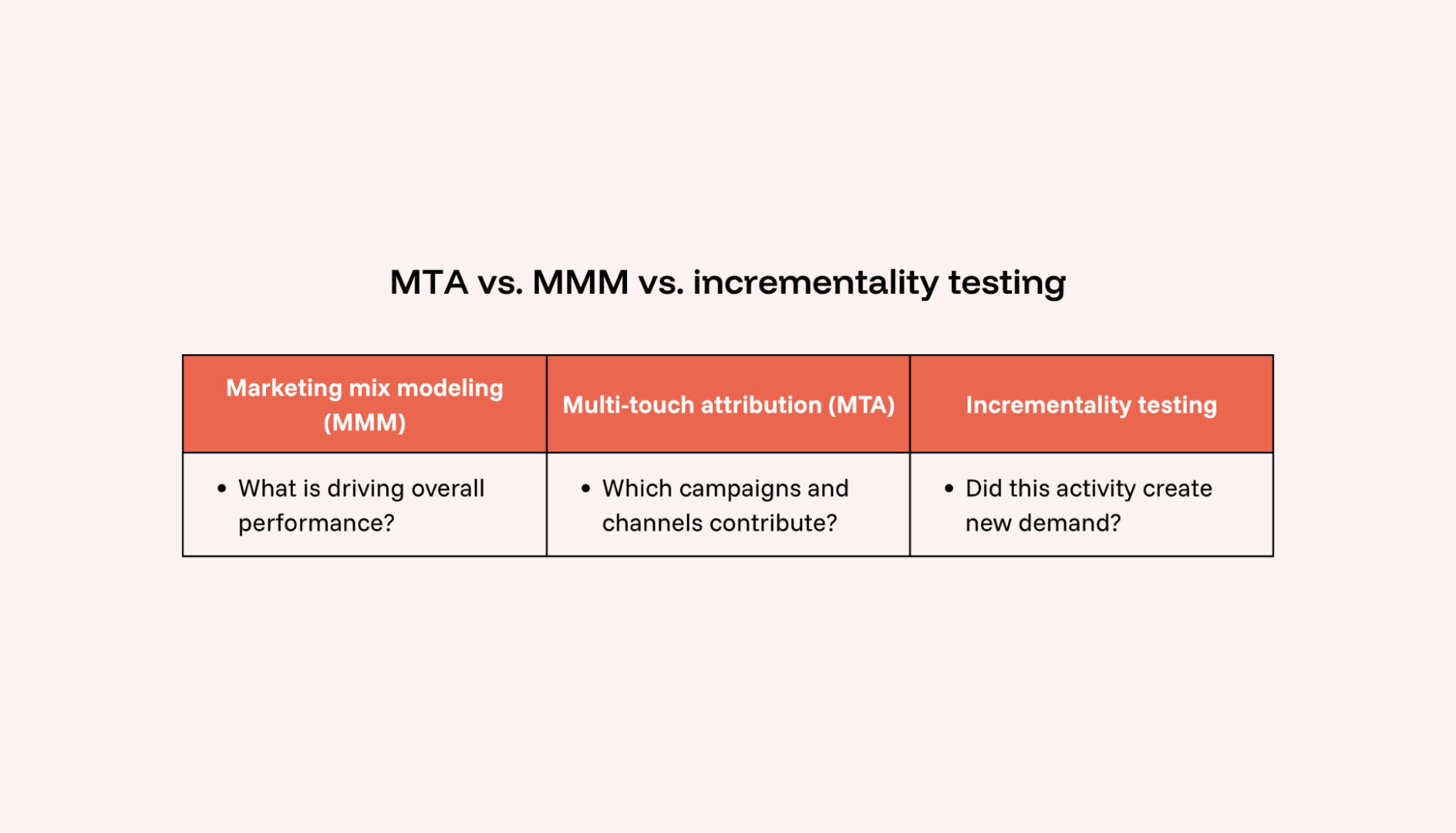
For that level of detail, you need methods that work closer to the user journey and help isolate impact more clearly. Two approaches work well here.
Multi-touch attribution (MTA)
Multi-touch attribution tracks how users interact with your ads and assigns credit across multiple touchpoints. It operates at the individual journey level, which makes it well-suited for campaign and channel optimization.
This measurement method shows you which marketing tactics or campaigns are driving conversions in the short term. It's the tool for day-to-day optimization and making decisions on where to shift budget.
Although MTA can tell you which touchpoints got credit, it can't tell you whether those conversions would have happened anyway. A user who saw your retargeting ad and then converted might have converted regardless. Attribution doesn't isolate incremental impact. For that, you need something else.
Incrementality testing
Incrementality testing is about cause and effect. It compares a group that was exposed to your marketing with a group that wasn't to see how many conversions your campaign actually created, not just influenced.
This is where you get answers to the deeper version of the campaign-performance question. Instead of, “Did this campaign drive conversions?” incrementality testing answers, “Did this campaign create demand or just take credit for demand that already existed?”
That distinction has real consequences for how you evaluate ROI and make investment decisions.
Measuring advertising incrementality is slower and more involved than attribution. But it validates what attribution suggests, and it's the closest thing to a controlled experiment most marketing teams can run at scale.
How to combine MMM with other measurement approaches
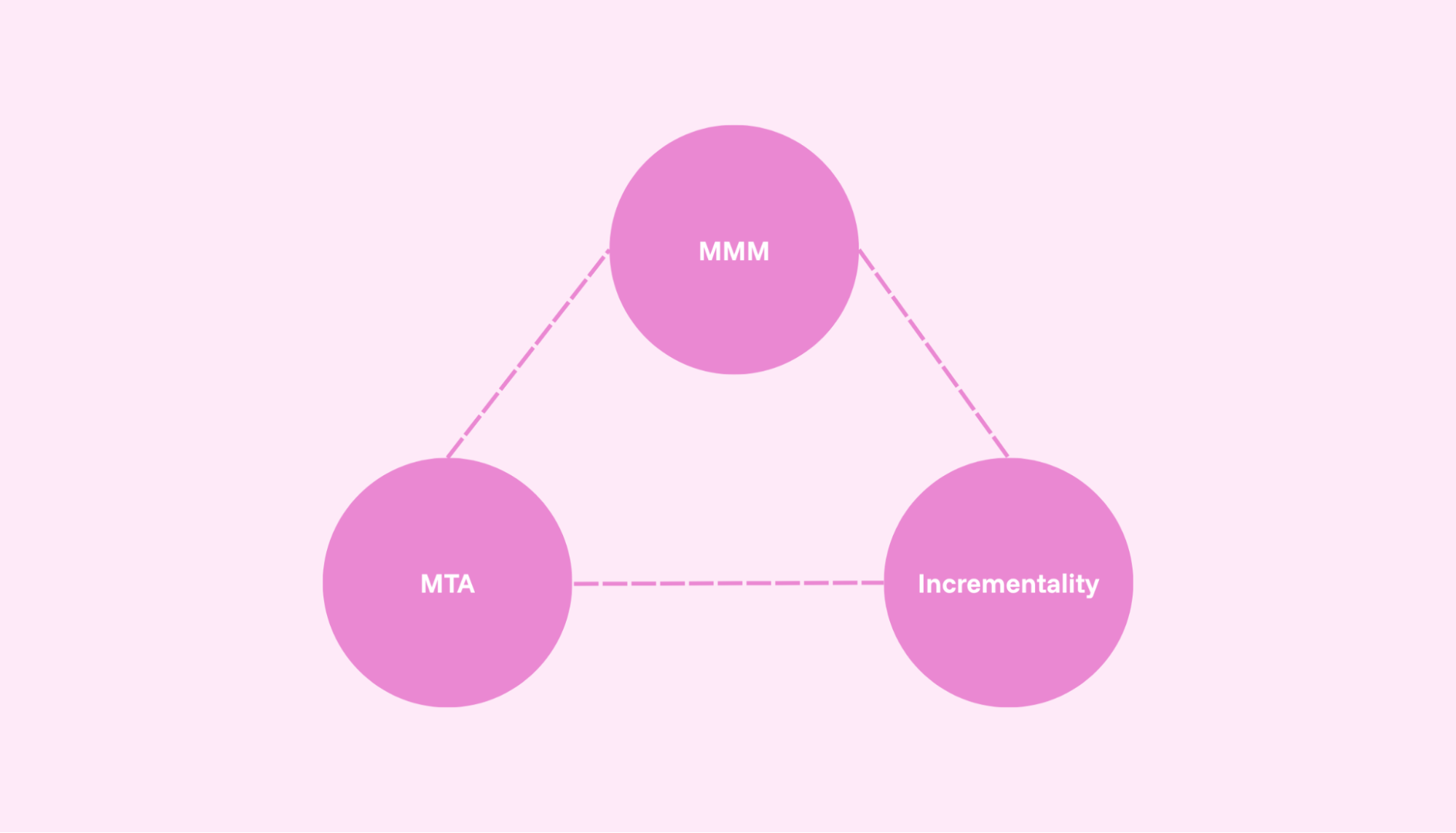
Because MMM, attribution and incrementality testing answer different questions at different levels, they aren't competing methods. The goal is to use them together so their strengths overlap and their blind spots don't compound.
When you use them together, you get more reliable insights into what to scale, what to fix and what to cut. That’s triangulation, and it’s what turns data into something you can rely on.
Deuba, a German online retailer, ran into a problem most teams will recognize. Last-click attribution in Google Analytics was crediting paid search for conversions while social and display ads barely registered. The team suspected the picture was wrong, but couldn't prove it.
When they combined MTA and MMM, the real story emerged. Social media ads weren't underperforming. They were responsible for 80% more conversions than last-click attribution would have suggested. They were actually outperforming paid search on both cost per acquisition and return on investment.
Neither method would have gotten there on its own. Attribution without MMM would have kept crediting the wrong channels. Marketing mix modeling without attribution wouldn't have given them the campaign-level detail to act on it. Together, they produced an insight that changed how the whole budget was allocated.
Here's how to build your own triangulation tango for your team.
Start with the question, not the tool
Before you decide which measurement method to use, be clear about what you're actually trying to understand. For example, if you’re deciding how to allocate budget next quarter, you need a high-level view. If you’re optimizing day-to-day campaigns, you need granular data.
You can’t answer both of those questions in the same way. When you use the wrong method, the answers start to look trustworthy when they’re not. The best way to manage this is to consider how much detail the decision needs.
Define clear roles for each method
Once your team is clear on this, it becomes much easier to define the role each method should play.
MMM is for strategy. Where do we invest, across which channels and how much? What's the long-term return on brand spend? How do our channels interact? These are the questions MMM was built for.
Attribution models are for optimization. Which campaigns are driving conversions? Where should we shift the budget this week? Which creative is outperforming? Attribution answers these.
Incrementality testing is for validation. Is this channel actually creating demand, or just capturing it? Would our conversions have happened anyway? This is how you stress-test what attribution is telling you.
Used separately, each method has gaps. Attribution alone won't tell you if your strategy is sound, and MMM alone won't help you optimize a live campaign. But together, they give you a coherent picture from the strategic level down to the tactical.
Build a system that combines all methods
Each method fits a different point in your marketing planning.
Marketing mix modeling tends to run quarterly. It's the input to budget planning conversations, not to daily decisions.
Attribution runs continuously, because campaign optimization is an ongoing job.
Incrementality tests are scheduled around specific decisions. For example, when you're considering a major budget shift, testing a new channel or need to justify an investment to leadership.
Align your team around expectations
Here's a situation you might recognize. Two marketing measurement reports land on the same day, and the numbers don't match.
Someone looks at an MMM output and asks why it doesn't match what Meta is reporting. Someone else treats an attribution number as the final word on ROI. An incrementality test muddies the water further. And half the meeting gets spent arguing about which one to trust.
Nobody is wrong, exactly. But nobody knows how to reconcile what they're seeing either.
Without a shared understanding of what each method does, it looks like a contradiction. But once everyone is on the same page about what each method is built for, a bigger picture starts to emerge. Your team can have a completely different conversation about what the data means, not which data to trust.
That clarity changes how teams make decisions. Instead of defaulting to the most familiar number or the loudest stakeholder, you can use each method for what it's actually good at and build a view of performance that holds up under scrutiny.
Bringing it all together: MMM works best in context
It’s time to think of MMM as part of a measurement ecosystem, not a standalone solution.
Yes, it works incredibly well at the right level. But the moment you ask it to answer the wrong questions, it starts to fall apart.
That’s not a flaw in the model, but a mismatch between the tool and the task.
If you want to get the most value from measurement today, your team needs to combine MMM with attribution and incrementality instead of relying on a single method. This is what’s going to give you a clearer, more reliable view of what’s really driving results from your campaigns.
But combining methods only works if they’re connected in practice.
That means working from the same data, keeping models up to date and ensuring insights align rather than compete. When everything is connected, you get a clear, unbiased measurement of marketing performance that proves impact.