



 Talk to sales
 Log in




If incrementality testing has done one thing, it’s replaced “we think this worked” with “we can prove it did.” But knowing the methodology works and knowing which tool to run it with are two very different things.
Most teams default to the path of least resistance: the lift study that’s already built into Meta or Google, or a tool a former colleague swore by.
But the issue is that not all marketing incrementality software suits every stage of marketing measurement maturity. And the one that’s easiest to set up isn’t always the one that gives you results you can act on to improve your marketing efforts. So, how do you know which tool is best for your team?
We’ve broken down the best incrementality measurement platforms and the criteria that actually matter, so you can stop second-guessing and start running tests you can trust.
The three approaches to incrementality testing
Experimentation has become the industry standard, and recent data from an EMARKETER report shows that 52% of US brand and agency marketers now use incrementality tests or experiments to measure their campaigns, and 36% plan to invest more over the next year.
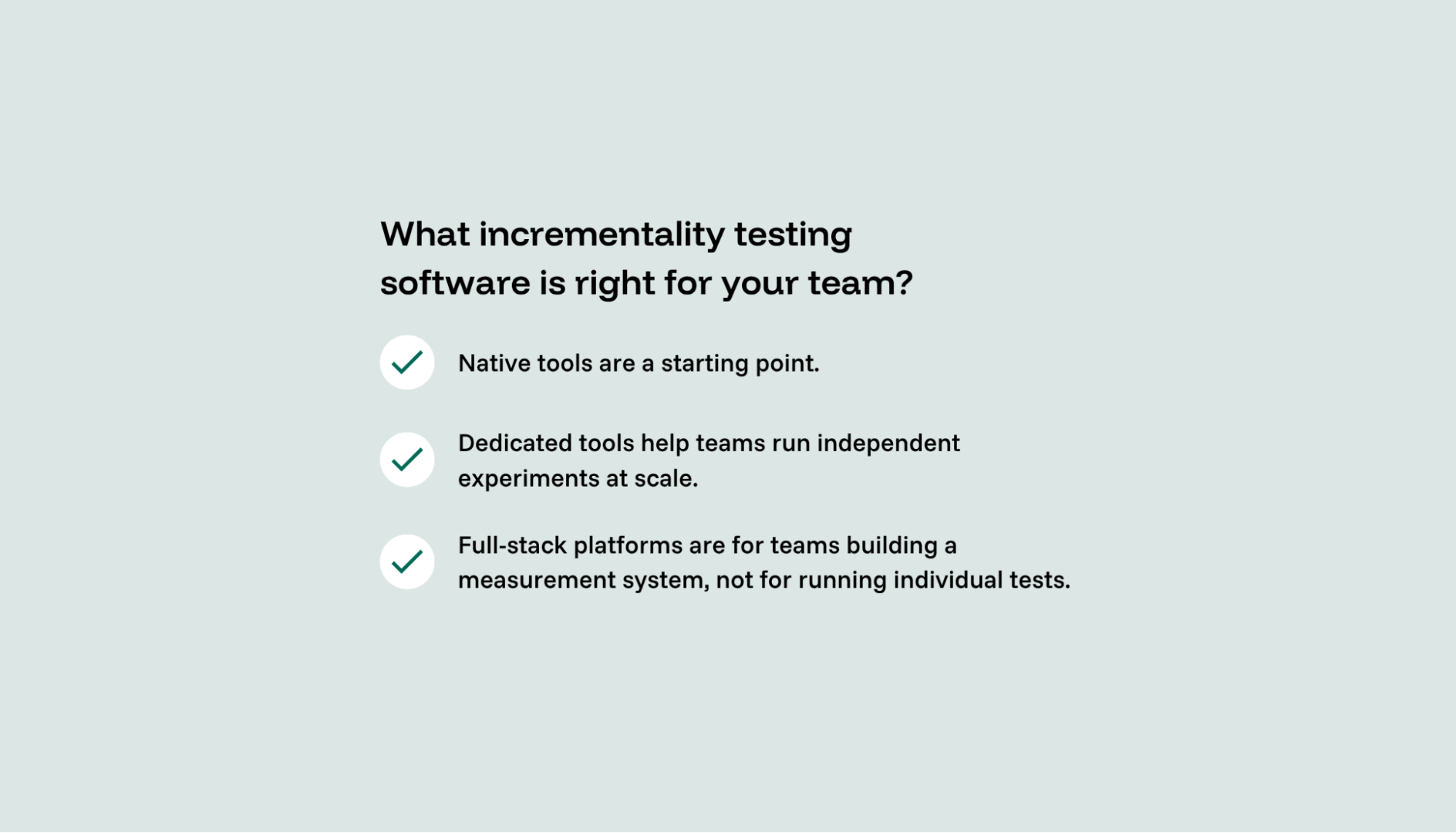
Software for running incrementality tests generally falls into three categories. The category you choose will influence how much the experiments cost to run and how much weight the results carry.
Native platform experiments
Meta, Google and TikTok provide built-in experiment tools within their own software. These native tests don’t cost extra and are quick to deploy because the ad network already controls who sees your campaigns. The platform splits your audience into a test group that sees ads and a holdout group that doesn’t, then compares the final sales.
However, platform biases will limit the accuracy of your results. A platform cannot track cross-channel behavior on its own, meaning a Meta test completely ignores how Google Ads affect the same buyer. Plus, the company that sells you the ad space also scores the test performance, so it’s basically grading its own homework.
As such, built-in platform tests typically report much higher success rates than independent software; they’re ideal for basic directional guidance rather than absolute proof.
Dedicated incrementality tools
Dedicated software platforms focus exclusively on multi-channel experiments, and as they operate outside the ad networks, you can test any combination of marketing channels simultaneously. They work by using advanced geographic matching methods, where the software, for example, picks two identical cities, cuts ad spend in one market and uses the other city as a statistical control group.
The primary benefit is unbiased objectivity because software vendors don’t sell ad space; they have no reason to fudge the numbers. But what you give up is integration. A standalone tool produces a lift estimate, but then it’s up to your team to reconcile that number with reporting, attribution and planning data that are stored somewhere else.
Full-stack measurement platforms
Full-stack platforms treat incrementality as one input into a broader system that also covers data integration, marketing mix modeling and attribution. The main benefit here is triangulation, which helps your team make more confident decisions. It’s just like getting directions when you’re lost. If you ask just one person, they might guess or give you the wrong turn. But if you ask three different people and they all point toward the same church steeple, you know you’re on the right path.
Each measurement method essentially gives a view into the blind spot of the others, which is the working principle behind a marketing measurement system. Google’s measurement guidance also advocates for this structure because real-world experiments calibrate your high-level statistical models, which then project actionable insights across your entire budget.
The biggest hurdle is just how much time and money you have to put into an enterprise system like this compared to a standalone tool. It’s a major investment, and taking into account implementation and training, it only pays off if your team commits to it.
What to look for in incrementality testing software
The same EMARKETER report mentioned earlier found that accuracy and reliability concerns are marketers’ top testing barrier. As such, it’s best to focus your evaluation on whether a tool delivers true proof or statistical noise, rather than worry about the features. Here’s a framework to check your options against.
Flexible experiment design
A weak tool will only tell you what happens if you turn off your entire ad budget. You need a software dial that lets you test campaigns, creatives or spend levels and supports geo holdout and audience-based designs. Also, try to plan what you’d like to test for in 18 months as your business scales, so you don’t outgrow the tool and have to repeat this process.
Geo holdout support
Geographic tests have become the gold standard for privacy-safe measurement because they don’t rely on tracking cookies, web browser IDs or individual user data. Instead, geo tests involve segmenting your audience by where they live. Incrementality testing software with geo holdout support analyzes your historical sales data across a region and groups similar areas together.
For example, if testing for the US, it might find that shoppers in Kansas City and Columbus buy your products at an identical rate, following the same seasonal peaks and dips. To run the test, you keep your advertising active in Kansas City but turn it off in Columbus. If your sales in Columbus tank while Kansas City stays steady, you have proof that your ads drive revenue.
But the biggest vulnerability with this approach is data contamination (or audience spillover). People don’t live their lives inside perfect, isolated bubbles. If a shopper from your control zone drives into your test zone, sees an ad and buys your product, your baseline numbers get corrupted.
Look for platforms that use the following methods to prevent contamination with geo holdouts:
Synthetic controls
An algorithm blends data from multiple markets (like 40% St. Louis, 30% Indianapolis, 30% Cincinnati) to build a perfect synthetic clone of your test city, rather than placing bets on one twin town.
Pre-trend validation
The software runs a baseline check to verify that sales lines in both regions move in parallel before you change your ad spend.
Platform independence
As we mentioned, while native platforms are an accessible beginner's guide to incrementality, they’re structurally biased and need to be taken with a grain of salt, especially if you’re reporting them to finance and your leadership team.
Speed to insight
An expensive failure in marketing data science is running a six-week experiment only to end up with an inconclusive result. This happens when your conversion volume is too low to prove that a sales spike didn't happen by pure chance.
Avoid this by selecting tools that run a predictive power analysis before you deploy any budget. The software evaluates your historical sales variance and current spend levels to tell you exactly how long the test must run to achieve statistical significance.
Integration with your stack
Ask where results go once a test ends. A tool that connects to your data warehouse or data hub can feed the results into marketing mix model calibration and your reports, while a self-contained tool will leave the reconciliation work up to you.
The top incrementality testing tools and platforms in 2026
The tools below are organized by category: native platform experiments, dedicated incrementality tools and full-stack measurement platforms. Within each category, the right choice depends on your measurement maturity, data infrastructure and the types of questions you're trying to answer in your experiments.
|
Tool |
Category |
Experiment approach |
Platform independent |
Channel coverage |
Best for |
|
Funnel |
Full-stack marketing measurement platform |
Geo holdout uplift and inverse tests with synthetic controls |
Yes |
Any channel where spend varies by region |
Mid-size and enterprise teams that want testing inside their data and reporting workflow |
|
Lifesight |
Full-stack measurement platform |
Geo tests that feed causal MMM and attribution calibration |
Yes |
Digital and omnichannel retail |
Omnichannel brands and mid-market DTC teams |
|
Measured |
Dedicated incrementality tool |
Automated geo holdouts with MMM calibration |
Yes |
Digital, TV and offline |
Mid-market and enterprise multi-channel media programs |
|
Haus |
Dedicated incrementality tool |
Randomized geo tests, plus synthetic controls for fixed regions |
Yes |
Digital, TV, out-of-home and podcasts |
Growth-stage and mid-market brands that want self-serve testing |
|
INCRMNTAL |
Dedicated incrementality tool |
Always-on causal modeling with no holdout windows or paused spend |
Yes |
Digital, with a strong mobile focus |
Mobile and gaming advertisers who want a continuous read |
|
Meta Conversion Lift |
Native platform experiment |
Audience-level holdouts inside Ads Manager, free |
No |
Meta only |
First experiments on Meta-heavy campaigns |
|
Google Ads experiments |
Native platform experiment |
Conversion lift and campaign experiments from $5,000 in spend, free to run |
No |
Google only |
Advertisers with substantial Google spend |
Full-stack measurement platforms
Full-stack platforms make sense when incrementality needs to live alongside the rest of your measurement work rather than in a separate tool.
1. Funnel
Funnel builds incrementality testing into its measurement solutions and is based on the foundation of its marketing data hub, so experiments run in the same environment where marketing data is collected, cleaned and reported. The platform supports uplift tests as well as inverse tests, where you pause or reduce spend to measure what disappears, and runs geo holdouts with synthetic control methodology.
The test results also report lift alongside total and average effects and the key metrics behind them. Because the experiment reads from the same data foundation as your reports, you won’t have to reconcile your findings. For teams already using Funnel for data integration and reporting, incrementality is an extension of an existing workflow.
Football gear brand NXTRND used Funnel's tests to prove that Meta wasn't only responsible for sales on their website, but for 20% of overall sales, including sales on Amazon. This type of insight is huge for optimizing budget.
2. Lifesight
Lifesight integrates multi-channel incrementality testing, causal marketing mix modeling and causal attribution into a unified platform.
The software automatically uses your real-world geographic test results to calibrate its statistical models. The automated feedback loop saves your data team from manually exporting and mapping tables between systems. Lifesight is a strong fit for omnichannel brands and mid-market e-commerce teams that need unified budget planning.
Dedicated incrementality tools
Dedicated tools trade breadth for experimental depth and vendor independence.
3. Measured
Measured serves as an enterprise staple for isolated incrementality tracking. The software automates complex geographic holdouts across digital, linear television and offline retail channels.
It provides highly granular reporting down to specific campaign tactics and ad sets. As Measured scales across complex offline environments, the upfront engineering implementation requires significant development resources compared to alternatives on this list.
4. Haus
Haus is a streamlined, self-serve geographic experimentation platform built for growth-stage businesses. The software uses automated matched-market selection to isolate the performance of digital platforms, connected TV, podcasts and print media.
Haus provides enterprise-grade causal inference math through an accessible user interface. This design lets marketing teams run statistically sound tests without employing an in-house team of data scientists to build the backend models.
5. INCRMNTAL
INCRMNTAL deviates from traditional testing frameworks by entirely eliminating holdout groups and ad blackouts. Instead, the platform relies on always-on causal modeling built from Bayesian methods and synthetic controls, which means measurement continues without pausing or withholding spend.
The design mainly suits mobile and gaming advertisers, but it can work for any team that values continuous reads over discrete tests. However, because it lacks a physical control group, the tool relies heavily on statistical assumptions to guess what your sales would look like without ads.
Native platform experiments
Native tools serve as an accessible entry point to validate the concept of testing before you purchase independent software.
6. Meta Conversion Lift
Meta runs audience-level holdout experiments inside Ads Manager at no extra cost.
The software splits your target audience into test and control groups using Meta's internal user data. While this provides an easy flow for Facebook-heavy brands, the tool cannot track cross-channel actions. Use these results exclusively for internal directional guidance, as the software won’t tell you how your Meta budget impacts other networks.
7. Google Ads experiments
Google offers Campaign Experiments and Conversion Lift within Google Ads, and access widened considerably in late 2025. Google announced that it lowered the minimum spend for incrementality experiments; what once could have cost $100,000 for a single experiment can now be done for $5,000.
The setup panel includes built-in feasibility scores that perform an automated power analysis to warn you if your conversion volume is too low to produce a clear answer before your budget runs.
Of course, the same platform-bias limits apply here: Google only grades its own ecosystem, so these metrics provide directional signals rather than objective proof.
Choose incrementality software based on measurement maturity and data infrastructure
The experiment runs on your data, so focus on your data foundation first. Incrementality tests read business outcomes, like revenue, conversions or orders, against regions or audiences over time, and if your data is in disconnected platforms with inconsistent naming and gaps in history, no testing platform can fix it.
From there, match the tool to your measurement path. If you’re a small team with modest spend, run native platform tests for free while you learn the ropes, or buy a standalone tool when you want an independent referee. Either option works without a massive infrastructure project, provided your baseline outcome data remains reliable.
If you’re at or building toward advanced measurement, the data foundation becomes the multiplier. Incrementality tests, marketing mix modeling and attribution all draw from the same underlying data, and they only strengthen each other when that data is consistent. A test can calibrate your model, and a model can tell you what to test next, but only if both draw from one clean source.
An integration-first setup also makes testing faster and cheaper. Because your data is already collected, cleaned and mapped to business outcomes, you skip the exhausting manual prep before every experiment. You can launch a new test with a few clicks. Get the data layer right first, and advanced measurement transforms from a headache into a competitive edge. Choose your tool with that end state in mind.
Frequently asked questions
What are the best incrementality testing tools for small teams?
It depends on your media spend and measurement maturity. Native tools like Meta Conversion Lift are a reasonable place to start because they’re free, and Google’s move to a $5,000 minimum for incrementality experiments has made it more accessible. Once you want independent, repeatable reads, a self-serve dedicated experimentation tool is the natural next step.
What’s the difference between incrementality testing and marketing mix modeling (MMM)?
Incrementality testing runs controlled experiments to prove whether a channel or campaign caused a result. Marketing mix modeling estimates how spend relates to outcomes across your whole mix over time, so it’s broader but weaker at proving cause and effect. Our comparison of multi-touch attribution and marketing mix modeling covers how the two methods work together.
Can you run incrementality tests without a dedicated tool?
Yes, within limits. You can run a real test with no tool at all by using something you can control, like the regions where an ad runs, and comparing outcomes in exposed regions against similar regions without ads. Our guide to incrementality testing walks through the setup.
The hard part is everything around the result. Without software, your team handles market selection, synthetic controls and pre-test validation by hand, tests take longer and reaching statistical confidence is much harder. A dedicated experimentation tool or a full-stack measurement platform like Funnel runs controlled experiments, removing most of that manual work.