






Marketing measurement is changing. Not because of new tools, but because marketing itself has changed.
Customer journeys now span multiple channels. A growing share of spend flows into upper-funnel activities that do not generate clicks. At the same time, privacy restrictions limit what can be directly observed.
This creates a simple constraint. No single method can explain performance on its own.
What is emerging instead is a system: one that combines multiple signals, continuously recalibrates, and produces decision-ready estimates of impact.
This shift reflects a broader transformation in how marketing operates. As we discussed in our dive into the future of marketing in 2026, execution is becoming increasingly automated. Measurement now needs to operate at the same speed and level of rigor.
From reporting performance to guiding investment
Most measurement systems were designed to explain what happened.
Marketing leaders need something different. They need to decide what to do next.
That requires moving beyond reporting and toward decision support.
Today’s measurement landscape includes platform dashboards, attribution models, aggregated performance data and experiments. Each provides useful information but no individual model is complete.
This is why measurement is evolving from choosing a model to building an always-on system.
Instead of asking which method is correct, the focus shifts to combining signals into a consistent estimate of incremental impact. This is the foundation of triangulation.
As we’ve covered before in other articles about measurement, the objective is not perfect precision. It is a level of confidence that allows teams to allocate budget, justify investment and move quickly when conditions change.
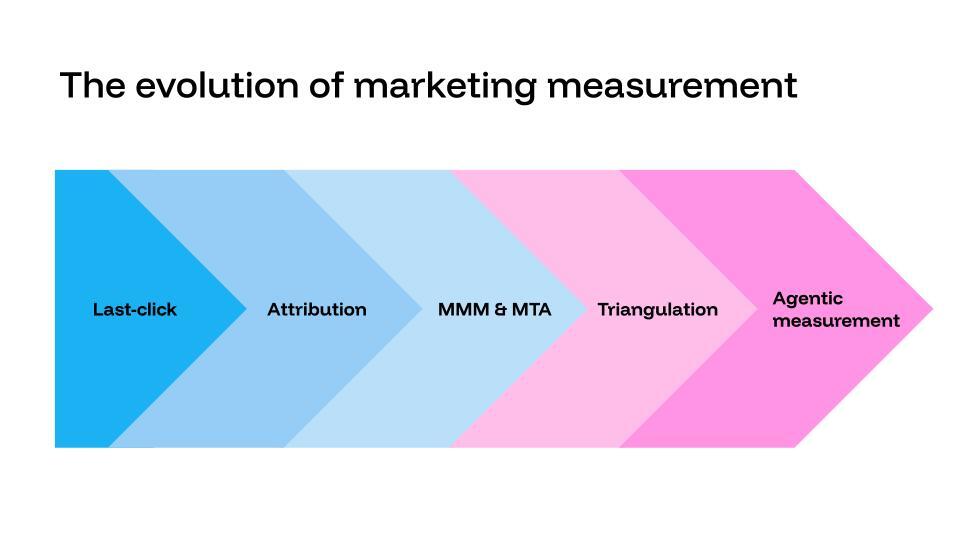
Triangulation: measuring what actually drives growth
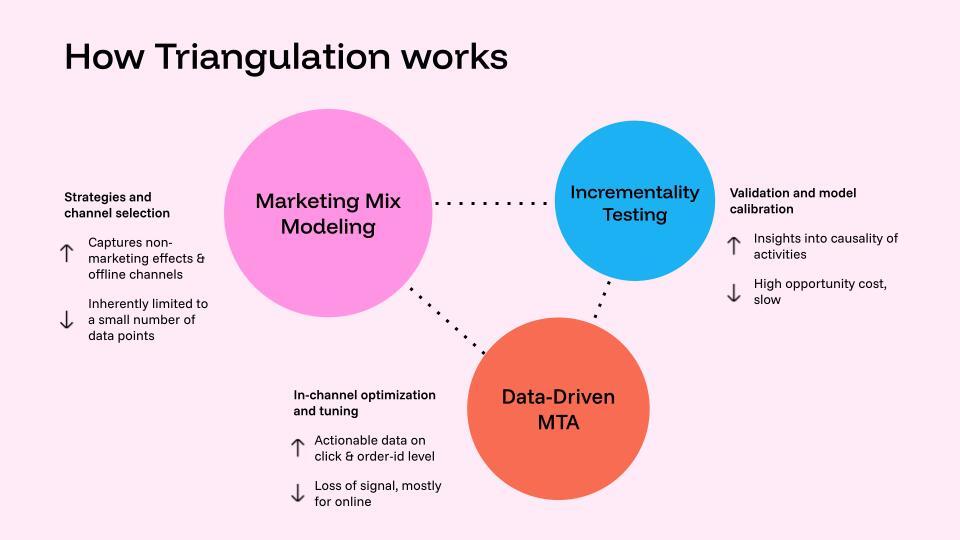
Triangulation combines multiple approaches into a single measurement system. It typically includes marketing mix modeling, multi-touch attribution, platform data and incrementality testing.
Each method addresses a different aspect of performance.
Marketing mix modeling connects spend to outcomes at a business level. Attribution analyzes how users move through the funnel. Platform data provides real-time feedback. Testing isolates cause and effect.
On their own, each method has limitations. Together, they provide a more balanced view.
Rather than relying on a single output, triangulation compares signals and identifies where they converge. The result is a more reliable understanding of what is actually driving growth.
This approach helps answer a critical question: where should the next dollar go?
It also improves alignment across teams by grounding decisions in a shared view of performance.
Understanding incremental impact at the right level
At the core of modern measurement is the ability to separate baseline demand from marketing-driven impact. Here’s how the major measurement models in a triangulation system work together:
Marketing mix modeling (MMM)
Marketing mix modeling operates at a strategic level.
It distinguishes between conversions that would occur naturally and those driven by marketing activity. It also accounts for how marketing behaves over time.
Adstock reflects the fact that marketing effects accumulate and decay gradually. Saturation curves capture diminishing returns as spend increases.
Together, these components provide a clearer picture of marginal return and help guide budget allocation decisions.
Without this level of modeling, performance is often overstated and investment becomes less efficient.
Multi-touch attribution (MTA)
Multi-touch attribution operates at a more granular level than MMM.
It analyzes sequences of interactions and estimates how each touchpoint contributes to conversion.
Instead of relying on predefined rules, it learns from observed behavior. This allows teams to understand how channels interact and which combinations of touchpoints are most effective.
This level of detail supports campaign optimization and helps connect high-level strategy with day-to-day execution.
Platform data
Platform data plays an important role in modern measurement.
Ad platforms such as Google, Meta and TikTok provide modeled performance based on what they can observe within their own ecosystems. These signals are useful for understanding in-channel performance and are updated in near real time.
However, they come with limitations.
Each platform measures performance using its own attribution logic and visibility, which makes results difficult to compare across channels. In many cases, platform data can overestimate impact, especially for upper-funnel activities.
Within a triangulated system, platform data is not treated as a source of truth. Instead, it acts as a reference signal.
It helps define a realistic range of performance and adds speed to decision-making, while other methods provide context and calibration.
Calibration: turning signals into decisions
The real value of triangulation lies in calibration.
Different signals are used as inputs to guide the model. Platform data, attribution outputs and modeling results act as reference points rather than absolute truths.
Bayesian priors help anchor the model. They introduce informed starting assumptions based on existing data, allowing the model to converge more quickly and avoid unrealistic results.
The system then evaluates multiple model configurations using Multi-Objective Optimization. This means each model is assessed not only on how well it fits the data, but also on how well it aligns with other measurement signals.
In practice, the system selects models that balance statistical accuracy with real-world consistency.
This ensures that outputs are not only statistically sound, but also reflect how performance behaves in practice.
From periodic analysis to continuous systems
Traditional measurement is periodic. Reports are reviewed weekly or monthly. Models are updated occasionally.
Modern marketing requires a more responsive approach.
Measurement is becoming continuous. New data leads to ongoing recalibration. Models evolve alongside changes in campaigns, platforms and external factors.
This reduces the delay between performance shifts and decision-making. It also ensures that insights remain relevant in a fast-moving environment.
Measurement systems are designed to continuously evaluate, calibrate and update themselves as new data becomes available, and are supercharged by advances in AI and machine learning.
Agentic measurement: scaling modern measurement
Triangulation has long been recognized as best practice. The challenge has been operationalizing it at scale.
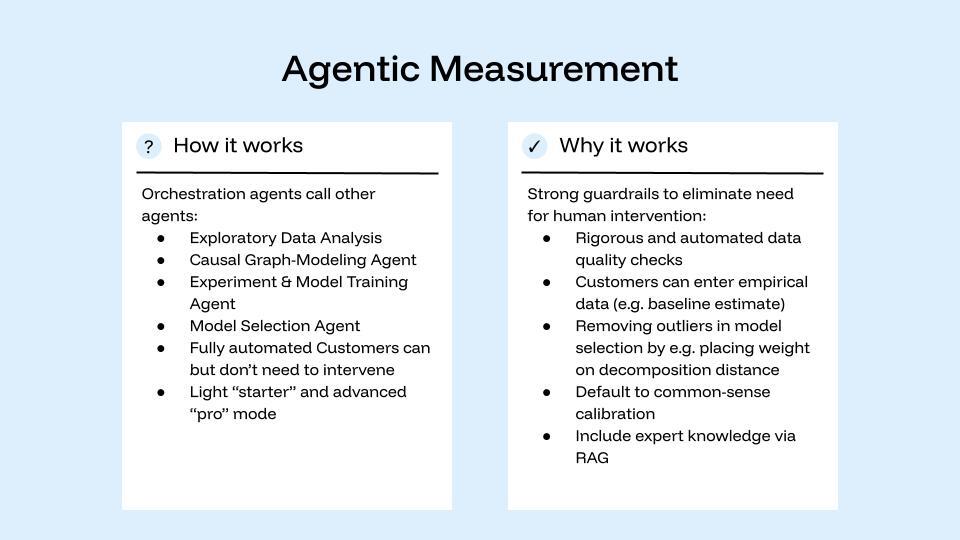
Agentic measurement addresses this by automating the modeling process with AI.
Instead of relying on manual workflows, the system breaks the process into smaller components. Data validation, model design, training and evaluation are handled by different parts of the ecosystem.
With this, Funnel’s agentic measurement system can generate multiple model variations, each with different assumptions about how marketing works.
These models are then evaluated using both statistical metrics and external benchmarks.
The system selects the models that best balance accuracy and real-world consistency.
Continuous improvement loop
Agentic systems operate in a continuous loop.
New data is ingested, assumptions are updated, models are retrained and results are evaluated and deployed.
This allows the system to adapt to changes in channel mix, budget allocation and platform behavior without requiring manual intervention.
It also introduces consistency. The same logic is applied across markets and time periods, reducing variability in how performance is measured.
What this looks like in practice
NXTRND, a fast-growing American football equipment e-commerce brand, improved its marketing ROI by adopting comprehensive digital measurement.
Initially, relying on siloed data and last-click attribution led to misallocated spend. Testing revealed Amazon ads cannibalized organic sales, while Meta ads drove a previously uncredited 20% "halo effect" across all sales channels.
By using Funnel for data aggregation and incrementality testing, NXTRND gained a clear, cross-channel understanding.
This enabled them to confidently shift budget from inefficient Amazon ads to more effective Meta campaigns and new top-of-funnel initiatives, aligning marketing expenses with true financial impact.
Measurement as part of marketing intelligence
Measurement is no longer a standalone function. It is part of a broader ecosystem of marketing intelligence.
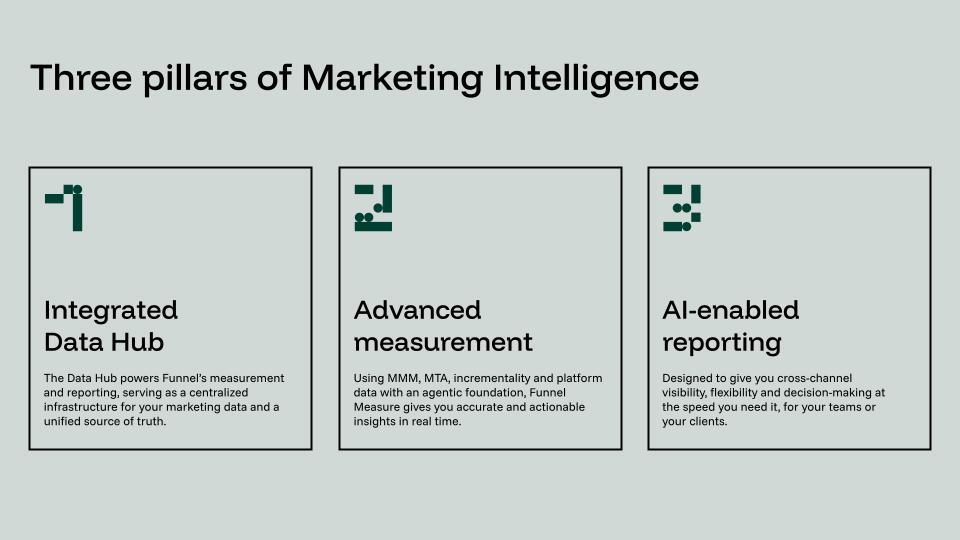
Marketing intelligence connects data integration, measurement, and reporting into a unified workflow.
Measurement plays a central role by transforming fragmented data into estimates of incremental impact that can guide planning and optimization.
As outlined in Funnel’s perspective on marketing intelligence, this approach enables faster learning, better allocation decisions and stronger alignment across teams.
The future of marketing measurement
The future of measurement is not about choosing the right model.
It is about building systems that support better decisions.
Systems that combine multiple signals. Systems that continuously recalibrate. Systems that produce consistent, defensible outputs.
Triangulation provides the foundation. Agentic measurement makes it scalable. The goal is not perfect accuracy, it is confidence.
Because in modern marketing, the advantage is not having more data, it is knowing how to use it.