






Ask ten marketers what the future of marketing looks like, and you’ll get the same answers: AI tools, GEO and data-driven decision-making. The common denominator is data maturity.
When data is clean, structured and unified, these initiatives reinforce each other. But when data foundations are weak, they start to fall apart. Because AI fails without clean data. GEO fails without structured data. Measurement fails without unified data and experimentation fails without trusted data.
So, the biggest challenge for marketers today isn’t adopting new tech, it’s whether teams have the data maturity to support new trends.
Funnel’s 2026 Marketing Intelligence Report highlights an important reality: progress has far outpaced transformation. So, what will the future demand and how can teams ensure they’re truly data-ready?
Our 2026 outlook breaks down what that future looks like and how teams can start building towards it.
What is the future of marketing? A look ahead beyond the hype
So, what is the future of marketing? It depends less on how much technology and more on how teams work with it. There’s a tension running through the industry between rapid technological change and low organizational readiness, and that tension is shaping the path forward.
AI’s creative paradox
The industry is almost at an even split: according to our 2026 report, 46% of marketers fear AI threatens creative roles, while 54% believe it enhances creativity.
Is AI a threat, a tool or a multiplier? There’s a deep uncertainty about how AI and machine learning should be used and what role this type of technology should play inside organizations. The lack of clarity about AI’s role has led to two competing mindsets that are shaping adoption.
With a cost-cutting mindset, marketers are pressured to do more with less. The focus is on efficiency, faster content production, fewer people per project and tighter budgets. Under pressure, AI becomes a shortcut for reducing effort rather than increasing impact.
Over time, using this mindset, marketing output becomes more uniform while brand differentiation and emotional resonance are lost. Teams lose one of marketing’s strongest growth levers: creative work that drives customer engagement by influencing how people feel, remember and choose.
A value-creation mindset, in contrast, uses AI to remove friction rather than replace human judgment. AI is applied to repetitive and time-consuming work, such as data preparation, reporting, performance and customer behavior analysis, and operational tasks, so that teams are free for more strategic, high-impact work.

The future of marketing isn’t about choosing between humans and machines; it’s about defining how they work together.
GEO as the new era of discovery
Search behavior is shifting from keyword-based queries to conversational discovery. According to our Marketing Intelligence Report, 64% of marketers expect customers to use traditional search less, as generative engine optimization (GEO) rises.
Being selected by generative systems, such as ChatGPT, Gemini and Perplexity, now plays a big role in discovery. This shift fundamentally changes how marketing teams need to operate.
Brands are no longer competing only for rankings on search engine results pages. They’re competing to be included in AI-generated outputs. This means authority signals like proprietary data, citations and contextual examples become more important because generative systems prioritize credible, well-supported information.
Marketing teams now need to create content that shows real expertise. For example, instead of publishing high-level blog posts for ranking, teams should include original research, customer case studies or sourced statistics to strengthen content credibility.
Terminology needs to be consistent across landing pages, product documentation and knowledge hubs so AI models can interpret and connect meaning accurately. Content and analytics teams also need tighter alignment so that definitions, metadata and performance data reinforce each other.
GEO is a structural shift that requires tighter coordination between departments, clearer governance and stronger data discipline across marketing.
The data readiness gap
A core weakness in marketing foundations is poorly structured and fragmented data, yet our 2026 report shows that only 33% of marketing teams invest in structured data. But advanced analytics and AI readiness depend on data integrity.
It's simple: messy inputs generate unreliable outputs. Weak data foundations slow down decision-making because insights aren’t reliable across marketing campaigns. Even the most advanced measurement models are only as good as the data behind them.
Future marketing belongs to teams that can close this gap. They invest in structure, governance and consistency so insights support faster, more confident decisions.
Three major shifts reshaping marketing
Marketing change has often been described as a series of key trends, but there are bigger structural changes underway in 2026. How marketing teams operate, measure success and create value is shifting at a foundational level.
AI as co-pilot, not a replacement
AI’s role in marketing is moving from execution engine to augmentation engine. Early adoption focused on output, but marketers are realizing that speed doesn’t equal better outcomes.
AI’s highest value is when it supports human judgment, not when it replaces it. It’s effective at pattern recognition, synthesis and scale, but humans are responsible for context, prioritization and trade-offs.
This distinction matters because marketing performance depends on judgment calls. Which signals should you trust, which channels should you invest in and when should you pull back? AI can frame these possibilities, but it can’t decide which risks are worth taking.
As AI-generated content and automation scale across the industry, people are craving distinctiveness, and the numbers prove it. Marketing decision-making company System1 found that emotionally impactful creatives drive up to 12× more profit than generic ads.

Teams that combine AI efficiency, human creativity and strong data foundations are the ones that will be wired for success in the AI era.
GEO search is rewriting the rules of visibility
The days of scrolling through pages of search results to find an answer are gone. Beyond SEO, visibility depends on:
- Data structure: how clearly information is organized and connected
- Content authority: trust, expertise, consistency
- Semantic clarity: how well content communicates meaning to machines
- Machine interpretability: the ability of AI systems to extract and reference content
If systems can’t parse your data, trust your content or understand its context, your brand doesn’t appear in either search engine or AI system results.
Data quality and measurement maturity are competitive advantages
Growth is now constrained by data quality, not access to tools. With more data (and tools that rely on good data to work well) than ever before, the bottleneck for marketers is trustworthy intelligence.
Our Marketing Intelligence Report found that 86% of in-house marketers and 79% of agency marketers lack a clear signal through the noise when evaluating channel impact. Even well-resourced teams struggle to answer basic questions when they don’t know what numbers to trust.
Clean, standardized data creates the conditions for stronger measurement. With the rise of privacy restrictions, loss of third-party cookies and fragmented search, the need for advanced measurement is urgent, even though adoption remains low.
When we asked over 230 marketing professionals, only 8% of in-house marketers and 21% of agency marketers said they consistently use it. What’s often overlooked is that a lack of measurement maturity doesn’t just reduce accuracy, it changes behavior — teams become more cautious and risk-averse.
Investing in data quality enables measurement maturity. Teams with both experiment more boldly because they can isolate lift, validate results and explain outcomes in a way leadership trusts.
Fear vs. optimism: where the industry lands will define the next era of marketing
Technology can’t compensate for culture. Our research shows that 56% of marketers don’t feel empowered to experiment, not because of a lack of marketing tools, but because experimentation isn’t built into the organizational structure. In fact, only 13% of teams say continuous review and refinement is embedded in company culture.
Mindset will decide who wins the next era of marketing, as the industry’s trajectory will be shaped by fear or optimism.
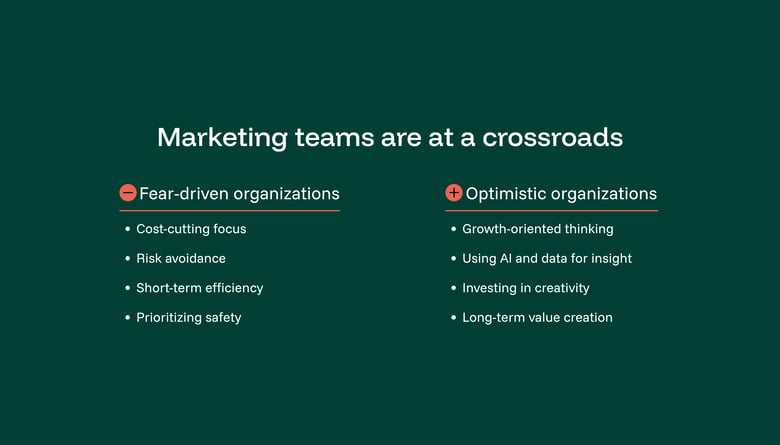
Organizational fear is killing innovation
A widespread lack of psychological safety is affecting how modern marketing teams operate and innovate. It comes as no surprise that 41% of in-house marketers are uncomfortable raising concerns or challenging existing strategies.
Fear-driven organizations treat experimentation as risky and tend to fall back on familiar tactics, even when performance plateaus. But playing it safe becomes the riskiest long-term marketing strategy. Teams in this environment prioritize avoiding mistakes over learning. Decisions become political, as more energy is spent on defending past choices, and failure becomes a personal career risk.
But markets don’t wait until you’re ready to move. Marketing leaders in 2026 must actively change the conditions that create fear. They need to normalize questioning and uncertainty, reward learning over perfection and make experimentation less risky through better data foundations.
The risk of using AI purely as a cost-cutting tool
Much of the fear around AI stems from how it’s being introduced inside organizations. A common fear-based adoption pattern frames AI primarily as a way to reduce headcount or maximize immediate gains. But short-term efficiency often comes at the expense of long-term organizational capability.
Sure, production ramps up, but content is generated by AI, optimized by AI and evaluated by AI. There’s little differentiation from other brands doing the same thing.
Optimism reframes AI’s role. Optimistic teams ask how AI can support better thinking and decision-making. They use AI to eliminate low-value work and surface insights faster. How teams choose to deploy AI will shape competitive outcomes across the marketing industry.
Creative talent matters more than ever
There’s a growing fear that creative roles will be replaced by AI. In fact, we found that 46% of marketers believe creative roles are most at risk of decline or replacement due to AI when surveying marketing professionals for our Marketing Intelligence Report. But replacement thinking is dangerous because it misunderstands where creative value actually comes from.
Interpretation, judgment and perspective are all core aspects of creativity. But AI-generated content is inherently derivative. It’s built by recombining existing patterns with limited human context or lived experience.
When creative roles are reduced or removed, teams may produce more outputs, but they lose any creative distinction that makes them stand out from all the AI content that floods the market.
Creative talent provides the creative direction that AI lacks. They shape the narrative, prioritize ideas and decide what to say. These very human judgment calls make a compounding difference in how the brand is perceived and remembered. They are what earn long-term brand loyalty.
Leading brands, like Apple and Nike, continue to invest in marketing and creative teams. Creative design, brand marketing, content and advertising roles are still actively advertised and staffed on their websites. Their advantage has never come from producing more digital marketing campaigns, but from creating intentional content that resonates emotionally.
These brands use technology to support creative work, not replace it. Marketing automation helps with execution and scale, but human creatives are needed for the nuance AI can’t replicate.
The need to invest in structured data and experimentation infrastructure
Infrastructure shapes how decisions get made. Teams that don’t invest in robust infrastructure often rely more on intuition, hierarchy or past precedent than on evidence. It’s easier for fear to take over decision-making in those circumstances.
In 2026, marketing performance is determined by how fast teams can move from insight to action without friction. Structured data offers a shared language that helps marketers stay aligned and act with confidence.
Optimistic leaders understand that infrastructure is what makes experimentation scalable across an organization. They invest in systems that fundamentally change how people work, including:
- Unified data environments
- Clear KPIs and shared definitions
- Automated reporting and feedback loops
- Governance designed to support testing
The companies that grow in 2026 will be those that design systems where experimentation is part of the routine, not a side project. Culture, not technology, limits innovation now. A culture of experimentation follows confidence, and confidence follows trusted data.
The role of marketing professionals is evolving
Automation has raised the bar for how marketers create value. As execution becomes easier, the role of marketers needs to evolve with it.
Here are what marketers need to succeed in 2026:
Measurement literacy and AI judgment
As data complexity increases, marketers are expected to interpret performance, understand trade-offs and explain outcomes in business terms to gain trust from finance and leadership.

But our research shows that only 13% of marketers believe they communicate very well across departments, despite 76% believing their work is closely tied to business goals.
This gap reflects a skills issue. Modern marketing requires the ability to evaluate performance critically and defend decisions with evidence.
Stronger measurement literacy also includes interpreting AI-generated insights. Marketers must question automated recommendations, understand how conclusions were reached and identify when outputs don’t align with business reality.
In 2026, competitive advantage depends on who can evaluate evidence, not who can generate it.
Data and system ownership
What brands can measure, optimize and automate now depends largely on the data they collect. How that data is structured, governed and connected across systems directly shapes what insights are possible.
Marketers can no longer treat infrastructure as someone else’s responsibility. They need to own how data flows between platforms, how performance definitions are standardized and how signals are preserved across media, analytics and CRM systems.
Teams that build and manage a strong data foundation adapt faster to privacy shifts, AI evolution and changing discovery models.
Strategic experimentation
Marketers are no longer measured solely on execution, but on their ability to generate validated insight and apply it strategically.
Experimentating is a core responsibility, but it requires structure. This means marketers need to form clear hypotheses, define success criteria and isolate variables before making changes. Otherwise, testing becomes reactive and conclusions are unreliable.
Structured experimentation improves decision quality over time. Teams build evidence gradually, as each test clarifies what drives impact and informs future decisions.
The Infrastructure modern teams need in 2026
All of the trends outlined in our report depend on one thing: confidence in data. When data is structured and governed at the foundation, AI becomes more reliable, measurement becomes more credible and experimentation becomes less risky.
That’s why unified marketing data must be treated as core infrastructure. Platforms like Funnel are designed to support this infrastructure, helping teams consolidate fragmented data into a centralized hub where it’s structured, validated and ready for analysis.
In 2026, the advantage won’t come from having more tools. It’ll come from having more trust in the data that drives decisions.