







LinkedIn has more than a billion members, making it the largest professional network in the world. For B2B marketers, it’s one of the few platforms that allows you to target by job title, seniority and company size as well as reach decision-makers while they’re in a professional mindset.
But LinkedIn advertising in 2026 looks different from what it was even a year ago. New LinkedIn ad formats, AI-powered targeting, server-side tracking and rising costs have shifted how smart teams plan and measure their campaigns.
What hasn’t changed is that success requires more than audience targeting alone. It demands a strategy that connects creative, budget and measurement into a unified system that can prove impact. Whether you’re evaluating LinkedIn as a channel for the first time or refining an existing LinkedIn advertising campaign strategy, here’s what’s worth knowing as we head into the rest of the year.
LinkedIn ad formats worth knowing in 2026
If you want to optimize your ad budget and increase awareness with your target audience, which ad types work best? From unobtrusive text ads and follower ads to more visually compelling video content meant to draw attention in a LinkedIn feed, there are several ad formats worth keeping in mind in 2026.
Below is a quick orientation of the major format categories you’ll see in your ad account. Consider what each format is best suited for and where it fits in a full-funnel approach.
Feed-based formats
Sponsored Content remains the flagship of feed-based formats when advertising on LinkedIn. You can use single image, carousel, event, document and video ads in 2026 when posting Sponsored Content.
That being said, single-image ads still anchor most campaigns and deliver strong click-through-rates (CTR), especially in square format. Other formats are gaining traction as well. Interactive and content-rich formats like Document Ads are shaping high-performance strategies.
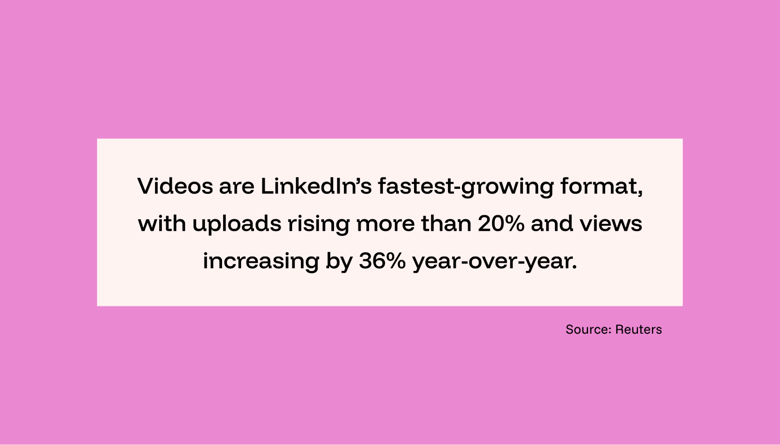
However, videos are LinkedIn’s fastest-growing format. According to Reuters, uploads rose more than 20% in the first half of 2025, with views increasing 36% year-over-year from February 2024 to 2025. You can upload landscape, vertical, square and Stories-type videos within Sponsored Content, and interactive video features now let marketers embed polls, clickable CTAs and overlays directly within video ads.
Thought leader ads, in which you boost organic posts from individual employees, not just the company page, are also valuable. According to LinkedIn, these have a 1.7x higher click-through rate and a 1.6x higher engagement rate than other single-image ad campaigns.
LinkedIn messaging ads and dynamic ads
Sponsored Messaging Ads (Message Ads, Conversation Ads) are great if you want to send direct messages to prospects. Sponsored Messaging Ads can spark conversations and drive actions like booked calls and sign-ups. They tend to have high response rates, but there are restrictions if you’re targeting EU members because of the EU Cookie Law (the ePrivacy Directive). People in the EU have to agree to see Sponsored Messaging in their inbox before they receive these ads.
Dynamic ads are tailored based on a LinkedIn member’s profile information. LinkedIn automatically personalizes the ad content to help drive engagement. Follower ads are great for increasing brand awareness. Spotlight ads are dynamic ads that take someone to your website. They work well for leading prospects to information about your product, event or service. Content ads let you showcase your content, which can help your LinkedIn page generate leads.
Relatively new LinkedIn ads to watch
Reserved Ads on LinkedIn ensure your advertising content appears in the first ad slot on the LinkedIn feed on a given day or date range. Connected TV, on the other hand, extends LinkedIn advertising to streaming TV screens for brand awareness campaigns.
First Impression Ads are a new ad format for vertical videos. These give you more control over when and where your video ads appear.
Finally, LinkedIn Accelerate mode uses AI to optimize targeting, creative and bidding. LinkedIn itself claims that this AI-driven campaign mode improves cost per action by 42% compared to classic campaigns.
Choosing the best LinkedIn advertising formats is one part of the equation, but how do you know who to target?
How do you find the right audience on LinkedIn?
Multiple ad formats are great for increasing brand awareness and engagement, but LinkedIn’s targeting is its biggest differentiator. You can segment users by job title, company size, industry, skills and seniority within your ad account. The question here isn’t just who to target, but how to layer targeting with your campaign objectives.
Professional targeting
With professional targeting, you can access core targeting dimensions such as:
- Job title
- Job function
- Seniority
- Company name
- Company size
- Industry
- Skills
- Groups
- Education
You can also target Matched audiences. This leverages website retargeting via the Insight Tag, contact list targeting, account-based targeting and lookalike audiences.
AI-powered audiences and the Microsoft data layer
LinkedIn gives marketers access to AI-powered predictive audiences. It combines first-party or third-party data with LinkedIn’s predictive AI modeling to build audience segments tailored to specific business needs.
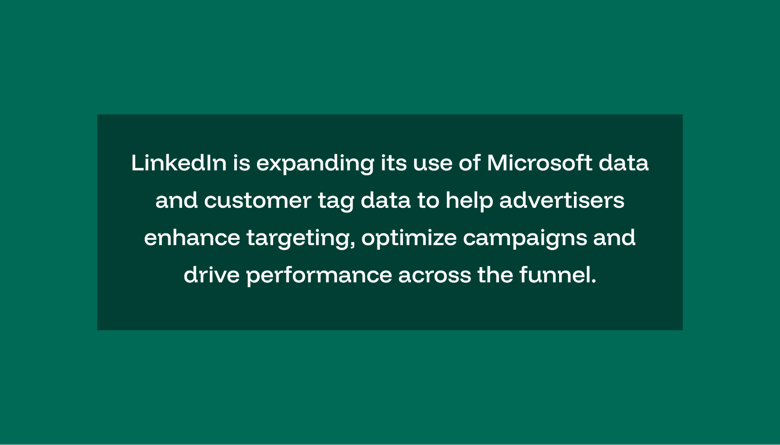
According to Microsoft, LinkedIn is currently expanding its use of Microsoft data and customer tag data to help advertisers enhance targeting, optimize campaigns and drive performance across the funnel.
Audience expansion and the LinkedIn Audience Network can extend reach beyond the LinkedIn feed, but make sure to monitor placement quality if you decide to use this feature.
You should also avoid overtargeting in this ecosystem. A narrow audience drives up costs and limits the algorithm’s ability to optimize delivery.
What LinkedIn ads actually cost and how to bid strategically
LinkedIn is one of the most expensive paid social channels, and that’s unlikely to change. On paper, the benchmark costs seem higher, but in reality, they're simply more honest about what B2B marketing should cost.
Are LinkedIn ads expensive?
On average, LinkedIn ads cost:
- $2 to $3 per click
- $5 to $8 per 1000 impressions
- $0.26 to $0.50 per message sent
You’ll also need to spend a minimum of $10 per day, with a minimum lifetime budget of $100 for new campaigns. That being said, LinkedIn’s suggested daily spend for new advertisers is $25 per day.
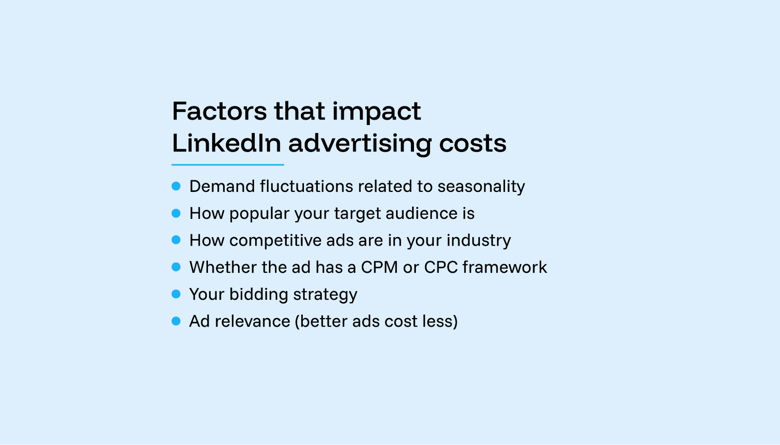
Keep in mind that, like Meta ads, LinkedIn ads are auction-based. This means many factors impact the cost of your ads. As such, your expected ROAS can vary, sometimes significantly.
Bidding and budget strategies to consider
With an auction-based advertising platform, your bidding strategy matters. AI-powered campaign optimization now automatically adjusts bidding, placement and creative delivery, but manual oversight still matters.
There are three bidding strategies you can use:
- Maximum delivery (automated): Use this strategy when you want to spend your full ad budget and generate the most key results possible without managing bids manually. It’s a good starting point for new campaigns or when brand awareness and reach are your priority.
- Cost cap: Use this strategy when you want LinkedIn to optimize delivery automatically, but when you still need to keep your cost per result within a defined threshold. It’s ideal for lead generation campaigns with a specific CPA target.
- Manual bidding: Use this bidding strategy when you want the most control over how much you’ll bid per key result. This requires the most oversight, but it helps prevent overspending.
No matter which bidding strategy you choose, the way you structure and pace your budget matters just as much. Campaign Groups (now being renamed “Campaigns”) allow budget allocation at the initiative level. Start with broader audiences and let the algorithm learn before narrowing further. This is especially important if you’re using maximum delivery or cost cap, since the system needs enough data to optimize effectively using those methods.
Note that always-on activity outperforms campaign spikes, and consistency beats ‘big splash’ campaigns. Plan always-on activity, layer in campaigns, then retarget from there. This cadence gives your chosen bidding strategy more room to perform, since the algorithm benefits from a sustained signal rather than short bursts of spend.
Crafting creatives that earn attention on LinkedIn
The days of ‘download our whitepaper’ paired with a stock photo and generic headline are over. 2026 will reward specificity, strong POVs and actual insights. Creative quality is now a performance lever, not just a branding exercise, so let’s explore how to make the most of yours.
Video is no longer optional
According to LinkedIn Ads, 71% of decision makers are now Gen Z and Millennials, and these audiences prefer video. That’s one reason why 78% of B2B marketers are already using video, and 56% will increase their use of it in 2026.
In addition, video-warmed members are 1.6 times more likely to open a lead gen form compared to a non-warmed LinkedIn member during a 30-day nurture window.
The split for traffic on LinkedIn is 70% mobile vs. 30% desktop, so optimize your video creatives for vertical or square formats, which work well on both. Always add captions or subtitles, since you can’t assume people are scrolling with the sound on.
Thought leadership as a paid format
Thought Leader Ads let you promote posts from employees’ personal profiles, and as discussed above, these often outperform brand-page content. This format works well for building trust and credibility with senior decision makers.
The Collaborative Post feature also enables two or more employees to co-author a post for extra organic reach and credibility.
Document ads and interactive content
Document ads, such as slide decks, guides and reports, drive high engagement, since viewers swipe through content natively on the feed. Interactive elements like embedded polls in video are creating new engagement patterns on the platform.
Prioritize giving value over asking for the sale. Value means engagement, and according to LinkedIn’s Engineering Blog, a post with a lot of engagement will be more likely to be shown to more people.
Setting up measurement from day one
Measurement should be a part of campaign planning, not an afterthought. The data you collect from day one feeds directly back into how LinkedIn optimizes your campaigns. If your tracking isn’t set up before launch, you’ll fly blind while the algorithm is learning the most.
LinkedIn’s measurement infrastructure has come a long way from basic pixel tracking, when all you could do was hope the numbers told a coherent story. Today, you can connect CRM data, attribute revenue to specific campaigns and forecast performance before you even launch, all of which we’ll cover below.
The Insight Tag and Conversions API
The Insight Tag is LinkedIn’s JavaScript pixel. It tracks page visits, conversions and audience building on your website.
LinkedIn’s conversions API (CAPI) creates a direct, server-to-server connection between your systems and LinkedIn. That means you can track conversions wherever they happen without relying on cookie-based tracking. This gives you both more reliable data and a lower cost per action.
Using CAPI with the Insight Tag gives a more complete view of conversion tracking, since the former catches what cookies miss while the latter covers standard web activity. This means you can track what cookies alone can’t, such as phone sales, in-person event leads and offline conversions logged into your CRM. LinkedIn deduplicates events sent through both and only counts each once, so you don’t have to worry about double-counting conversions.
UTMs and attribution context
As of March 2025, according to LinkedIn’s marketing blog, you can use dynamic UTMs in the Campaign Manager. You can also automatically append campaign, ad group and creative parameters to URLs.
Consistent UTM structures are essential for cross-channel reporting, since you’ll lose campaign-level detail without them once traffic hits your analytics platform. You also won’t be able to compare LinkedIn performance against your other channels on an apple-to-apple basis.
In addition, LinkedIn has integrated real-time CRM data directly into Campaign Manager as of June 2025. This gives you visibility into how campaigns drive pipeline and revenue.
Finally, Revenue Attribution Reports let you move past lead volume to pipeline and revenue impact.
Where LinkedIn fits in your measurement stack
LinkedIn ads rarely operate in isolation. Most B2B strategies run it alongside search, display and other paid social and content programs.
The real challenge in B2B marketing measurement is understanding how LinkedIn contributes to outcomes when the sales cycle spans months.
The long-cycle attribution problem
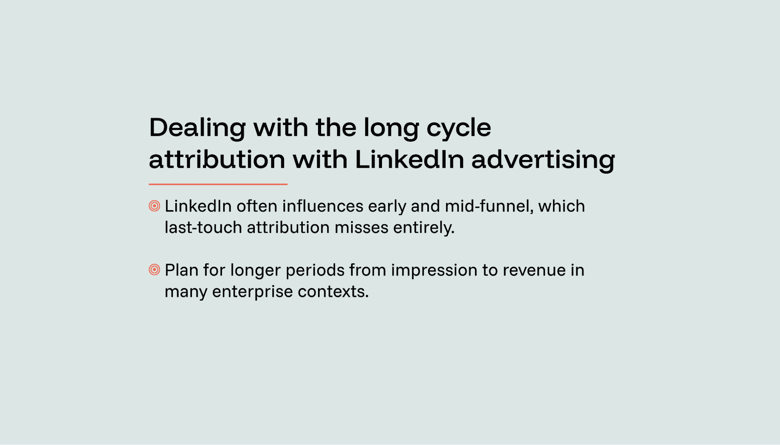
To account for the long purchase cycles that are common in many enterprise contexts, plan for longer periods from impression to revenue. Judging your LinkedIn ad campaigns only on last-click ROAS can systematically underfund a major driver of B2B demand. That’s because LinkedIn often influences early and mid-funnel, which last-touch attribution misses entirely, especially for these campaign goals:
- Brand awareness
- Consideration
- Trust
Platform-reported metrics only tell one part of the story, whereas cross-channel measurement tells a more complete one.
Connecting LinkedIn to cross-channel reporting
Consistent UTM taxonomy preserves campaign-level detail once LinkedIn traffic hits your analytics platform, which makes it possible to compare performance across channels accurately. A marketing intelligence platform can accelerate this process by automatically normalizing metrics, currencies and naming conventions so that LinkedIn data arrives clean and ready to sit alongside every other source without manual reconciliation. CAPI can further enrich the signal by sending conversion events back to LinkedIn for better optimization.
That said, even with unified data, attribution alone won’t give you the full picture of LinkedIn’s impact. LinkedIn influences your pipeline through awareness and consideration touchpoints that click-based models consistently undervalue. For teams with the maturity and budget, marketing mix modeling can help quantify LinkedIn’s contribution, including upper-funnel effects that attribution misses. Meanwhile, incrementality testing validates whether those conclusions hold up.
The goal is a measurement system where multiple methods inform and calibrate each other. In such a system, you don’t need to rely on any single model to tell the whole story.
Leverage LinkedIn ads in your 2026 marketing strategy
LinkedIn advertising in 2026 rewards teams that think beyond the campaign level. The platform’s targeting is as strong as ever, although costs keep climbing and measurement complexity grows alongside it. The advertisers getting the most from LinkedIn are the ones treating it as part of a broader system — connecting campaign data to their reporting stack, thinking carefully about how it interacts with other channels and building creatives that earn attention in a professional feed.
Whether you’re running your first campaign or refining an established program, the foundation stays the same: know your audience, structure your measurement and let the data guide your decisions.