






Privacy changes like Apple’s App Tracking Transparency (ATT) policy have led to a reduction in the data that fuels ad optimization, so platforms can’t see which conversions actually drive profit. As a result, algorithms chase cheap clicks that rarely lead to high-value customers.
The fix to this signal loss isn’t more data. It’s using the right data — data that’s closely tied to business value — and sharing it with ad platforms. Predicting customer lifetime value (LTV) early helps you show platforms what real success looks like and rebuild the feedback loops on which performance depends. But it’s just one way to represent value early. There are multiple types of high-quality value signals teams can send, including margin-weighted events like completing an order for a certain value, or qualification events, such as requesting a demo or filling out a lead form.
Funnel’s Data Activation and conversion API (CAPI) connections make that possible by activating modeled insights your team generates, feeding them back to Meta, Google, TikTok and other platforms. These engineered signals teach algorithms to optimize for growth, not noise.
To see why value-based optimization matters, let’s look at how today’s feedback loops broke in the first place.
Why conversion optimization is broken (and how value-based signals fix it)
Conversion performance didn’t collapse because ad platforms became less intelligent. It collapsed because the signals they rely on stopped reflecting real customer value. Privacy rules limit how platforms connect ad engagement to downstream revenue, so bidding systems now work with a narrower field of vision.
The algorithms still run efficiently, but they optimize for the signals that remain available instead of the ones that matter most for profit. They respond to surface-level user behavior instead of identifying the target customers who drive real growth.
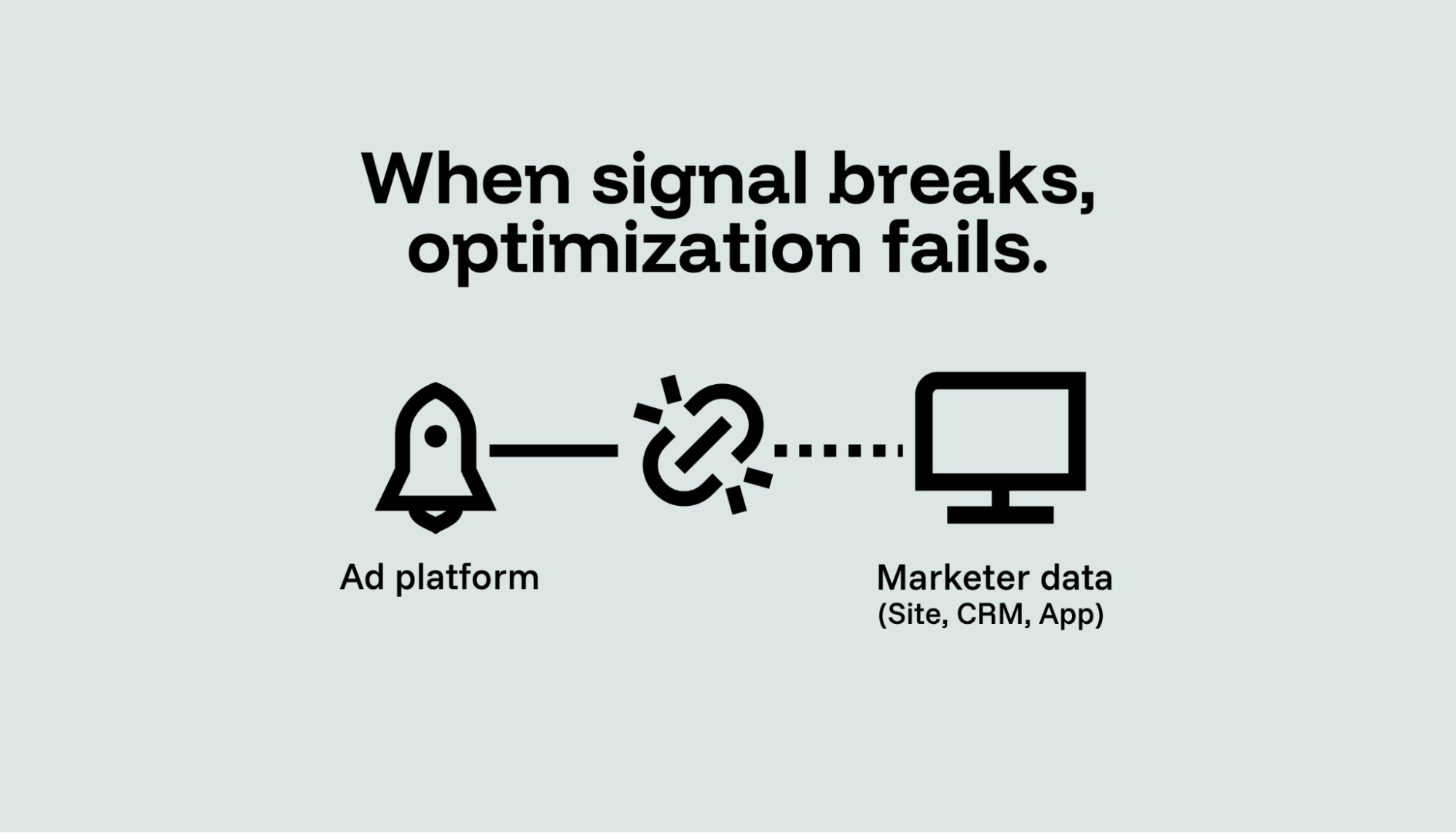
A click, a low-cost signup or a first purchase can appear as a strong result within the platform, even when that behavior has little to no long-term value. And, the system responds to what it can see, which, in this case, doesn’t actually drive sustainable revenue. As a result, budget is flowing into ad campaigns, but it’s not making the impact it should. With fewer verified conversion events and limited visibility into website interactions, the system will continue to fall back on whatever is easiest to detect.
Measurement metrics reinforce the wrong behavior
Even when teams recognize that their campaigns attract low-value users, the metrics inside ad platforms push them to reward the wrong outcomes. CPA and ROAS still act as the default scorecards, so campaigns that produce low-value conversions look successful even when those users rarely generate profit.
What ends up happening is that the platform reports healthy efficiency while the business sees weak retention and little revenue left. A campaign that lowers customer acquisition costs can deliver users who never lift average revenue or contribute to profit.
Internal analytics often reveal the gap, but those insights don’t make it back into the system that controls bidding on their own. Without a way to feed value-based signals into the platforms, the algorithms continue to learn from incomplete data. The feedback loop rewards volume instead of quality, which teaches the system to repeat unprofitable behavior.
Here’s the thing: optimization is only as good as the signals you feed the algorithms. If your success metrics drift from value, the algorithms’ output will drift, too.
So, what can marketers do to steer the algorithms in the right direction? Using predictive customer lifetime value and other signals tied to customer quality can shift how the algorithms work.
Predictive LTV modeling redefines the signal around value
Predictive LTV is an advanced value signal that helps teams calculate customer lifetime contributions and understand retention rates that don’t appear in short-term metrics. It also gives marketers a way to measure customer lifetime value earlier than traditional reporting allows.
Instead of waiting for revenue to mature after purchases, marketers can identify high-value users early in the buyer’s journey and understand which acquisition paths create profit, not just conversions. When teams feed those predictions into ad platforms, such as the probability of a repeat purchase or predicted subscription retention, the system can start learning from signals that represent customer quality.
Predictive LTV is only one type of value-based signal used in performance marketing to help push the algorithms in the right direction. Think of pLTV as an advanced signal option. Retention proxies, lead scores, margin-weighted revenue and qualification events are other conversion signals that can teach the platforms to optimize toward value.
With the help of these signals, algorithms gain the context they lost after privacy changes, because they receive inputs tied to revenue instead of shallow engagement metrics. With this information, marketers can bid more aggressively for users who are likely to return and spend, and pull back on audiences who convert once and disappear.
Synthetic events make predictive signals usable at scale
Ad platforms can’t process complex model outputs directly. They need simple event types or numeric values that fit their optimization systems. Synthetic events bridge that gap by making the modeled insight visible. They turn a predictive score into a signal that the platform can understand.
For example, you might create a synthetic event that marks when a new user reaches an engagement level that usually leads to higher lifetime value, or you might trigger a weighted event when a lead completes a set of actions that strongly correlate with becoming qualified. When these synthetic events flow back to the platforms, the algorithms can learn from signals that represent long-term value instead of low-value one-time conversions.
Once you redefine value and convert those insights into synthetic events, the next step is getting those signals into the ad platforms that power your campaigns. That requires a reliable way to deliver first-party data with accuracy and control. This is where conversion APIs (CAPIs) matter. CAPI is the delivery mechanism, not the modeling layer. It provides the pathway that lets teams send verified, privacy-safe signals back into the platforms so the algorithms can relearn what strong performance actually looks like.
Feed your algorithms signal data with conversion APIs
Predictive LTV and synthetic events can only improve optimization if platforms can actually see those signals. Conversion APIs deliver server-side conversion data from your systems or customer data platform (CDP) to ad platforms, giving them clearer signals that reflect business value.
Conversion APIs restore a direct, high-quality signal path
CAPIs create a server-to-server link between your data environment and the ad platforms. This bypasses pixel loss and browser restrictions but works best alongside the pixel if you want total fidelity, so modeled data gets through cleanly and consistently.
Conversion APIs also help fill the gaps left when you can’t reliably capture browser events due to privacy limits or tracking protection. This applies whether you use the Facebook Conversions API or still rely on the Facebook pixel as your baseline event source.
The big win with CAPI is that marketers can send custom values, including predictive LTV and other high-quality signals like qualified lead events, margin categories or weighted engagement steps, instead of depending on default metrics. Conversion APIs also help remove duplicate conversion events by using consistent event IDs, which prevent platforms from counting the same action twice. The result is a direct, privacy-safe channel for more relevant, value-based feedback.
Early modeled signals outperform perfect delayed data
Predictive signals give marketers an early read on which customers are likely to deliver value even before revenue fully appears in the CRM. That early signal matters because platform learning windows are short. If teams wait for perfect total revenue to appear, the signal arrives too late for the learning window. Platforms need timely indicators that are accurate enough to guide the next round of optimization.
Modeled values fit that need. They aren’t meant to replace actual revenue. They fill the gap between the first conversion and the moment when customer value becomes visible. When these modeled signals flow through a conversion API, the platform can adjust targeting while the campaign is still active instead of reacting weeks or months later.
The strength of modeled signals isn’t speed alone. It’s that they provide relevant information during the period when the algorithm is still forming its understanding of what a valuable user looks like.
Once platforms start learning from modeled value instead of raw volume, marketers can move past CPA and optimize for the customers who matter most.
Predictive LTV gives platforms a clearer definition of value
As Eran Friendinger explained on the Mobile Dev Memo podcast, early predictive feedback changes how algorithms learn. A conversion fires right away, but the value of that customer doesn’t show up until much later.
In many cases, the first purchase is small, or the account isn’t qualified yet, so the revenue signal that matters arrives outside the platform’s learning window. If you wait for that actual revenue, the optimization cycle has already moved on. Predictive modeling closes that timing gap by estimating customer value early and sending a signal the algorithm can use while it’s still learning. That gives the system a head start on finding lookalikes of the customers who are most likely to become valuable.
Using predictive LTV, along with other value signals, also helps teams shift focus from short-term efficiency to long-term growth. When performance is judged only by CAC or ROAS, smarter targeting can seem more expensive even when it drives higher returns later. Predictive modeling makes that tradeoff clear so teams can prove the financial impact of quality.
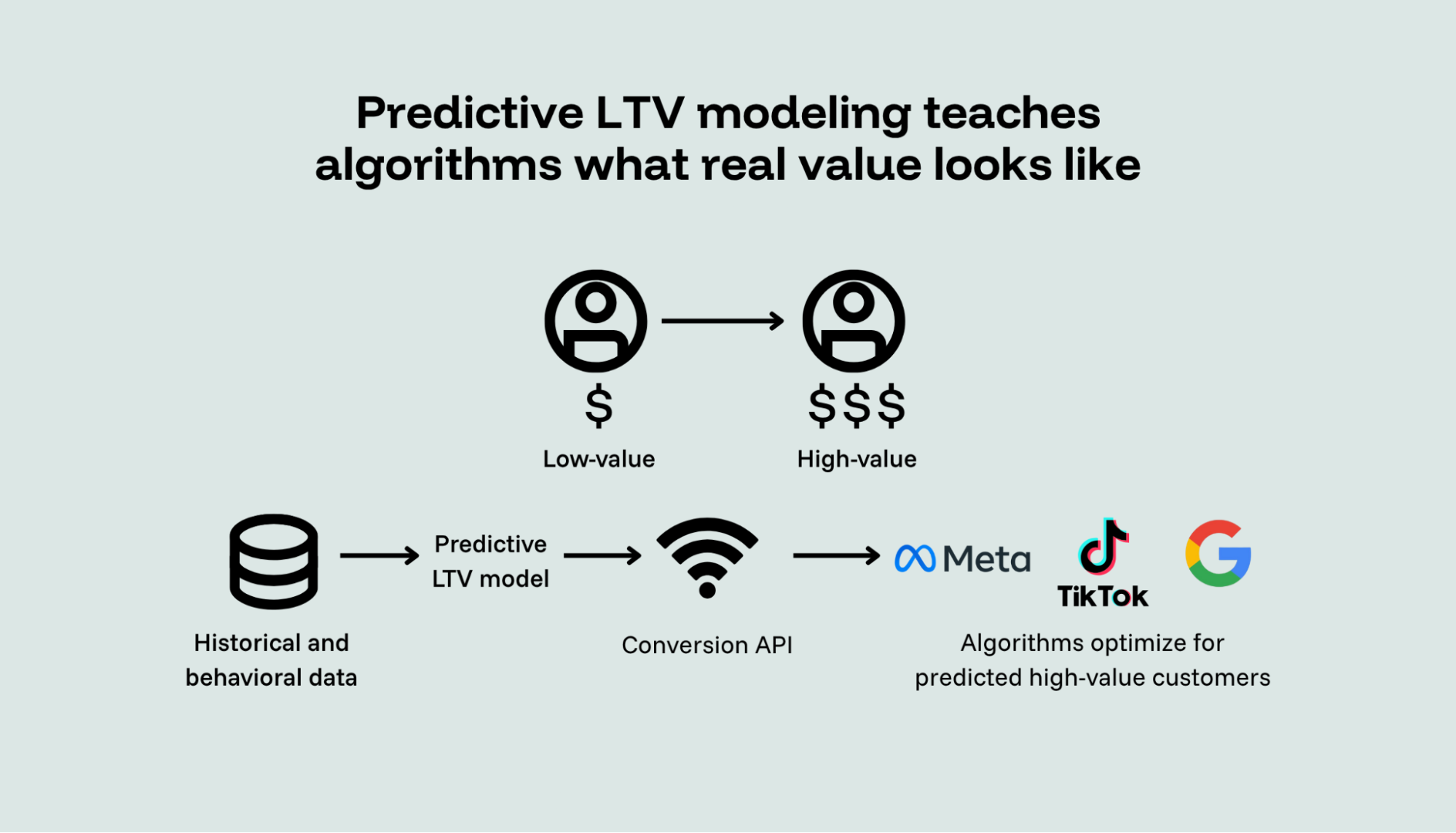
Together, predictive LTV and synthetic events help rebuild parts of the feedback loop that ATT weakened, but their value depends on the strength of the underlying models. These models need solid historical data, clear segmentation and reliable predictive analytics. Also, their accuracy can fade unless teams monitor and refresh them over time.
With conversion APIs and signal engineering, algorithms can learn what real value looks like. As a result, marketers can move past CPA and prioritize the customers who actually matter, and ads can work their magic to help drive business growth.
Beyond CPA: Optimize for the customers who actually matter
Most teams still judge performance with CPA, even though it rewards cheap conversions instead of customers who drive real profit. With stronger value signals in place, marketers can break out of that pattern and focus on the users who actually grow the business.
Traditional metrics reward efficiency, not growth
Metrics like CPA and ROAS were built for a simpler era when every conversion could be tracked and compared. They measure cost efficiency, not profitability. A campaign that lowers CPA can still bring in low-value users who never buy again. This encourages teams to optimize for what’s easy to track instead of what drives business growth.
Value-based optimization replaces cost with quality
Predictive LTV shifts focus from transaction cost to lifetime contribution. Even without full LTV modeling, teams can shift toward quality by weighting events based on margin, lead score, engagement depth or funnel qualification. Every conversion can now be weighted by its predicted value instead of being counted equally. That allows bidding strategies that favor profitable customers even if they cost more to acquire.
This mindset change shifts the focus from saving money to making smarter investments in growth.
For example, a subscription app might pay more for users who complete onboarding steps linked to long retention, such as finishing a tutorial or watching key content. An ecommerce brand might prioritize shoppers who browse multiple categories or add high-margin products to a wishlist. In B2B, a team might bid higher for leads who engage with deeper content like case studies or pricing pages because those behaviors correlate with qualified pipeline.
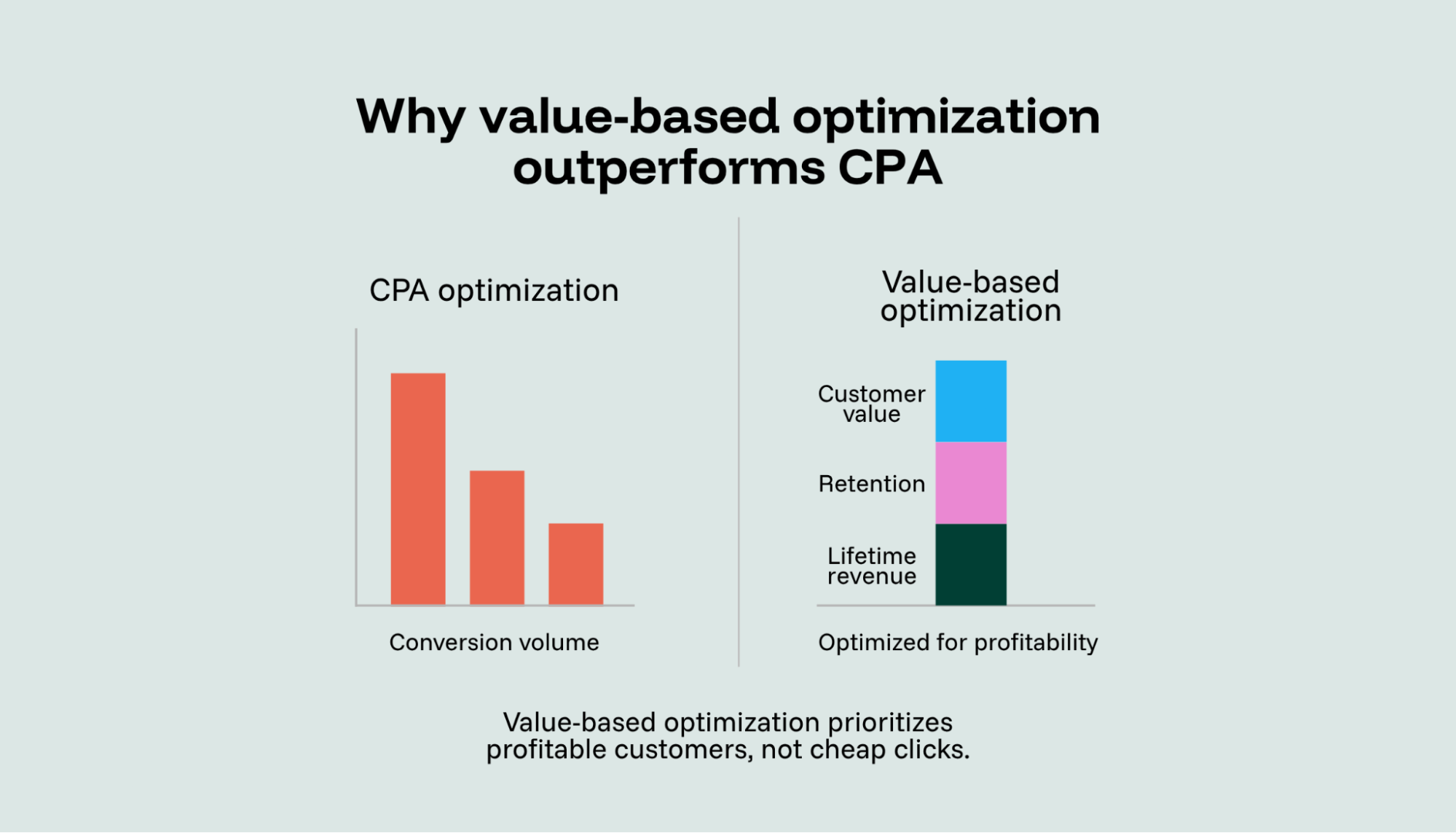
Value-based optimization turns marketing from a cost center into a growth engine.
Proof that value-based bidding works
Multiple industry studies confirm that value-based optimization outperforms standard CPA tactics. For example, a study of 150 ecommerce brands by Adzeta found that campaigns using predictive value-bidding achieved 2.7 times higher ROAS, cut acquisition cost by 32% and shortened payback times by 41%.
When modeled or enriched signals feed into conversion APIs and deliver value-weighted signals into the platform, algorithms get clear, profit-aligned feedback. Even imperfect models help because they arrive early enough to influence optimization, while waiting for actual revenue often means the algorithm’s learning window is already closed.
How Funnel makes value-based optimization easier
Funnel makes this process seamless by activating your modeled or enriched signals. Funnel’s data activation capability automates how synthetic signals flow through conversion APIs to Meta, Google, LinkedIn, TikTok and other platforms.
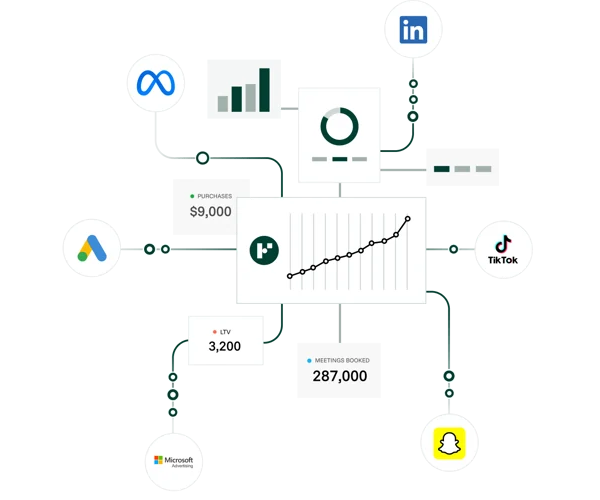
This keeps every platform aligned with the same value-based inputs instead of isolated channel data. Teams can activate predictive scores or weighted conversions directly from their data warehouse or BI tool without engineering support. Funnel keeps the data consistent, privacy safe and stable even as platform APIs change, so the signals remain reliable over time, giving marketers more confidence. This turns predictive modeling and enriched signals into live inputs for optimization.
Funnel Activate turns value-based optimization into a consistent process. It delivers signals the algorithm can learn from, then connects those signals back to measurement so teams can see the real impact on revenue and efficiency.
Once success is defined by value instead of cost, marketers can start focusing on scaling smarter systems rather than pushing more volume.
Build an adaptive performance engine that never stops learning
The next era of performance marketing isn’t about reacting faster; it’s about designing systems that learn continuously. Predictive models will evolve from campaign-level inputs into organization-wide intelligence, connecting spend, pipeline and revenue in real time.
The marketers who win won’t just analyze results but feed insights back into the system automatically. The real advantage is building an adaptive marketing engine that learns faster than the market changes.
Value signals will become the new performance currency
As third-party data disappears, every brand will need to define its own internal value signals.
These signals will determine how algorithms prioritize audiences, how budgets are allocated and how leadership measures growth. Predictive LTV models will be central to that system, translating business outcomes into machine-readable feedback.
Future performance will depend on how precisely you can define and deliver your own value signal.
Funnel’s role in the intelligence era
Most data tools stop at aggregation and reporting. Funnel closes the loop by activating modeled signals so platforms can learn from the same value-based inputs that guide the business.
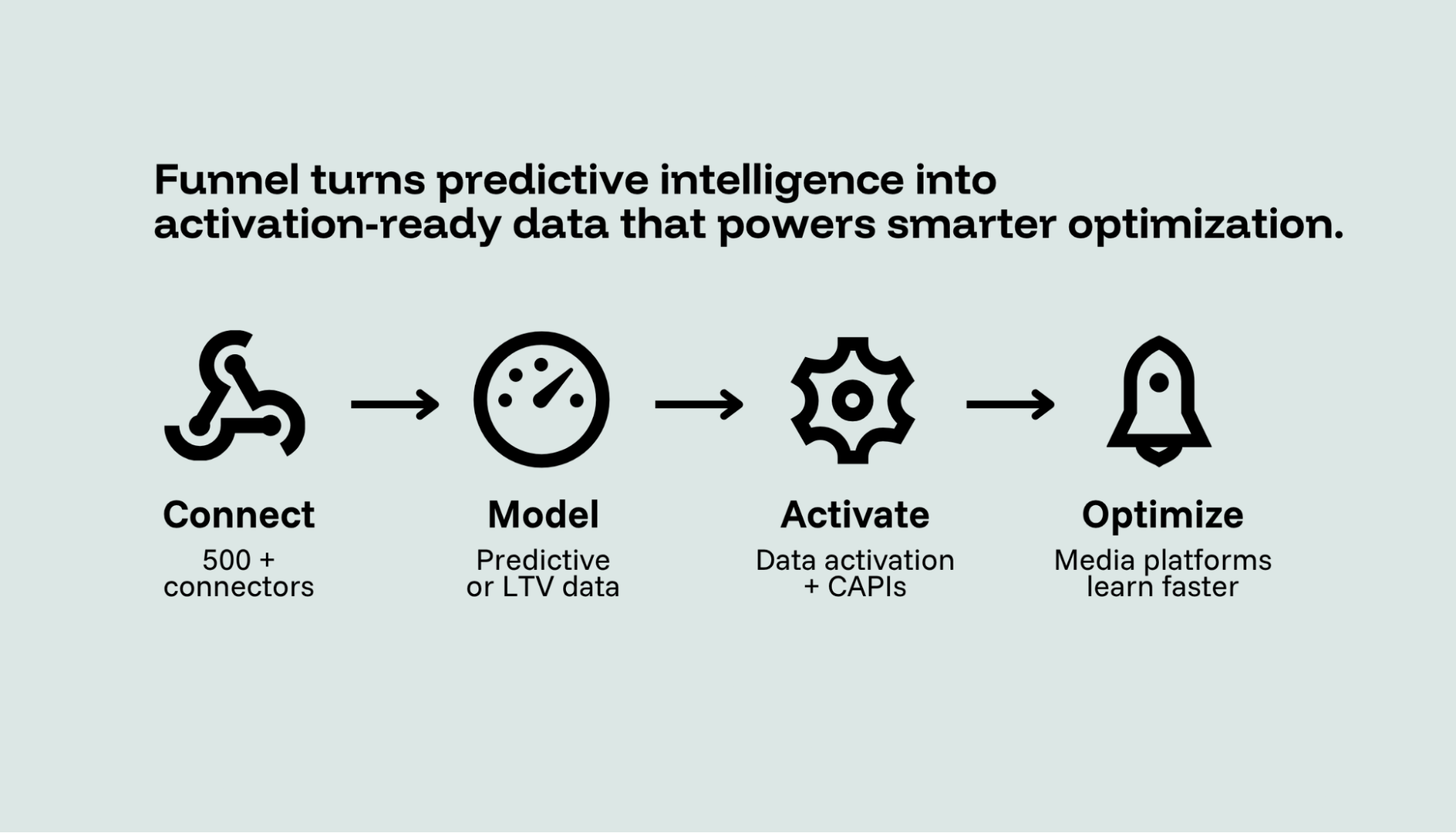
Funnel gives marketers the infrastructure to support adaptive learning. Data activation keeps predictive signals accurate and in sync across every platform, which means the algorithm sees a consistent definition of value no matter where the user converts. Instead of waiting for data teams to rebuild models or pipelines, marketers can iterate on live feedback, refine predictive inputs and scale what works.
Funnel empowers marketers to move from reactive reporting to proactive intelligence.
The next era of optimization starts with better signals
Performance marketing’s next advantage is the ability to teach algorithms what real value looks like and let that intelligence scale. Predictive LTV, other synthetic events and conversion APIs rebuild the signal, but it’s how you use them that defines success. Funnel activates by connecting your modeled data to every platform in real time. When your feedback loop learns from value, not volume, every decision compounds.
Whether that signal is modeled value, a qualification event or margin-driven weighting, the brands that define value will win. See how Funnel’s Data Activation makes value-based optimization possible.