



 Talk to sales
 Log in




TransUnion and Emarketer report that 54.1% of marketing leaders haven’t improved confidence in measurement this year. At the root of this confidence gap is access to high-quality data.
Without unified, clean, up-to-date data to feed measurement models and reports, marketing and analytics teams can’t make sense of data, let alone act on insights with confidence. Data teams carry the burden when connectors break, schemas shift and pipelines stall. Instead of driving analysis, your team’s stuck maintaining brittle connectors that never stay fixed for long.
That’s where the right integration setup makes all the difference.
Funnel and Fivetran both move data, but they’re built for different data integration processes. While Fivetran focuses on general data ingestion and moves it directly into your warehouse, Funnel offers a much-needed complement that provides marketing teams with faster access to analysis-ready data. It transforms and stores data in a governed hub that connects seamlessly to the rest of the stack. By taking care of marketing data complexity upstream, Funnel reduces the burden put on data teams while empowering marketing.
Funnel and Fivetran both play important roles in the modern data stack. In this comparison, we’ll break down why data teams choose Funnel for marketing data to support scaling without the operational burden and cost unpredictability that come with relying on Fivetran alone.
Funnel vs Fivetran: Who does each platform serve?
Funnel and Fivetran were designed for different operators. That distinction explains most of the differences you’ll see in cost, speed, data readiness and reporting reliability.
Fivetran focuses on control
Fivetran is an ELT tool built for engineers managing general-purpose data pipelines. Marketing is only one of many use cases it supports. It depends on warehouse infrastructure, schema management and technical monitoring. That setup fits IT-led teams but slows down reporting cycles when marketers rely on those same resources for quick access.
Fivetran fits neatly into a centralized data strategy. It’s strong on scalability and governance, but slower when it comes to marketing-specific updates. Even simple changes, such as renaming campaigns or adjusting currency fields, are typically handled through warehouse models and require data team involvement. This creates a queue of small fixes that keep analysts waiting and reduce agility.
For data teams, Fivetran fits their data workflows and existing architecture. The platform handles large volumes well, but not the daily variability of marketing data, with changes across dozens of APIs and accounts to wrestle with.
Funnel focuses on collaboration
Funnel is a marketing intelligence platform that gives data teams dependable marketing data while giving non-technical users safe self-serve access. It automates transformations, harmonization and currency normalization so data stays consistent and analysis-ready from the start.
Agencies running multiple clients depend on Funnel because their reporting can’t slow down every time a platform updates an API or a connector breaks. Funnel’s automated maintenance and normalization keep pipelines stable even when campaign volume spikes during busy periods.
For data teams, Funnel connects directly to BigQuery, Snowflake, Redshift and Databricks. That means full control of warehouse architecture with far less manual oversight. Funnel complements the modern data stack by reducing the maintenance burden and freeing data teams to focus on analysis, not repairs. It streamlines how teams aggregate data from various platforms into one user-friendly solution designed for marketers, analysts and engineers.
Funnel vs. Fivetran at a glance
Fivetran focuses on raw ingestion that fits into a larger enterprise stack. Funnel delivers business-ready data that supports reporting, measurement and decision-making without the engineering overhead.
The table below shows how each platform compares across the areas that matter most for reliable marketing intelligence.
|
Category |
Funnel |
Fivetran |
|
Primary user |
Data and marketing teams |
Central data teams |
|
Connector focus |
Full marketing coverage across ad, analytics and platform schemas |
Broad enterprise connectors that require data warehouse setup |
|
Transformation |
No-code mapping, harmonization and currency handling |
SQL/dbt models executed in the data warehouse, typically owned by data teams |
|
Data readiness |
Analysis-ready tables for reporting and measurement |
Raw tables that require modeling before use |
|
Pricing model |
Predictable subscription not tied to data volume |
Row-based pricing that fluctuates with data scale |
|
Speed to insight |
Fast setup with self-serve workflows |
Slower due to SQL modeling and warehouse dependence |
|
Collaboration |
Exports to BigQuery, Snowflake, Redshift and Databricks |
Built for data teams that manage pipelines centrally |
|
Best for |
Teams needing daily reporting confidence and fast delivery |
Engineering teams managing enterprise ingestion |
The differences between Fivetran and Funnel shape how quickly your team can answer questions, how stable your reporting is during busy periods and how much surprise-cost risk you carry.
Funnel prepares data for reporting as it's collected, which removes the need for SQL models and reduces the delays caused by engineering queues.
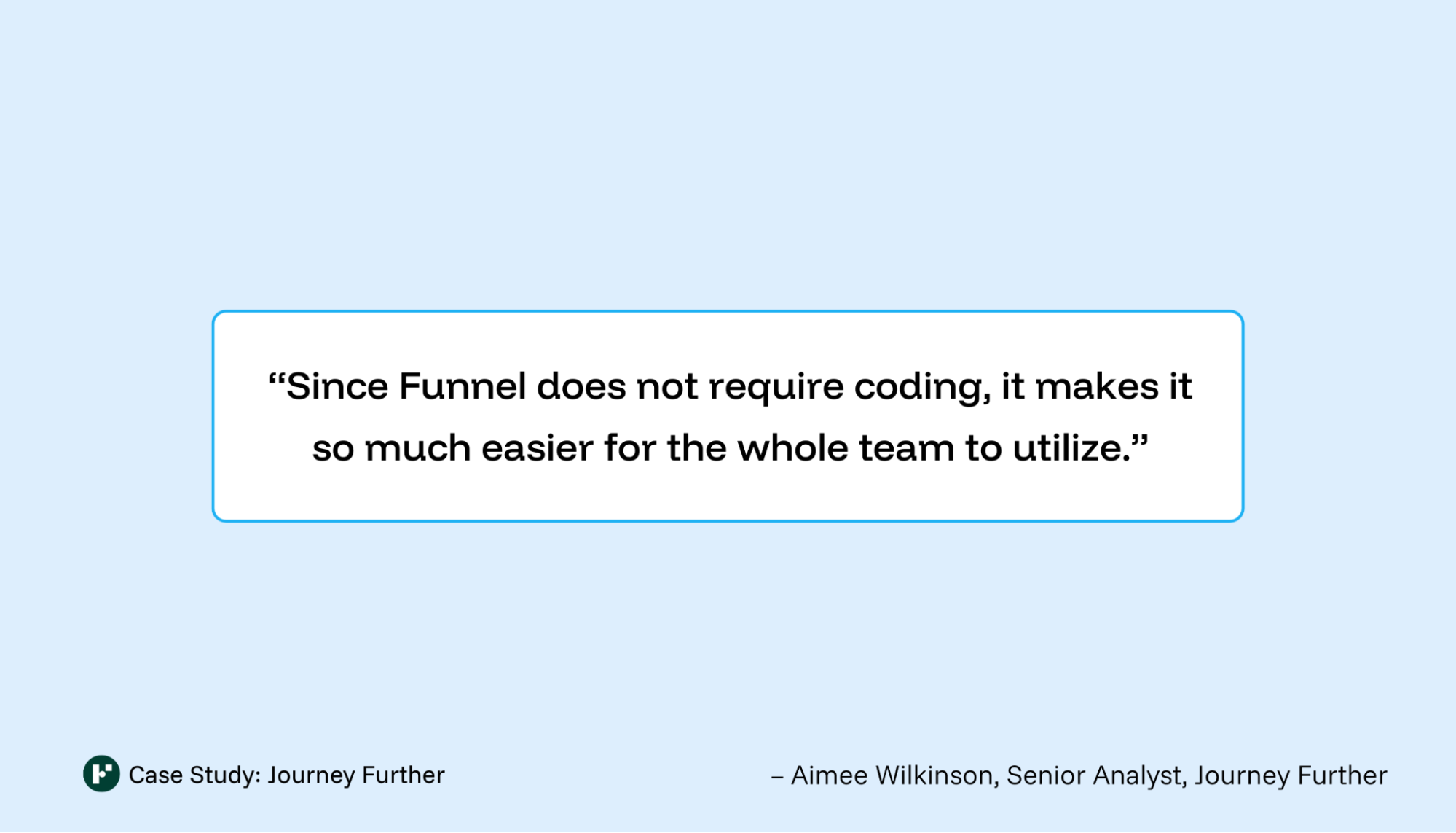
The crucial factor for most data teams is how quickly a platform moves data efficiently from source to the desired destination without breaking schemas. Funnel delivers that speed through automation and doesn’t require extensive coding knowledge, while Fivetran relies on SQL-based transformations.
Fivetran pipelines work well for data teams, but they rely on a warehouse-first process that adds friction for marketing users. If your workflow depends on fast insight and clean, structured data every day, Funnel delivers the reliability and clarity that your operations require.
These differences create the foundation, but the biggest gap shows up in how each platform handles real marketing workflows. The next section breaks down the core differentiators that matter for reporting speed, data quality and long-term scalability.
Funnel vs. Fivetran: Key differentiators in action
Each differentiator below reflects how the platforms perform in real workflows, not just on paper.
1. Marketers stay in control with true no-code ownership
One of the biggest pain points for data teams is the constant stream of small marketing requests. Someone needs to rename a campaign, adjust a conversion rule or add a new metric before the weekly report goes out. Those requests often require SQL edits or connector reconfigurations that pull engineers away from higher-value work.
Funnel removes that friction by giving business users direct control over ingestion, mapping, transformation and harmonization. The interface is entirely no-code, which means users can set naming rules, define channel groupings, align currencies and create calculated metrics without touching the warehouse.
Funnel’s connectors handle the complex field mappings and API changes that normally fall to engineering. Agencies can standardize logic across dozens of clients without rebuilding SQL models. Brand teams can update taxonomies or KPIs immediately when campaigns shift.
The impact is twofold. Marketers stay in motion because they don’t wait for technical fixes, and data teams spend less time managing low-value marketing tickets.
Fivetran, by comparison, handles transformations through SQL or dbt models in the data warehouse. Every adjustment, from naming updates to metric definitions, is handled through warehouse models and typically involves engineering or analytics teams. For fast-moving marketing environments, that dependency slows the reporting cycle and reduces agility.
2. Pricing reflects how marketing actually scales
Cost predictability is another major difference between the two platforms. Fivetran’s pricing model is based on usage. That makes sense for general-purpose ingestion, but marketing data doesn’t behave like a static database. Volumes fluctuate constantly as ad impressions, clicks and conversions scale with budget, seasonality and new campaigns.
Under a usage-based model, these fluctuations drive cost spikes that are difficult to forecast. A holiday campaign, a viral post or an expansion into a new region can double or triple row counts overnight. When that happens, teams face unexpected ingestion bills that throw off client margins or departmental budgets.
Funnel provides a solution that stays predictable as data integration processes expand across marketing channels. Agencies can forecast margins across clients without worrying that a high-performing campaign will eat into profitability. Brands gain stable budgeting for reporting and measurement even as they scale across new platforms.
The difference goes beyond accounting. Predictable cost structures encourage teams to collect more data and test new channels. When data is no longer a cost risk, it becomes an operational advantage. Fivetran’s variable model may fit general-purpose pipelines, but for high-volumes of marketing data, it adds unnecessary financial friction.
3. Data arrives structured for marketing analysis
Raw data may satisfy an ingestion requirement, but it rarely supports reliable reporting on its own. Marketing platforms all define metrics differently. A conversion in Google Ads doesn’t match a purchase in Meta, and a session in Analytics isn’t equivalent to an interaction in LinkedIn. Without harmonization, dashboards show conflicting numbers that erode trust.
Funnel solves this by standardizing metrics, dimensions, naming conventions and currencies at the point of ingestion. The platform applies consistent logic across every connector, producing analysis-ready tables that work immediately in BI tools like Looker Studio, Tableau or Power BI.
By the time data lands in the warehouse, it’s already clean and structured. Agencies reuse aligned schemas across all clients, removing the manual reconciliation that usually happens in spreadsheets or SQL scripts. Brand teams reduce reporting discrepancies because everyone works from the same definitions.
For data engineers, this means a steady flow of reliable inputs instead of a flood of raw, inconsistent tables. They can trust that marketing datasets will load correctly and feed into broader models without custom patches or cleanup.
Funnel also compresses datasets to remove redundant or empty fields, which improves query performance and reduces warehouse storage. Teams spend less time modeling and more time analyzing.
Fivetran, on the other hand, delivers raw source tables exactly as they appear in each API. Engineers typically build and maintain SQL or dbt transformations in the warehouse to make the data usable for reporting. Every schema change requires updates, testing and validation before data can be safely used for reporting.
The workflow impact is clear. Funnel shortens the path from collection to insight for marketing data. Reports are faster, dashboards are more accurate and teams gain confidence in the numbers driving their decisions.
4. Collaboration improves through stack fit and clean exports
In most organizations, marketing and data teams share responsibility for data quality. Marketing owns context, data teams own governance and infrastructure. Problems arise when tools blur those lines or create dependencies that slow one side down.
Funnel’s architecture is built to prevent that. Data teams stay in control of warehouse management, permissions and governance while marketing teams retain ownership of ingestion and transformation.
This separation of responsibilities keeps workflows independent but aligned. Engineers don’t need to maintain marketing connectors or transformation logic, and marketers don’t have to wait for pipeline updates or schema changes.
Funnel handles marketing-specific transformations upstream so data teams receive standardized tables they can model or audit as needed. The result is better alignment, shorter feedback loops and higher trust between teams.
Fivetran places transformation inside the warehouse itself. That approach centralizes control but creates ongoing engineering dependency for marketing updates. Every taxonomy change or metric tweak requires a new SQL commit. Over time, that slows delivery and increases risk when updates overlap with enterprise-wide data changes.
With Funnel, both sides get what they need. Marketing can operate at campaign speed, and data teams maintain a clean, governed warehouse without the maintenance overhead. It’s a true stack fit that supports collaboration instead of constraining it.
How these differences play out in real operations
When you look past the feature lists, the real distinction between Funnel and Fivetran is operational. Funnel fits into a marketing workflow where stability and speed are essential. It’s not a replacement for an ETL tool like Fivetran, which handles general enterprise ingestion. Rather, it’s an ideal complement that fits cleanly into a warehouse–centric stack and gives marketing a competitive advantage.
For agencies managing dozens of clients, these differences determine whether reporting happens on time or not. Schema drift or connector downtime in a general ELT tool can ripple across every dashboard in production. Funnel’s managed connectors, data normalization and Data Guarantee eliminate that risk by keeping pipelines stable even when platforms change.
Data teams that use both tools often integrate them side by side. Fivetran manages enterprise data sources like ERP systems, finance tools and product databases. Funnel handles all marketing sources, ensuring that performance data arrives unified, standardized and ready for use. This combination creates a clean boundary between domains, giving engineers fewer maintenance tasks and marketers faster, more accurate insights.
The collaboration benefit is especially clear in fast-moving businesses. When marketing data updates daily without engineering involvement, campaign optimization becomes continuous instead of reactive. Analysts spend their time interpreting performance, not fixing pipelines.
The bottom line
The differences between Funnel and Fivetran shape how teams work, how fast insights reach decision makers and how stable reporting stays under pressure.
Funnel’s no-code ownership reduces dependency on engineering. Its predictable pricing protects budgets as campaigns grow. Its standardized datasets ensure accuracy from the moment data lands. And its warehouse exports make collaboration simple for data and marketing teams alike.
Fivetran remains a strong tool for central ingestion and enterprise governance, but it demands more engineering time for marketing-specific use cases.
For organizations where marketing performance data drives business decisions, Funnel delivers the speed, reliability and predictability that make insight possible every day.
For agencies managing dozens of accounts, the impact is immediate. The next section looks at how Funnel helps agencies scale client reporting with speed, stability and predictable performance.
How Funnel helps agencies scale client reporting
Agencies live or die by their ability to deliver fast, accurate reporting across many clients. As accounts grow and platform data changes daily, the biggest challenge becomes scale. Spreadsheets break, APIs shift and engineering queues get longer. The difference between a team that scales smoothly and one that constantly scrambles lies in how stable their data pipelines are.
Scale client reporting without breakages
Every schema change, connector failure or API update risks downtime. For agencies managing dozens of clients, even a short outage can stall reporting cycles and damage client trust.
Funnel removes that risk. Its managed connectors and built-in data storage keep reporting stable even when source platforms change. If a client’s ad account disconnects or an API fails, Funnel preserves the last known good data so dashboards stay live and consistent.
Agencies like Arm Candy use Funnel to eliminate broken client reports entirely. Havas France runs more than 50 client datasets in parallel without disruption, allowing its analysts to work collaboratively instead of firefighting. On average, teams report saving up to 12 hours per week per analyst that would otherwise be lost to troubleshooting and rework.
Empower every account manager, not just engineers
With Fivetran, every adjustment to campaign names, channels or metrics needs SQL input. That dependency slows delivery and forces agencies to rely on limited technical resources for routine updates.
Funnel gives account managers and analysts control through a fully no-code interface. Users can set naming rules, build custom dimensions, harmonize channels and define metrics directly. Standardized templates keep logic consistent across all clients without involving engineers.
Journey Further saw the impact firsthand, saving more than 500 hours per month after switching to Funnel. Analysts now focus on interpreting performance, not maintaining pipelines.
Predictable pricing for scalable reporting
Fivetran’s usage-based billing grows with data volume, which means every successful campaign adds cost. Agencies can’t always pass those charges to clients, which eats into margins.
Funnel’s predictable subscription model scales cleanly. Agencies can onboard new clients or expand data sources without surprise cost jumps. Budgets stay stable even during high-volume campaign seasons, making long-term forecasting simple.
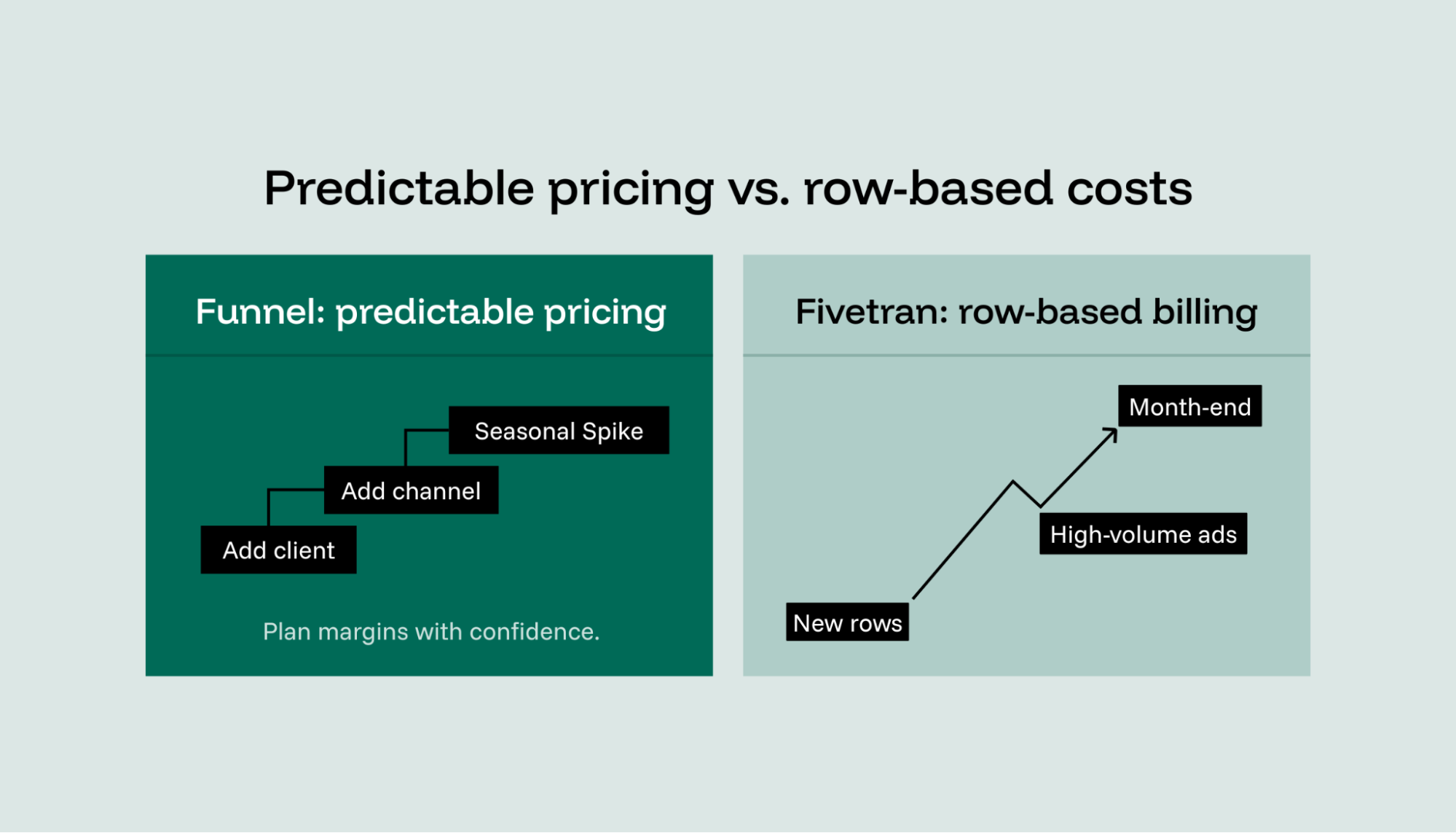
Agencies use Funnel to deliver stable, scalable reporting with more control over cost and cadence. The same principles apply to in-house marketing teams, too. The next section explores how Funnel helps brands move faster without IT dependency.
How Funnel empowers brands to move faster
Marketing teams often waste hours collecting data from multiple platforms or waiting for dashboards to refresh. Fivetran’s raw data delivery requires SQL models before marketers can use it, which slows action on performance trends.
Eliminate IT bottlenecks
Fivetran’s warehouse-first design slows marketers when they need quick changes. It depends on warehouse infrastructure, SQL transformations and engineering maintenance.
Funnel removes that dependency. Its no-code transformation layer lets marketers clean, map and harmonize data on their own. Updates to KPIs, metric names or campaign groupings can be made instantly without opening a warehouse ticket.
Babyshop’s marketing team used Funnel to take full ownership of data transformation, removing IT from daily reporting tasks. Elastic replaced manual data work with automated pipelines, cutting turnaround times and improving agility.
Move from manual data pulling to on-demand reporting
Fivetran’s raw data delivery means results must be modeled in SQL before marketers can use them. That extra step limits how quickly teams can act on performance trends.
Funnel automates ingestion, harmonization and delivery into analysis-ready datasets. Campaign data refreshes daily, giving teams a clear and current view across every channel.
Elastic moved from monthly reporting cycles to daily visibility using Funnel, while Digicel streamlined its performance tracking across markets through automated updates.
Unify cross-channel data for a single source of truth
Enterprise ELT tools often miss the long tail of marketing data sources. Fivetran focuses on general-purpose systems but lacks depth across niche ad platforms, leaving gaps in performance measurement.
Funnel connects more than 600 marketing, ad and analytics platforms, along with custom connectors for regional or specialized channels. Its normalization ensures every metric, dimension and currency aligns, giving brands one consistent view of performance across markets.
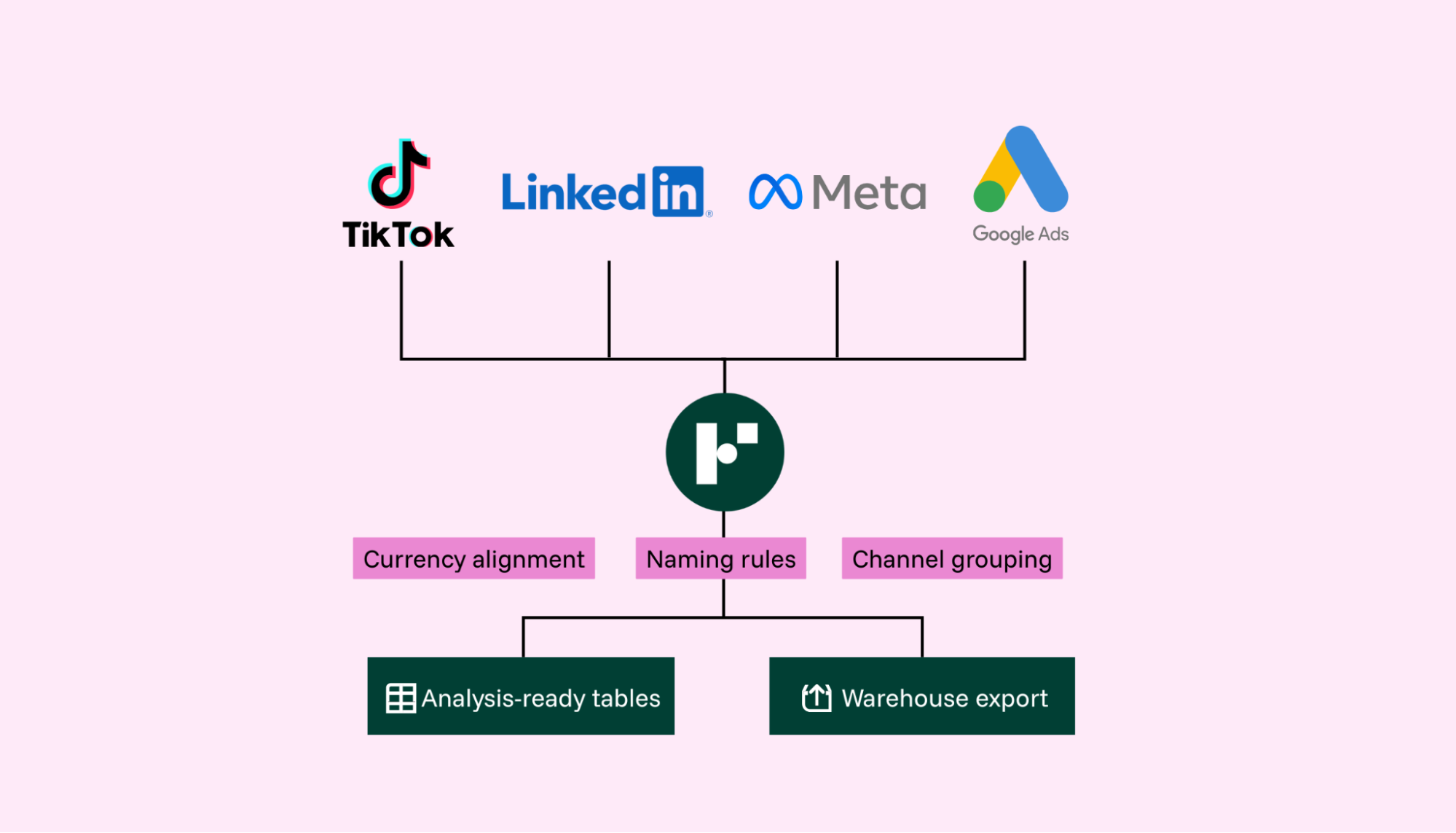
Trivago used Funnel to expand from 30% to 100% complete channel coverage by integrating smaller regional platforms that had previously been invisible in its reports.
Whether managing a global brand or a lean in-house team, the difference between Funnel and Fivetran comes down to autonomy and speed. Funnel gives marketers direct control of their data while remaining fully compatible with enterprise data stacks.
The next section shows how customers and G2 users rate both platforms in real-world use.
What users are saying: Funnel vs. Fivetran on G2
Real users show the clearest differences between the two platforms for marketing data integration. Across hundreds of verified G2 reviews, data and marketing teams consistently rate Funnel higher than Fivetran for usability, support and overall partnership quality.
Fivetran earns strong marks for enterprise-scale data engineering, but users often point to its technical complexity, inconsistent support and row-based pricing as barriers to agility. For many organizations, those issues make marketing data harder to maintain and more expensive to scale.
Funnel performs better where collaboration and clarity matter most. Data teams highlight its stability, predictable cost structure and strong connector management. Marketing teams value the speed and independence it brings to reporting without creating extra work for engineers.
On G2, Funnel outperforms Fivetran on data reliability, ease of setup, quality of support and product direction.
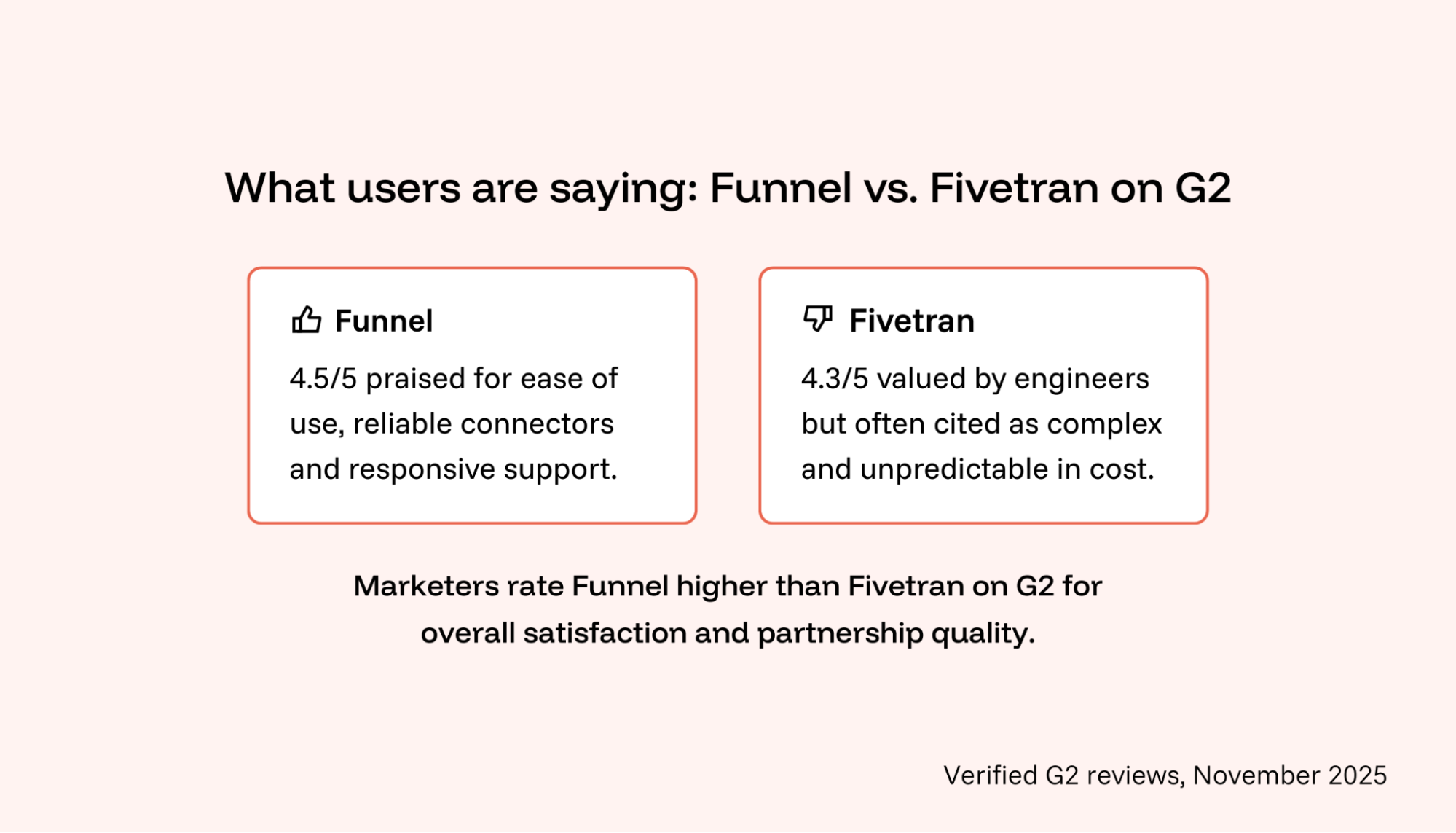
These ratings reflect day-to-day results for data teams responsible for marketing data. Users mention faster onboarding, simpler stack integration and fewer maintenance tickets. Data teams report stronger collaboration with non-technical business users because Funnel keeps pipelines clean and consistent without constant engineering oversight.
In a space crowded with general-purpose ELT tools, Funnel stands out because it reduces downstream complexity, ownership friction and cost volatility while still integrating smoothly into the warehouse.
Buyer FAQs
Does Funnel support BigQuery, Snowflake, Redshift and Databricks?
Yes. Funnel exports structured datasets to each, so data teams keep warehouse control.
How does Funnel handle API changes?
Managed connectors and a Data Guarantee preserve the last known good data, so dashboards stay live during incidents.
What’s the pricing model?
Predictable subscription not tied to rows. Costs don’t spike with campaign volume.
What’s the time to value?
Hours to initial datasets. No SQL modeling needed for core marketing reporting.
How do governance and lineage work?
Data teams control warehouse permissions, modeling and audit. Funnel delivers standardized inputs that fit existing governance.
When data stability drives marketing speed
High-performing marketing depends on clean pipelines that data teams trust. Funnel keeps marketing data stable, so reporting never stalls.
Fivetran was built for broad enterprise ingestion. Funnel was built to take pressure off data engineers by managing the most unpredictable part of the stack: marketing data.
With Funnel, data teams spend less time repairing connectors and managing schema changes and more time delivering analysis that drives strategy. Clean, normalized datasets and predictable pricing remove the guesswork from scaling marketing pipelines.
The result? Fewer maintenance tickets, faster delivery and complete trust in the numbers your business depends on.
See how Funnel keeps your data pipelines stable and your reporting future-proof. Book a demo today.