







AI has become the default answer to almost every marketing question in 2026. Need faster reporting? AI. Better attribution? AI. Smarter budget allocation? Also AI.
The enthusiasm isn’t entirely unfounded. AI has genuinely changed aspects of how measurement works. For instance, models run faster, platforms infer more and pattern recognition operates at a scale no analytics team could match manually.
That being said, enthusiasm has also created confusion. When every vendor claims AI has transformed measurement, it becomes harder to separate what’s structurally different from something that’s simply faster.
That distinction matters. Measurement is still where marketing earns or loses the trust of leadership. According to Funnel’s 2026 Marketing Intelligence Report, most in-house marketers still lack clear insights for making confident decisions, even with AI tools in the mix. The problem was never just speed. Rather, it was always about evidence, judgment and the data underneath.
Here’s what has actually changed with AI in marketing measurement, what hasn’t and why the difference matters.
What AI has actually changed in marketing measurement
AI’s impact on marketing measurement is real, but it’s more operational than philosophical. The core questions that measurement usually answers still remain unchanged; specifically, what’s working, what’s not and where the budget should go next.
What has changed, on the other hand, is the speed, frequency and scale at which teams can attempt to answer those questions. Let’s cover this in more detail.
Speed and scale of modeling
Marketing mix models (MMM) that once took months to build can now be rebuilt in days or weeks. Where there was once a bottleneck in feature engineering, variable selection and calibration steps due to human limitations, marketers can now use AI to accelerate and unblock the process.
Attribution models process larger volumes of touchpoint data and surface patterns across channels faster than manual analysis ever could. This means measurement can become more iterative than once-a-quarter exercises that arrive too late to influence live campaigns.
Expanded pattern recognition
AI excels at identifying correlations across large, high-dimensional datasets. It can spot patterns in the interactions between channels, creative formats, audiences and timing that would take an analyst team far longer to surface.
Platform algorithms now use machine learning to infer conversions and other marketing performance indicators, even when user-level tracking data is missing due to privacy restrictions. This modeling is necessary since it allows measurement to function in a privacy-restricted world. But it also means that more of what teams see in their reports is estimated rather than observed.
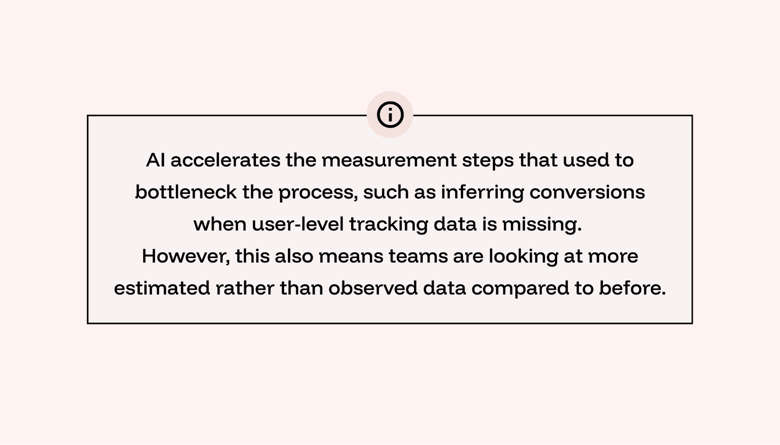
The shift toward modeled data has practical consequences. It makes cross-checking results across methods more important, not less. AI allows for faster modeling and pattern recognition, but its accuracy must always be checked.
How AI in marketing is reshaping attribution
Attribution was one of the first areas where AI replaced rules-based logic with data-driven approaches. Most major ad platforms now run some sort of machine-learning-based attribution as the default, including LinkedIn[c] and Meta.
The question isn’t whether AI improves attribution within a single platform, because it does. The question is rather whether that improvement translates to better cross-channel decisions, which is ultimately what should be driving your future campaigns.
Platform-side data-driven attribution
Google, Meta, LinkedIn and other advertising platforms now use AI to distribute conversion credit across touchpoints rather than relying on last-click or position-based rules. This is especially powerful for B2B brands, whose longer purchase cycles can make attribution trickier.
These models are more sophisticated than their predecessors, and they adapt as user behavior changes. However, each platform’s model still operates within its own ecosystem and reports results using its own definitions. Those definitions will change depending on who you’re speaking to.
As such, the fundamental problem remains. When you sum platform-attributed conversions across channels, the total often exceeds what actually happened in the business. Unfortunately, this is the rule, not the exception. According to Funnel’s 2026 Marketing Intelligence report, 86% of in-house marketers and 79% of agency marketers struggle to determine the impact of each marketing channel on overall performance.
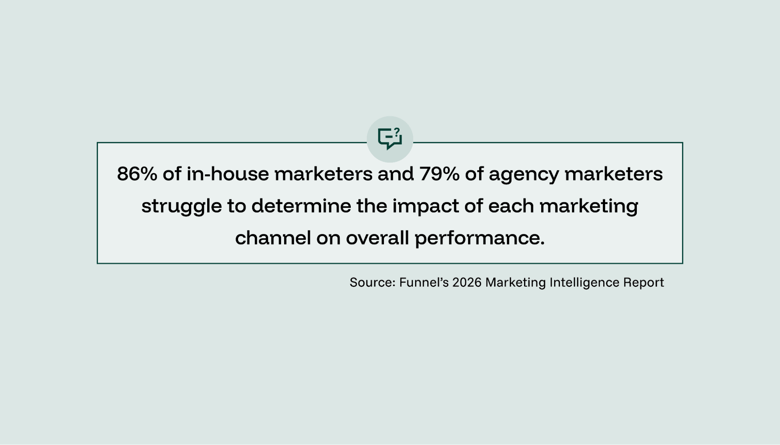
As of 2026, AI-powered attribution alone hasn’t solved this problem.
What AI-powered attribution still can’t do
Currently, even AI-powered attribution isn’t a suitable marketing measurement tool when used on its own. AI-driven attribution within a platform can optimize relative performance inside that channel, but it can’t judge performance across channels.
Plus, it still operates on observed or modeled click and impression paths. This means it undervalues channels that influence decisions without generating trackable interactions. Examples of such zero-click interactions include brand campaigns, connected TV and word of mouth.
It’s also important to note that attribution, even AI-enhanced attribution, assigns credit to a conversion, but it doesn’t prove causation. This is why teams eventually need to move beyond attribution alone and combine it with broader measurement approaches.
AI and marketing mix modeling
Marketing mix modeling (MMM) has seen one of the clearest benefits from AI, and it’s experiencing a resurgence partly because it helps mitigate signal loss. AI allows for an accelerated model build and improved variable selection, making it more feasible for mid-marketing teams to run MMM. This means that for the first time, MMM is no longer just accessible to large enterprises with dedicated data science departments.
But AI hasn’t eliminated the need for the judgment calls that make or break a model. Let’s cover what AI can and cannot do within the context of MMM.
Faster model builds and more frequent updates
Open-source tools like Meta’s Robyn and Google’s Meridian have lowered the barrier to entry for MMM. Now, smaller teams can leverage this marketing measurement tool.
AI-driven automation handles steps like hyperparameter tuning and adstock transformation, which previously required significant manual effort from data scientists. As a result, teams can now update models more frequently, potentially shifting from quarterly refreshes to monthly or even ad hoc cycles.
This higher refresh rate means MMM outputs can inform active campaign decisions rather than only serving as retrospective planning inputs. The role of MMM in your campaign planning has the potential to become bigger if you believe your team is ready for it.
Why human judgment still sets the parameters for data analysis
Marketing mix modeling works on aggregate time-series data. Because of this, the model is only as reliable as the assumptions baked into it. And there’s no such thing as a model without any built-in assumptions, no matter how unbiased a team may think they are. What analysts and marketers need to account for is that AI itself is far from unbiased.
AI allows humans to test more variable combinations faster, but a human still needs to decide:
- Which variables to include
- How to define a conversion
- What time period to model
- How to interpret the results
For example, a model can tell you that paid social contributes 8% of revenue, but it can’t tell you whether that contribution reflects a healthy strategy or one that is overspending past the point of diminishing returns. That conclusion is only possible with a human who understands the business context because a different context can change the answer drastically.
Funnel’s 2026 Marketing Intelligence Report found that only 15% of marketers have advanced skills in marketing mix modeling. However, 70% of marketers want to improve.
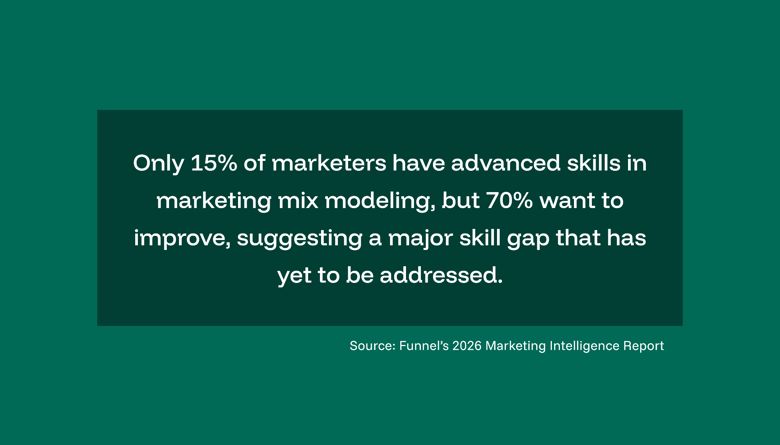
This shows that the technology is more accessible, but there’s still a significant skill gap. Without fixing that skill gap, technology may speed up your progress, but it can lead you down the wrong path entirely.
Agentic AI in marketing and the data foundation it depends on
In 2025 and 2026, the conversation has shifted from generative AI and natural language processing to agentic AI and how agents can help with everything from predictive analytics to creating social media posts.
The main difference with agentic AI is that these systems don’t just generate content or insights. They also take actions, make recommendations and execute decisions with increasing autonomy.
In measurement, this could look like automated budget reallocation, real-time model updates or AI agents that flag anomalies and suggest next steps without waiting for a human analyst. The promise is significant, but agentic systems inherit whatever flaws exist in the data they operate on, including issues with data hygiene.
What agentic systems need to function reliably
Agentic AI requires a shared semantic layer to function in the way you expect it to. The system must understand what terms like ‘conversion,’ ‘upper funnel,’ ‘revenue’ and ‘channel’ mean for a specific organization. Without this shared semantic layer, an AI agent might confidently reallocate budget based on a mismatched definition of what counts as a qualified lead versus a raw form fill.
This is the ‘confidently incorrect’ problem described in more detail inside Funnel’s 2026 report. Unfortunately, AI, even agentic AI, doesn’t resolve ambiguity in business logic. Instead, it automates and scales it.
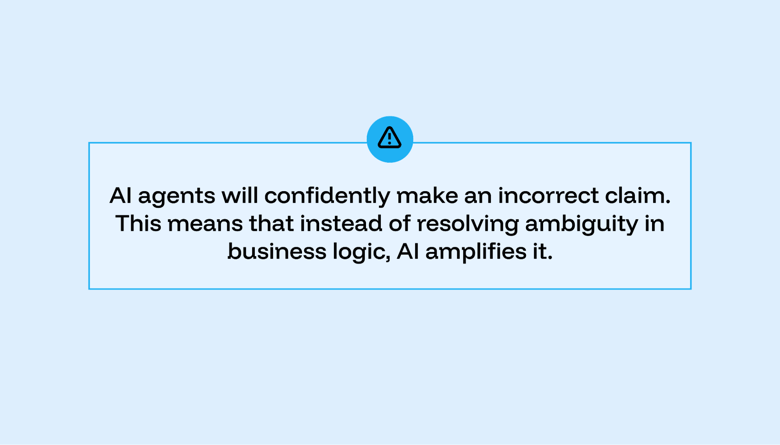
For example, if ‘lead’ means different things across your CRM, your ad platform and your analytics tool, AI won’t correct that discrepancy. It will just scale the inconsistency until the term ‘lead’ is virtually meaningless.
Get clear on your semantics, and make sure this clarity is reflected in any agentic AI tool you deploy across your campaigns and measurement.
Data hygiene should be a prerequisite, not an afterthought
According to Gartner research, poor data quality costs organizations an estimated $12.9 million per year on average. Funnel’s 2026 report shows that only 33% of in-house marketers invest in structured data and metadata. But structured data and metadata are critical when using AI for measurement. They’re the foundation that artificial intelligence marketing systems rely on to generate trustworthy results.
For agentic AI to deliver on its promise in measurement, teams need clean, governed data where:
- Definitions stay consistent across systems
- Naming conventions are standardized across the entire organization
- History remains preserved
A marketing intelligence platform addresses this by normalizing metrics, currencies and naming conventions across platforms automatically. As a result, the data is clean before AI ever touches it.
What AI marketing tools don’t solve
AI hasn’t solved some of the core issues that exist in marketing measurement. These issues aren’t limitations that a better model or more computational power can fix. Rather, they’re structural features that require deeper solutions.
Let’s cover these limitations as well as how to best handle them.
Causality, business context and strategic tradeoffs
One of AI’s strengths is its ability to identify correlations with impressive speed, but correlation is not causation. Knowing that two variables move together doesn’t tell you whether one caused the other or whether a third factor drove both. And adding AI to the mix won’t magically provide the answer.
Instead, proving that a specific marketing investment caused an incremental lift in revenue still requires controlled experiments, such as incrementality tests. Those types of tests require human planning, clean execution and patience for results to emerge. In this case, AI cannot speed up the time it takes for those results to come through.
AI also lacks business context. It won’t know that your CEO just announced a pricing change, that a competitor launched a new product last week or that seasonality in your industry works differently than what historical data suggests.
These contextual factors shape how results should be interpreted, and they’re precisely the kind of judgment that experienced, human marketers bring to the table. Even the most powerful AI models with the largest context windows cannot currently surpass a human’s ability to understand background context.
The trust and culture problem
One of the most persistent measurement challenges isn’t technical. It’s organizational. Funnel’s report found that 47% of in-house marketers find it difficult to keep up with data-driven aspects of their work. Moreover, 56% of them don’t feel empowered to experiment with new approaches.
AI can’t fix a culture where teams are afraid to test, where reporting exists to justify past decisions rather than inform future ones or where marketing and finance don’t share definitions of success. In addition, only 13% of marketers say continuous review and refinement is embedded in their company culture.
These are issues that need to be addressed at their root, and these have nothing to do with your tech stack. AI can surface better answers faster, but if the organization isn’t structured to act on those answers, the speed is wasted.
Why triangulation still matters in an AI-powered world
If AI made one method of measurement perfect, you wouldn’t need the other methods. But no single method captures the full picture, even with AI enhancements.
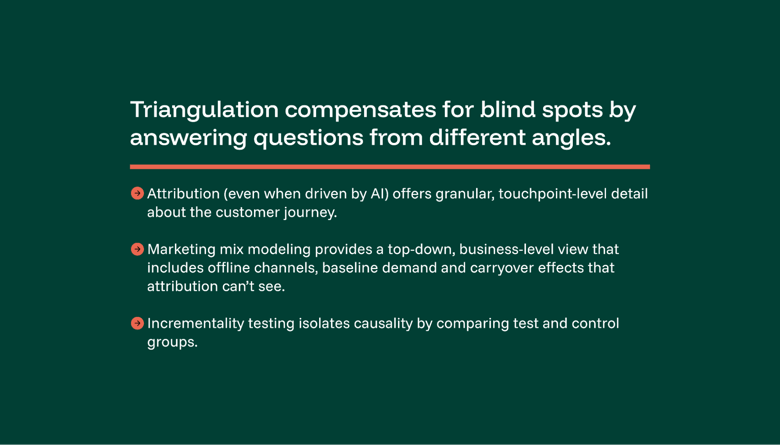
Triangulation — combining attribution, marketing mix modeling and incrementality testing — remains the most robust approach to measurement because each method compensates for the blind spots of the others.
Each method in triangulation answers a different question
Attribution, even when driven by AI, offers granular, touchpoint-level detail about the customer journey. This is useful for optimizing within channels and understanding which creative or audience segments perform best.
Meanwhile, marketing mix modeling provides a top-down, business-level view that includes offline channels, baseline demand and carryover effects that attribution can’t see.
Finally, incrementality testing isolates causality by comparing test and control groups. This last piece of the triangulation puzzle is the most rigorous way to validate whether a channel or campaign actually drove results or simply captured demand that would have happened regardless of the campaign taking place.
AI makes each of these methods better and faster, but it doesn’t eliminate the need to cross-reference them against each other.
Cross-checking AI outputs with human expertise
When attribution says paid social drove 40% of conversions, MMM says it contributed 15% and an incrementality test shows a 8% true lift, triangulation helps reconcile those numbers into a decision-grade estimate. AI can accelerate the generation of these outputs, but the reconciliation requires judgment from a real person.
Human judgment allows you to understand why the numbers differ and which estimate best reflects reality, given the current conditions. So, where artificial intelligence can help run the model, it’s human intelligence that interprets what it means and decides what to do next.
Platform-reported metrics only tell one part of the story, which is why cross-channel measurement and a unified data foundation both matter. Teams using a marketing intelligence platform that offers unified marketing measurement (UMM) can compare performance, pipeline influence and revenue impact across channels in a single view rather than toggling between disconnected dashboards.
The risk of over-reliance on AI in measurement
AI confidence isn’t the same as AI accuracy. And the gap between the two is where the most expensive mistakes happen. Funnel’s 2026 report highlights this dynamic.
Unfortunately, AI systems can return very self-assured answers that, when examined against actual data, tell a very different story. This is why over-reliance on AI-generated measurement creates several specific risks.
Optimizing towards the wrong signals
Automated bidding and AI-driven campaign optimization will optimize toward whatever signal they receive. But if that signal is noisy, inconsistent or misaligned with actual business value, the system optimizes in the wrong direction.
But that’s not all. Not all conversions are equal, and treating them as equals trains algorithms on the wrong objectives.
Improving signal quality through clean data, consistent definitions and reliable server-side tracking can improve marketing performance by more than 15%, according to industry research cited in Funnel’s report. Clean data isn’t just a nice-to-have, but can make a huge difference in revenue and campaign performance, which only becomes greater as you use AI to scale.
Losing the ability to question results
When AI generates a recommendation, but the team doesn’t have the skills or the culture to push back or analyze this recommendation with the right judgment, decisions go unchallenged. This is why the most effective measurement setups use AI to generate hypotheses and human expertise to validate or disprove them.
Marketers who treat AI-powered measurement as a black box risk repeating the same mistake that plagued last-click attribution. They also risk accepting a simple answer because it’s available, not because it’s right.
On the other hand, the marketers who’ll get the most from AI and marketing measurement are those building solid foundations now. The best way to build these solid foundations is through unified data and transparent measurement, and by investing in teams that know how to question, validate and act on what AI surfaces.
Leverage AI in your measurement strategy without losing control
AI has made marketing measurement faster, more accessible and more responsive. Models that once required dedicated data science teams now run on open-sourced frameworks. Attribution adapts in real time. Pattern recognition scales across channels and markets in ways no manual process could ever hope to match.
None of that changes the fundamentals. Measurement still depends on clean, governed data. It still requires triangulation across methods, because no single model captures the full picture. And, it still demands human judgment in order to set the right parameters, interpret results in context and decide which tradeoffs are worth making.
The teams getting the most from AI measurement aren’t the ones automating everything. Rather, they’re the ones investing in their data foundation, building measurement literacy across the organization and treating AI as a powerful tool that works best when someone qualified is watching the outputs. The combination of better tools and better judgment is what separates confident decisions from confident mistakes.