



 Get in touch
 Log in




Do you ever look at your marketing data and think, “How did it get this messy?” New channels keep getting added, and dashboards seem to multiply. Yet most teams are still working with tools built for a much smaller, slower and simpler world. When your data is scattered or inconsistent, even the best AI tools can’t help. Machines misread context, fill in the gaps and create more noise than clarity.
Most teams are rethinking their entire stack because they need a better data foundation. That’s the only way the core jobs of modern marketing actually work together: measurement, reporting and activation. A marketing intelligence platform brings those pieces into a single flow through effective data integration. You pull data in once, trust it, report with confidence, understand what drives performance and turn those insights into action without stitching together a pile of fragile tools. It can create a cleaner starting point and a faster path to meaningful results.
Now, marketing intelligence is moving into an AI-native phase, with early agentic capabilities helping teams plan and work through complex decisions, leading to more focused data-driven decisions. Agents won’t replace marketers, but an agentic landscape does give us guardrails, quicker answers and a much stronger chance of protecting budgets in a market where every decision is under scrutiny.
By the end of this article, you’ll see why this change in marketing intelligence is happening now, how your competitors are already modernizing their stacks and why waiting too long will leave your team at a disadvantage.
The evolution of marketing data and analytics tools
Marketing teams didn’t land in today’s complexity overnight. The tools they use now came from a long chain of fixes, each one built to solve an immediate problem but never the whole picture.
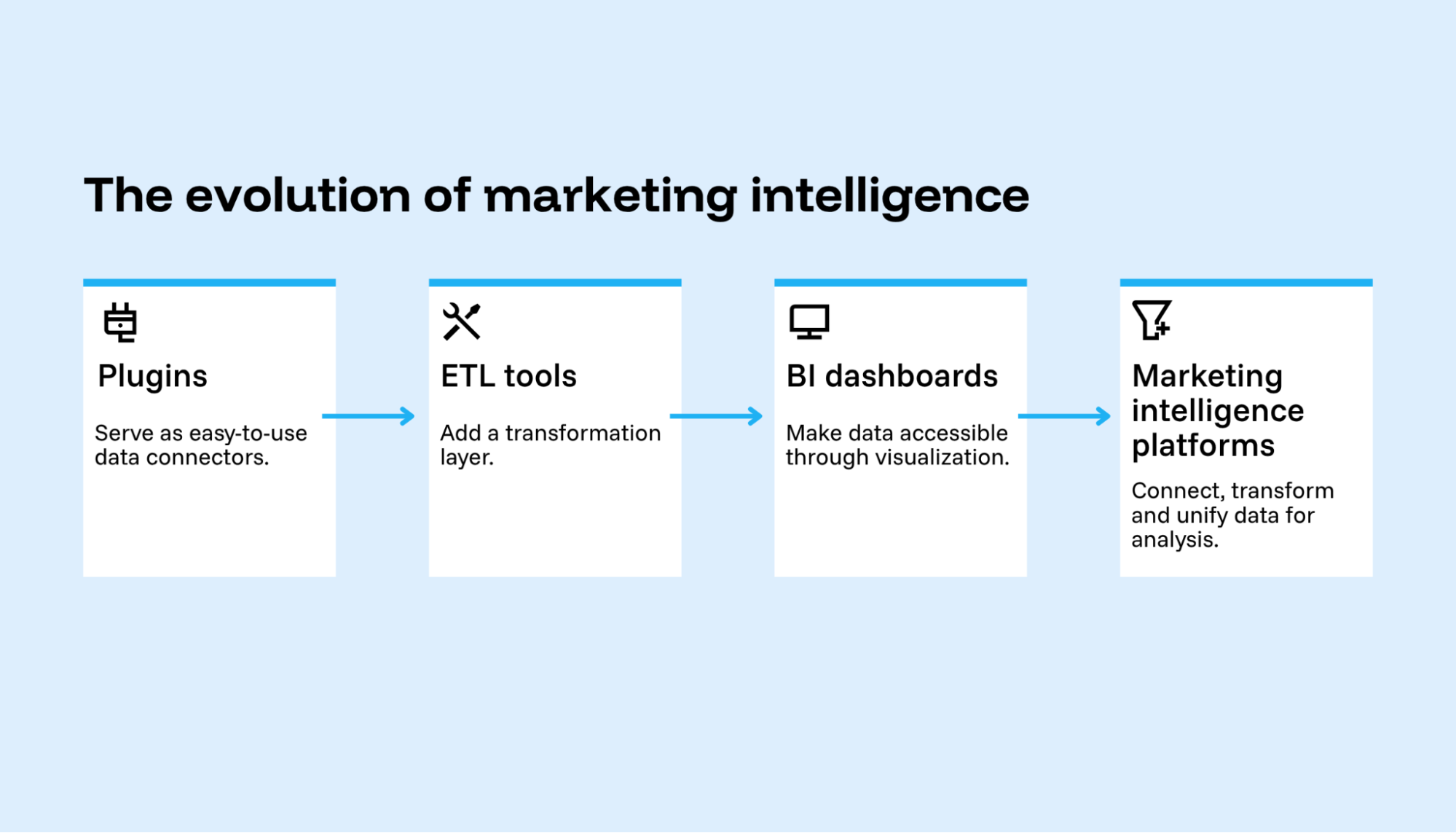
Understanding how we got here explains why so many teams are now stuck with a patchwork of plugins, pipelines and dashboards that can’t keep up.
The spreadsheet and plugin era
Most teams started where everyone else did: Excel. For the first time, marketers could dig into performance data after it was imported via a plugin, including insights from Google Analytics, without waiting on another department.
It felt empowering until the spreadsheets multiplied. Broken formulas, version issues and dozens of slightly different files turned quick analysis into a constant clean-up job. Data lived everywhere and nowhere at once, and nobody agreed on which numbers were “right.”
First-generation business intelligence (BI)
To fix the chaos, companies introduced heavier systems that could move data from source to warehouse. These early ETL and data-management tools were powerful, but they came with a cost. They sat inside broader business intelligence projects, which meant IT controlled everything. Marketing teams waited in line for access, changes took weeks and the insights arrived long after decisions were made. Speed became the tradeoff for structure.
The self-service revolution
As the next wave of tools arrived, things finally felt more open for marketers. Platforms like Tableau, plus a growing set of data connectors, meant you could build reports yourself instead of waiting on a developer. It was a big step forward, but with it came another mess. One tool handled charts, another pulled the data, something else transformed it and you crossed your fingers that none of those connectors failed overnight.
The stack became more flexible, but also more fragile, and noticeably more expensive to keep running. So, naturally, the market started moving to meet the evolving needs of marketers.
The market is moving
If you pay close attention to how vendors talk about themselves, you’ll notice something interesting. The tools that spent years calling themselves connectors, data integration solutions or ETL pipelines no longer use those terms. They now describe themselves as “marketing intelligence platforms,” not because the technology transformed overnight, but because the market around them has. Teams have outgrown point solutions, and the vendors who built those tools can feel the pressure.
This change didn’t appear out of nowhere. It showed up the moment teams realized that stitching together half a dozen tools only works when the data is small, the campaigns are simple and nothing breaks. Once the stack grows, connectors fail, dashboards fall out of sync and someone spends every Monday morning hunting down mismatched numbers. Leaders lose confidence, reporting slows down and the gap between what marketing needs and what the current stack can deliver widens.
You can see that tension in how major players are repositioning. Supermetrics, Adverity and others have rewritten their messaging to focus on marketing intelligence. However, the companies that rely on them are hitting a ceiling the moment their spend scales or their client list expands. A connector can move data, but it can’t support advanced measurement, activation or multi-market complexity. Rebranding as a platform is an attempt to match the expectations modern teams now have for their data.
Even enterprise giants like Salesforce are revising their analytics story because customers want unified intelligence rather than a toolkit that only fits together with heavy configuration and constant upkeep. When companies of that size start to adjust course, it’s a sign the market has already moved.
And this is what your competitors will respond to. They’re not upgrading their stack for the fun of it; they know that the teams that modernize now will spot patterns sooner, make decisions faster and defend their budgets with more confidence.
Why this shift is happening now
Marketing teams have reached a point where the pressure on data has outpaced the tools built to manage it. Leaders need clarity, consistency and defensible measurement, yet most stacks still rely on fragile connectors and manual fixes.
The moment you add more channels or try to prove ROI at a deeper level, the whole system strains. To understand why the stack is cracking now, we need to look at the three forces that have collided to create this breaking point.
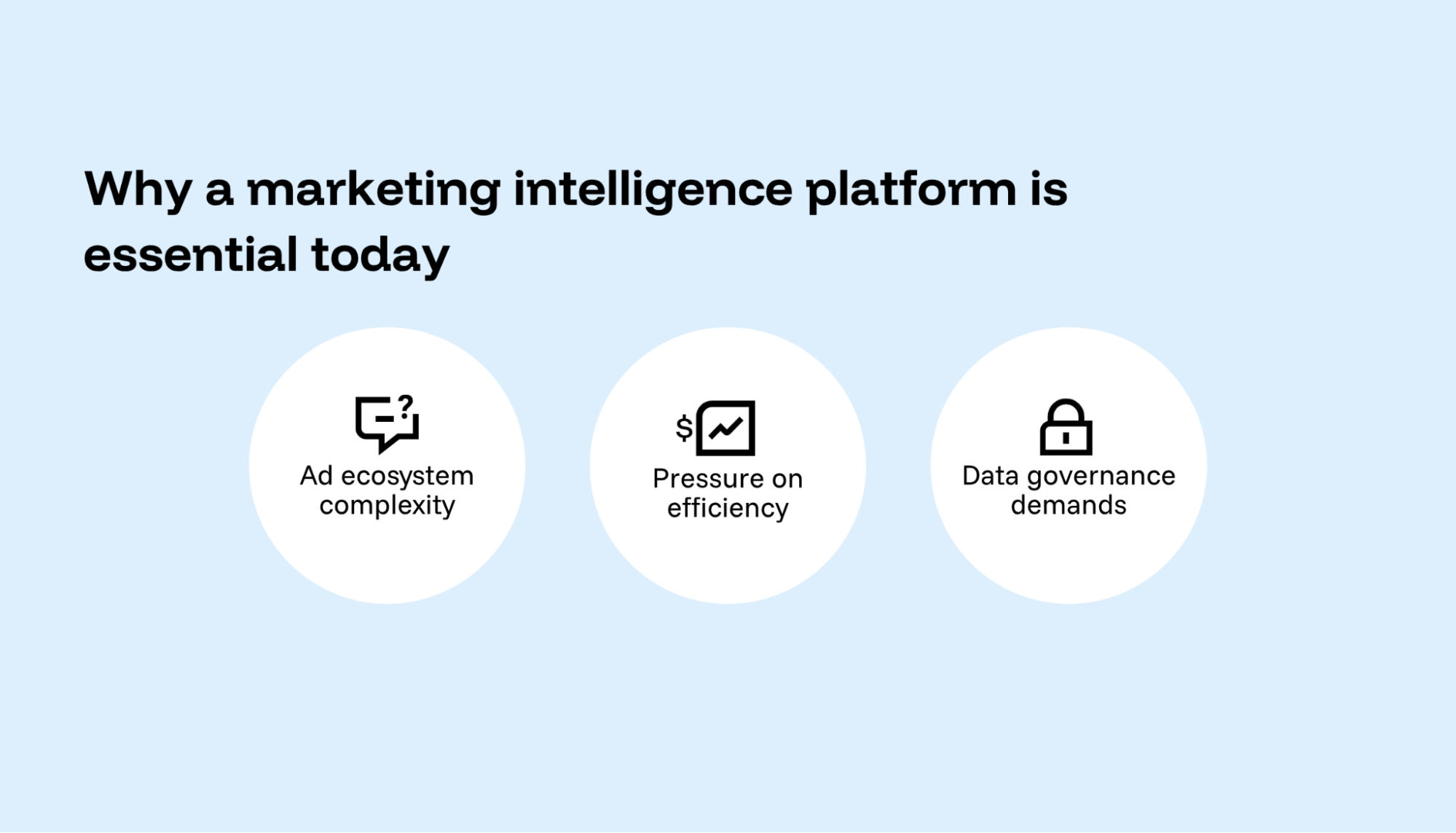
Increased complexity, the pressure to increase efficiency and data governance demands are forcing marketers to evolve beyond plugins and ETL pipelines and to build a future-proof foundation that powers AI and agentic marketing intelligence.
Ad ecosystem complexity
Modern marketing doesn’t operate on a small set of predictable channels anymore. Budgets span dozens of platforms with their own APIs, naming conventions and quirks. Each one introduces a new layer of reporting logic that rarely aligns with the others, and every mismatch creates another place where insights slow down or drift off course.
When teams rely on isolated tools to keep everything consistent, they spend more time reconciling numbers than interpreting them. The question goes from “how did we perform?” to “why doesn’t this match?”
Intense pressure on marketing efficiency
At the same time, marketing efficiency has become a defining expectation. You’re expected to explain exactly how your budget is performing, yet half the battle is getting clean, reliable data to begin with. And because customer journeys today are anything but straightforward, simple attribution won’t get you there.
You need to see how your choices translate into real outcomes. When your stack can’t support that, it becomes a lot harder to trust your reporting and a lot easier to end up reacting rather than planning.
Data governance and privacy demands
Layered on top of everything is the responsibility to manage data properly. Regulations like GDPR and the shift away from third-party cookies have made governance an essential part of marketing operations.
When data lives across disconnected tools, it becomes much harder to enforce consistency, document transformations or control who sees what. Every new export or manual fix increases the risk of errors and makes data management more time-consuming than it should be.
A marketing intelligence platform enables teams to unify data, increase clarity and automate data governance. It supports all the jobs marketers are doing today and will be doing in the future, with data integration, marketing reporting, measurement, data activation, media planning and more.
What defines a true marketing intelligence platform?
“Marketing intelligence platform” gets thrown around a lot, yet only a small number of platforms actually meet the standard. A complete marketing intelligence system supports the full marketing data and analytics lifecycle in one stable environment, so teams don’t have to stitch together fragile tools or rely on manual fixes.
The easiest way to understand what a real marketing intelligence platform looks like is to explore the pieces it needs to get right.
1. Comprehensive data coverage
A marketing intelligence platform needs to pull in data from every source marketers rely on, not just the major ad networks. That includes analytics platforms, CRMs, subscription tools, ecommerce systems and offline files. Partial data leads to partial insights, and partial insights don’t drive confident decisions. Coverage is the foundation that everything else sits on.
2. Automated data transformation
Raw data rarely lines up across channels. A real platform handles the cleaning and harmonization automatically, so teams aren’t stuck fixing naming issues, mapping metrics or stitching exports together. It standardizes terms, folds similar metrics into shared structures and produces a single analysis-ready dataset without extra work.
3. Integrated measurement
Understanding what actually drives growth requires more than surface-level attribution. A true platform includes measurement capabilities such as marketing mix modeling and multi-touch attribution so teams can analyze campaign performance, incrementality, cross-channel influence and changes in spend in one place. You shouldn’t need a second vendor to understand your ROI.
4. Built for scale
The platform must be able to handle large data volumes and complex accounts without slowing down or breaking. Managed APIs are important here. They keep data flowing even when a source changes its structure or introduces rate limits, which prevents the outages that happen with lightweight connectors.
5. Reliable data export and activation
Once the data is transformed, teams should be able to send it to any destination (warehouses, visualization tools, media platforms or AI systems) without loss or degradation.
That includes sending first-party conversion data back to ad platforms to help the algorithms improve bid decisions and target the right audience automatically. A true platform treats activation as a first-class capability, not an afterthought.
6. Usable by everyone
Finally, the system must work for marketers and data teams. Marketers need a no-code interface that lets them explore and adjust their data, while analysts need deeper controls. When both groups can operate in the same environment, reporting becomes more consistent, and collaboration becomes easier.
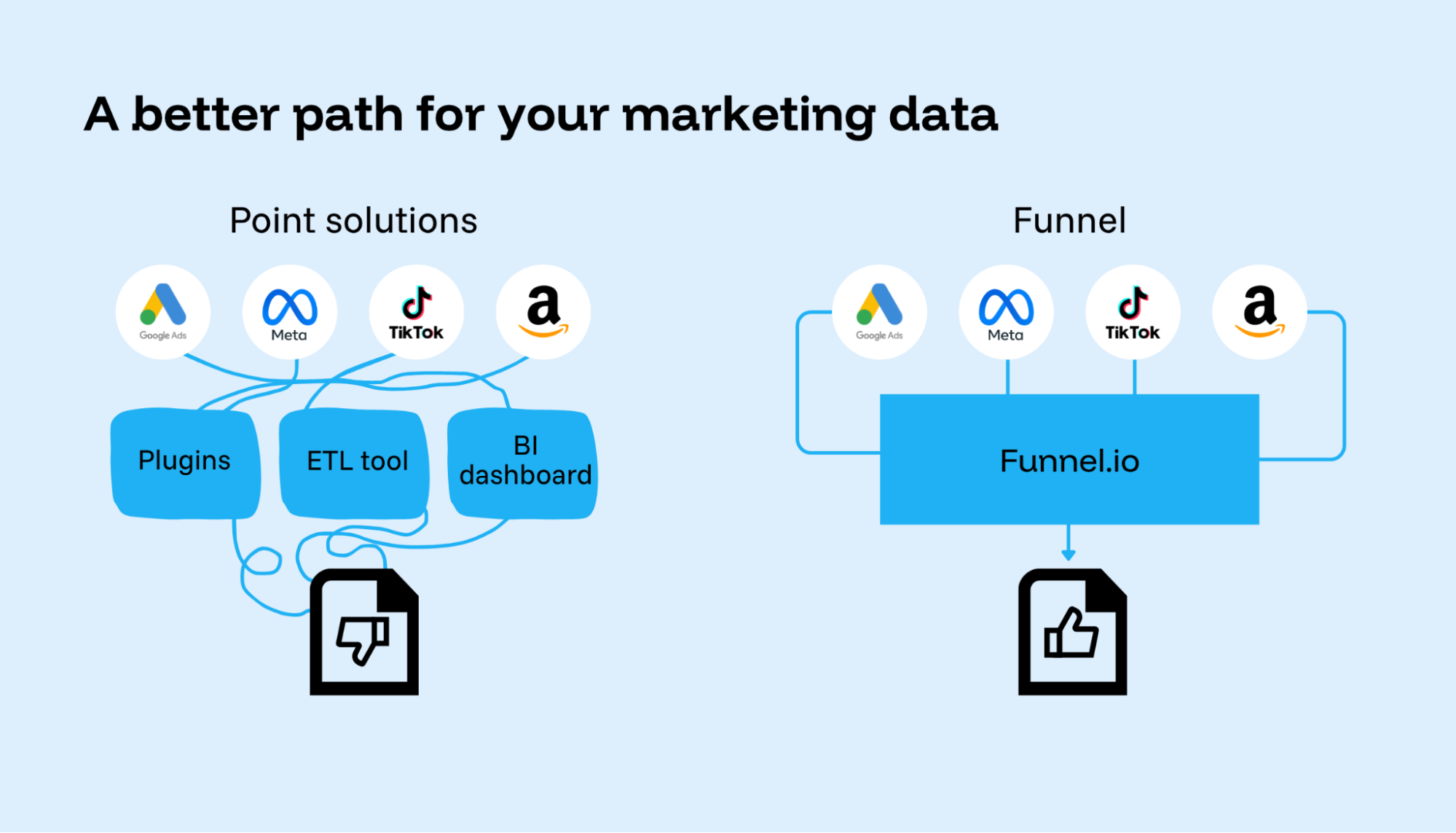
How Funnel delivers on the promise of marketing intelligence
Those pillars sound neat in theory, but they only matter if a platform actually does the work. This is where Funnel earns the “marketing intelligence” label in practice.
Bridges marketing and data teams
Funnel gives marketers a no-code way to work with their own data, while still giving data teams the control they need. At Power Digital, that bridge changed the day-to-day reality of the analytics team. They went from fixing broken Google Sheets reports to building a proprietary analytics platform on top of Funnel.
Associate Director of Business Analytics Mattan Romano puts it simply: “The best thing about Funnel in my day-to-day is that it allows me to execute on everything by myself. I don’t need to ask anybody for help. It makes me a data engineer. Even though I’m not an engineer.”
That is what “usable by everyone” looks like when you zoom in.
Handles scale without breaking
Arm Candy felt the pain of scale first-hand. Their reporting lived on Supermetrics, feeding huge Sheets files, and as accounts grew, the whole setup started to fall over: timeouts, missing history, broken formulas, clients staring at broken dashboards.
After moving to Funnel, they saved about 12 hours a week on reporting and improved their data management, which virtually eliminated broken customer-facing reports. Funnel now sits under their upcoming media planning tool, Cyris, because they trust it to keep data flowing even when sources change.
Provides comprehensive coverage
Before any analysis can even happen, you need the data to show up in one place without gaps. That’s where Funnel’s coverage connects to more than 500 sources, including the long-tail and niche platforms that usually get pushed into manual uploads or forgotten exports.
When everything flows in automatically, the picture you’re looking at isn’t just the big ad networks and whatever someone had time to pull last week. It’s the full story, gathered the same way every time, which gives every insight that follows a stronger footing.
Offers integrated measurement
And once your data is actually in good shape, Funnel’s measurement layer kicks in. Instead of running models on a mix of exports and patched-together inputs, everything pulls from the same cleaned data hub. That gives marketing mix modeling, multi-touch attribution and incrementality testing a steadier foundation to work from, so the results don’t feel like they’re coming from three different worlds.
From there, you get something else teams usually don’t have: room to explore. The scenario planner lets you test budget shifts before you commit to anything, which makes the planning process feel less like guesswork and more like a safe way to understand your options. It’s a much sounder way to make decisions when everything else around you is moving fast.
Preparing for AI-native marketing workflows
And once the core pieces are in place, the role of AI starts to make more sense. A lot of the excitement around marketing AI centers on instant insights and agent-like workflows, but none of that holds up if the data underlying it is messy or inconsistent. AI is only as good as the data and structure you feed it, which is why the foundation matters more than the features layered on top to implement an effective strategy.
With Funnel, that foundation is already there. The same cleaned, harmonized data hub that powers reporting and measurement also supports the new conversational analytics features we’re rolling out, along with the machine learning capabilities built into our advanced measurement suite. As the industry moves toward more agentic, AI-native ways of working, having a stable, trusted data layer gives teams space to adopt those tools with confidence instead of hoping the system guesses correctly.
Taken together, this is how Funnel delivers on the promise of a true marketing intelligence platform rather than just renaming a connector or dashboard.
Modernize your marketing data and analytics with Funnel
The days of juggling connectors, scattered exports and constant fixes are coming to an end. Modern marketing has too many moving parts and too much pressure for teams to rely on tools that only cover one part of the workflow. You need a system that pulls everything into one place, keeps it clean, measures what matters and sends it wherever it needs to go without slowing you down.
The teams that modernize early get cleaner insight, steadier reporting and a clearer view of what actually drives growth. The ones who wait often don’t notice the cracks until they’re too deep to ignore.
If you’re starting to feel those pressures in your day-to-day, this is the moment to look at what a proper marketing intelligence platform can do for you.
Funnel gives you the foundation to work with confidence instead of patching things together. When you’re ready, see what your data looks like in Funnel.