






Paid social conversions are down 30% week over week, but nobody's changed anything. You double-check spend, creative and audience targeting. Everything's as it should be, until you find a connector stopped pulling data from one of your ad platforms two weeks ago.
Marketing data connectors are software that pulls data from platforms like Google Ads, LinkedIn Ads or Meta and delivers it somewhere you can use it, like a reporting dashboard, BI tool or spreadsheet.
But the trick is that a connector isn't really just a plug between two software platforms. It's a piece of infrastructure that determines whether your marketing data is trustworthy. And when they break (which they do all the time), you don't get an error message.
You get the wrong answer.
What is a marketing data connector?
Marketing data pipeline connectors are a piece of technology that allows data to flow from one point to another.
The connector automatically pulls data from a marketing platform such as Google Analytics, Meta Ads or an email tool, and delivers it to a destination like a dashboard, spreadsheet or data warehouse.
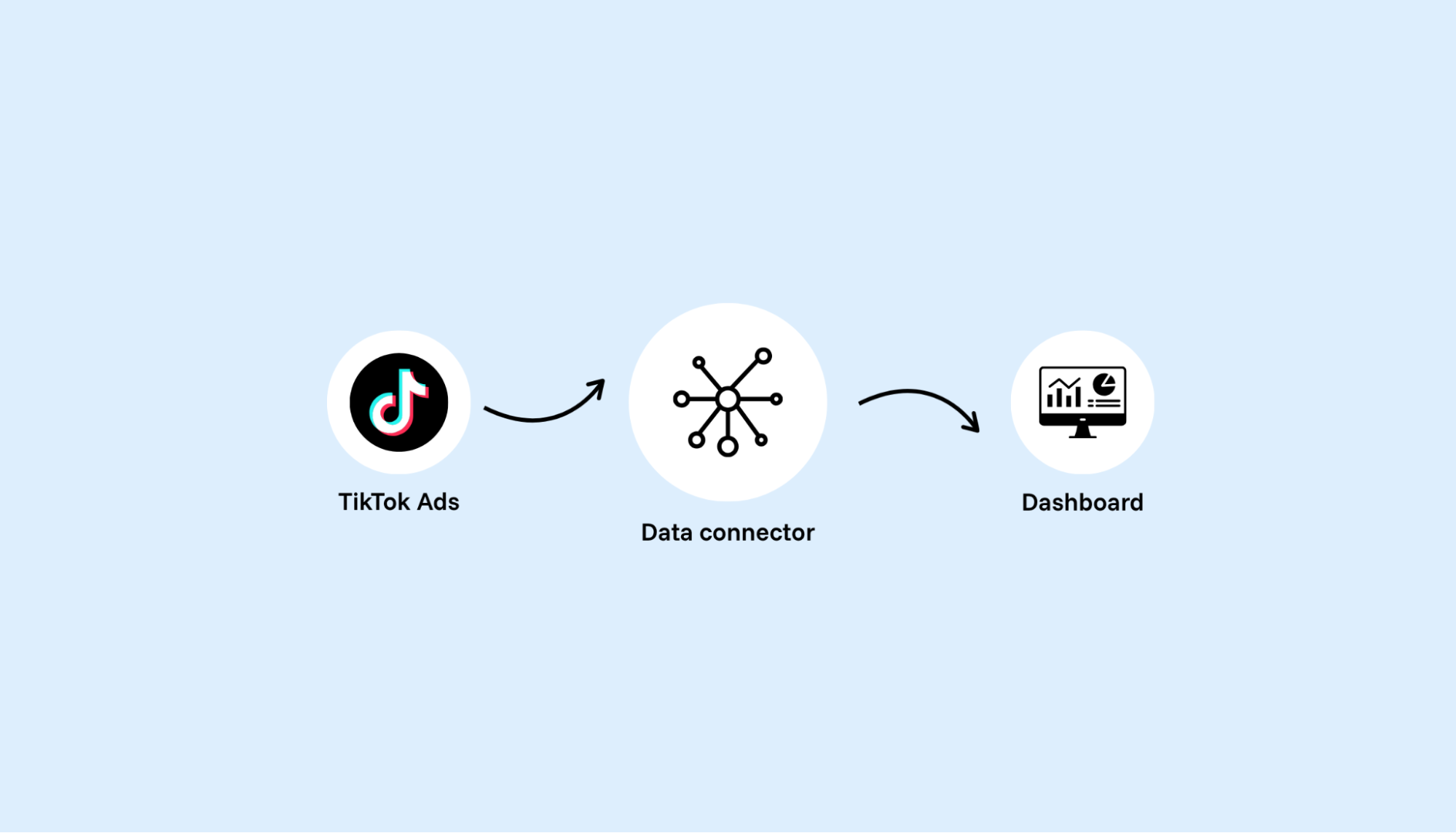
Say you want to pull performance data from your social media ad platforms and move it to your analytics tool. You’d use a marketing data connector for that.
A data connector is not an API, however.
An API is a set of rules that open a metaphorical doorway through which the data connector can be established. The marketing data connector itself is another piece of software that specifies which data will be pulled out of your sources, where it comes from and where it goes.
Without a connector, getting data to move from one tool to another means you’re stuck with manual data collection and exports, or a custom developer-built integration.
How data connectors work: the anatomy of a connection
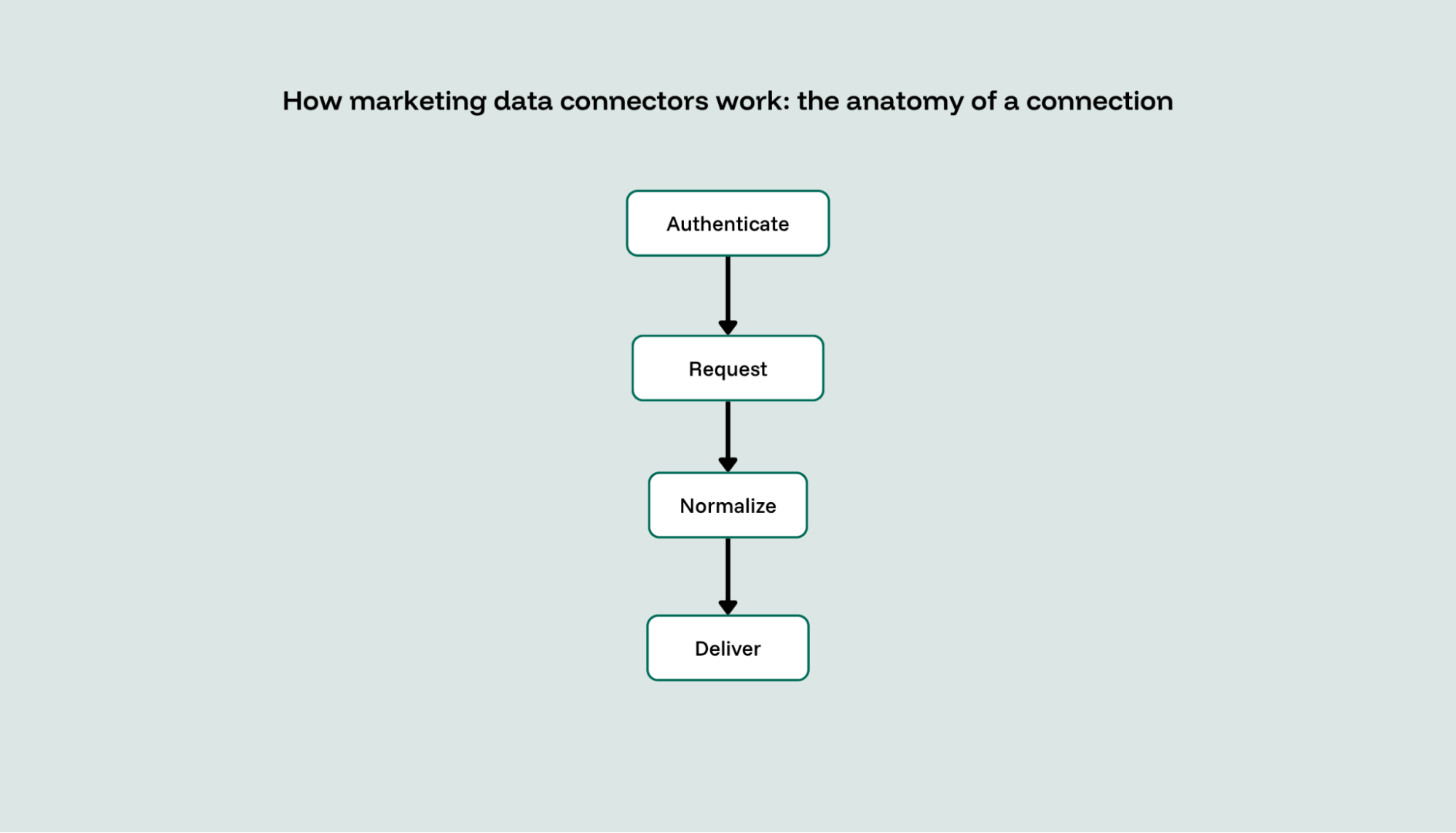
Every marketing data connector runs through the same four steps regardless of the platform it's extracting data from or sending it to:
- Authenticate: The connector logs into the source platform via API key, OAuth token or credentials.
- Request: It pulls data from the platform's API endpoints on a set schedule (hourly, daily, on demand).
- Normalize: The connector restructures the data into a consistent format so it lines up with data from other sources. This is where most of the complexity sits, as different platforms use different field names, metric definitions and attribution windows for the same thing (e.g., "spend" vs "cost").
- Deliver: It then sends the normalized data to the destination (dashboard, warehouse, spreadsheet, BI tool).
None of this is visible when it's working.
The connector runs on its schedule and the data turns up where it should.
The thing is, every one of these steps depends on the source platform staying exactly as it was when the connector was built. But that doesn’t happen in the real world.
Why marketing data connectors break (the main failure modes)
When a data connector breaks, it's not always obvious at first. It doesn’t send you an error message or tell you “hey, I’m not working properly anymore.”
It just keeps running, but extracts the wrong numbers. Or nothing at all.
There are three main issues that impact connector reliability:
API instability: when the source changes without warning
Platforms update or deprecate API versions all the time, and they do so on their own timeline.
When a platform launches a new product, feature or ad format, it will often make a change to the underlying APIs that support them, and any connectors built on the old version break.
For example, on June 9, 2026, Meta deprecated all Marketing API versions before v24.0. Any connector still moving data from an older version after June 9 stopped syncing, causing a full outage for that integration until it was rebuilt against the new version.
Schema drift: when field names and structures shift
When a platform renames fields, changes data types or restructures responses, any marketing data integration connector built on the old schema keeps running but pulls the wrong column or no column.
For instance, when Meta removed the 7-day and 28-day view-through attribution windows from its API in January 2025, any query still asking for those windows just came back empty.
The connector doesn’t throw an error or send you a message to choose a new attribution window. It just returns nothing, and the missing data shows up as a gap in your reporting.
Data retention windows: the data that disappears before you collect it
Some platforms only retain data for a limited period. Whenever a connector fails, you have to move fast, or you lose the opportunity to capture data that’s about to age out.
Take TikTok, which only retains pixel data for 180 days. This is a much shorter window than what platforms like Meta have.
If a connector breaks and is left broken for months (because you don’t get any kind of alert about it), you can’t recover what has already aged out, leaving a permanent hole in your historical data.
What separates a reliable connector from a fragile one
A reliable connector is not one that doesn’t break. Those don’t exist. Connectors are only a gateway to the platform, meaning they’ll always break when something changes, since the connector doesn’t control the platform’s API.
So connector reliability is really less about whether or not the connection and more about what happens when it does.
With that in mind, there are three things you want to be asking:
Is there someone watching for breaks, or will you only find out when a report comes out wrong?
Does the connector get updated to new API versions automatically, and does it remap shifted fields without you intervening, or does it stop working while waiting for a manual fix?
When a break happens, will all the data be preserved?
The data retention question is important because some setups only query the platform live but never keep a copy (this is the case for connector plugins for Data Studio and Google Sheets), so when the platform ages data out, it's gone.
A data hub that stores and keeps your historical data once it's ingested keeps your history safe even when the platform changes or it ages out.
Managed vs. self-built connectors: the maintenance question
Building the connectors yourself isn’t really the difficult part. It’s keeping them working as APIs are deprecated or fields are renamed.
The maintenance burden is real, and it compounds with every source. Each platform has its own API and its own update schedule, so the maintenance load grows with every connector you add.
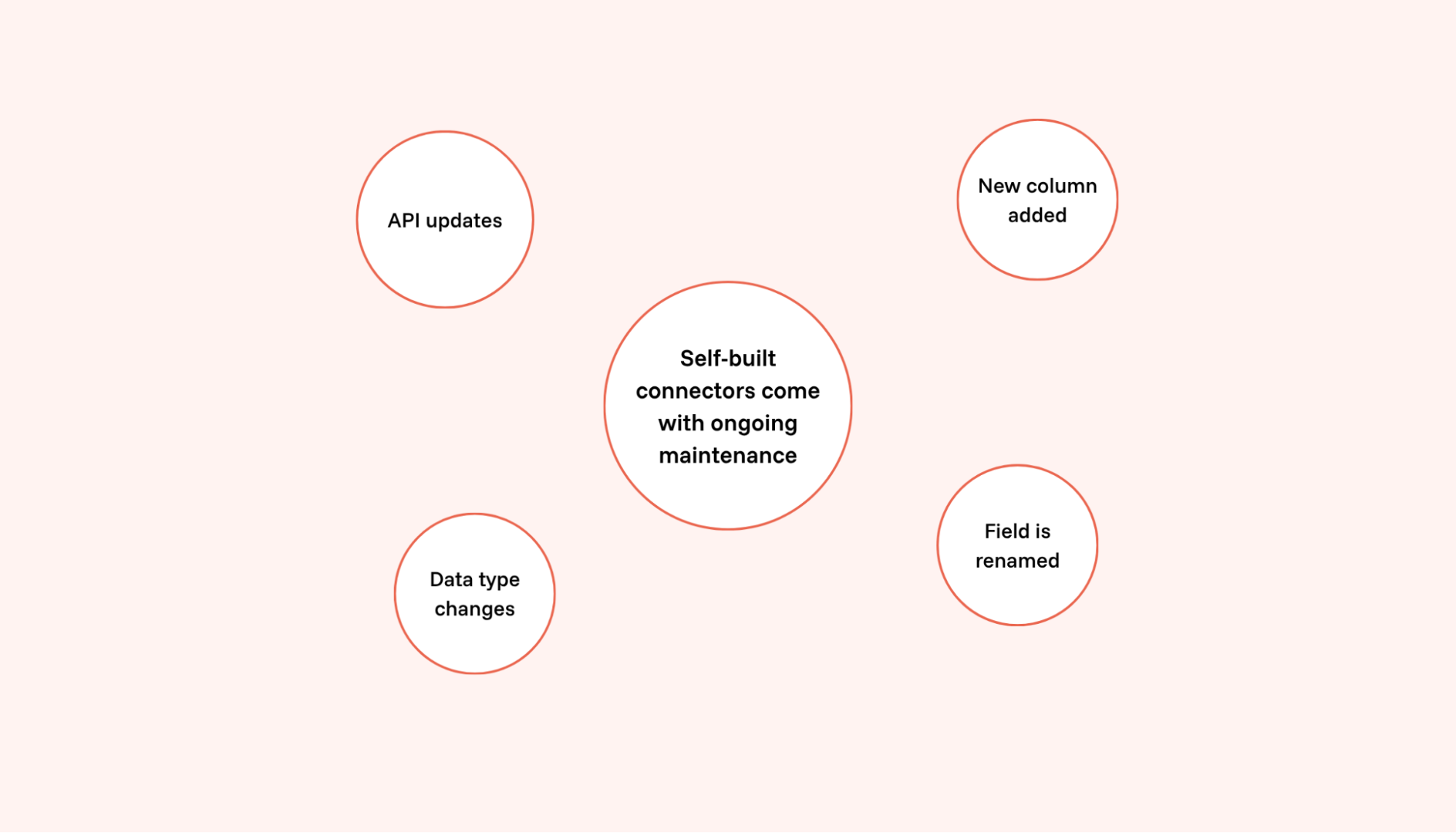
All of this means that self-built connectors can be manageable at three to five sources, but it becomes punishing across more than 10.
At that scale, data connector maintenance becomes specialist work.
Platforms change APIs constantly, which means someone has to monitor every source's changelog, catch breaks and rewrite the integration, often with data already missing while they scramble. That means data engineering resources are spent on pipeline management, not building.
The upfront build can look cheaper if you have in-house engineering capacity, but you inherit the monitoring and repair of every connection, forever. A managed provider absorbs the API monitoring, version updates and field remapping so your team isn't pulled into emergency fixes every time a platform changes.
With a managed provider, you’re choosing a known cost over a hidden one. Nobody on your team is watching changelogs, rebuilding a data integration the week a platform ships a breaking change or working out why last month's numbers moved. The connectors are somebody else's job to keep alive, which means your team gets to spend its time using the data rather than fixing the pipe that carries it.
How to evaluate connector quality before you commit
A connector isn't a plug you set and forget. It's infrastructure your reporting depends on, so it deserves the same scrutiny you'd give any other part of your data stack.
The problem with choosing third-party connectors is that quality is invisible at the demo. Everything works on day one. A connector's real quality only shows up months later when a platform changes, so you're evaluating something you can't directly see yet.
Instead of looking at what the connector itself does, you need to be looking at:
The track record, not the feature list
- How long has the provider maintained these connectors?
- How have they handled past changes from major marketing platforms?
- What happens when data volume spikes?
- How do they handle backfills after an outage or field remapping when a platform shifts?
How you would find out about a break
- Is someone monitoring the connection and working on the fix, or is that on you?
- Is there a status page or alert that tells you what's happening and whether it's already being handled?
Marketing data hubs like Funnel surface this rather than leaving you to find out the hard way. Funnel provides data source error and delayed-download notifications in the app, an in-app warning that flags connections that haven't updated in an unusually long time and a public status page that tracks incidents as they're diagnosed and fixed.
What happens when you need to connect data to a source that doesn’t have a pre-built connector?
- Are you added to a feature request queue with no timeline, or does the provider commit to building it?
- Does the provider have the technical resources to connect to your analytics tools or other marketing data sources quickly?
Funnel's Data Guarantee is the commitment to build any connector you need. If a source isn't in the library yet, we build custom connectors rather than leaving you waiting in a queue with no answer. That way, a missing connector is a matter of time rather than a dead end.
A data pipeline is only as good as its weakest connector
Your reporting is only as trustworthy as the connectors feeding it. And a pipeline is only as good as its weakest connector, so the connector layer is worth choosing as deliberately as anything else in your stack.
If you want to see what that looks like in practice, Funnel's connector library of over 600+ connectors is worth a look.
Frequently asked questions
What is the difference between a data connector and an ETL tool?
The connector is the piece that pulls data from one platform, while ETL (extract, transform, load) is the broader process of pulling, reshaping and delivering it.
So, a connector handles the extract part, while an ETL tool wraps extract, transform and load together. Many ETL tools use connectors as their extract layer.
Why does my marketing data keep disappearing?
There are two common reasons your marketing data keeps disappearing:
- A connector broke without a signal, so data stopped flowing and no one was alerted.
- A retention window was exceeded, where the platform aged the data out before it was collected and stored.
What is schema drift?
Schema drift is when a platform renames fields, changes data types or restructures its API responses, and the connector keeps running as it was. It’s a common data quality issue. Because of schema drift the connector pulls the wrong data or nothing at all.
Should I build my own marketing data connectors?
You can build your own marketing data connectors if you have the engineering capacity, but the real cost isn’t the build; it's the ongoing maintenance. A solution that offers managed connectors and builds custom connectors is a better option for most teams. Every platform changes its API on its own schedule, and the load grows with each source you add. That’s fine for a couple of stable sources, but it becomes painful across many.