






Most marketing teams have more data than they know what to do with. According to Funnel’s 2026 Marketing Intelligence Report, 72% of in-house marketers say they gather data by the ton, but turning it into insights is a challenge. And 41% admit that when they report results, they don’t even analyze the “why” or identify what to do next.
That gap between having data on your marketing efforts and understanding what it means is exactly where marketing data analysts live. They’re part data engineer, part strategist and part translator. As marketing channels fragment and measurement grows more complex, the demand for people who can make sense of it all is accelerating fast.
So what does the role actually look like, and how do you get there?
What a marketing data analyst actually does
Unlike a general data analyst who works across operations, finance and product, a marketing data analyst focuses specifically on campaign performance, spend efficiency and audience behavior.
Analysts typically spend their time doing the following:
- Pulling data from advertising platforms, web analytics and CRM systems
- Structuring the data for analysis
- Building reports and dashboards
As a marketing analyst, you’ll also be in charge of surfacing insights and interpreting data to help marketing teams make better decisions.
More than just reporting
Many organizations confuse reporting with analytics. But the marketing data analyst’s job goes further than reporting the data they find.
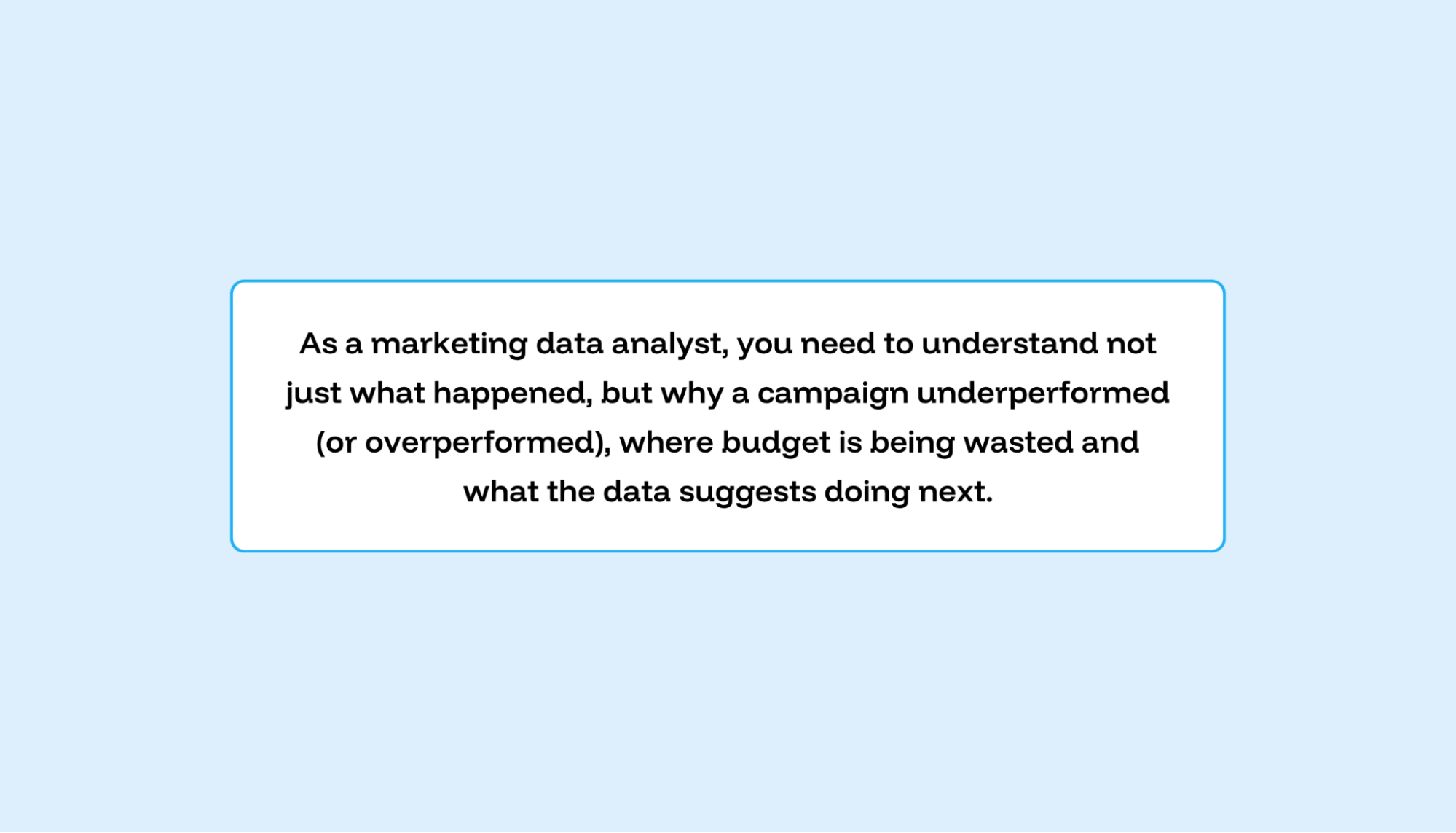
The role requires what Tom Roach, VP Brand Strategy at Jellyfish, describes as “strategy, curiosity and storytelling on top of the data analysis.” This means that you need to understand not just what happened, but why a campaign performed the way it did, where budget is being wasted and what the data suggests doing next. The skills required to succeed in those tasks are different from what's required to create effective reports.
Why this role has become essential for modern marketing teams
So, why are modern marketing teams adding marketing analysts to the roster?
According to our 2026 Marketing Intelligence Report, agencies are 2x more likely than in-house teams to make robust recommendations in performance reports. Only 29% of in-house marketers include actionable recommendations compared to 60% of agency marketers. This marks a clear gap between in-house teams and agencies for both analysing data and using it to inform better decisions.
But that’s not all. Eighty-six percent of in-house marketers and 79% of agency marketers struggle to determine the impact of each marketing channel on overall performance. The reports from marketing campaigns exist, but the ability to analyze them is missing. Plus, 68% of in-house marketers say they lack up-to-date visibility into campaign performance across channels.
Today, marketing operates across more platforms and channels than ever before, yet visibility into performance remains poor.
Pulling further from the marketing intelligence report, only 8% of in-house marketers and 21% of agency marketers consistently use advanced analytics to gain marketing insights. It makes sense, then, that so many marketing managers struggle to define the impact of their campaigns.
Marketing data analysts exist to close that gap. They have the necessary skills to turn scattered platform data into something leadership can actually act on.
Core skills every marketing data analyst needs
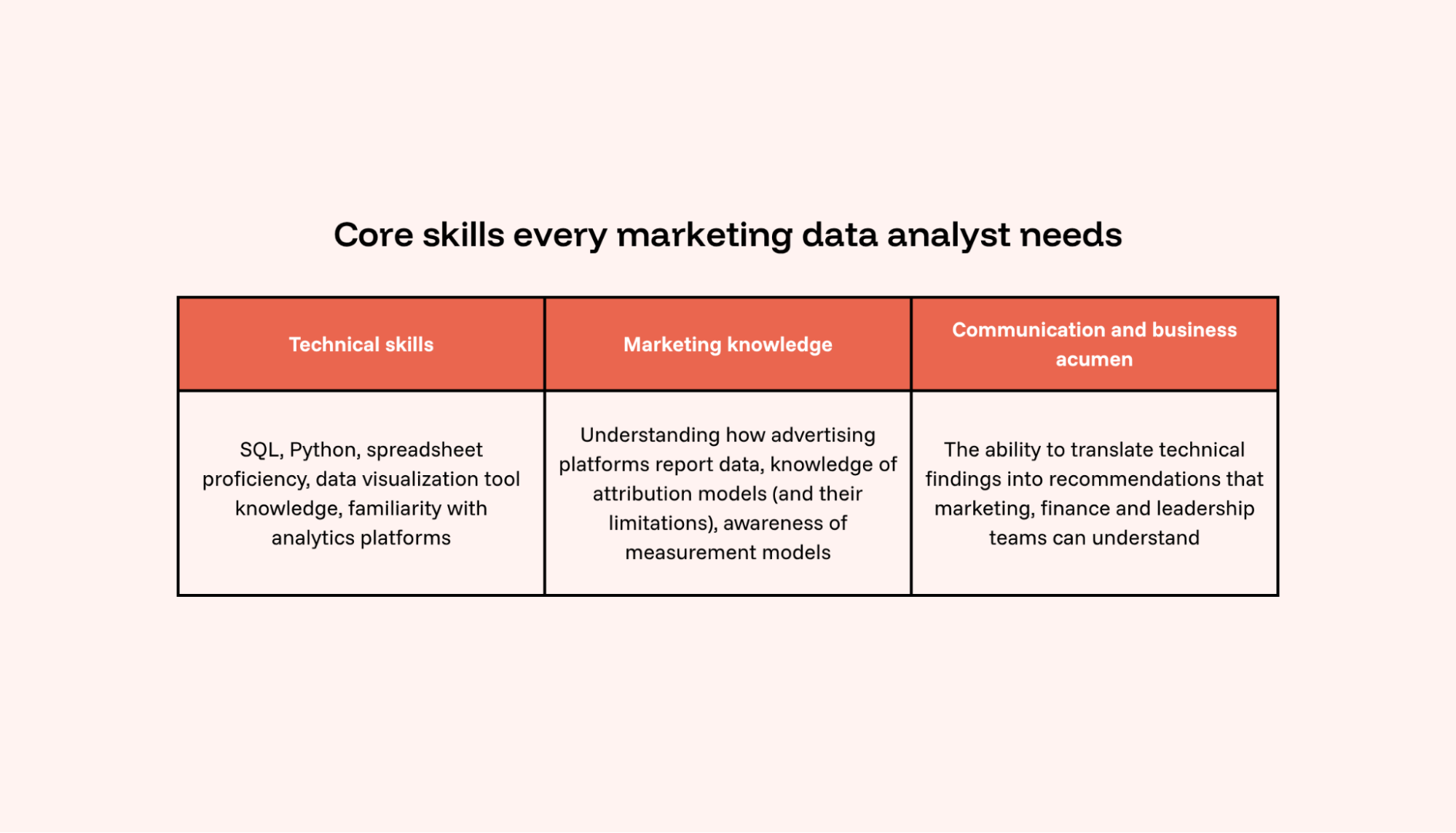
The role demands a hybrid skill set that blends technical proficiency with marketing domain knowledge and business communication. Let’s break down each of these skill groups in more detail.
Technical skills
If you want to get into any sort of data analysis (not just for marketing) you’ll need several technical skills. Knowledge of structured query language (SQL) is the baseline for querying marketing databases and data warehouses. Python or R is a plus for more advanced analysis, statistical modeling and automation. You may not need to know Python or R to dip your toes in this career, but you’ll get farther if you learn it early.
You’ll also need a higher-than-average spreadsheet proficiency for ad hoc analysis and stakeholder-friendly reporting. Plus, data visualization tools such as Tableau, Looker Studio or Power BI are essential for building dashboards that tell a clear story.
Finally, you’ll need to become familiar with analytics platforms like Google Analytics 4.
Marketing domain knowledge
Technical skills will allow you to get into general data analysis, but you’ll also need proficient knowledge in marketing. First, you’ll need to understand how advertising platforms report data, including the nuances of metrics like return on ad spend (ROAS), cost per acquisition (CPA), customer lifetime value (CLV) and the difference between ROI and marginal ROI.
General marketing skills won’t cut it, though. Knowledge of attribution models and their limitations, including why last-touch attribution systematically undervalues upper-funnel activity, will be essential to your success. You’ll also need awareness of measurement models like marketing mix modeling (MMM), incrementality testing and multi-touch attribution, as well as triangulation.
Communication and business acumen
If marketing analysts worked in a silo, the above skills would be enough. But that’s not the case. Analyzing marketing data will be useless to an organization’s bottom line if you’re unable to communicate your findings clearly.
Funnel’s Marketing Intelligence report states that just 13% of marketers say they communicate well with finance, which is the function that actually tracks business outcomes. This is a huge gap in marketing teams that a marketing research analyst can help close. Strong data analysts translate technical findings into recommendations that marketing, finance and leadership can understand.
This bridging ability is what separates a dashboard builder from a strategic partner.
Technical tools commonly used in marketing analytics
If you want to become a marketing data analyst, the following tool categories are what you’ll need to get comfortable with in addition to the skills we’ve just covered.
Analytics and visualization
For analytics and visualization tools, start learning:
- Web analytics platforms to understand consumer behavior, industry trends and conversion paths
- Business intelligence and visualization tools for cross-channel dashboards and executive reporting
- Statistical programming environments for deeper analysis beyond what BI tools offer
Data infrastructure
The following data infrastructure tools are essential for a marketing research analyst:
- SQL-based querying of marketing data stored in data warehouses
- Marketing intelligence platforms that collect, clean and unify data from hundreds of advertising and analytics sources
- Data pipelines that automate the flow of data from platforms to reporting environments to reduce manual CSV downloads and copy-paste errors
Measurement and experimentation
Finally, start developing skills in these analysis tools:
- A/B testing frameworks and experimentation tools
- Attribution platforms and measurement models
- Survey and marketing research tools to get qualitative data
Understanding marketing data pipelines and integration
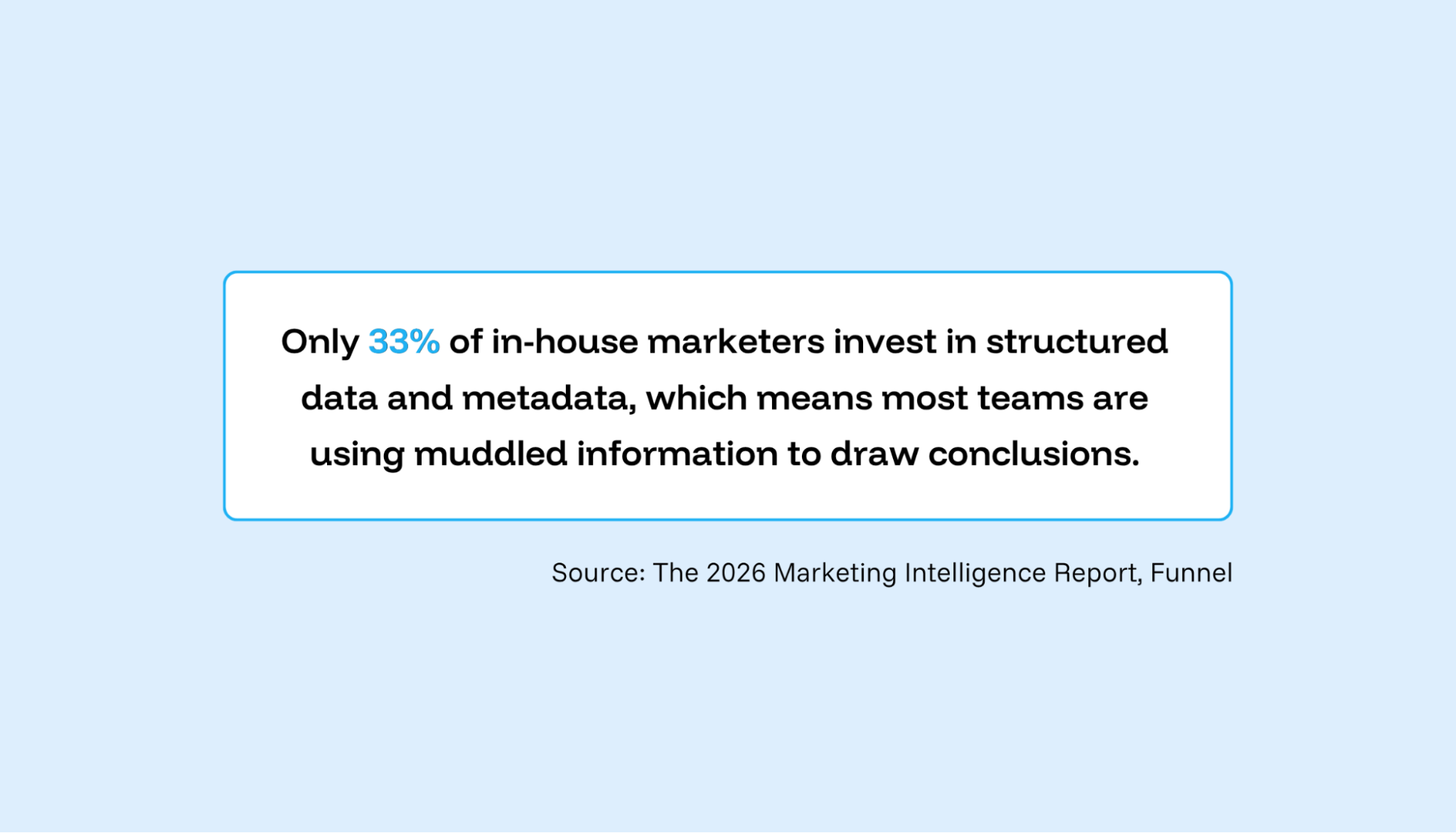
Only 33% of in-house marketers invest in structured data and metadata. This means most teams work from messy, siloed information, which is yet another explanation for the lack of actionable insights for marketing departments. Marketing data analysts become useful by understanding how data flows before it lands in a dashboard.
Data originates in advertising platforms (Google Ads, Meta, LinkedIn), analytics tools, CRM systems and e-commerce platforms. That data must be extracted, normalized and loaded into a warehouse or reporting layer. And it’s during this step that most data quality issues arise.
For example, marketing teams may use inconsistent nomenclature when naming campaigns, or API changes may start breaking reports. Analysts who understand data pipelines can diagnose reporting discrepancies, identify gaps in tracking and ensure that the data they’re analyzing is trustworthy. The opposite is also true; analysts who don’t have a solid grasp of those pipelines will struggle to get to the root of issues and may miss those gaps.
How to transition into a marketing data analyst role
Marketing analyst jobs are accessible from several starting points, including:
- Marketing operations
- General analytics
- Digital marketing
- Business intelligence
We’ll split these into two categories to showcase how you can transition from either a marketing or data background into a marketing analyst career.
Coming from a marketing background
Start by learning SQL, which is the single most valuable technical skill to get into data roles. You’ll need to build proficiency with data visualization software in addition to database languages.
Collect data and practice pulling and cleaning data from the advertising platforms you’re already familiar with. This will make it easier to hone these skills before dipping your toes in platforms you’re less familiar with once you land a marketing analyst position.
You should also consider volunteering for reporting and data analysis projects within your current team. While that may not be a part of your official responsibilities yet, this will allow you to gain hands-on experience, start to analyze statistical data and study market trends.
Coming from a data, intelligence or analytics background
If you have experience in data science, your priority should be to invest time in understanding marketing-specific metrics like ROAS, CPA, CLV, marketing efficiency ratio (MER) and attribution models. Next, learn how advertising platforms collect and report data, including the gaps and biases in platform-reported conversions.
You’ll also need to study the marketing funnel and how different channels contribute at different stages. This knowledge will give you the context you need to leverage your analytical skills for powerful insights.
Career paths and growth opportunities in marketing analytics
Marketing data analytics is a launching pad into several high-demand career development paths. You can start with data-driven attribution, layer in correlation analysis and funnel diagnostics and then graduate to marketing mix modeling and incrementality testing.
Growth trajectory
Junior analysts typically focus on generating insights, performance reporting, dashboard building and platform-level data pulls. Mid-level analysts take on cross-channel analysis, attribution modeling and stakeholder communication. Finally, senior analysts and leads manage measurement strategy, work with advanced modeling techniques and advise leadership on how to allocate marketing budgets.
Where advanced data analytics skills lead
Among marketers who consistently use advanced data analytics skills, 76% say they feel empowered to experiment with new marketing approaches, compared to just 36% of those who don’t.
Teams with strong statistical analysis capabilities are described as being more confident in their recommendations. They can experiment more boldly and speak the language of business impact instead of just marketing activity.
Natural career progressions include marketing analytics manager, head of marketing data, marketing science lead or director of marketing intelligence.
Will AI replace marketing data analysts?
The short answer is no, but the role will change.

AI doesn’t fix messy data; it amplifies it. This means that without a strong data foundation, generative AI and machine learning can’t deliver meaningful intelligence.
Given this, routine reporting and data pulling will increasingly be automated. AI-assisted tools will surface anomalies and patterns faster, which will reduce the time spent on manual exploration.
Human analysts will spend more time validating AI outputs and providing business context that models lack. However, someone still needs to understand whether the data feeding the model is clean and trustworthy. Someone still needs to interpret what a spike in cost per acquisition means in the context of a seasonal shift versus a real performance problem. And someone still needs to translate findings into recommendations a CMO or CFO will understand and be able to act on.
The analysts who lean into data governance, measurement design and strategic interpretation will be the ones whose careers accelerate.
Start your career as a marketing data analyst
The marketing data analyst role asks you to develop the ability to move between data infrastructure and marketing strategy. You also need to understand where the numbers come from and what they mean for the business. You’ll master the right tools and cultivate a mindset that allows you to view problem-solving at both a granular and a high level.
Organizations at every level are recognizing that having data isn’t the same as having insight, and they need people who can bridge that gap. Whether you’re coming from a marketing background and picking up SQL for the first time or you’re a data analyst learning the nuances of attribution, the path is open for you. Start learning and let curiosity drive the rest.