



 Talk to sales
 Log in




Marketing teams have never had more data, and they’ve never trusted it less.
It’s a classic too many cooks in the kitchen situation. Your ad platforms tell you different things; your CRM says something else. According to a Forrester study, 55% of US marketers believe poorly integrated data has directly caused revenue loss.
And the scale of the problem just keeps growing; the martech landscape just hit 15,384 solutions in 2025, a 100x increase since 2011. Every new tool or channel your team adds is another data source. So it’s no surprise that 65.7% of CMOs cite data integration as their biggest MarTech management challenge.
You can't answer high-stakes questions your leadership team needs if your data is stuck in silos. That’s why data integration is so critical. Marketing data integration is the process of connecting, collecting, standardizing and centralizing data from all of these platforms into a single, analysis-ready format. In this guide, you’ll learn why marketing data integration matters and how to make it the backbone of your marketing intelligence engine.
What is marketing data integration?
At its core, marketing data integration involves pulling data from every platform in your marketing stack, like ad platforms, CRMs, analytics tools, email platforms and ecommerce systems, and turning it into a unified dataset your team can work with. Instead of logging into ten different tools to piece together what happened last week, you have one source of truth where a click is a click, a conversion is a conversion and spend is spend, no matter which platform it came from.
The work itself breaks down into four jobs that happen in sequence:
- Extraction pulls raw data from each source platform via its API.
- Transformation cleans and standardizes that data so metrics from different sources line up and can be compared.
- Storage keeps the data organized in a way that supports flexible analysis.
- Delivery pushes the finished dataset out to the tools and teams that need it, whether that's a BI dashboard, a spreadsheet, a data warehouse or a measurement model.
As such, the whole system is only as strong as its weakest layer.
The need for stable marketing data is getting more urgent every year, which is why global spend on data integration is on track to hit $33.24 billion by 2030. Organizations at every scale are realizing they can't run modern marketing on the patched-together infrastructure they've relied upon for the last decade.
When integration works, it can be the bedrock of the marketing department. Conflicting reports stop because they pull from the same clean dataset. Advanced measurement gets the inputs it needs because marketing mix modeling, attribution and incrementality testing all depend on unified data. And marketing intelligence becomes possible. Bad integration leads to poor measurement, which leads to poor decisions, which tend to turn into credibility problems for marketing.
Why data integration has become so important in 2026
Every era of marketing has its data challenges, but what makes 2026 different is that four forces are hitting at once. Individually, each one is manageable. Together, they compound and expose weaknesses in how marketing data is connected, which is why integration has shot to the top of the priority list for many marketing teams.
The explosion of marketing platforms
The 15,000+ tools currently on the market tend to accumulate within the stacks of high-growth marketing teams. Organizations often add tools faster than they can integrate them. While every new platform solves a specific problem (like social listening or email automation), it simultaneously creates a new one by introducing another schema, API and proprietary definition of what a conversion is.
Fragmented datasets across ads, CRM and analytics
Right now, marketing data is scattered across a dozen different places, from your social media ads and CRM to your website's tracking tools, each with its own metrics, naming conventions and reporting logic. NIQ’s CMO Outlook 2025 found that 31% of senior marketers still struggle to connect data from multiple sources. A Perion/Advertiser Perceptions study puts the gap even higher, with 70% of marketers saying they still can’t track holistic performance across platforms.
Signal loss from privacy changes
The invisible string that once allowed marketers to follow customers across the internet has been cut. For years, tracking was easy, but a combination of new privacy laws and updates like Apple’s "Ask App Not to Track" has changed the game.
As a result, the data we get from platforms like Facebook or Google Analytics is becoming increasingly blurry and incomplete. It’s now much harder to tell, for example, if the person who clicked an ad on their phone is the same person who eventually bought the product on their laptop.
Because we can no longer rely on external platforms to provide the full picture, brands are moving their focus toward first-party data, the information they collect directly from their own customers. What was once a nice-to-have luxury has become one of the only reliable ways to see how your marketing is performing.
Pressure on marketing to prove business impact
The spotlight on marketing has never been brighter. According to the Duke CMO Survey, 64% of marketing leaders now say demonstrating financial impact is their single biggest challenge, and the pressure is coming from every direction at once.
CFOs are the loudest voices in the room when signing off on marketing budgets, with finance scrutiny rising to 63% from 52% in 2023. The uncomfortable truth is that marketing leaders just don't feel equipped enough to answer them, with just 22% of marketers saying they have enough data to justify their value to leadership. In a downturn, that fragility becomes existential because marketing spend is usually the first item on the chopping block.
The flip side is what makes integration worth investing in now. When marketing and finance partner effectively, revenue grows faster and profits rise by 20% to 40%. And what CFOs increasingly want from CMOs is customer intelligence. As one consumer goods CFO told McKinsey, "I need the CMO to tell me what customers want. They know them best, and I can't make decisions without their input." You can't deliver that kind of insight if your data is fragmented across a dozen platforms, which is exactly why a unified, governed data hub has become the foundation of credible marketing measurement.
Why marketing data integration is difficult
If data integration feels harder than it should, rest assured, it isn’t your team. The complexity is structural, and most marketing teams are wrestling with the same industry-wide headaches. Understanding the plumping problems is the first step toward overcoming them.
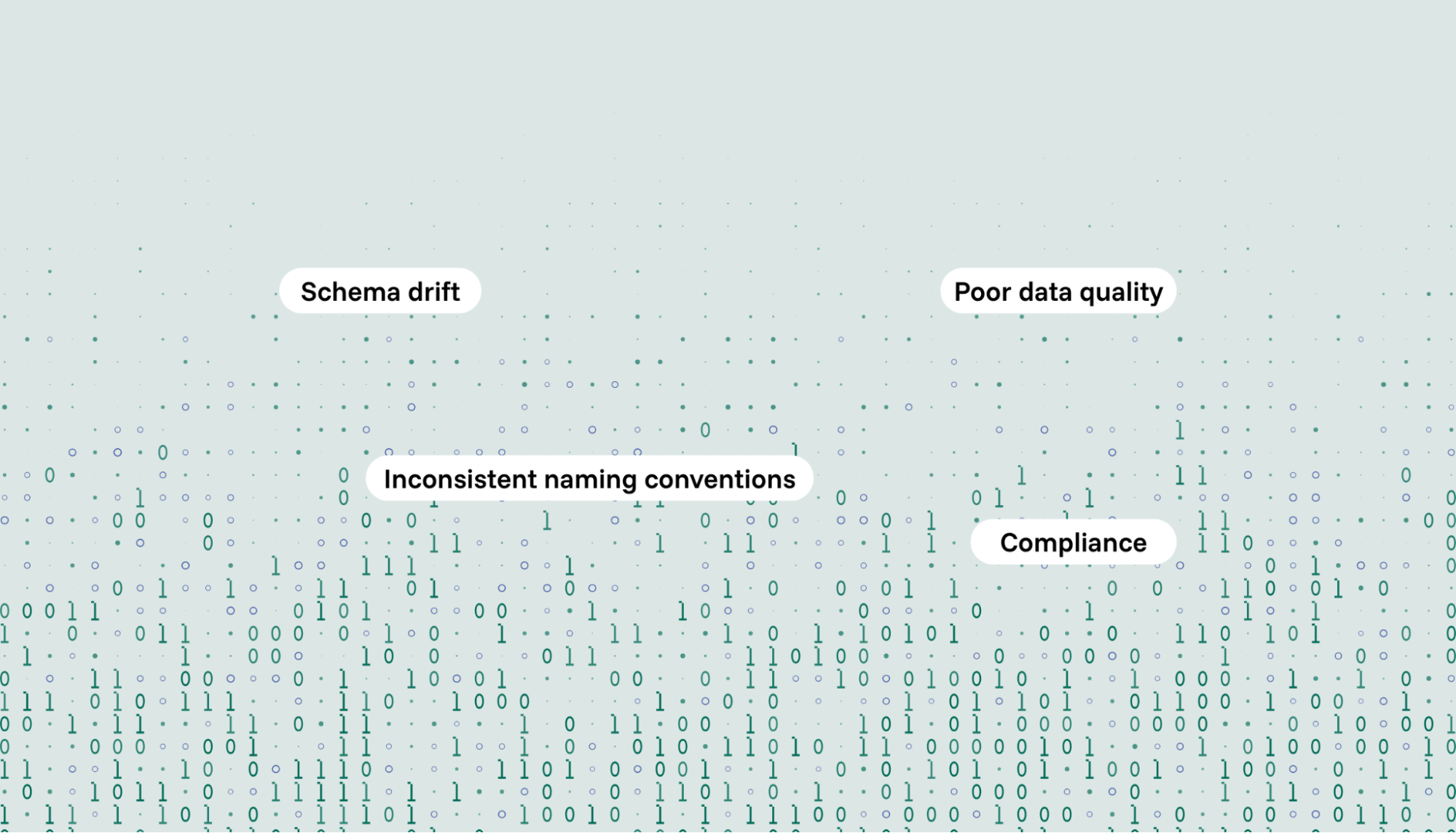
API instability and schema drift
Platforms update their APIs constantly. Fields get renamed, deprecated or restructured with little to no warning. For example, when Facebook renames a field like "spend" to "total_spend," every dashboard connected to it will break until someone manually updates the mapping. Maintenance isn’t a one-time setup cost; it's an ongoing operational burden. Marketing teams that run DIY pipelines can underestimate how much engineering time is burned simply keeping the API connections alive.
But the most insidious part of API changes is that they rarely announce themselves. The first sign of a failure is usually a dashboard displaying incorrect numbers. By the time someone on your team (or worse, a client) spots the error, the data feeding downstream reports has been corrupted for days. Niche platforms are even more volatile, often changing APIs without a formal deprecation policy, turning every update into a surprise for your engineering team.
Inconsistent metrics and naming conventions
Every platform defines success differently, which is more of a problem than it first appears. Attribution windows vary. The definition of “conversion” changes from tool to tool. Timestamp formats don’t match. Currencies, naming conventions and metric definitions all diverge across platforms and regions, and when agencies are involved, each brings its own campaign-naming logic into the mix.
The sneaky part is that the numbers look comparable even when they aren’t. A “conversion” pulled from Google Ads with a 30-day click window isn’t the same thing as a “conversion” pulled from Meta with a 7-day click and 1-day view window, but when both land in the same report, they tend to get added together like they are. Without deliberate standardization, your cross-channel totals are misleading by default.
Data quality issues
Even when data flows correctly, it isn't always trustworthy. Precisely’s 2025 Data Integrity Trends report found that 50% of respondents consider data quality the top issue that impacts integration projects, and 77% rate their own data quality as "average" or worse. Bad data at the integration layer ripples through the entire ecosystem, as every dashboard and decision downstream inherits those original flaws.
Data quality issues are also likely hidden from view. A single misclassified campaign can skew a channel's reported ROI for months. By the time it’s caught, the decisions made, like budget allocations for the quarter, have already been finalized.
Scale, fragmentation and compliance
As an organization grows, the challenge compounds. In Europe, over 65% of organizations cite data silos and integration as top-tier challenges. Regulations like GDPR and CCPA add strict data governance requirements that integration tools must be able to handle. Teams running global marketing campaigns end up juggling overlapping privacy regulations, with different consent mechanisms feeding into different data flows.
Compliance also fundamentally changes how data is stored and shared. An integration system designed without these constraints will eventually require an expensive rebuild when legal or compliance departments perform an audit.
The build-vs.-buy trap
The majority of marketing teams don’t purposefully architect their data integration. It happens to evolve with the way they work. What starts as a few manual CSV exports turns into a custom script, which turns into a fragile data pipeline that swallows engineering.
As such, the real cost isn’t the build itself; it’s the opportunity cost of analysts and engineers stuck on maintenance instead of the work they were hired to do. A homegrown data integration setup is usually the one that gets voted in as it’s significantly cheaper than buying one. But that only rings true until the person who built it leaves, a new platform is added or leadership asks a question the original design never anticipated.
The core components of a data integration system
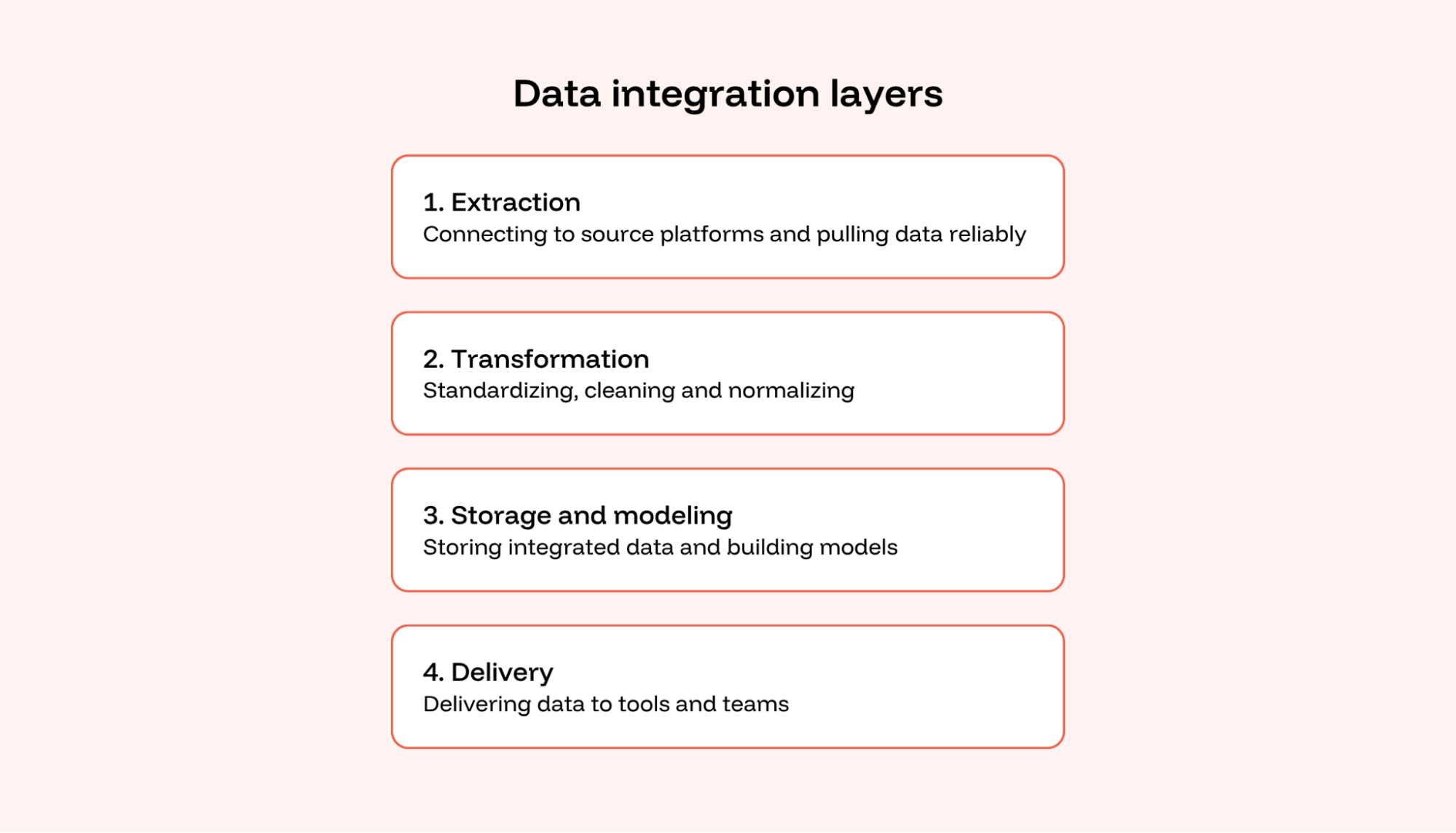
A complete data integration system has four layers, and most problems happen when one or more are missing, manual or patched together with duct tape:
- Extraction: connecting to source platforms and pulling data reliably
- Transformation: standardizing, cleaning and normalizing
- Storage and modeling: organizing data for flexible use
- Delivery: getting analysis-ready data to the right tools and teams
This four-layer framework can be useful because it gives you a way to audit your own setup. If any one of these layers is being handled by a spreadsheet, a person or a script nobody dares touch, you’ve probably found the weak point, and it’s almost certainly the source of the data issues everyone else has been complaining about.
But a quick note on terminology before we go deeper into each layer of the data integration strategy.
ETL (extract, transform, load) is a type of data integration, not a separate category. It works well for stable departments like finance or operations, where data structures don’t change much, like payroll. But it struggles to keep pace with marketing because it locks the shape of your data at the point of extraction, and marketing data is inherently unstable.
An integration-first approach flips the script: store the raw data first, defer transformation until it’s actually needed. Marketing teams get flexibility and control without having to wait on engineering every time the business asks a new question. It sounds like a small distinction, but it’s the difference between rebuilding data pipelines every time a question changes and simply writing a different query.
To learn more, we've explained the two approaches in this breakdown of data integration vs. ETL.
Data extraction: connecting and collecting source data
Data extraction pulls raw data from every platform in your marketing stack. It might sound like a simple technical handover, but it's really the most vulnerable point in the process. If you begin with a broken or incomplete extraction, no amount of sophisticated analysis or AI down the line can fix the resulting insights. You're essentially working on quicksand.
A strong foundation means that your tool manages many moving parts at once.
Connector breadth is important
The hard part of extraction involves managing a complex web of data connections across ad platforms, analytics tools, CRMs, email platforms and ecommerce systems. The primary challenge is that each of these sources operates as a walled garden. Every platform has its own proprietary API with unique authentication requirements and data structures.
The variety creates a barrier to entry because your connector breadth (the total number of platforms your integration tool can reliably pull from) determines how complete your data picture is. If you cannot extract data from a specific influencer platform or a niche local ad network, that data becomes a blind spot. And blind spots inevitably lead to manual workarounds.
APIs change, and so should the data pipeline
But simply establishing a connection isn't enough, because the reality of modern extraction is that it's never a set-and-forget task. Platforms change their APIs with frustrating regularity, often without warning. In a DIY environment, these changes require an engineer to manually repair the data pipeline.
Managed tools can solve the problem by automatically handling these API updates, so the data flow is never interrupted. It's important to have this resiliency because marketing platforms also update their data retroactively. Without a robust extraction layer that includes automatic backfills and lookback windows, your historical data will never stay in sync with the source of truth.
Rate limits and the future of first-party extraction
The difficulty of maintaining these connections is further compounded by the internet's traffic cops: API rate limits. Limits restrict how much data you can pull and how frequently you can pull it. While high-quality tools handle these rate limits in the background, lower-quality tools may fail without warning, leaving you with Swiss cheese datasets that produce skewed reports.
As we look toward the future, extraction is becoming even more complex due to cookie deprecation and privacy changes such as iOS 14.5+. As third-party signals degrade, the data extracted from individual platforms is more fragmented and less granular, which reinforces the need for a first-party integration strategy to bridge the gaps. A data integration tool addresses this by connecting to platforms with pre-defined schemas, ensuring your extraction layer is both broad enough to cover your entire stack and resilient enough to survive the shifting privacy landscape.
Data transformation: normalizing and standardizing marketing data
Once data is extracted, the real complexity begins. Marketing data does not naturally fit together; a “Click” in Google Ads is technically (and even philosophically) different from a “Link click” on Meta or a “Click” on LinkedIn. They measure different actions, follow different attribution windows and are reported in different currencies.
The knock-on effect is that when harmonization isn’t done properly, every cross-channel number comes with an implicit caveat. The team presenting the numbers either has to explain the caveat every time (which erodes trust) or skip the explanation and risk leadership making decisions on data that isn’t actually comparable. Neither option is great, and both get worse as the stack grows.
A real transformation layer needs to handle a few jobs at once:
- Campaign naming standardization. Decoding naming strings into structured fields like region, channel, audience and creative variant, so performance can be sliced in ways the original naming didn’t anticipate.
- Currency conversion. Multi-market campaigns need automatic conversion with configurable exchange-rate logic (day-of, monthly average, and so on) because the currency choice materially affects the reported ROI.
- Deduplication across platforms. The same event is often reported under different names or structures across different tools; transformation should resolve those conflicts.
When should transformation happen?
Traditional ETL locks the logic in at the point of extraction, which means once it’s applied, the original values are gone. If a business question changes or an attribution window needs revisiting, there’s no going back without re-pulling everything.
An integration-first approach takes the opposite path. Raw data is always preserved, transformation is applied on read and you can recut metrics, adjust attribution or revisit past performance without re-extracting anything. Using a marketing data integration platform that normalizes common fields means clicks are clicks and costs are costs, regardless of source. That saves time the first time around and even more time the second, third and fourth times, because every future business question becomes a query against the same clean dataset rather than a new pipeline build.
How data transformation paid off for Sephora
Sephora's a good example of what transformation done well looks like at scale. Working with data agency Hanalytics, they consolidated marketing data from 18 European markets into Funnel, outputting clean, pre-shaped tables with just the dimensions and metrics they needed instead of consolidating hundreds of raw tables in BigQuery. That one architectural choice reduced their data processing costs by 75%, because the warehouse was doing far less work.
Of course, when you're pulling that much data into one place, governance matters as much as cleanliness, which is why we've covered it in detail in this guide to data security best practices for integration pipelines.
Data storage and modeling for integrated marketing data
How you store data isn't something that will naturally get a marketer excited. But it’s one of the most consequential decisions your team will make because it determines what you can still do with your data two years from now.
Data storage as a core function
Traditional ETL treats storage as the destination. Data arrives pre-transformed, the raw source is discarded and the reporting you designed on day one is more or less the reporting you’re stuck with. That’s fine until the business asks a question the original design never anticipated, and suddenly you’re rebuilding pipelines to answer it.
An integration-first approach treats storage as a core function instead of an endpoint. Raw data is preserved in its original form, so nothing is lost when business logic evolves, platforms change their APIs or you need to restate historical figures. Every data point stays as it came in from the source, untouched, and transformation happens at query time instead. So when a new question comes along, you can give answers fast.
There’s also a continuity benefit. Once data is ingested, it should stay permanent and reliable. If a marketing platform goes down or changes its data retention policy, your historical data shouldn’t disappear with it, because the measurement models and multi-year trends depend on continuity. And platforms drop historical data more often than you may realize: a retention policy change or a deprecated API can erase months of data from the source, and if your storage layer is just a mirror of what’s currently upstream, that data is gone from your reporting, too.
Modeling marketing data
Marketing data also has specific modeling requirements that generic tools don’t always handle well:
- Multiple hierarchies (account > campaign > ad group > ad)
- Multiple metric types (spend, impressions, clicks, conversions, revenue)
- Multiple dimensions (platform, region, audience, creative)
A good integration tool natively handles these requirements. The tool also needs to stay flexible as the business evolves, because new dimensions get added regularly, and a rigid model either breaks or forces a painful rebuild every time.
Many teams store their marketing data in Snowflake, BigQuery or Redshift, which works well if you have the engineering resources to maintain the pipelines and modeling on top. Alternatively, marketing-specific data hubs can also serve as the storage and modeling layer, especially for teams looking to reduce their dependency on engineering.
The choice comes down to how much control marketing wants to have over the data layer versus how much engineering capacity the organization can reliably commit to supporting it. IBM’s Institute for Business Value found that 53% of executives said difficulties integrating infrastructure with legacy systems derailed target outcomes, which is usually what happens when the storage layer was designed for somebody else’s problem.
If you’re weighing your data storage options, this overview of data warehouses for marketing walks through the tradeoffs.
Delivering integrated data for marketing analytics and decision making
All the extraction, transformation and storage in the world is essentially wasted effort if the data never reaches the people and tools that need to use it. Delivery is the last mile of the data journey, and it's here that your integration strategy either pays off or falls apart. While the previous layers focus on gathering and cleaning, the delivery layer is about accessibility and utility. It's the bridge between a technical database and a strategic decision.
Every destination has different demands
The bridge must be built to support a wide variety of destinations, each with its own technical requirements. Integrated data needs to flow to BI tools, Google Sheets, data warehouses and measurement platforms, yet no two destinations are identical.
A data warehouse might require daily, massive loads with full historical context for long-term modeling. A performance marketing dashboard in Looker might need hourly refreshes. Meanwhile, a finance team pulling numbers into a spreadsheet simply requires a stable, immutable format they can trust from month to month.
A sophisticated delivery layer handles conflicting demands simultaneously, so that no one has to manually patch the gaps to get the data they need.
The right data pipeline, many outputs
Under an integration-first approach, this delivery becomes way more efficient. Because the data has already been harmonized in a central hub, the same validated dataset can be pushed to Google Sheets, Tableau or a warehouse without the need for separate, fragile pipelines.
A one-pipeline, many-output model is the only way to prevent the fire drills that occur when a platform like Meta changes its API. In a fragmented system, that change would break five different custom jobs; in a unified system, you fix it once at the source, and every downstream report remains accurate.
Activation: delivering data back to the platforms
In 2026, the most competitive marketers are sending first-party conversion data back to ad platforms via conversion APIs (CAPIs), a process called Activation. As third-party signals continue to degrade due to privacy regulations, algorithms need high-quality data. By delivering bottom-of-the-funnel outcomes, like a qualified lead, back to the platform, you allow their bidding models to optimize for real business profit rather than vanity metrics like "clicks."
Activation closes the loop between integration and campaign performance by automatically steering your budget toward the customers who matter to your business.
Finally, a successful delivery layer must support collaboration between marketing and IT. Marketers crave speed and autonomy; they need to test new channels and see results immediately. Data and IT teams, however, prioritize governance, security and a single source of truth. If IT locks the data down too tightly, marketers inevitably revert to manual exports and spreadsheet workarounds to stay agile. But if marketing has unrestricted access without governance, you end up with multiple versions of the truth, and the credibility that was supposed to be built is lost.
The right delivery layer serves both masters, providing marketers with self-serve access to clean data while maintaining the role-based controls and version tracking that IT requires.
From data integration to a winning marketing strategy
Data integration is what makes marketing intelligence possible. By marketing intelligence, we mean the ability to connect marketing efforts to business outcomes, understand what's driving performance and use that insight to make better decisions about where to spend next. It's the difference between reporting on what happened and actually knowing what it means, and it only works when the data underneath is consistent to support the analysis.
The trouble is that teams aren't there yet. Research found that only 11% of advertisers use shared KPIs across marketing and finance, so the two departments define performance differently. BCG research found that 80% of respondents want forward-looking simulations rather than historical ROI reporting, but a simulation built on inconsistent inputs is still guessing. Closing the gaps starts with integration, because neither shared KPIs nor reliable forecasts work without a clean, unified data layer underneath. Which is the real job of a marketing data hub, and why it sits at the center of any modern marketing intelligence operation.
Data integration is the foundation for credibility in marketing
Marketing data integration isn’t a one-time project you check off and move on from. APIs change. Platforms get added. Teams restructure. Business logic evolves. The organizations getting it right treat integration as an ongoing capability, not a plumbing exercise, and build their reporting, measurement and planning on top of it.
The cost of a fractured foundation is visible in every corner of a marketing department, like dashboards no one trusts, measurement models built on inconsistent inputs, analyst hours burned on reconciliation instead of actionable insight and budget conversations with finance that go nowhere.
The flip side, however, is a transformation in how marketing operates. When data is connected, standardized and governed in a single environment, the entire organization moves faster. Reports become reliable points of truth. Measurement models produce outputs that leadership can act on with confidence.
Ultimately, data integration gives more than just technical efficiency; it gives the marketing team credibility. Robust data integration provides the evidence marketing needs to move from being viewed as a cost center to a sophisticated driver of business growth. It's the essential foundation of modern marketing intelligence.