






Marketing teams are using AI more than ever. But the answers still don't feel reliable.
That's not a coincidence, it's a data problem. And that problem doesn’t show up the same way for every team.
Most teams have plugged AI into their workflows and found it impressive for some things: drafting copy, summarizing reports, generating ideas quickly. But when you ask it something that actually matters — what's driving performance, where to shift budget, why ROAS dropped last week — the answers feel shaky. Confident-sounding, but hard to trust.
If you’re working with one or two platforms and relatively clean data, connecting AI directly can work well enough. The model has less to reconcile, and the gaps are easier to spot.
But the cracks start to show when complexity increases, and there are a few common problems that many teams are starting to struggle with.
The problems nobody talks about
When marketing teams connect AI to their data, the instinct is to go direct. Plug in Google Ads, add Meta, pull in your CRM. The AI gets the data and you start asking questions.
But the AI doesn't actually understand your data. It sees numbers from platforms that weren't designed to talk to each other. Different naming conventions, different attribution windows and different definitions for the same terms. What Meta calls a campaign and what Google calls a campaign are not the same thing.
Funnel's 2026 Marketing Intelligence Report found that 86% of marketers say they don't have a clear signal through the noise, and that was before most teams started routing their analysis through AI. The problem has only gotten sharper.
The uncomfortable truth is that right now, most teams are getting AI-speed answers built on a foundation that isn't ready for it. The longer that gap stays open, the more decisions get made on data the AI never really understood.
The "API fatigue" problem
Agencies and performance teams who pushed furthest into AI-driven analysis hit a wall that has a name now: API fatigue.
Connecting platform after platform sounds manageable until you're actually doing it. Each integration needs its own setup and maintenance. Data formats vary. Fields don't match. And even when the pipeline holds together technically, the AI still lacks the context to interpret what it's seeing. It knows what the numbers are. It doesn't know what they mean for your business.
The result is a lot of effort for answers you still can't fully trust.
The context problem
There are also layers beneath data quality that can be easy to miss: semantics and business context. These are the layers that set standardized definitions and give AI models context on your organization. How your team defines a conversion. Which campaigns map to which business units. How you measure performance across channels.
That context doesn't travel automatically to an AI product. And even if it did, there’s a practical constraint: AI models can only work with a limited amount of information at once — what’s known as a context window.
So when you connect raw, fragmented marketing data directly to AI, you’re forcing it to interpret inconsistent inputs within a limited frame of reference. Important definitions get lost. Relationships between data points break down. And the model fills in the gaps.
That’s why you end up spending the first half of every conversation explaining what your data means rather than actually learning from it.
What MCP changes
Model Context Protocol (MCP) is the open standard developed by Anthropic that defines how AI tools connect to external data sources. It's now supported across Claude, ChatGPT, Gemini, Perplexity, Cursor and others, replacing the old model of custom point-to-point integrations with a single shared connection method.
Instead of building and maintaining separate integrations for every AI product your team uses, you build once and it works everywhere. The connection travels with you as the AI landscape shifts.
But MCP is just the pipe. What flows through it is what actually matters.
Introducing the Funnel MCP Server
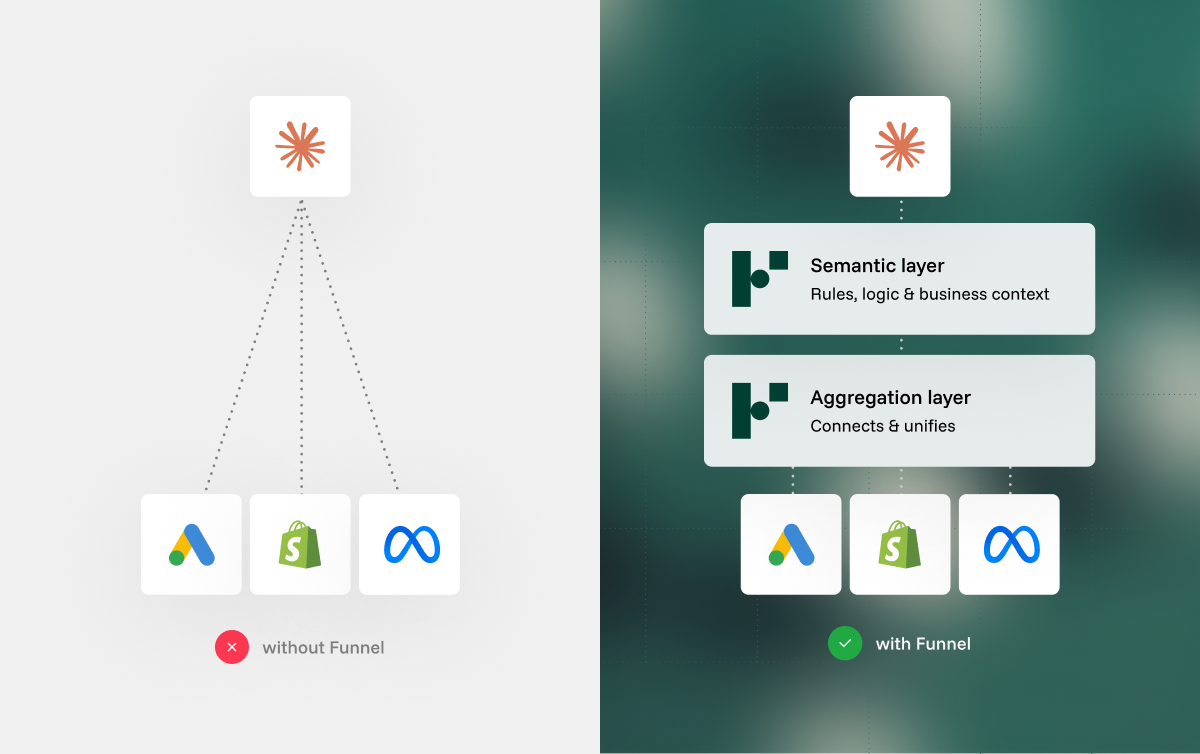
Funnel isn't just connecting your marketing data to AI. It's structuring and defining it so AI can actually reason about it.
That's the distinction worth holding onto. A lot of tools can move data from one place to another. What's hard, and what most teams are missing, is the layer that makes that data meaningful. The aggregation logic. The semantic definitions. The business context that turns a number into an insight.
The Funnel MCP Server brings all of that into the AI products your team already uses through a single connection. That means 600-plus connectors, a semantic layer that makes cross-channel data comparable by default and the business context your team has already built into your Funnel workspace. By the time the AI sees your data, it already understands what everything means.
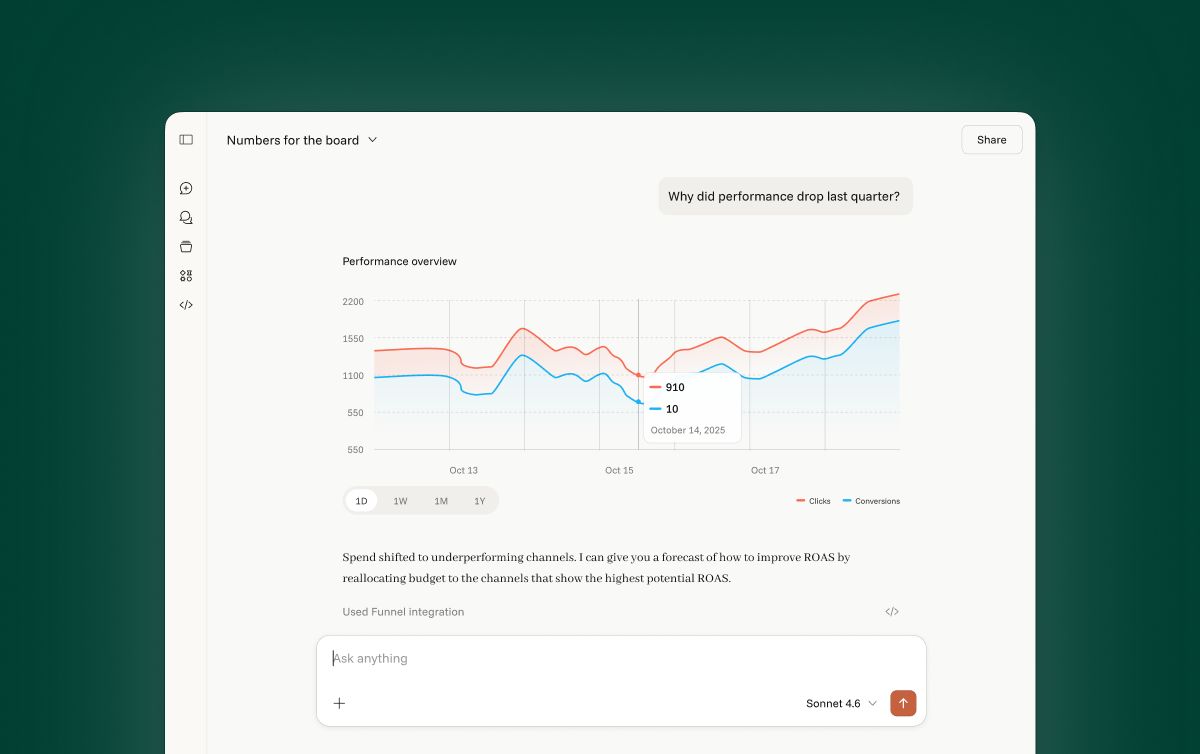
In practice, that means you can ask something like "walk me through my ROAS for the last 30 days, what's driving it and what should I do about it" and get a grounded, reliable answer back, without spending the first ten minutes explaining your attribution model.
The first version supports marketing analytics, exploration and troubleshooting. Write capabilities will follow in future iterations. It works with every MCP-compatible AI product from day one.
An interview with Kim Frithiof, Staff Product Manager for AI
We asked Kim Frithiof, Funnel's Staff Product Manager for AI, to go beyond the announcement and explain what's actually going on under the hood. What follows is an edited version of that conversation, covering everything from why direct platform integrations fail at scale to where agentic marketing workflows are heading next.
Funnel: Most marketing teams already use some form of AI in their workflows. What's the specific problem the Funnel MCP Server solves that they haven't been able to solve on their own?
Kim: “AI is only as powerful as the tools and context it has access to. Funnel's MCP Server gives marketers full access to their marketing data through a single connection. Most other solutions integrate directly with each platform, which is fine when dealing with a limited number of sources. But when you need to perform cross-channel, cross-market, cross-client analytics, we're often talking hundreds, if not thousands, of data sources. That just doesn’t scale.
Funnel has an advantage with our Data Hub, which integrates, stores and transforms data from all these platforms and accounts. We expose that directly to Claude and other AI products by providing the tools to efficiently query it with a single connection.
At this scale, you don't want to expose an LLM to just the raw data. You're going to run into accuracy problems: mixing attribution models, using the wrong cost definitions, using platform-specific campaign dimensions instead of the cross-channel one. Funnel’s semantic layer is built to solve this. It defines the relationships, descriptions and definitions of the data, letting the LLM deterministically query it with correct and accurate results it can reason about.”
We've heard agencies describe direct platform integrations as "API fatigue." How common is that experience, and what does it tell you about where the market is heading?
“We've heard a version of this from several agencies. What I've seen is that agencies tend to be early adopters of the latest technology; it's a very competitive space, and anything you can do to better serve your client gives you an edge. With AI, the pace of change has been staggering, and many agencies are under pressure to deliver on their clients' ever-increasing expectations.
Agencies use what’s available, so we’ve seen them use AI and connect directly to ad platforms via MCPs or APIs. This works for a while. But as the number of integrations grows and the underlying APIs keep changing, the setup becomes unsustainable to maintain. This is the “API fatigue”. Funnel fixes that.”
The MCP standard is still relatively new. Why was now the right moment to build on it, and what does broad MCP adoption mean for marketing teams longer term?
“At the speed that this space is moving, I'd consider MCP fairly established by this point. It's an open-source standard for connecting AI applications to external systems, and we've seen all the major AI players adopt it. This means we can build and improve our MCP Server knowing it will work everywhere. And our customers can be confident that their marketing data will work with whatever AI tools they adopt, now and in the future.”
A common concern with AI-generated analysis is that the outputs sound confident even when they're wrong. How does the Funnel MCP Server address the trust problem?
“That’s a valid concern to have. LLMs are inherently probabilistic systems, and there is no way to fully guarantee the accuracy of their outputs. However, the models have gotten significantly better and hallucinate much less now than they did just a few months ago. In addition, there are ways to drastically improve accuracy by giving the LLM access to the right tools and context.
Funnel's semantic layer defines the rules and definitions of your business and marketing data. We expose that via our MCP Server, which lets the model query the data in a deterministic way: the same query always gives the same accurate result. We also expose useful context like our product documentation, users' own instructions and descriptions, to help the LLM reason and make better, more tailored recommendations.
You should still use human judgment, but with the semantics and context Funnel provides, we can drastically reduce the risk of the AI getting things wrong.”
What does the roadmap look like beyond the initial analytics and exploration use cases? Where does this go?
“Our focus with this initial release is to make sure it's really good at analyzing, exploring and troubleshooting your marketing data. You can use it to dive deep into a specific channel or create a high-level executive summary of your marketing performance. It will initially be limited to reading your data, but with that strong foundation, we plan to introduce write capabilities that will let you fully manage your Funnel setup via the MCP.”
How to connect the Funnel MCP Server to Claude
Funnel is getting listed in Claude's native connector directory soon. In the meantime, you can add it manually as a custom connector. The whole process takes a few minutes.
Before you start, make sure you have a Funnel account with access to at least one workspace and at least one data source already connected, plus permission in Claude to add a custom connector.
- In Claude, open Settings → Connectors and select Add custom connector.
- Give it a name — Funnel MCP works fine.
- Enter the server URL for your region. For the EU, use
https://mcp.eu.ai.funnel.io/mcp. For all other regions, usehttps://mcp.ai.funnel.io/mcp. - Leave the Advanced settings fields blank and hit Add.
- Claude will open a browser sign-in flow for Funnel. Sign in, approve the requested permissions, and you're connected.
Once connected, open your Funnel MCP connector back in Settings to configure tool permissions. For each tool, you can choose always allow, needs approval, or deny — set them individually or all at once, depending on how much oversight you want over Claude's actions.
One thing worth noting: the Funnel MCP Server is read-only in this first release. Claude can query your data but cannot make changes to your Funnel configuration. Write capabilities are on the roadmap.
To confirm everything is working, start a fresh chat and ask something like "List the workspaces I can access in Funnel." If the connection is live, Claude will pull that back directly from your account.
From there, you're ready to start asking the questions that actually matter.
If you run into issues or are connecting from Claude Code, Claude Desktop, or another surface, see the help center article.
Why this matters right now
The center of gravity for marketing workflows is shifting. Teams are starting their analysis in AI products rather than dashboards, and that's not reversing. But the teams getting the most out of that shift aren't the ones with the most sophisticated AI. They're the ones whose data was ready for it.
Right now, most teams aren't there yet. They're getting fast answers from AI that doesn't fully understand what it's looking at. The gap between AI confidence and data reliability is where bad decisions get made.
The AI products themselves are converging fast. The data infrastructure underneath them is not. That's the gap that matters. And the window to get ahead of it is now, before the teams around you do.