



 Get in touch
 Log in




Here's the thing nobody tells you when you buy enterprise ETL: it works fine on your CRM, your finance data and your product database. Then someone plugs in Meta Ads, and the wheels come off. The tool isn't bad; the problem is that marketing data just doesn't work like other data.
Marketing data is chaotic by nature, as it comes from platforms that don’t always align on what constitutes a click, let alone a conversion. You might see attribution windows move mid-quarter or realize that your currency conversions are applied differently than how the account was set up. And even if you manage to keep everything stable, APIs can change every few months with almost no warning, eating up engineering time.
A general-purpose ETL tool is built with stability in mind, where “customer_id” means “customer_id” today and forever. So when you feed a rigid system a stream of volatile marketing data, the result is either the pipeline breaking or continuing to run while filling your warehouse with the wrong data.
If you’re in the market for a new ETL, the main procurement question you should be asking is whether the one in your stack right now is doing anything useful with your marketing data or if it's just an expensive way to move broken numbers into Snowflake.
To help you decide, we’ve put together a comparison of the leading enterprise options for 2026 and a framework to test each one against your own data and use cases.
Why enterprise marketing teams have distinct ETL requirements
Standard corporate data tools work perfectly fine for finance or HR. But marketing data is a completely different beast. Because your marketing team relies on a massive network of constantly changing apps, you need a data pipeline built for the chaos of modern advertising.
More platforms than any other team
A decade ago, enterprise marketers were using an average of 91 tools. Tool complexity is still an issue today, even though, according to Gartner, in 2025, teams actually use less than half of their martech capabilities. No other team shares its daily information across so many separate places. Standard data tools simply aren't built to plug into that many different outlets.
APIs that change faster than your schemas
Marketing platforms like Meta and Google update their software configurations every quarter; they can rename data categories or drop them entirely without telling you. Traditional corporate tools assume systems will remain stable, so your pipeline can break when API changes happen faster than your team can handle. If this happens, your tech team wastes valuable hours fixing broken pipelines instead of building new things.
Data that needs to be standardized first
A "click" or a "lead" doesn't mean the same thing to every platform. If you dump all that raw data straight into your central data warehouse, you just push a big mess downstream. Marketing data needs to be automatically translated into a single, uniform language when you pull it, rather than forcing your analysts to manually sort through conflicting spreadsheets later.
Compliance that scales with data volume
Privacy laws are strict, and major GDPR violations can cost brands a big chunk of their revenue. Because large marketing teams handle massive amounts of personal customer info, they face the highest amount of legal scrutiny. Right now, data engineers waste a huge portion of their week manually scrubbing and organizing these huge lists just to keep the company safe from fines.
General-purpose extract transform load vs. marketing-specific ETL
General-purpose ETL and marketing-specific ETL aren't necessarily rivals; they can also work together. Here's how to tell them apart.
Where general-purpose data extraction works
Standard corporate tools absolutely earn their place in your company's tech stack. They excel at copying massive internal databases into a central cloud warehouse; they give your engineering team clean ways to manage company backend files, and they export data in highly predictable, well-documented formats.
Even the Gartner Magic Quadrant guides judge these large vendors entirely on general corporate needs, like basic data engineering and database support. Not a single category focuses on marketing data because enterprise tools prioritize database stability over daily flexibility.
General-purpose ETL falls short on marketing data mapping
General tools spread their focus across every business department; their depth within complex advertising platforms is thin. Marketing-specific tools put that depth on ad networks, automation platforms, CRMs and web analytics.
Standard corporate tools rarely feature built-in math to handle fluctuating retail variables, such as tracking windows, local currencies or promotional campaigns. When an ad platform updates its system without warning, your software breaks, your developers waste hours coding a manual fix and your marketing team remains completely locked out of their own data.
A complex data integration-first option for marketing
Dedicated marketing platforms take a fundamentally different approach to your data pipelines. They save your raw data as it comes from the source and only apply your tracking rules when you run a report. Because the original data remains safe and untouched, your analysts can recalculate metrics, change their attribution rules or update performance history instantly without re-pulling a single spreadsheet.
Most successful enterprise companies run a general corporate tool for standard business operations, paired with a dedicated marketing-specific ETL built for complex ad networks. A dual-tool setup in the architecture can withstand the volatile nature of marketing data and gives your engineers and growth teams the data environment they need to succeed.
How to evaluate enterprise ETL tools
Take this framework into your next procurement meeting.
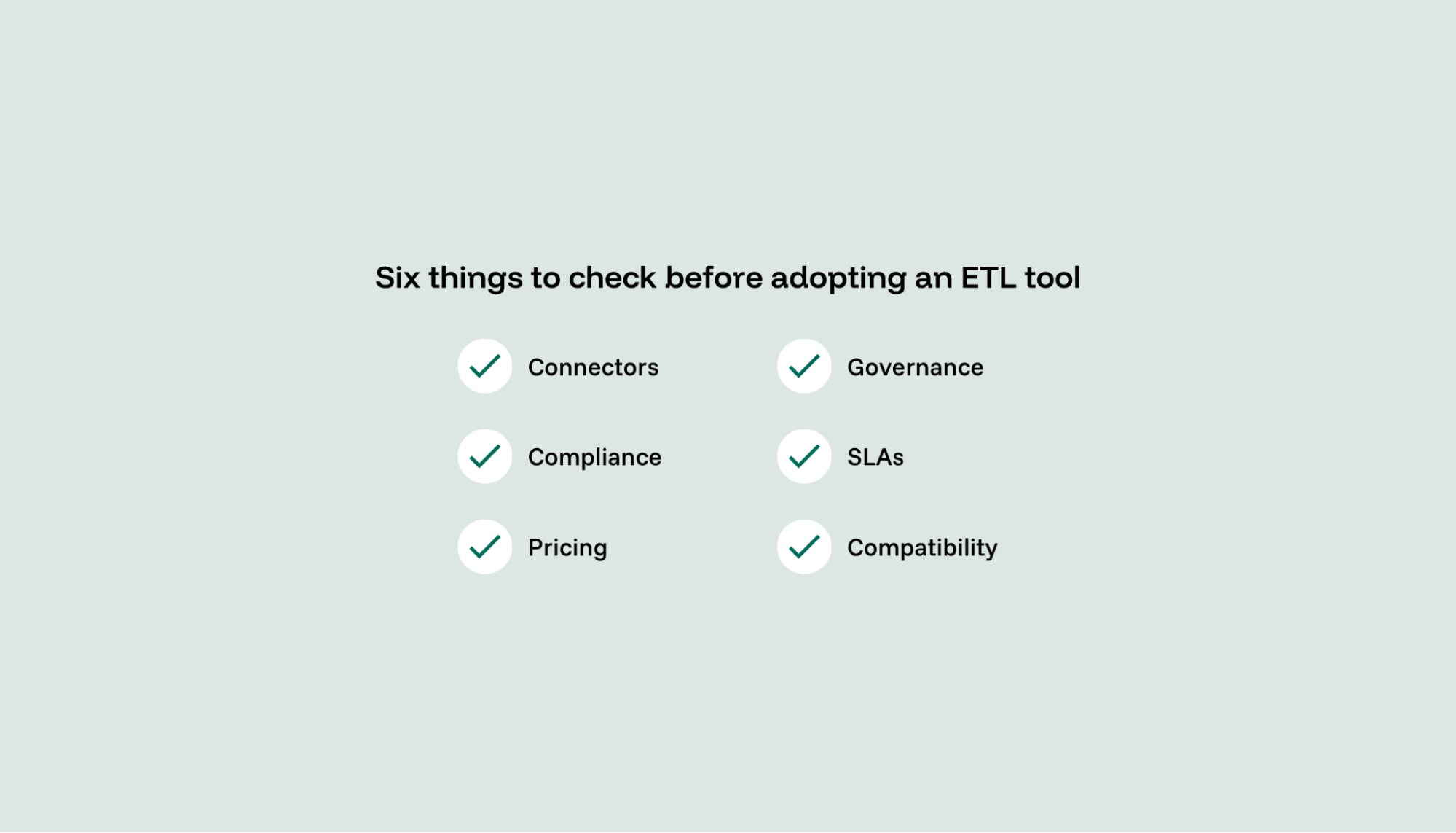
Connector coverage and marketing depth
Connector count and depth matter because you want to connect to the tools your team currently uses easily. But future martech flexibility also comes into play here. You don’t want connector availability to dictate what marketing tools you invest in down the road.
Connector quality and management are also important. Check if the platform maps custom fields and automatically manages historical backfills or merely pulls a basic summary. Ask: if an ad platform alters its API, who manages the fix? If the vendor doesn't handle it, your own data engineers lose their evening to code a patch.
Data access, governance and lineage
For data safety, you need a clear, audit-ready trail from source to dashboard. Your analysts need access to performance numbers, but they should never see sensitive customer details.
When you're assessing vendors, look for precise access controls across every table and column. Automated compliance reports for GDPR and CCPA are now non-negotiable, and leading analysts agree that this level of control separates market leaders from outdated tools.
Compliance and security certifications
Even if the vendor has strong data governance, verify that they have security certifications like SOC 2 Type II and ISO 27001. If you manage global ads, make sure the vendor offers local data storage options.
Support SLAs
The minimum uptime standard for enterprise software is 99.9%. Even a drop to 99.5% can introduce a dangerous liability that can delay your reports. You should expect a four-to-six-hour resolution window for critical pipeline failures, along with 24/7 technical coverage. Just make sure the contract explicitly outlines your service credits in the event the system fails.
Cost predictability for large data volumes
Enterprise pricing structures are either volume-based, per-connector, per-account or a spend commitment. Volume-based plans become a financial trap as you scale. Per-connector models offer flat fees but penalize diverse software stacks, while per-account fees can strain multi-brand setups. All in all, an upfront, spend-based commitment offers the highest predictability for your bill.
Multi-cloud and data warehouse compatibility
Last but not least, confirm if the platform integrates with your data lake or warehouse. The engine must support modern data stacks, with open table formats like Apache Iceberg and Delta Lake without complex workarounds. Ultimately, check for bidirectional data sync as well, because your growth teams will eventually need to push clean warehouse data back out to activate the ad platforms.
The best enterprise ETL tools for data integration in 2026
Here's a quick shortlist of the premier options for enterprise data, followed by a deep dive into each data integration platform.
|
Tool |
Type |
Connectors |
Vendor managed |
Marketing depth |
Built-in normalization |
Compliance |
|
Funnel |
Marketing data foundation |
600+ |
Yes, all |
Full, marketing only |
Yes (currencies, attribution, metrics) |
SOC 2, ISO 27001, GDPR, CCPA |
|
Fivetran |
Warehouse-first ELT |
700+ |
Yes for paid plans |
Partial, mostly Lite tier |
Limited |
SOC 2 Type II, HIPAA, PCI DSS |
|
Informatica |
Data management cloud |
Broad |
Yes |
Major platforms only |
Limited |
Strong governance |
|
IBM watsonx |
Unified integration |
Broad |
Yes |
Major platforms only |
Limited |
Strong |
|
Microsoft Fabric |
SaaS lakehouse |
Via Azure Data Factory |
Yes |
Major platforms only |
Minimal |
Integrated governance |
|
Google Cloud |
Dataflow + Data Fusion |
Broad |
Yes |
Strong on Google, light elsewhere |
Minimal |
Strong |
|
Qlik Talend Cloud |
Integration + quality |
Via Talend catalog |
Yes |
Major platforms |
Quality-focused |
Strong governance |
|
Adverity |
Marketing platform |
600+ |
Yes, all |
Full, marketing |
At extraction (Python, dbt) |
SOC 2, ISO 27001, GDPR |
1. Funnel
Funnel is a marketing-specific data hub. The platform has 600+ connectors, and they're all fully managed.
Funnel monitors and updates both core and custom connectors for the life of your contract. The catalog is 100% marketing, with built-in normalization for currencies, attribution and metric definitions. Funnel takes an integration-first approach, so your raw data is preserved at the source and transformations run at query time. The platform also includes advanced measurement capabilities.
It’s the best fit for the marketing data layer within an enterprise stack and for marketing teams that need reliable data quality to make fast, confident decisions.
2. Fivetran
Fivetran is a warehouse-first ELT tool with 700+ sources. For a marketing team, though, the connector count matters less than the tier each connector falls into. The tier decides how much support you get.
For example, standard connectors are fully managed by Fivetran. Lite connectors run on a lighter setup, with simplified support and a build cycle that often pulls you into the testing. The Partner-Built tier comes from external vendors, so support is routed through them.
So why should you care? Many of the marketing connectors you'd rely on, such as TikTok regional variants and niche affiliate networks, are in the Lite tier. That means your most volatile ad data gets the lightest support. When one of those APIs changes, more of the upkeep falls back on your team. That said, if you're in an organization where engineering owns the data stack and marketing is one source category among many, you're unlikely to run into a connector issue.
3. Informatica
Informatica is a heavyweight contender; it’s built for complex data setups and industries with tight regulations like healthcare or banking. Marketing data, though, sits on the bench. You'll get the big names like Google Ads, Meta and Salesforce. Beyond that, the ad-tech coverage runs thin, so the niche platforms land back with your engineers again. It’s a good enterprise ETL for heavily regulated industries with complex data setups.
4. IBM watsonx.data integration
IBM watsonx.data integration is built for large-scale data processing. But it's meant for data that barely changes from month to month, like payments and financial systems. IBM does this so well that Gartner has named it a leader in data integration for 20 consecutive years.
For a marketing team, though, you'll get the big ad platforms like Google and Meta, but smaller niche platforms aren't ready to use. Plus, because marketing data is inherently volatile, your data scientists will have to build each connection and keep it running. This ETL tool is a good option for large organizations that need large-scale movement for their standard business data.
5. Microsoft Fabric (with Azure Data Factory)
Microsoft Fabric delivers a complete storage and analysis platform with built-in data governance. Ad connectors run through Azure Data Factory, which covers the major platforms.
However, once it arrives in your system, Fabric copies your data in but doesn’t transform it. For example, your Meta spend might start in dollars, and your Google spend in euros. Similarly, one platform counts a conversion after a click, while another counts it after a view. Before anyone can trust a report, someone with the necessary technical expertise must manually adjust the data. If your company already runs on Microsoft software, the setup makes sense. Just know that the data cleanup falls entirely on your developers.
6. Google Cloud (Dataflow and Cloud Data Fusion)
Google Cloud is great if your data is inside the Google ecosystem. The system pulls Google Ads and GA4 records into BigQuery with minimal setup. However, no large ad team relies on Google alone. Your stack likely includes diverse data sources like Meta, TikTok and Amazon. Google Cloud doesn't natively support those rival platforms, which will force you to build or buy separate connectors for each, and your own team must stitch them together for data visualization. Google Cloud is the best fit if your workflow centers entirely on BigQuery and Google's native ad tools.
7. Qlik Talend Cloud
Qlik Talend Cloud puts data quality and governance first. For a team that gets audited or works under strict rules, that's a real plus.
But the ad platform connectors run through Talend's general catalog, so they don't go as deep. Talend can transform your data, but it doesn't offer marketing rules out of the box. It's on your team's shoulders to build and maintain the data cleansing itself. Qlik Talend Cloud is the best fit for companies that prioritize data quality and rules over marketing depth.
8. Adverity
Adverity is built for marketing, with 600+ fully managed data connectors. Adverity uses a traditional ETL approach. At the point of data extraction, Adverity transforms the data using Python scripts and dbt. That hands your engineers a lot of control, and some teams want that.
But let's say you want to change how you count a conversion, or move your attribution window. You can't just flip a setting. An engineer has to rewrite the code that processed the data, then run the whole thing again. So Adverity suits teams that want to own the work and have the capacity for engineers to take on the load. Adverity is the best fit for marketing teams with their own data engineers who want full control over how their data gets transformed.
Building a business case for investing in enterprise data integration tools
Most of these enterprise systems cost six figures, so your request will need to get the green light from finance and procurement. Here are some talking points you can arm yourself with:
The cost of fragmentation
Only 7% of martech decision-makers name poor integration as a top hurdle to value, per eMarketer. Yet 70% of organizations use more than one data integration tool. Every extra tool means higher costs, greater complexity and more engineering time spent on connector upkeep.
Shared KPIs between marketing and finance
Only 11% of advertisers have shared KPIs between marketing and finance, and 18% bring effectiveness insights into cross-team decisions. Integrated data makes sharing KPIs possible to facilitate alignment.
Becoming forward-looking
According to BCG, 80% of advertisers want forward-looking simulations, not just historical ROI. Simulation quality depends on the data quality feeding it.
Marketing time
Marketers spend 24% of their data-related time on collection and 19% on cleaning, according to MarketingProfs. In all, 63% of marketing data time goes to tasks you could automate. The top frustrations are data quality at 50% and data silos or availability at 43%. Every hour a senior marketer spends reconciling numbers is an hour not spent on strategy. The data integration process turns marketing from a reporting function into a planning function.
The right data integration platform is out there
When you’re procuring a new ETL tool, your decision will boil down to whether you should try to find one tool that does everything or accept that your marketing data needs its own space. For most large companies, the best approach is to keep the two worlds separate.
Your general-purpose ETL handles broad business needs, such as replicating databases or feeding the warehouse with finance and sales data. A marketing-specific platform manages the volatile ad data and analytics tools that your reporting relies on. These systems work best when they run in parallel; they both feed into the same central warehouse, but they allow each team to work in an environment that fits their own workflow.
The platform you want handles the whole marketing job, not just pieces of it. It connects to your cloud data warehouse, automates data integration and keeps your raw data intact, so your marketing team can run its own reports without breaking the data team's governance.
Frequently asked questions
What is the best enterprise ETL tool for marketing?
For pure marketing data, a platform like Funnel offers deep ad-platform connectors, built-in normalization and self-serve access for marketers. For broad database replication across the entire business, a general-purpose ETL like Fivetran or Informatica is a better fit. Most large companies run both. Match the tool to the data and to the team that owns it.
What's the difference between Fivetran and Funnel for enterprise?
The main difference is that Fivetran treats marketing as one source category. Funnel focuses only on marketing data.
Fivetran is a warehouse-first ELT tool built for engineering teams. The platform moves raw data from many source types into your warehouse, where you transform it. Funnel is a marketing-specific data hub. Funnel preserves raw marketing data at the source and applies transformations at query time, with built-in currency normalization and attribution.
How do you evaluate ETL tools for large marketing teams?
Start with the connector depth, then ask who fixes a connector when an API changes: the vendor or your engineers? Check governance, security certifications, support SLAs and warehouse compatibility. Look at expected pricing based on your data volume. And before you sign anything, test each tool with your own data.