






Are you comparing Funnel and Adverity because you need rock-solid, scalable marketing reporting? Both Funnel and Adverity help teams bring marketing data together. The difference is what happens after the data arrives.
Adverity follows a more technical data workflow approach, giving teams flexibility to build and manage data pipelines. It’s a better fit if you want a more traditional extract, transform and load (ETL) setup and are happy to lean on engineers for modeling and maintenance.
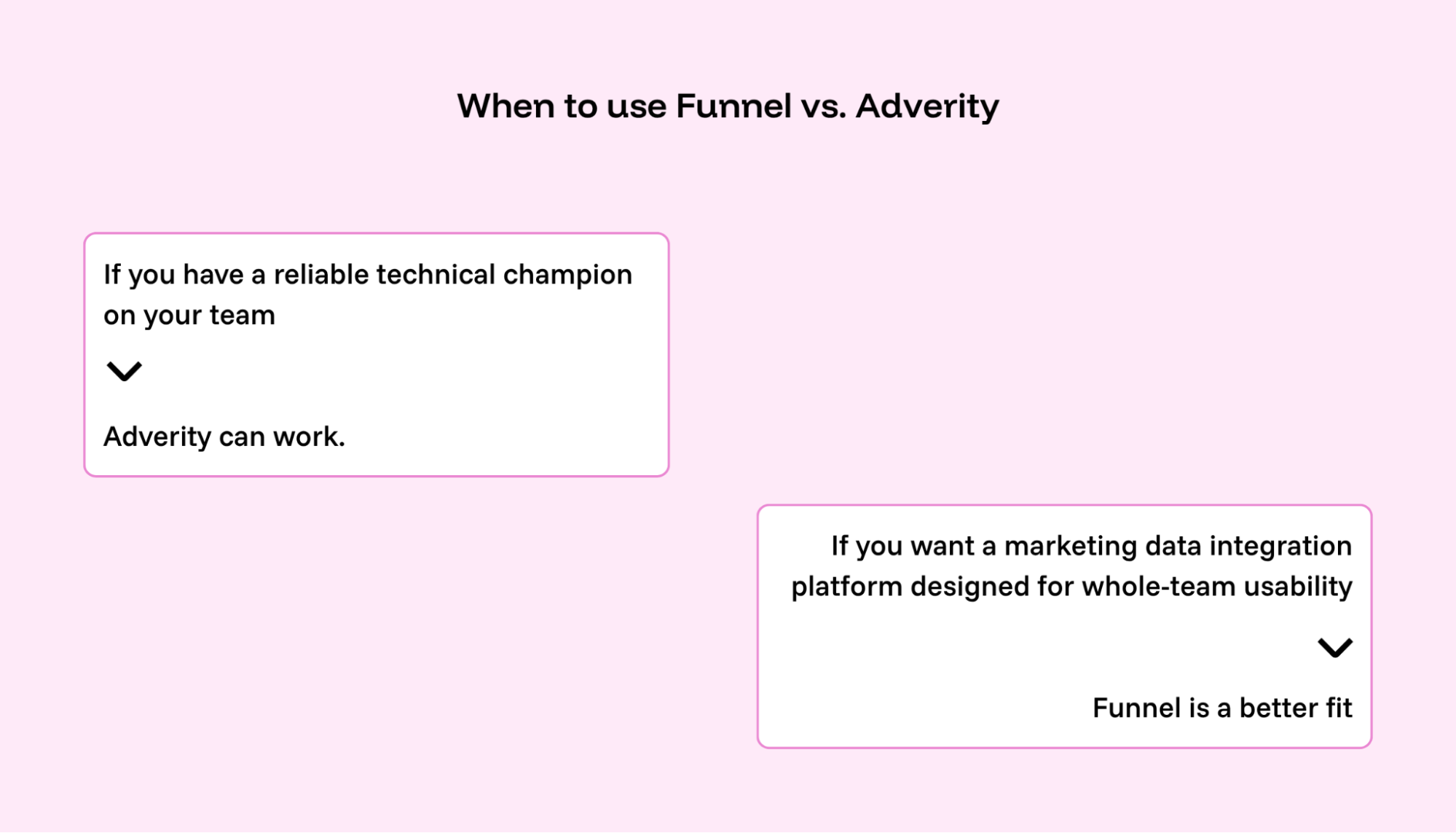
Funnel is a marketing intelligence platform designed to give marketing and data teams dependable marketing data they can use across reporting, measurement and AI workflows. It’s designed for the whole marketing team, so even if your technical champion leaves, your team isn’t stuck.
We’ll look at ease of use, speed to value, pricing and measurement of both platforms so you can decide what fits your roadmap.
Two approaches to managing marketing data
On paper, Funnel and Adverity solve a similar problem: bringing marketing data together. But they are built around different approaches.
Adverity is designed around a technical data workflow. Teams can build sophisticated pipelines, transformations and destinations, particularly when they have dedicated engineering resources.
Funnel is built around dependable marketing data. It gives marketing and data teams one foundation where data can be collected, prepared, governed and used across marketing use cases.
.Funnel is a marketing intelligence platform built on the Data Hub. The hub pulls in your marketing data, harmonizes data that would otherwise stay fragmented across tools and keeps it structured, reliable and governed. That single, trusted dataset then feeds everything else: you can use it in advanced measurement models, activate it back to ad platforms, export it to BI tools or data warehouses or build reports directly in Funnel.
Furthermore, the Data Hub is also fully no-code. Marketers and data teams connect sources without SQL, use pre-built dashboards to get to reporting fast and track performance across channels like LinkedIn and Google Ads with daily data refreshes. There’s no need to rely on a single tech champion to run everything because it’s designed for the whole team to use.
At a high level, the trade-offs look like this:
|
Question |
Funnel |
Adverity |
|
What problem does it solve? |
Gives teams dependable marketing data they can use across reporting, measurement and workflows |
Helps technical teams build and manage marketing data pipelines |
|
Who typically operates it? |
Marketing teams, analysts and data teams |
Teams with technical expertise managing data workflows |
|
Where does marketing logic live? |
In a shared marketing data foundation |
In technical workflows and transformations |
|
How does it scale? |
Through reusable definitions, managed integrations and shared workflows |
Through technical control and custom pipeline management |
|
Best fit when... |
Teams need marketing data they can trust and use across the organization |
Teams have engineering resources to manage complex pipelines |
Why agencies choose Funnel over Adverity
Agencies don't win awards for complex data stacks. Your clients care that reports land on time, tell a clear story and don’t break the night before a QBR. So while Adverity and Funnel can both centralize performance data, agencies that want to scale reporting without hiring a bunch of engineers tend to lean toward Funnel.
Scale client reporting without the chaos
Think about your current client list. As soon as you add a few more brands, channels or markets, any fragile setup in your data integration starts to show cracks.
Adverity offers robust ETL capabilities and plenty of connectors, which is why data teams often speak highly of its flexibility. But G2 reviewers also mention a steep learning curve for advanced data transformation work, a tricky setup and limited guidance when something goes wrong. A few even call out confusing error tracking and mistakes that are hard to reverse. So when you are running dozens or hundreds of data streams, instability can easily lead to missed SLAs and last-minute spreadsheet fixes.
In contrast, Funnel’s marketing intelligence platform gives you a stable foundation to build on. Platform-specific teams specialize in API changes, maintenance and new connections, so if a platform updates an API, Funnel catches it before data gets lost, reports break or data quality gets affected.
Additionally, Funnel keeps historical marketing data available so teams can maintain continuity as definitions evolve and reporting needs change.
On top of that, Funnel automates the advanced transformations layer (collecting, labeling, cleaning and organizing) to harmonize data, instead of leaving you to manually fix things like naming conventions or currencies. This ensures data accuracy. Arm Candy used Funnel to rebuild its reporting layer and transform data, saving about 12 hours a week on reporting alone and cutting broken client-facing reports to near zero.
For larger networks, the same foundation scales out across teams and markets. For example, Havas Media France has around 50 people collaborating in Funnel to manage reporting for more than 50 clients in one shared environment, instead of juggling one-off workarounds per account. The team uses Funnel Portals, which gives each client a customized dashboard for unlimited users, so they choose what to share, invite the right stakeholders and roll new clients or channels into a proven structure instead of rebuilding reports from scratch.
Your whole team can use Funnel
Most marketing agencies don’t want a world where only one or two people hold the keys to the connected data model. Some Adverity users hint at that single-champion dynamic, with advanced features feeling inaccessible for team members without the technical skills.
Funnel’s no-code workspace is designed to democratize connected data so account leads, analysts and data specialists can all work from the same canvas in a self-service style. You define shared logic once (the dimensions, groupings and calculations across your client portfolio) and reuse it everywhere instead of maintaining custom formulas in scattered Google Sheets. This makes it possible for the whole team to use the platform rather than having to go through the one or two people who have enough technical knowledge. Since anyone can use it, your team won’t get stuck if your technical champion goes on leave or exits the company entirely.
That’s what matters most to Funnel users like Journey Further, who use Funnel to save more than 500 hours of analyst time each month and free people up to focus on why performance changed, not how to fix a broken extract. Power Digital’s analytics lead explains: “It makes me a data engineer, even though I’m not an engineer,” because they can execute end-to-end workflows without waiting in line.
Why brands choose Funnel over Adverity
If you run marketing on the brand side, the pressure is on from every angle. Channels keep piling up, IT can only handle so many “quick” data requests and leadership needs answers now. Both Adverity and Funnel pull your marketing data into one place, but there’s a stark difference between them when you want answers fast.
Eliminate the IT bottleneck
With a traditional data pipeline approach, marketing data often moves through engineering-managed workflows before marketers can use it. That model works well when teams have dedicated technical resources, but it can create bottlenecks when marketing needs to move quickly.
If every new view of performance means a request to IT, you are in the same position as Babyshop.
Babyshop hit the limit of that model and switched to Funnel. The team stopped throwing raw tables at marketers and started shaping data in a no-code interface first, then sending modeled output to Snowflake and their external BI tools. The data science lead chose Funnel because it lets performance marketers handle real transformations in an interface they understand. Marketing now owns how its data looks and behaves, and the data team focuses on architecture, governance and deeper analysis.
If your day looks like ETL, SQL and ticket queues, Funnel helps you ease that bottleneck so you can move faster without giving up control.
Move from manual data pulling to real-time action
You might recognize this next pattern, too. Your data exists, but by the time you export it, clean it and roll it up, the moment to act has passed.
Elastic worked like that for a long time. Monthly reports took hours or even days to build by hand, and the team could not adjust budgets until the next big report cycle.
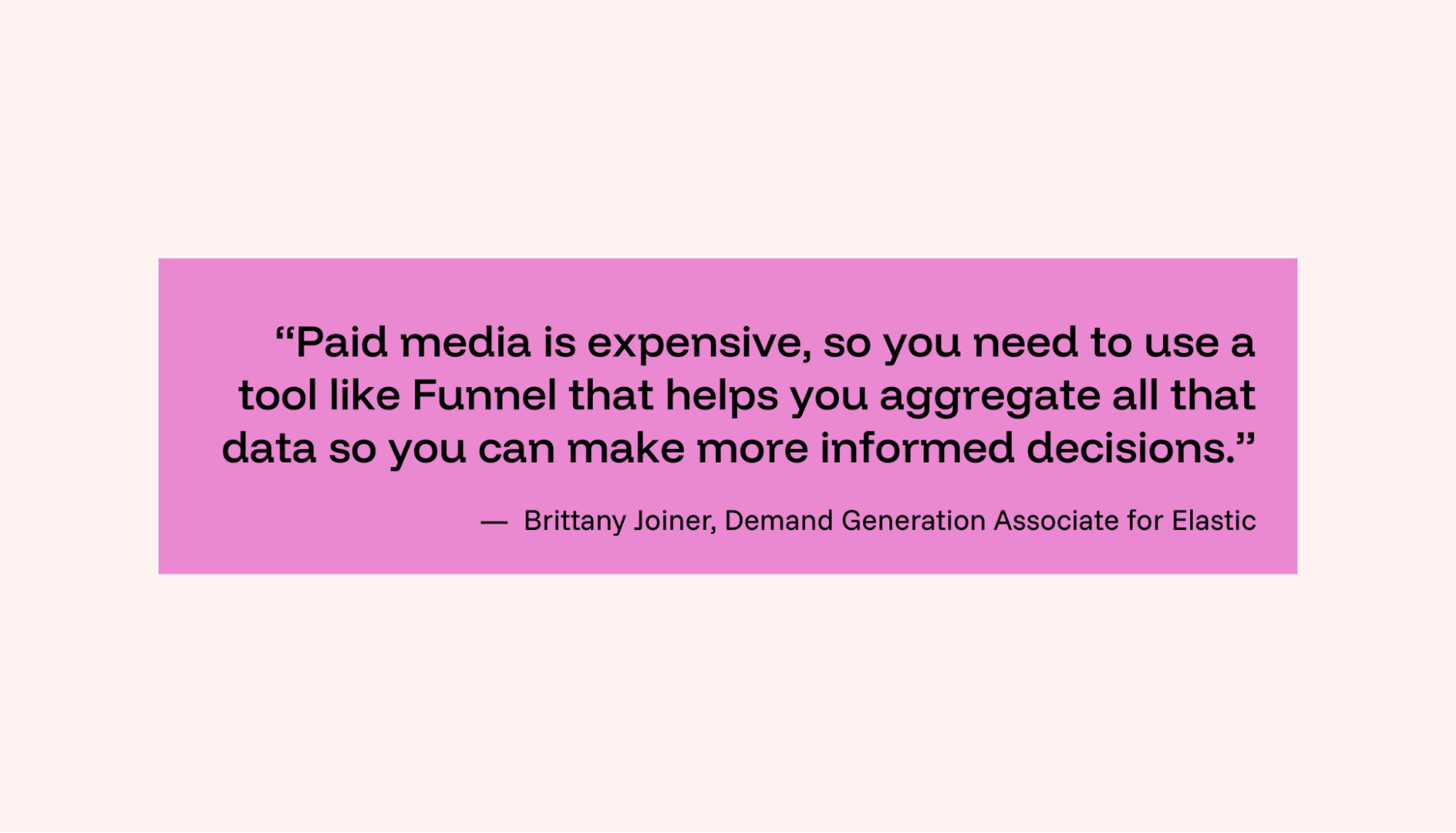
Once they switched to Funnel’s marketing intelligence platform, they set up shared dimensions once and built a simple budget pacer on top instead of another static deck. That pacer shows how webinar and ebook campaigns spend and perform in real time, not weeks later. The team now checks one screen a day and can nudge budget up or down while it still matters.
Digicel had the same problem, just on a larger scale. The media team spent four to five days every month reconciling budgets across 12 brands and 26 markets. With Funnel in place, reconciliation dropped to under 48 hours. Now, automated flows handle most of the collection and standardization, and the team spends the time gained on improving campaigns.
Get 100% coverage, not just the big platforms
A lot of brand setups look solid from a distance, but they’ll likely have Google and Meta in neat dashboards, then the regional search engines and smaller partners in side spreadsheets, even though they eat a big share of the budget. On paper, they can say they have one view of performance. In reality, they’re flying half blind.
Trivago was in a similar position; they automated the largest platforms but had no central view of many smaller ones, even though those channels made up most of their mix. Consequently, leadership made calls on only a slice of the data.
Funnel helped the team see the full picture. Out-of-the-box connectors covered major sources, and custom connectors picked up local search engines, all without extra developer work. Data from every channel now flows into one model and straight into their backend and BI stack. Trivago easily moved from partial coverage to a full unified view.
If your reports spotlight five big platforms and leave everything else as footnotes, Funnel’s connector library and pre-built dashboards give you an easier path to full coverage than an ETL-first approach like Adverity, which often needs more hands-on configuration.
A deep-dive comparison: Adverity vs Funnel
When you weigh Adverity against Funnel, you’re not just comparing features. You’re deciding how you and your team will work with marketing data, analytics tools and marketing channels every day.
When you compare Funnel and Adverity, you are not just comparing features. You are choosing how your organization wants to work with marketing data as complexity grows.
One approach gives technical teams control over building and managing data workflows. The other gives marketing and data teams a dependable foundation they can use across for reporting, marketing measurement, signal engineering and agentic AI.
The right choice depends on whether your priority is technical flexibility or a shared foundation that helps teams trust the data, move faster and use it wherever decisions happen.
Adverity acts as an ETL tool that sits close to engineering and keeps most changes in the hands of people with technical expertise. Funnel works as a marketing intelligence platform and gives marketing teams and data specialists one shared hub with extensive no-code data connectors and reporting. It also includes data activation and measurement as part of the core product, so you see insight and impact in the same place you manage the data.
The breakdown below shows how those two approaches play out in daily use.
Speed to value
A marketing data platform should not become another long technical project before teams see value. The goal is not simply to connect data sources. It’s to help teams reach trusted answers faster.
Different organizations take different approaches. Some teams prefer building highly customized data workflows with significant technical involvement, and for organizations with those resources, that approach can provide valuable flexibility. But it can also mean more time spent setting up pipelines, defining models and maintaining the infrastructure before marketers can use the data.
Funnel takes a different approach. It is built around helping marketing and data teams establish a dependable foundation for their marketing data quickly, then build on that foundation as needs evolve.
With pre-built connectors, a no-code interface and support from Funnel’s solutions team, teams can start bringing their marketing data together, align definitions and create a consistent structure for reporting and analysis. Instead of spending months preparing data before teams can use it, organizations can establish a working foundation and refine it over time.
The difference becomes more important as marketing complexity grows. New channels, markets and stakeholders should not require rebuilding the data setup from scratch. With Funnel, teams can reuse shared definitions and structures as they expand, so adding new sources becomes part of an existing workflow rather than a new technical project.
The result is less time spent maintaining the data foundation and more time spent using it: understanding performance, identifying opportunities and deciding where to invest next.
If leadership expects marketing teams to move quickly, time to trusted insight matters more than the number of features a platform has.
Ease of use
Technical teams may prefer platforms that give them detailed control over data workflows and transformations. But when marketing data depends heavily on specialist knowledge, everyday questions can become bottlenecked by the people who maintain the setup.
This can create a familiar pattern: a small group of technical users owns the data model, while everyone else relies on requests and handoffs to make changes or answer new questions.
As a marketing intelligence platform, Funnel gives marketers, analysts and data teams a shared foundation for working with dependable marketing data. The platform is no-code, which means teams can connect sources, define metrics and prepare data without relying on scripts for everyday workflows.
Instead of creating a single point of dependency, teams can collaborate around shared definitions and reusable logic. Custom dimensions and metrics allow teams to standardize data across platforms, apply naming conventions once and use them consistently across reporting and analysis.
Funnel also helps teams answer questions without constantly moving data between tools. The Data Explorer lets users investigate performance directly, while built-in dashboards support pacing, budget tracking and reporting. When teams need deeper analysis, they can send harmonized marketing data to their warehouse or BI tools.
The result is not simply a platform that is easier to use. It is a way of working where technical experts can focus on complex challenges while marketing teams can answer everyday questions without unnecessary handoffs.
Pricing predictability vs. row-based billing
Marketing teams rarely stay the same size. New channels are added, campaigns scale, markets expand and more teams need access to the data. The question is not only what a platform costs today, but whether the pricing model supports growth without creating unexpected complexity.
Many data and pipeline tools tie cost closely to data volume or throughput, which can make spend harder to predict as marketing activity expands and others rely on fully custom quotes with little public transparency.
With Adverity’s row-based enterprise pricing, every extra event you send through the platform adds to the bill. That structure creates a second layer of risk. When you increase spend, test new channels or add markets, you don’t just ask, “will this drive revenue?” You also have to ask, “what will this do to our row count?”
With Funnel, pricing is based on the capabilities teams use (connectors, accounts and destinations) rather than the amount of data generated, so teams can scale marketing activity without every increase in data volume automatically raising costs.
For marketing leaders, this matters because data infrastructure should support growth, not become another constraint to manage. Teams should be able to add channels, explore new opportunities and expand their reporting workflows with confidence.
The goal is simple: your marketing can grow because your data foundation grows with it.
Renewal timing
Adverity contracts typically require notice well ahead of renewal. If you’re currently in an Adverity contract, the time to evaluate alternatives is at least six months beforehand, not at renewal. And if you intend to sign with them, keep this in mind, as being locked in a contract can compound the single-champion risk. If the one person who understands the platform leaves, you may be contractually committed to a tool the rest of the team struggles to operate.
On the other hand, Funnel’s marketing intelligence platform is built so the whole team can use it, and it doesn’t have a renewal clause working against you. You won’t need to worry about renewal timing like you would with Adverity.
No matter the platform you choose, always confirm the current contract terms directly with each vendor before signing anything.
Data coverage and reliability
Getting marketing data into one place is only the first step. The bigger challenge is keeping that data dependable as channels change, platforms update their APIs and teams need to answer new questions.
Both Funnel and Adverity help teams connect marketing data from different sources. The difference is what happens after those connections are in place. As marketing complexity grows, maintaining consistent, reliable data can require significant operational effort.
Some organizations choose a more technical approach, where teams build and manage their own data workflows, transformations and pipelines. This can provide flexibility and control, particularly when dedicated technical resources are available. But as channels, markets and stakeholders expand, maintaining those workflows can become an ongoing responsibility.
Funnel is built to give teams dependable marketing data they can use across reporting, measurement and other workflows. Funnel provides more than 600 connectors across advertising, analytics, ecommerce and CRM sources, with managed integrations designed to keep data flows reliable as platforms change.
When a platform updates an API or changes how data is structured, Funnel helps teams maintain continuity by managing those changes and preserving historical data. This allows teams to adapt definitions and reporting needs without starting over or rebuilding their data foundation.
Reliable marketing data is not only about having access to numbers. It is about knowing those numbers remain consistent, complete and available when decisions depend on them.
With a dependable foundation in place, marketing and data teams spend less time maintaining data flows and more time answering important questions: which channels are working, where should budget move and what opportunities should they explore next?
Measurement
At some point, teams stop asking only “can we get this data in?” and start asking “what should we do next?”
That is where dependable marketing data becomes critical. Measurement models are only as reliable as the data underneath them. If channel data is incomplete, inconsistent or difficult to trust, even sophisticated models can lead teams in the wrong direction.
A traditional data pipeline approach helps teams move marketing data into warehouses or business intelligence tools, where they can build their own reporting and analysis workflows. This can work well for organizations with the technical resources to manage the full measurement process.
Funnel connects the data foundation and measurement workflow. Funnel Measurement runs on top of the Data Hub, using the same governed marketing data teams rely on for reporting and analysis. This means measurement starts with consistent definitions, connected data sources and a foundation teams already trust.
Rather than relying on a single view of performance, Funnel uses measurement triangulation, combining marketing mix modeling, attribution and incrementality testing to help teams understand what is driving results across channels, markets and conditions.
The goal is not simply to explain what happened. It is to help teams make better decisions about where to invest next.
With Funnel AI, teams can explore their marketing data through natural language questions and understand potential scenarios before making budget decisions. For example, teams can explore the impact of shifting investment between channels and use those insights alongside their existing planning process.
Because measurement, reporting and marketing data preparation are connected through the same foundation, teams can move from analyzing performance to acting on it with greater confidence. If you need more than a place to send marketing data, the difference is the foundation underneath the decision. Funnel helps teams build measurement workflows on marketing data they can depend on.
What users are saying: Funnel vs. Adverity on G2
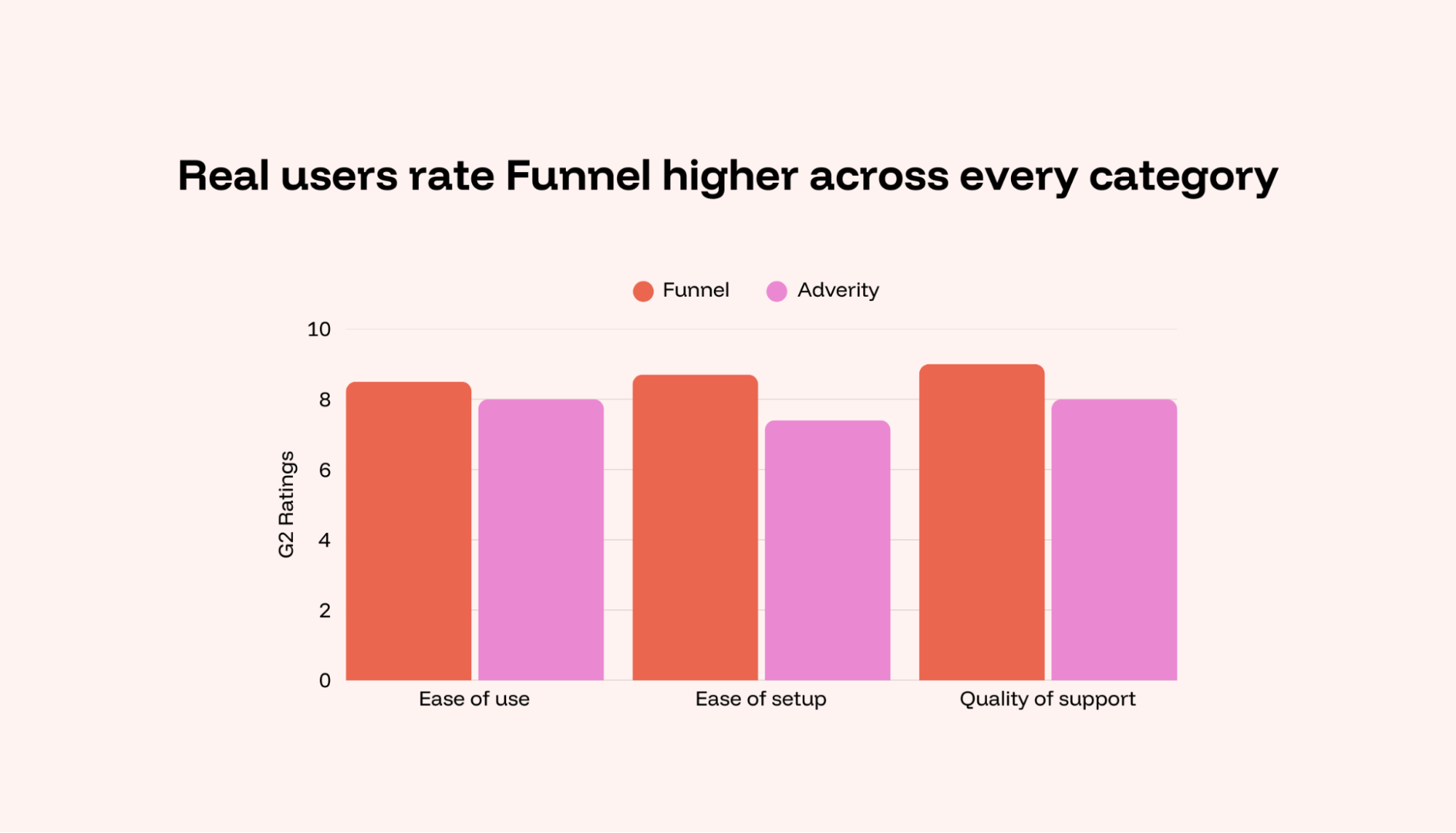
Real user reviews on G2 consistently rate Funnel higher than Adverity for ease of use, setup and customer support. That lines up with what you would expect from a marketing intelligence platform that aims to be genuinely no-code rather than an ETL platform with a friendlier face.
All in all, teams find Funnel simpler to get started with, easier to live in day-to-day, and more reliable when they need help.
Ready to simplify your marketing data?
You’ve probably landed here after wrestling with a platform that just feels harder than it should. Maybe you’ve spent weeks trying to make Adverity work, chasing Python scripts, looping in IT or waiting for someone else to fix your reports. Maybe you’ve even watched your costs climb for the simple act of growing.
We’ve built Funnel to be different; our platform is for marketers and agency teams who need to move fast. We believe you shouldn't need a degree in data science to get value from your data.
The choice between Funnel and Adverity is ultimately about what role marketing data plays in your organization. If data is mainly something to move from platforms into technical systems, a pipeline approach may be enough. But if marketing data needs to support reporting, measurement, AI workflows and decisions across teams, the foundation underneath that data matters.
Funnel gives marketing and data teams dependable marketing data they can use across reporting, measurement, AI workflows and other marketing use cases. Instead of spending time maintaining disconnected data workflows, teams can focus on understanding performance and deciding what to do next.
Don’t wait until your reporting breaks; get ahead with Funnel. Get a demo today.
FAQs about Adverity vs. Funnel
What is the difference between Adverity and Funnel?
The core difference between Funnel and Adverity is who can operate it day to day. Adverity centers on engineers and single tech champions, and Funnel is designed for the whole team.
Adverity is a traditional extract, transform and load (ETL) platform built for technical teams. Funnel is a marketing intelligence platform that collects, stores and harmonizes marketing data into a no-code workspace.
What does "single-champion dependency" mean in marketing data tools?
Single-champion dependency is when one technical person holds all the knowledge needed to operate a platform, so the rest of the team can’t make changes without going through them. When that person is unavailable or leaves, the team gets stuck, and reporting can stall. Single-champion dependency can also result in an overflow of support tickets filed to a single person, which further stalls marketing teams.
Is Adverity better than Funnel for enterprise?
Adverity offers strong ETL flexibility that suits enterprise teams with dedicated data-engineering resources. Funnel scales across large teams and markets without that dependency. For most enterprise marketing teams, the deciding factor is whether you want a tool only specialists can use or one the whole team can self-serve.
When should I choose Funnel over Adverity?
Choose Funnel when you need a marketing data platform that provides fast time-to-value, predictable pricing and reporting the whole team can build and maintain without filing tickets with IT. Funnel is also the safer choice if you want to avoid single-champion dependency.
Is Adverity more expensive than Funnel?
Adverity uses a row-based enterprise pricing model with no public pricing list, which makes it hard to forecast the actual price. Funnel uses transparent, plan-plus-usage pricing, so costs won’t spike if a campaign performs well. You always know what to expect and what you’re paying for.