






Marketers are flying the most advanced machines ever built, but most still have no radar.
In fact, nearly eight in ten marketers say they don’t have a clear signal on what’s truly working. Funnel’s 2026 research reveals the paradox of modern marketing: teams have more data, tools and AI than ever, yet most still feel like they’re flying blind.
Despite record investment in analytics and automation, marketing remains trapped in a “B– performance cycle.” Teams analyze reports on what happened, but they don’t have the marketing intelligence required to understand why something happened or what to do next. They’re not confident. They don’t feel capable enough to innovate. They’re just trucking along. The result is cautious, reactive decision-making in an era that rewards speed and experimentation.
So what’s behind this paradox in marketing and, more importantly, what can we do to get out of it? This article introduces Funnel’s latest research, which serves as a reality check and roadmap for moving from data overload to true marketing intelligence.
The paradox of progress: more data, less intelligence
Marketing teams have never had more data, tools or AI capabilities at their disposal, yet decision-making hasn’t improved. Funnel’s research found that 72% of in-house and 55% of agency marketers struggle to turn data into actionable insight. Many describe being buried under dashboards and metrics that measure activity, not meaning.
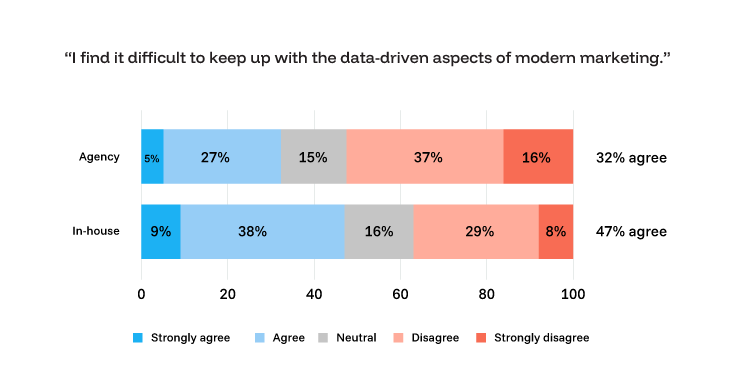
Automation has increased output, but not understanding. Eight in ten marketers still lack a clear signal on what’s working across channels, and the abundance of disconnected data often breeds hesitation instead of confidence.
The problem isn’t access to information. It’s the ability to interpret it, connect it to outcomes and act with conviction. Marketers are generating more reports than ever, yet many still can’t answer the most important question: what should we do next?
To understand why, you have to look at how most marketers grade their own performance.
The “B– marketer” problem
Marketers grade their own performance a B– (82%), and rate their agencies similarly at 81%, a clear sign of progress without transformation. The top reasons for underperformance are unclear or shifting KPIs, a lack of alignment with sales, poor data quality and slow decision-making.
More than half of marketers (53%) say their budgets or resources don’t match their targets. Another 38% cite misalignment with other teams, and 36% admit their goals keep changing. Cultural friction compounds the issue as many fear that challenging old practices will backfire.
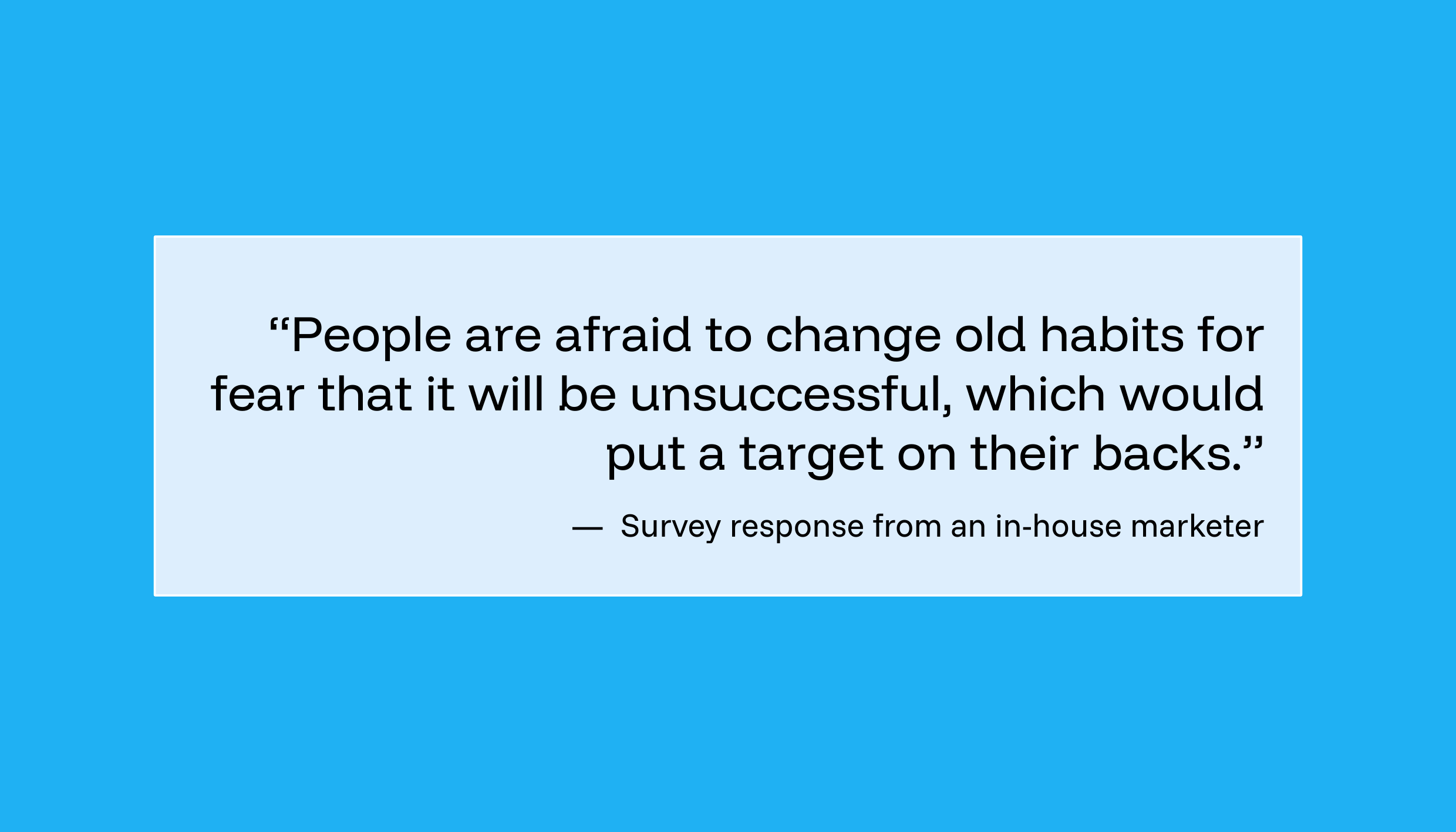
The result is a cautious, reactive mindset where teams report results but hesitate to test or innovate. This B– performance cycle keeps marketers focused on describing the past instead of shaping the future.
Breaking that cycle starts with rethinking what intelligence actually means.
Reporting isn’t intelligence
Forty-one percent of in-house marketers say that when they report results, they don’t analyze the “why” or identify actions to take. Instead, most teams focus on summarizing past performance rather than diagnosing causes or predicting what will happen next.
This is a major shortcoming in modern reporting, but it also reveals an opportunity. When marketers move beyond descriptive dashboards and start translating data into clear next steps, they unlock the ability to learn, adapt and drive meaningful growth.
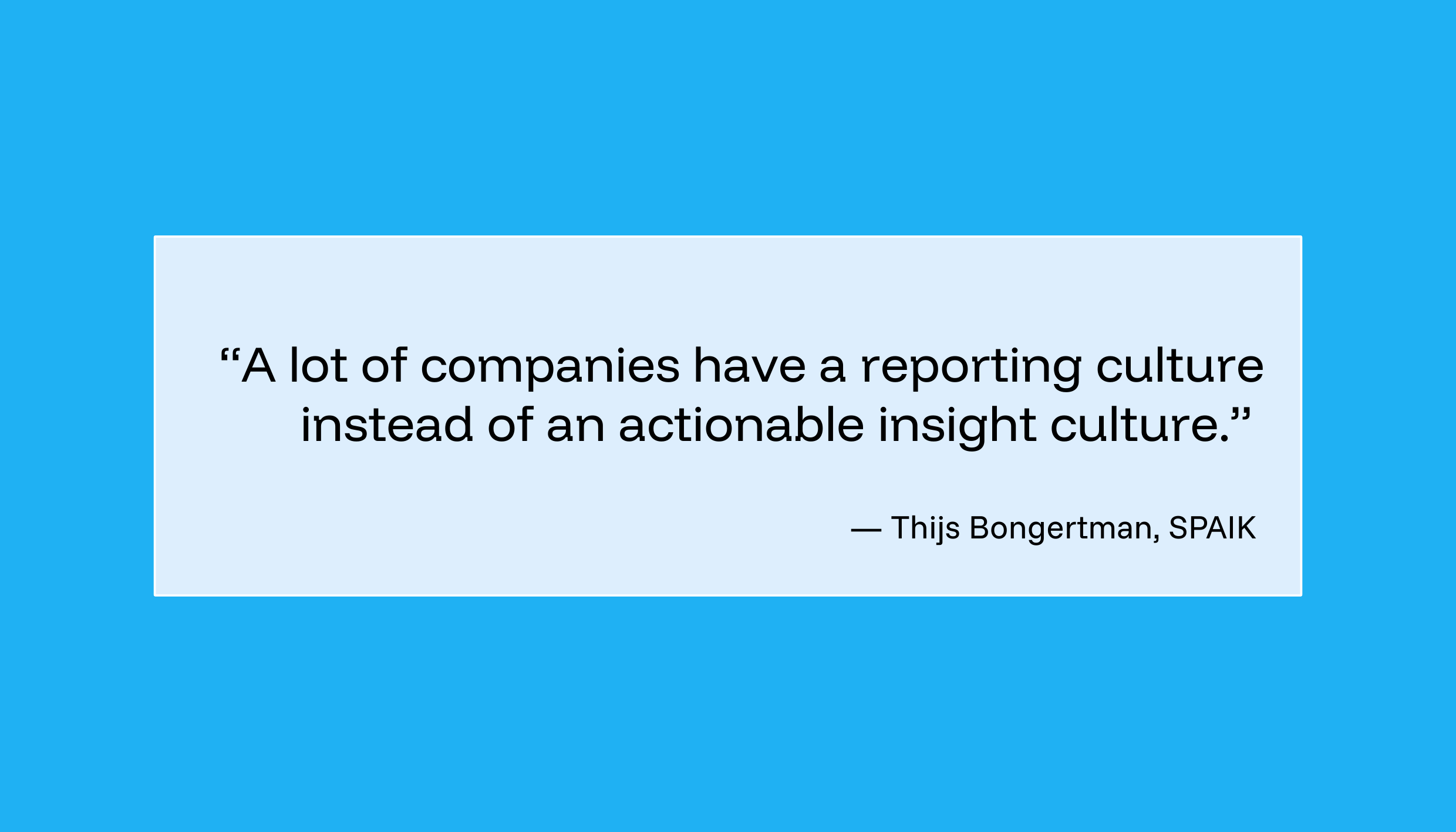
Reports without recommendations limit a marketer’s ability to learn and adapt. Without interpretation, data becomes a scoreboard instead of a decision-making tool. This mindset discourages curiosity and experimentation, reinforcing the B– cycle.
High-performing teams, on the other hand, focus on insight density. That means fewer metrics, deeper meaning. The teams that move beyond reporting to actionable intelligence all share one thing in common: consistent use of advanced analytics.
The performance divide: advanced analytics as the new advantage
Behind every confident marketer is a stronger handle on data. Yet only 8% of in-house marketers and 21% of agency marketers say they consistently use advanced analytics to inform and optimize campaigns. Another 36 to 41% use some advanced analytics but not consistently, while most still rely on descriptive or diagnostic methods.
Interest in upskilling is high. Most marketers say they want to improve their team’s analytical capabilities and 70% specifically want to build stronger marketing mix modeling skills. While the report focuses primarily on MMM, it’s clear that marketers are eager to deepen their proficiency across advanced analytics methods more generally.
The difference is visible in outcomes. Teams that use advanced analytics consistently are twice as likely to experiment and adapt based on testing and results, with 76% reporting active experimentation compared to 36% among those with limited analytics.
They also move faster. Teams that consistently use advanced analytics report higher levels of automation in their workflows and greater clarity around channel performance. These are benefits that teams with limited analytics capabilities struggle to achieve.
And that clarity matters. When data becomes easier to trust and act on, advanced analytics starts to do what it’s meant to: connect performance data to business results, shorten learning cycles and build confidence in every decision. Yet even with the right tools, turning intelligence into action only happens if teams have the confidence to experiment.
The confidence gap: culture makes intelligence possible
Funnel’s research shows that a marketer’s ability to act on data depends on the confidence level of the culture.
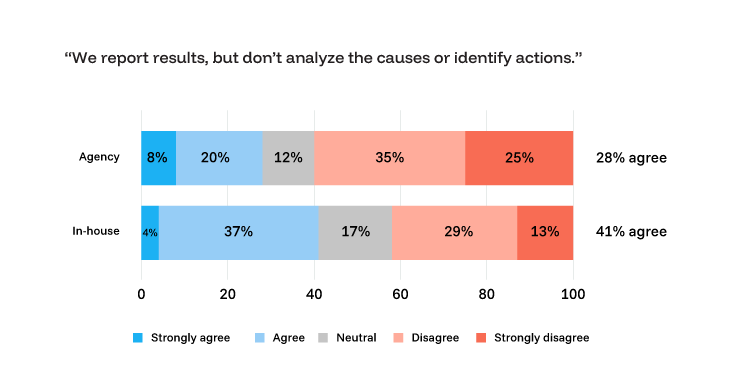
When asked if they feel empowered to experiment with new marketing approaches and adapt strategies based on what they learn, only 43% of in-house marketers and 56% of agency marketers said yes. Lack of confidence also limits insight generation. Forty-one percent of in-house marketers admit they report results without analyzing the causes or identifying actions, compared with 28% of agency respondents.
The gap extends to transparency and decision-making. Just 17% of teams using advanced analytics say they have a clear signal on channel performance, while 66% describe it as somewhat clear and 17% call it muddled.
Funnel’s research shows that teams with a test-and-learn culture act faster, adapt better and make more creative decisions. They’re the ones willing to shift strategy and try different channels and approaches to help increase marketing impact.
They know they can analyze the results and keep their marketing on track because they have reliable, centralized data and they’re comfortable analyzing it. They’re not worried about making a mistake because, with access to trustworthy marketing intelligence, they’ll identify problems or anomalies right away, giving them time to learn from the experiment and course correct before a significant loss in ROI.
Also, with unified data, everyone’s looking at the same numbers, so decisions can be made faster and collaboration is more seamless. This is important because, ultimately, building intelligence requires unifying not only data but people, bridging the gap between human insight and machine capability. Even with the most advanced analytics and automation, you won’t get good results if teams aren’t working together to align algorithms with business goals and identify the right questions to explore.
AI won’t fix bad data
AI promises speed, scale and automation, but without clean data, it only magnifies the mess. Funnel’s research shows that poor data hygiene and weak governance still break everything they touch. AI won’t fix bad data or a weak strategy. Marketing intelligence will.
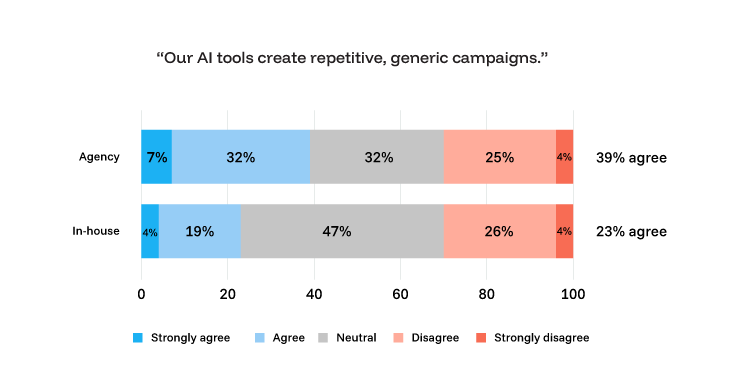
Marketers who skip the hard work of integration feed AI systems inconsistent and siloed data. The result is surface-level output that looks polished but lacks insight. Twenty-three percent of in-house marketers agree their AI tools create campaigns that all look the same, proof that automation cannot outthink disorder.
True intelligence starts with structure. High-performing teams invest in unified data pipelines, governed definitions and consistent measurement. They treat data quality as the foundation of every model, not an afterthought. When the groundwork is solid, AI becomes a multiplier that extends analysis rather than replacing it.
Data governance builds trust. Integration builds clarity. Together, they turn automation from a liability into an advantage. True marketing intelligence isn’t about using more algorithms. It’s about building the kind of data foundation that makes AI worth using at all.
From data overload to marketing intelligence
The marketers leading right now are learning to think with data. Funnel’s research makes one point clear: the teams winning today have mastered the shift from collection to interpretation.
They use data not just to measure the past but to predict what comes next. They connect channel performance to business outcomes and use those insights to guide creative and strategic decisions. Their advantage isn’t technical horsepower; it’s the confidence to act on what the numbers mean.
This is what Funnel defines as marketing intelligence. It’s the ability to unify data, extract insight and apply it consistently across decisions, channels and teams. It turns analytics into advantage and measurement into momentum.
The intelligence advantage
2026 will belong to marketers who operate this way, those who have built systems that learn, not just report. Intelligence, not information, will separate the high performers from everyone else.
The full 2025/26 Funnel Research Report breaks down how these teams are building that edge and how you can do the same. Download the full research report: The 2026 Marketing Intelligence Report, where we reveal the complete findings and a prescriptive playbook on how to move from data overload to marketing intelligence.