




Comparison overview
Supermetrics
Founded in 2013, Supermetrics is headquartered in Helsinki, Finland. It moves marketing data into the tools marketers already use, including Google Sheets, Looker Studio, Excel and Power BI, and more recently AI assistants like ChatGPT and Claude. It is a strong fit for straightforward, connector-based reporting into a chosen destination.
Adverity
Established in 2015 in Vienna, Austria, Adverity is an enterprise-grade ETL (Extract, Transform, Load) platform built for technical data teams that want deep, custom transformations and warehouse delivery. Its transformation depth and connector coverage are extensive. That power comes with technical implementation, and users often cite unclear pricing and a difficult-to-use interface.
Funnel
Funnel is a no-code marketing intelligence platform that gives marketing and data teams a governed data foundation. At its center is the Data Hub, which brings together all connectors, native data storage and a unified data model built for marketing data. Funnel offers quick onboarding and dependable data handling, making it a fit for brands, agencies and centralized data teams. Funnel has offices in Stockholm, Hamburg, Boston and Sydney and was founded in 2014.
We believe Funnel is the right fit for many marketing and data teams. Before we explain why, let’s look at Supermetrics and Adverity and the key differences between them.
Supermetrics vs Adverity
Both Supermetrics and Adverity are good solutions for specific use cases. Supermetrics excels in ease-of-use for smaller, simpler setups, offering a fully self-served platform where users can get started immediately.
In contrast, Adverity provides flexibility for technical data teams and enterprises but requires engineering resource, often involving a more hands-on onboarding process with longer lead times and more effort.
Supermetrics key strengths and weaknesses
Strengths:
- Ideal for small and simple use cases
- Connectors are quick to set up
- Moves data into spreadsheets, BI tools and, more recently, AI assistants
Weaknesses
- More limited for large or complex use cases, and teams can outgrow it as they add channels, markets and clients
- No native data storage in the core product, so history and dashboards depend on live connections
- Connection and refresh reliability can require ongoing attention at scale
- Costs stack up as you add users, destinations, data sources and ad accounts
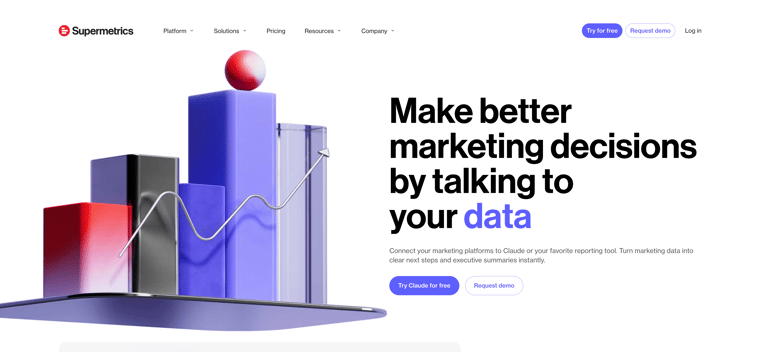
Screenshot from the Supermetrics website, August 2026
Supermetrics: fast to start, limited at scale
Supermetrics makes it easy to pull data into sheets, dashboards and AI tools. Because data is passed through rather than stored, a connector change or outage can affect history and reports. Teams that need marketing data trusted across many reports and workflows often move on as they scale.
Let's have a look at how Adverity compares.
Adverity key strengths and weaknesses
Strengths
- Deep, custom transformations and warehouse ETL
- Control over schemas and scheduling, preferred by technical data teams
- Wide range of data connectors with enterprise support
Weaknesses:
- Built for technicians and engineers, which creates an IT bottleneck for marketers
- Technical implementation and longer time to first value
- Users often describe the platform as slow or clunky in day-to-day use
- Pricing is not published, which makes cost harder to gauge
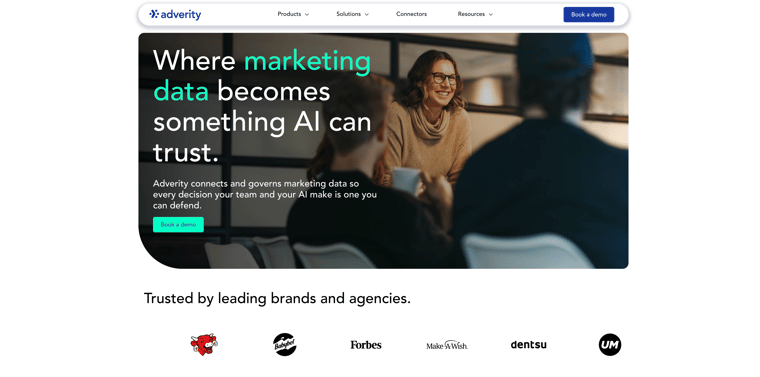
Screenshot from the Adverity website, August 2026
Adverity: powerful, and heavier to run
Adverity supports a large connector catalog and advanced transformations, and that flexibility is the point for teams with engineering resource. In practice it takes technical setup, day-to-day work can depend on a specialist, and pricing is quote-only.
Key differences between Supermetrics and Adverity
So, what are the biggest differences between Adverity and Supermetrics? Here are the three biggest differences:
Use case suitability
Supermetrics is best for small and simple use cases, offering a wide range of data connectors and ease-of-use. Adverity, on the other hand, is suitable for enterprises and technical data teams that want deep transformations and are ready to invest engineering time. In general, data engineers may favor Adverity, while marketers may opt to use Supermetrics, especially if they prefer working with their data in spreadsheets.
Data integration capabilities compared
Supermetrics’ core product lacks native data storage and relies on destinations like Google Sheets and Looker Studio, limiting its capabilities for managing large or complex data. In contrast, Adverity offers extensive connectors and transformations but processing can be slow, and changes to source setups can mean re-ingestion.
Pricing transparency and flexibility
Another significant difference is in pricing transparency. Adverity does not publish pricing, requiring potential customers to engage with sales for a custom quote.
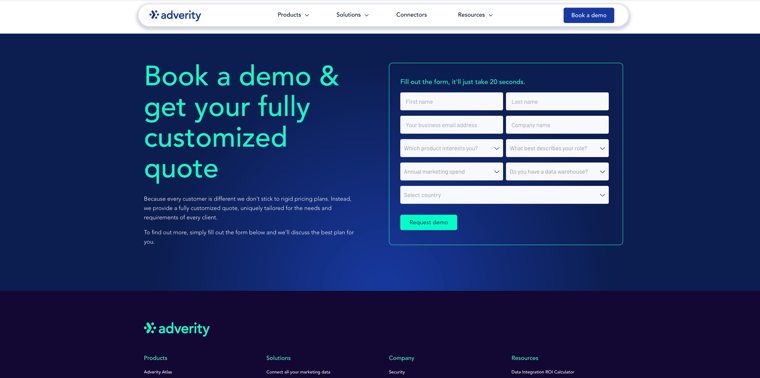
Adverity does not publish pricing and requires you to share a lot of details to get in touch with their sales team
Supermetrics offers four different plans: Starter (from €39/mo billed yearly), Growth (from €159), Pro (from €399), and Enterprise, priced on request. Each plan includes one data destination and a set number of data sources, and costs rise as you add extras like more destinations, users, data sources and accounts.
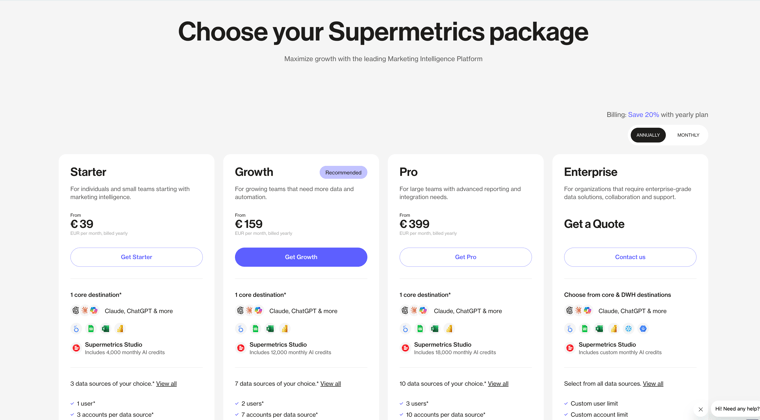
Supermetrics has price plans for small use cases, for example if you are fine with only 1 destination, 3 data sources and 1 user, you can choose their Starter plan
Funnel: a marketing data foundation the whole team can run
Funnel is a user-friendly, no-code marketing intelligence platform designed for comprehensive data management. At its core is the Data Hub, which includes all data connectors, native data storage, and a unified data model specifically designed for marketing data. Funnel offers quick onboarding and dependable data handling, making it a fit for brands, agencies, and centralized data teams. Funnel is ISO 27001, SOC 2 and GDPR compliant.
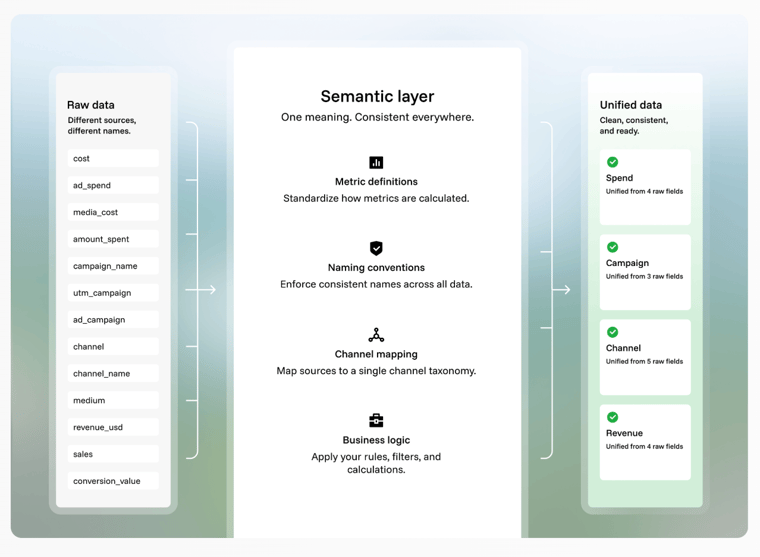
The Data Hub serves as the foundation of Funnel, enabling reliable, fast reporting and efficient exporting. Because your marketing data is stored in Funnel rather than passed straight through, a connector change or outage does not wipe your history or take dashboards down. Funnel manages API changes, schema changes, backfills and rate limits behind the scenes.
The Data Hub is the governed foundation for all your marketing data. It collects, stores, and models data from 600+ connectors in one place, with a built-in semantic layer so every team works from the same definitions. Specialized AI agents help build connectors, create custom logic, and keep your setup decision-ready.
On top of that foundation, Funnel helps you put the data to work:
- Measure: Funnel Measure quantifies the impact of every marketing dollar through a triangulation method that cross-validates marketing mix modeling (MMM), data-driven attribution, and incrementality testing, so you move beyond biased platform attribution.
- Report: Deliver clean, business-ready data to Funnel Dashboards or tools like Looker Studio, Tableau, and Power BI, all running on the same governed foundation.
- Integrate: Deliver standardized, governed data to 40+ destinations, including data warehouses like Snowflake and BigQuery.
And it’s built for every team: a no-code interface for marketers, Funnel as code for technical teams, and Funnel MCP to query your data from AI tools like Claude and ChatGPT. Funnel Measure is available as an add-on on the Business and Enterprise plans.
Some platforms position themselves as a fully integrated data platform, but what does that really mean? Tools like Supermetrics and Adverity often focus on connecting data sources. While they pull in data from multiple platforms, many marketers still end up juggling extra tools for cleaning, transforming, and reporting.
A truly integrated approach goes beyond data connectors. It gives marketers one place to manage, standardize, and use their data without stitching together scripts, dashboards, or exports. That’s the difference Funnel brings to the table.
AI tools need governed data
AI tools and agents are only useful when they can work from reliable data, clear definitions and the right business context. Funnel gives marketing data a governed foundation, with stored history, verified metrics and reusable definitions, so AI workflows query data teams already trust. Through the Funnel MCP, ChatGPT, Claude and other AI tools work with governed data from Funnel instead of fragmented exports and one-off report logic.
Detailed comparison: Funnel vs Supermetrics
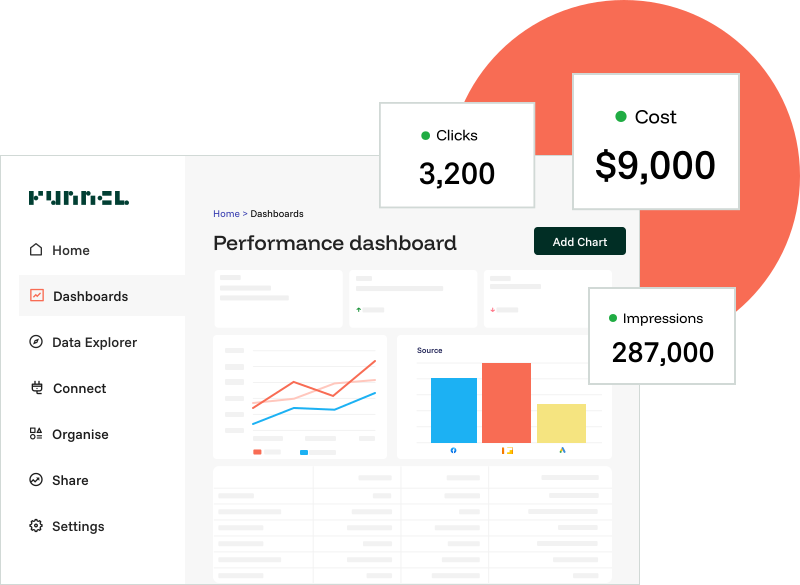
Funnel gives teams one governed source with native storage and strong data volume handling, so brands and agencies manage their marketing data and reach insight in one place.
Supermetrics, while easy to use for smaller operations, is more limited on large-scale data volumes and has no native storage in its core product.
Funnel excels in quick client onboarding and reporting setup, providing a no-code environment easy for non-technical teams, whereas Supermetrics often relies on destination plugins and manual configuration.
Funnel also provides secure data storage and comprehensive data management, simplifying the integration, transformation, and analysis of data. With a unified platform, extensive data connectors, and transparent pricing, Funnel is a more scalable option for teams that need numbers to hold up across many reports, clients and markets.
Detailed comparison: Funnel vs Adverity
Let’s compare Adverity with Funnel. Funnel’s user-friendly platform enables quick data integration and makes it easy to build dashboards, so marketing and data teams can manage and analyze data without an engineering bottleneck. In contrast, Adverity is built for technical data teams and expects engineering resource for complex transformations, and users often point to slower, more technical day-to-day work.
Adverity offers deeper, more custom transformations than Funnel, and for teams that need that depth and have the resource, it is a strong tool. Funnel offers scalable, customizable reporting that feeds data into many destinations for efficient, client-specific insight, without depending on a specialist to keep it running.
Adverity doesn’t show any pricing on their website, whereas Funnel publishes its plan pricing openly, starting at €280/mo, with pricing based on your plan plus flexpoint capacity rather than data volume or seats.
Finally, Funnel is known for a fast, helpful customer support team that helps users make the most of their subscription.
Funnel, Adverity or Supermetrics: compare all three
In a sense, all three solutions are good for specific use cases. Supermetrics excels in ease-of-use for smaller operations, Adverity provides flexibility and support for technical data teams, and Funnel combines comprehensive data management with a no-code experience that marketing and data teams share.
|
Feature |
Funnel |
Supermetrics |
Adverity |
|---|---|---|---|
|
Connector coverage |
600+ |
150+ |
600+ |
|
No-code interface |
✅ |
✅ |
❌ |
|
Built-in data storage |
✅ |
❌ |
✅ |
|
Transparent pricing |
✅ |
✅ |
❌ |
|
Advanced measurement (MMM) |
✅ |
❌ |
❌ |
All three solutions, Supermetrics, Adverity, and Funnel, offer broad coverage of data connectors. Each platform supports the connectors marketers use most, such as Google Analytics, Facebook Ads, and Google Ads, along with many other popular marketing platforms, so teams can integrate data from many sources.
What makes Funnel stand out is a governed foundation the whole team can run: a no-code platform, stable data integrations, native storage, built-in dashboards, advanced measurement, quick onboarding and dependable data handling. Funnel is a fit for brands, agencies, and data teams, and it pairs transparent pricing with efficient processing.
In addition, Funnel bakes governance into the core platform. From mapping fields to managing permissions, everything lives in one place, built for marketers. That means fewer gaps, less manual cleanup, and stronger trust in your data.
Why Funnel is built for modern marketing teams
Let’s recap what makes Funnel stand out:
- Marketer-friendly: No code. No IT bottlenecks. Marketing and data teams both move fast.
- One source of truth: Reports, models and AI workflows draw from the same governed data.
- Dependable: Stored history and managed connections keep dashboards stable as you scale.
- Smart measurement: MMM, attribution, and incrementality in one platform.
- Flexible exports: Send clean, standardized data to BI tools, warehouses, and apps.
- Trusted by global teams: ISO 27001, SOC 2 and GDPR compliant.
Where Supermetrics helps small teams move fast and Adverity serves technical data teams, Funnel sits at the intersection of scale, simplicity, and strategy.
Ready to see it in action?
Marketing deserves better data. Funnel makes it easy to unify, measure, and act on your marketing data, without relying on engineers or duct-taped workflows.