






If you’re looking at Adverity alternatives, you’ve already done the “serious stack” upgrade. You moved off manual exports, wired Adverity into your warehouse and gave your data team flexible streams to play with. On paper, you have a grown-up setup with effective data transformation.
But annoyances can quickly spring up like a game of whack-a-mole. Adverity has been a go-to data integration solution for marketing, but as teams scale, many discover it demands more engineering support and longer onboarding than expected. Every new client or market means another set of pipelines to configure, every API update or naming convention change requires technical support and onboarding a new client feels like a mini-project. Also, because pricing is tied to usage, it’s hard to predict costs month-to-month.
Unfortunately, these aren’t just “teething issues” you can iron out over time. Warehouse-first ETL tools like Adverity require engineering support to keep data governed, clean and accessible. Dependence on technical teams translates to slower time to insights, delayed decisions and inconsistencies that leave teams unaligned. However, marketers today want agility, which requires tools that make collaboration, reporting and measurement faster without losing control.
That’s why agencies and brands working with high data volumes are turning to marketing intelligence platforms. They’re built for storing modeled marketing data with a governed hub and measurement.
This guide looks at the main Adverity competitors, what each is built for, what to watch out for, and where a marketer-friendly option fits.
What to look for in an Adverity alternative
You're probably not shopping around for alternatives because you suddenly woke up curious about ETL tools. It's usually because your day-to-day is grinding to a halt.
You might be ready for an Adverity alternative if:
- You’re constantly waiting on engineering to add or fix a connector.
- A simple change to a metric or naming convention turns into a ticket and a sprint.
- You’ve outgrown spreadsheets, but a warehouse-heavy setup still feels overkill for marketing’s day-to-day.
- You struggle to explain why your data bill went up when you added a new client or market.
Those headaches aren’t just annoying. They’re getting in the way of the reliable, governed data foundation that marketing needs to move fast and iterate purposefully. In one campaign survey, more than 80% of marketing and sales “data horror stories” were traced back to poor data quality, and 75% of teams said bad data slows them down, making it even harder to reach their goals. Messy, unreliable data is also one of the biggest blockers to scaling AI in a meaningful way.
A new marketing data platform can turn things around, but how do you know you’ve found the right fit? When choosing a solution, look for four things: usability for marketers and data teams, onboarding speed, pricing transparency and predictability, and measurement and data governance.
Usability for marketers and data teams
A good Adverity alternative should feel like a data integration platform that serves as a shared ground for marketers and data teams, not a neutral territory that secretly belongs to engineering.
For marketers, “usable” means the ability to:
- Create dimensions and metrics without writing SQL.
- Adjust mappings and groupings themselves.
- Reuse the same model across clients or brands instead of rebuilding logic every time.
If a campaign manager needs to see all “UK - Brand - Prospecting” campaigns in a single view, they shouldn’t have to open a ticket. They should be able to tweak a rule in the interface, see the impact and then roll it out across reports.
Data teams need something slightly different. They care about:
- A governed data hub where the model is consistent and reusable
- Clean exports into warehouses and business intelligence tools
- The ability to set standards without becoming a permanent bottleneck
In practice, that means they can define the core rules for things like currencies, time zones and naming conventions in one place, then let marketers work within those guardrails.
That's where Funnel’s marketing intelligence approach really stands out. Funnel gives you a governed Data Hub with no-code controls on top, so marketers can explore and refine the data they use every day, while data teams keep the structure, lineage and exports under control.
Onboarding speed and time-to-value
Have you ever kicked off a “quick” data project that turned into a quarter-long saga? In a heavy ETL setup, you scope requirements, design the model, build pipelines, test, fix, test again… by the time marketing sees a dashboard, the original brief is a distant memory.
A better alternative to Adverity should help you move with speed. When you are evaluating tools, look at real moments in your day, not just features on a grid:
- How long does it take to get to the first cross-channel view that leadership actually trusts?
- How quickly can you plug in core channels like Google Ads, Meta, LinkedIn and your main analytics or ecommerce platforms?
- When you add a new client or region, does it take an afternoon’s worth of work?
Funnel is a marketing intelligence platform that's built to avoid that trap. You connect marketing platforms in a few clicks, shape data in the Data Hub once, then reuse that structure for new clients or markets. You'll see value in days, rather than quarters, and you can keep improving the model while the business moves forward.
Pricing transparency and predictability
If you have the budget, pricing is one of those things that seems secondary until it blindsides you. Many ETL tools, including Adverity, lean on usage or row-based pricing.
But if every extra impression, click or event adds to the bill, growth becomes a budgeting nightmare:
- You launch a high-volume awareness campaign, and your data invoice jumps.
- You add five new channels and suddenly have to explain a spike in rows to finance.
- You hesitate to increase data freshness because it might double your cost.
When you are already justifying budgets, the last thing you need is a data platform that makes monthly costs hard to forecast.
A better Adverity alternative should be clear on three points:
- Is pricing published or at least easy to estimate?
- Does it scale with connectors, users or raw volume?
- What happens when you add brands, markets or channels?
Let's take Funnel as an example of transparent pricing. Pricing is tied to things you can actually plan for, like connectors, workspaces and destinations, rather than raw row counts. That makes it easier to say, “We are adding three clients and two new platforms; here is roughly what that means for our data budget,” instead of guessing how many billions of rows they will generate. For agencies reporting back to clients and brands working closely with finance, that predictability, along with custom pricing plans, is just as important as any feature.
Measurement capabilities and data governance
Teams usually start by asking, “Can this tool connect multiple data sources and destinations?” But the more helpful question is, “Does it help us decide what to do next?”
Many ETL tools move raw tables into your warehouse and stop there. Measurement and governance live in scattered SQL and dbt models, plus a few fragile spreadsheets. A small group understands the logic, and everyone else has to trust that nothing changed between one report and the next.
A good Adverity alternative has to do two jobs at the same time.
Support real marketing measurement
You need more than a performance snapshot if you want to tie decisions to business outcomes. Look for marketing mix modeling, data-driven multi-touch attribution and incrementality testing that work on top of the same cleaned marketing dataset you use for everyday reporting. That way, the story you tell in a QBR matches the story finance sees in their models, and channel decisions line up with real incremental impact.
Build governance into a shared data model
You shouldn’t have to read SQL to answer basic questions. Governance should live in a shared data model.
That means:
- Shared definitions for core metrics like spend, revenue and qualified leads
- Consistent naming conventions across platforms, markets and clients
- Multi-currency and time zone handling that does not live in a single master sheet
- Role-based access so you can separate brands and regions without rebuilding logic
All of that matters even more now with AI, which is only as good as the data and structure you feed it. When your logic is spread across half a dozen transformation layers, you'll spend more time sanity-checking AI outputs and chasing strange numbers than actually using them to make decisions.
Funnel handles this within the Data Hub: it collects, stores and cleans your marketing data once, then you reuse that governed foundation for dashboards, advanced measurement and AI-powered analysis in Data Chat. Managed connectors keep data flowing, and the Data Guarantee means you keep your history even when platforms or APIs change.
Marketers and data teams work in one shared model with clear standards, not a warehouse full of one-off views. That makes it much easier to say, “Yes, we trust this,” and move budget with confidence.
Why you might need marketing intelligence rather than an ETL
It can be helpful to think of Adverity as part of a wider group of tools built for one main job: move data into a warehouse and stop there. Tools like Adverity or Fivetran excel at extracting, transforming and loading raw tables into Snowflake, BigQuery or Redshift so engineers and analysts can work with them.
That data warehouse-first design is great for company-wide analytics projects. The catch is that marketing usually stays on the outside looking in. Any new field, naming rule or view of performance turns into another ticket, another sprint and another round of “we’ll get to it.”
Marketing intelligence platforms start from a different place.
Instead of pushing data straight through to data warehouses, they give you a governed marketing data hub in the middle. In Funnel, that hub stores your marketing data, cleans it, standardizes things like currencies and time zones and applies shared definitions for metrics such as revenue or qualified lead.
Once that foundation is in place, you reuse the same model everywhere else: dashboards, spreadsheets, business intelligence tools, warehouses and measurement.
That difference in architecture is what makes self-service realistic. In a classic ETL setup, the logic that shapes your data lives in scattered SQL or transformation code that only a few people touch. With a marketing intelligence platform, marketers work in a no-code workspace on top of the shared model, while data teams set the guardrails and handle the edge cases.
Top Adverity alternatives in 2026
You’ve got the lay of the land: what’s breaking in your current setup, what “good” looks like and why marketing intelligence often fits better than a pure ETL tool. Now let’s look at the top Adverity alternatives in 2026 and which one can make sense for you.
Funnel: Best all-around marketing intelligence platform for teams that want speed, clarity and measurement built in
Funnel is built for teams that care most about marketing performance, not “all data everywhere.” It pulls spend, performance and revenue signals from hundreds of marketing platforms into a governed Data Hub, then keeps that data stored, cleaned and modeled so you can reuse it across reporting, exports, activation and measurement.
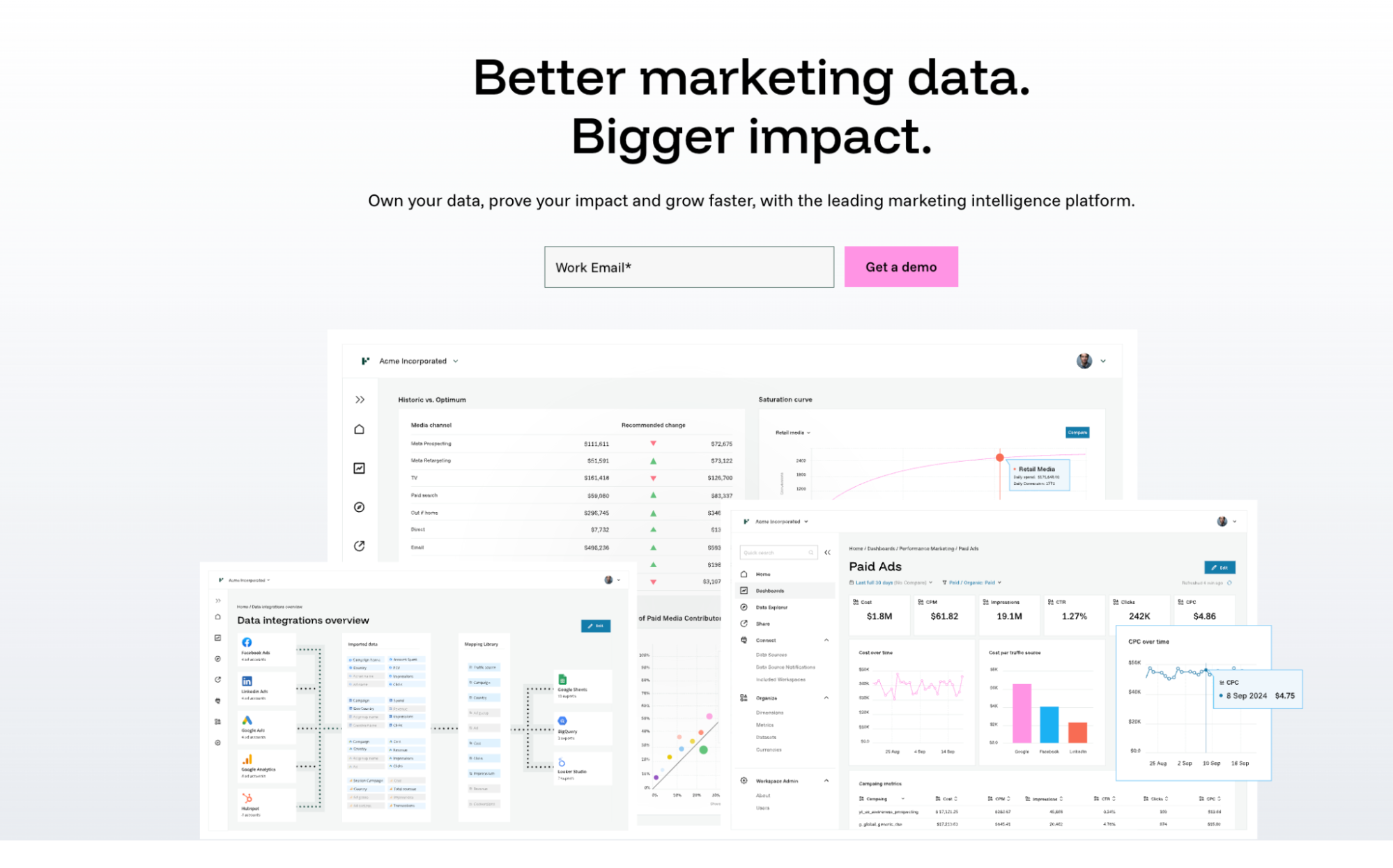
Having that foundation is a big win for marketing agencies, because you define shared dimensions and metrics once (channel groupings, conversions, revenue logic, naming conventions) and reuse them across accounts. And because everyone pulls from the same definitions, you spend less time cleaning up reports.
broadhead shows what that looks like in practice. Dan Mandle’s team cut data management spend by about 50%, got out of firefighter mode and agreed on clear rules for core metrics so PR, performance and analytics finally told the same story. With that standardized model in place, they could onboard clients from a new acquisition without extra hires and even launch advanced services like marketing mix modeling on top.
On the brand side, you get the same advantage, just at a different scale. Instead of juggling separate views for paid social, search, display and ecommerce, you get one cross-channel model that feeds your data warehouse, business intelligence tools and dashboards. Data teams still get clean, well-structured exports because the Data Hub keeps everything consistent. Marketers get a no-code workspace where they can adjust mappings, groupings and calculations themselves, instead of logging a ticket every time something changes.
But the perks don't stop there. Advanced marketing mix modeling, data-driven multi-touch attribution and incrementality tests all run on top of that same governed Data Hub. So, because reporting, measurement and planning share one source of truth, it is easier to move from “what happened last month?” to “what should we change next quarter?”
Supermetrics: Best for small teams and spreadsheet-based reporting
Supermetrics sits at the “keep it simple” end of the spectrum. It plugs your ad and analytics platforms straight into tools like Google Sheets, Excel, Looker Studio and Power BI, so you can refresh reports without downloading CSVs or copy-pasting numbers every week.

It works best for small in-house teams and early-stage agencies that live in spreadsheets. You set up a handful of queries, schedule refreshes and build lightweight dashboards on top. Because you stay inside familiar tools, the learning curve is minimal and the upfront costs stay low.
Where it helps:
- Quick wins like not needing to export CSVs, just hit “refresh" instead
- Low friction, so marketing can own most of the setup without involving engineering
- Budget-friendly, which is a good fit when you are still proving the value of basic cross-channel reporting
However, the tradeoff is in the foundation. Supermetrics doesn't give you a central place to store, clean and govern marketing data. There is no shared data hub with standard dimensions, and no built-in measurement layer. Each spreadsheet or Looker Studio report becomes its own mini-project, which can make life harder once you manage multiple clients or markets.
It is a solid pick if you just need automated pulls into spreadsheets and simple dashboards. But once you need standardized metrics, multi-client governance or advanced measurement, you’ll hit limits.
Fivetran: Best for data teams that prefer a warehouse-centric, SQL-based workflow
Fivetran lives firmly in the modern data stack world. It extracts data from hundreds of sources and lands it in cloud warehouses like Snowflake, BigQuery and Redshift, where your data team models everything with SQL and dbt.
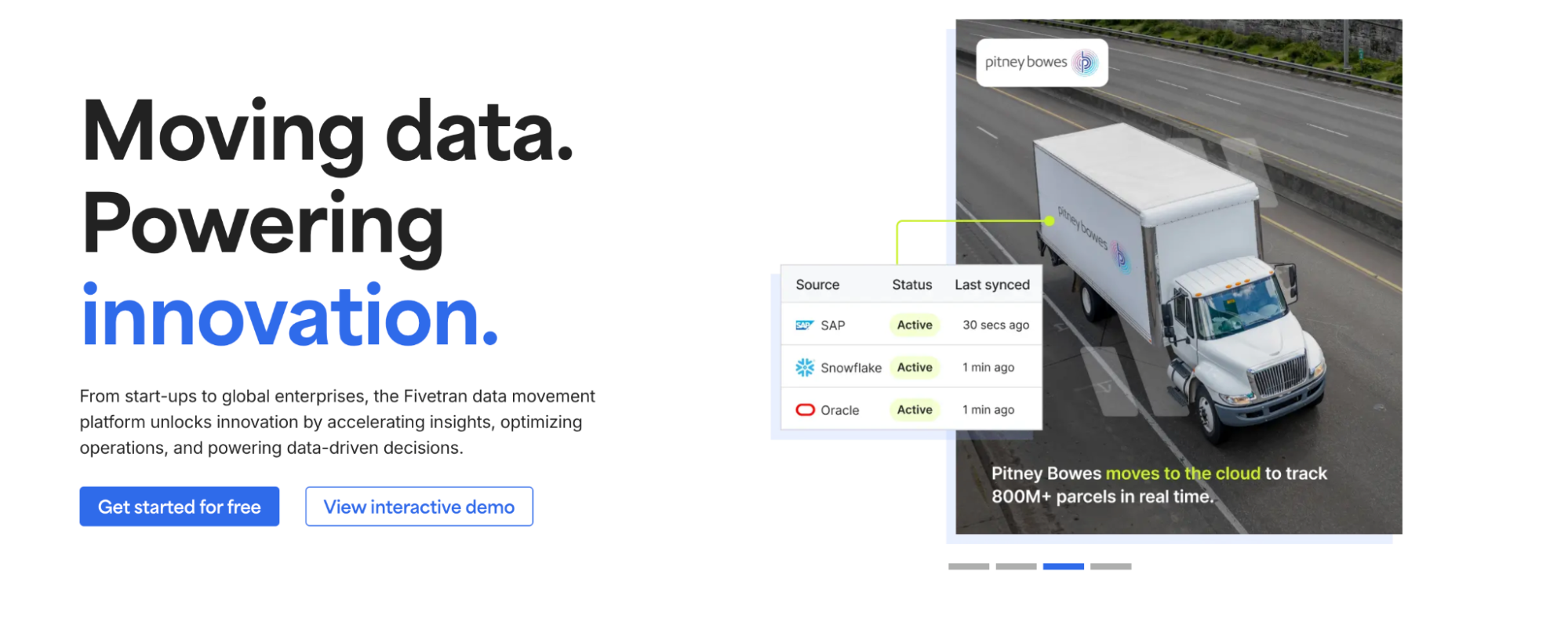
That setup suits engineering-led organizations that want a single data backbone across finance, product, sales and marketing. Pipelines are highly automated, schema changes are handled for you and data engineers can wire everything into their existing transformation layer.
The strengths:
- Warehouse-first, which is great if your warehouse is the unquestioned source of truth
- Broad connector coverage
- Tight fit with dbt and SQL workflows so data teams stay in their comfort zone
However, from a marketing perspective, there are a few catches. Fivetran isn't marketing-specific, so there is no governed marketing data model waiting for you. There's also no native reporting or measurement layer. Marketers depend on the data team for new fields, new joins and new views, because everything meaningful happens in SQL or dbt.
Fivetran is a strong option if you already invest heavily in a warehouse-centric stack and are happy to keep marketing modeling there. If you want marketers to self-serve without touching SQL, you'll need to look elsewhere.
Improvado: Best for enterprise-level data automation
Improvado sits at the heavier end of this comparison because it combines ETL pipelines with a managed services layer, so you're not only buying software but also a team to help you wire everything together. That combo can be attractive if you have multiple business units, custom reports for every region and a long list of stakeholders who all want something slightly different.
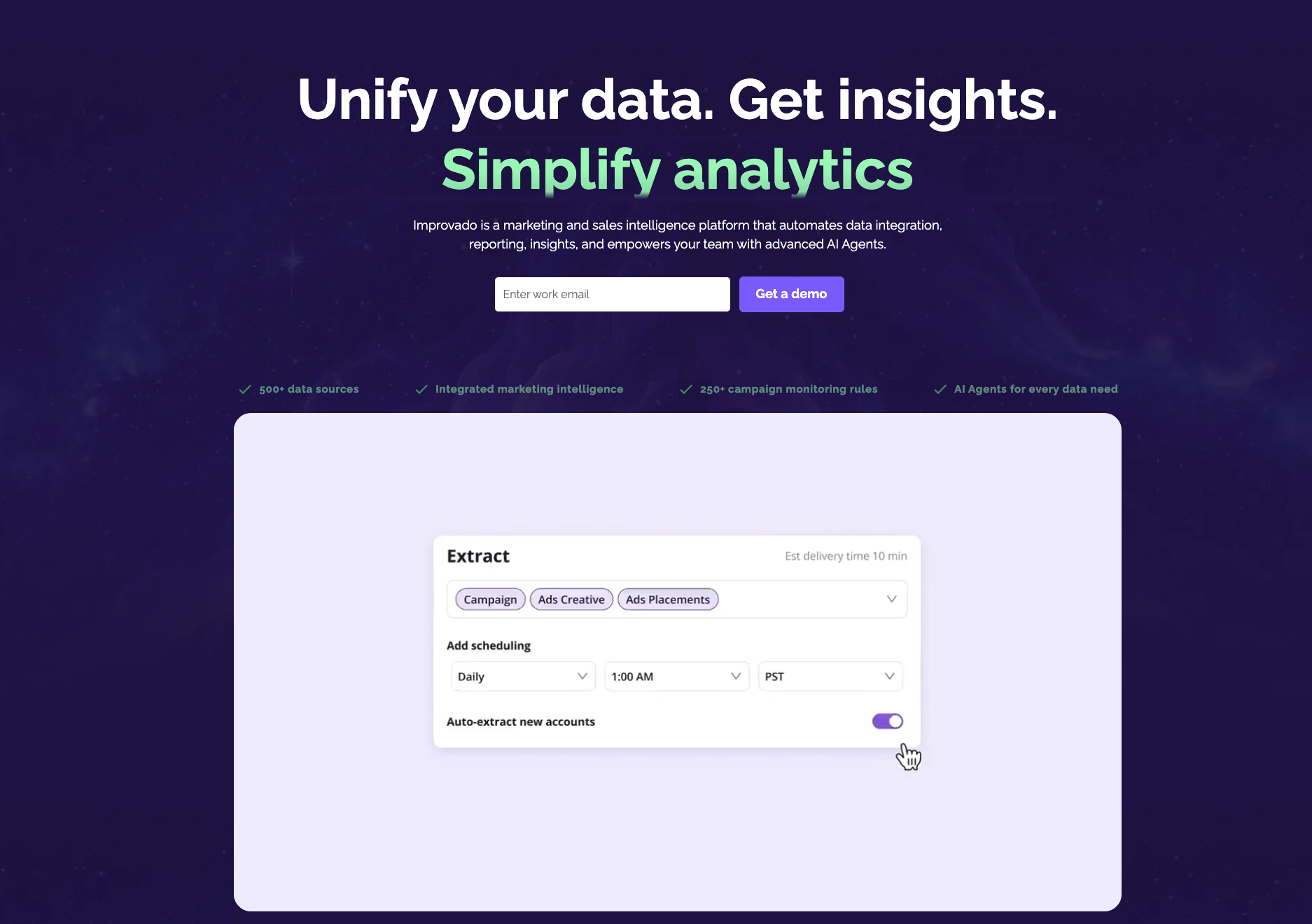
It tends to suit enterprises that already see data as a shared, strategic asset because they have the budget and appetite for a vendor that stays close to the work. Improvado’s team can help you stand up and maintain pipelines, chase down tricky APIs and keep global reporting flows running.
The tradeoff is speed and independence. Implementations lean technical and can take time to get right, which means marketers often wait for changes and new views. You also don’t get a first-class measurement suite on top of the pipelines, so you still need separate tools or internal models to answer questions about incrementality or channel mix. Improvado usually lands best where a large organization wants a “done-with-you” automation partner and accepts the ongoing vendor dependency that comes with it.
Windsor.ai: Best for marketing attribution and ROI-focused teams
Windsor.ai combines data connectors with an attribution modeling layer. You send in performance data from your main channels, and the platform applies different models to show how each touchpoint influences conversions and revenue.
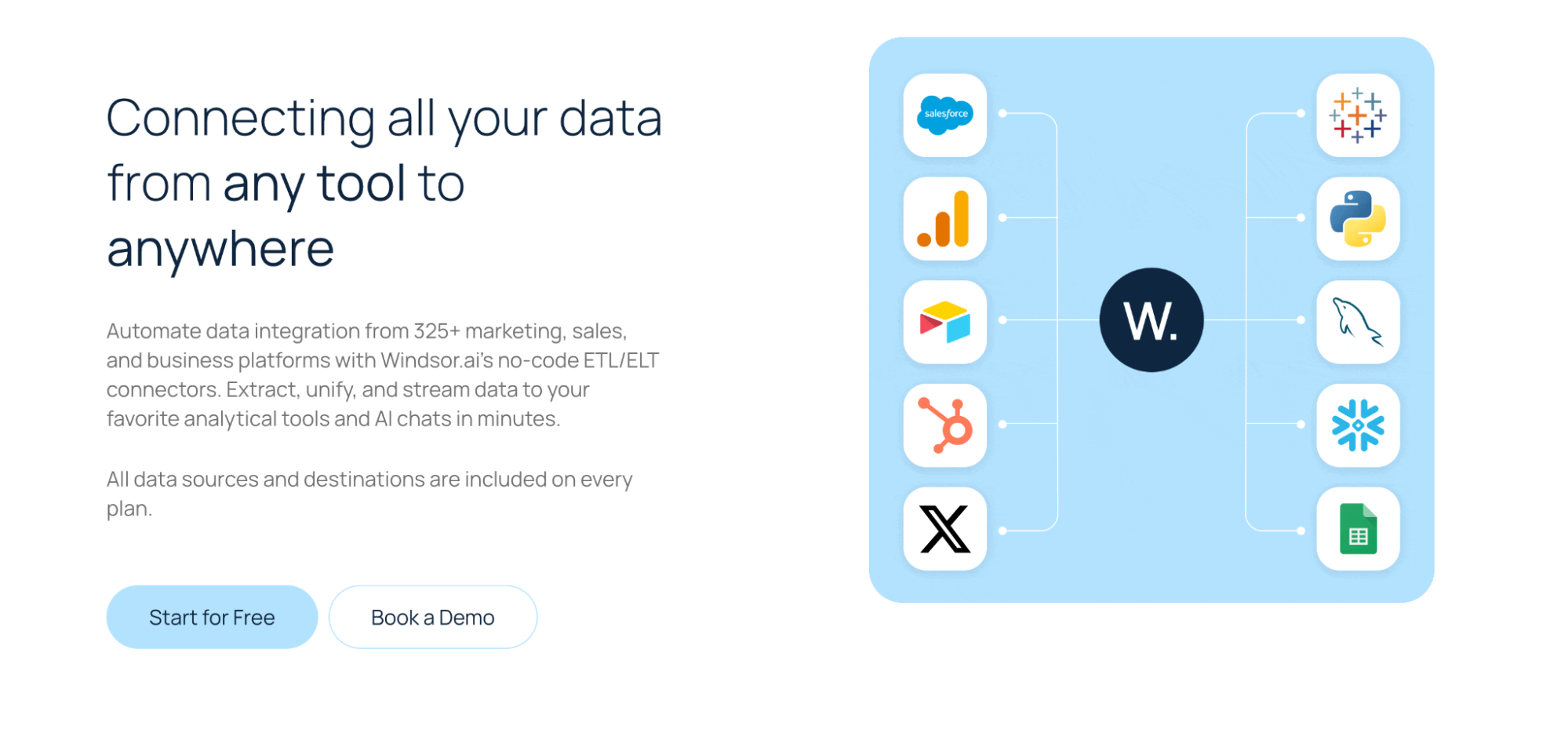
The platform is a good fit for performance marketing teams because it frames everything around return on ad spend, cost per acquisition and revenue impact. The built-in models and reports help you compare paths to conversion and see which channels, campaigns and keywords contribute most, so you can defend budget shifts with more confidence.
The trade-off is that Windsor.ai is more of a specialist tool than a central hub for the whole marketing team. You still need clean inputs and some data expertise to get good results, because the attribution models depend on consistent tracking and accurate spend and conversion data. Windsor.ai also doesn't replace a governed data foundation, since it's not designed to store, standardize and reuse all your data across reporting and exports.
Because of that, Windsor.ai works best when your main problem is attribution and channel influence, not day-to-day reporting, governance and collaboration.
Salesforce Marketing Cloud Intelligence (Datorama): Best for Salesforce-heavy enterprises
Salesforce Marketing Cloud Intelligence (Datorama) is very much the “Salesforce ecosystem” option. It sits on top of Salesforce as a marketing intelligence layer, with deep integration across Salesforce CRM, Marketing Cloud and the rest of the stack.
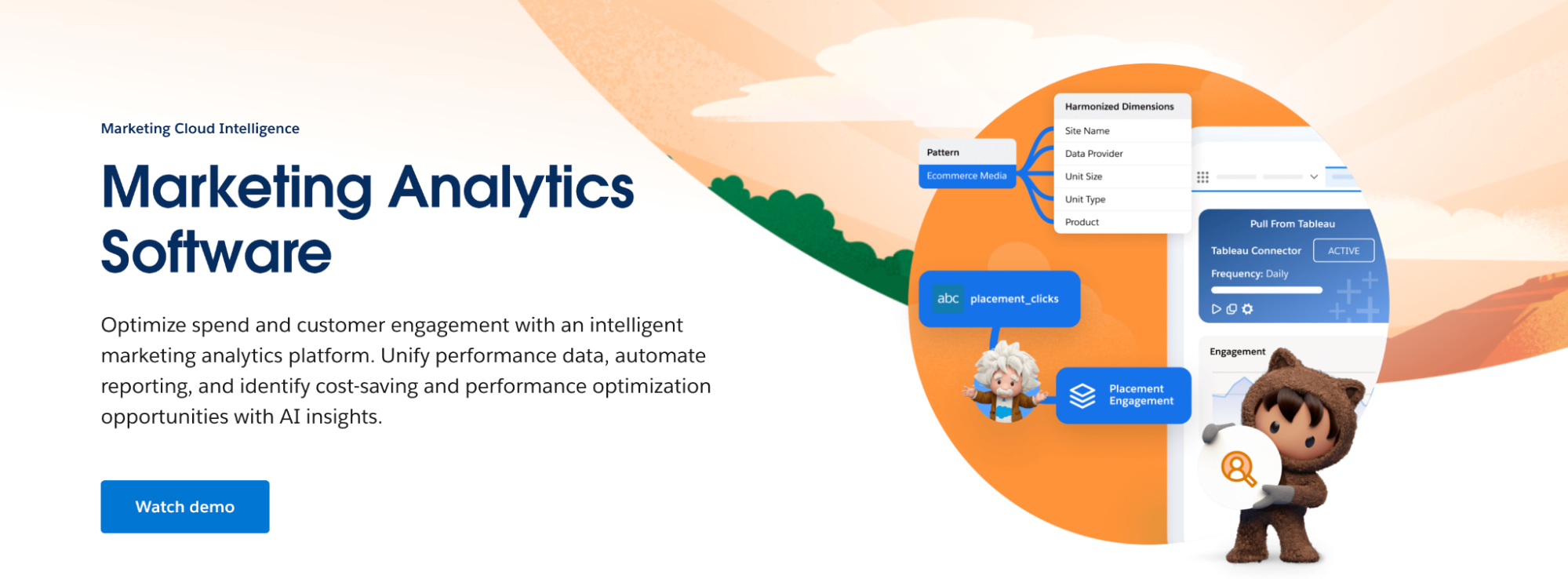
It tends to be a fit for large enterprises that have already standardized on Salesforce and want their marketing analytics to live in the same environment. If your teams are already committed to Salesforce CRM and Marketing Cloud, it keeps everything in one place.
The strengths line up with that Salesforce focus; you get strong native integrations with Salesforce products, highly customizable dashboards and support for complex global structures.
That said, the tool has a steep learning curve, implementations are often slower and more involved, and users often hire specialists or partners to set up and maintain the environment. For mid-sized teams or organizations that aren't already on Salesforce, it can feel heavy compared with more focused marketing intelligence platforms.
Datorama usually makes the most sense for enterprises with Salesforce at the center of their tech stack and the appetite for a more complex, ecosystem-first approach.
Adverity: Best for technical data teams who want flexibility and control
So, should you actually go with Adverity?
In this guide, Adverity is the benchmark we started from, but now we can see how it stacks up. It’s a flexible ETL platform built around “data streams,” with broad connector coverage and strong transformation capabilities. In practice, that means you can pull large volumes of data from many different sources, shape it with rich mapping and transformation options, then load it into your warehouse or analytics environment.

Adverity tends to suit data and analytics teams that want full control over pipelines in an engineering-led setup. If your organization already runs a warehouse-first stack, has experts who are comfortable with scripting and SQL and wants to support wider analytics use cases beyond marketing, Adverity can slot in as a central data integration layer.
Adverity’s main advantage is how flexible it is. You'll get powerful transformations, rich configuration options and enough depth to support cross-department use cases. For some teams, that level of control is the main reason to choose it.
The trade-offs are more noticeable for agencies and brands that want marketers closer to the data. Adverity usually needs specialist skills to set up and maintain; implementations take longer and engineering has to handle ongoing schema and API changes. There's also no embedded marketing measurement layer, so models like marketing mix modeling or data-driven attribution need to be built separately on top of the warehouse.
Because of that, Adverity is usually the best fit for organizations that are happy to own technical responsibility for the stack and where marketing is comfortable working through the data team rather than self-serving in a shared hub.
How to choose the right Adverity alternative
Once you have a feel for the main tools, the real work is matching them to your reality. Most of the time, that comes down to four things: who owns your data stack, how your team is set up, what you actually need from your data and the pricing model you can live with.
|
Need |
Best fit tools |
|
Fast setup, no-code, marketing-ready data plus measurement and data activation |
Funnel |
|
Warehouse-first stack with strong SQL/dbt skills and broad enterprise data |
Fivetran; Adverity |
|
Basic automated data pulls into spreadsheets and simple dashboards |
Supermetrics |
|
Attribution and ROI modelling on top of existing reporting |
Windsor.ai |
|
Salesforce-centric enterprise marketing stack |
Salesforce Marketing Cloud Intelligence (Datorama) |
|
Enterprise automation with managed services and BI integration |
Improvado |
1. Your team’s technical skills and resources
The first thing to figure out is who will actually need to keep the lights on.
If engineering support is thin and marketing needs to be firmly in the driver’s seat, it makes sense to go with a platform that even team members with low technical knowledge can manage without touching SQL. That means no-code modeling, managed connectors and a central hub where shared dimensions and metrics live.
Funnel is a good fit in that setup because marketers can shape data directly in the Data Hub, while data teams still set guardrails instead of rebuilding pipelines constantly.
If a central data team runs a warehouse-first stack and is already deep into SQL and dbt, an ELT tool that pipes data straight into the warehouse can work well. In those setups, Fivetran or Adverity are realistic options, because engineers are happy to own modeling and maintenance.
Some enterprises prefer to lean on vendors and consultants. If you have a budget for managed onboarding and ongoing help, Improvado or Salesforce Marketing Cloud Intelligence (Datorama) can be a better match, because they deliver more of a “done-with-you” approach.
2. Your team size and structure
Next, think about the scale of the operation.
Agencies need to avoid rebuilding logic every time a new client signs. Multi-client governance, reusable models and client-by-client permissions are crucial here. Funnel is designed for that pattern because you define channel groupings, conversions and revenue rules once, then reuse them across accounts.
Brands that spend $1M+/month across channels need a reliable cross-channel view and the ability to answer tough questions about effectiveness. For those teams, a marketing intelligence platform with measurement on top of a governed hub makes more sense than a bare connector. Funnel is a strong fit here, with Salesforce MCI as an option if the whole company has already standardized on Salesforce.
However, smaller teams with a handful of channels and straightforward reporting needs often don't need a full platform. In those cases, a connector tool like Supermetrics, which is pretty light, can be enough to automate data pulls into Google Sheets or Looker Studio.
3. Reporting vs. measurement
You may not be ready for advanced modeling right now, but it is worth being honest about where you are headed.
If your main goal is to keep dashboards up to date and answer “what happened,” tools that focus on reporting are usually enough. Supermetrics, Windsor.ai or Datorama can all support clean, automated reporting when you already know where you want the data to land.
If you need to move toward marketing mix modeling, data-driven multi-touch attribution or incrementality tests, you are looking for something different. You want measurement built on top of a governed marketing data model, not bolted onto a collection of pipelines. Funnel is the primary option here because MMM, attribution and incrementality run on the same Data Hub you already use for reporting and exports.
4. Pricing structure
Finally, think about how predictable you need your data costs to be.
If you want clear pricing and minimal operational overhead, you are better off with a model that ties cost to capacity rather than raw usage. Funnel uses flexpoints to measure capacity across connectors, data sources and destinations. You choose a plan, allocate flexpoints and know how much room you have. You're not going to ever get a nasty surprise just because impressions or clicks spiked in a great quarter.
If your team is comfortable with more complex implementations and variable, usage-based billing, tools like Adverity, Fivetran, Improvado and Salesforce MCI can still make sense. They often bill by rows, events or tiered usage, which is harder to predict as volumes grow.
The table below shows how Adverity competitors compare according to users.
.png?width=1999&height=1143&name=G2%20Ratings%20for%20Adverity%20Alternatives%20(2025).png)
Funnel stands out for its high ratings on G2, but it’s also the only option with advanced measurement and a governed data foundation. For agencies and brands struggling with Adverity or other warehouse-first ETL tools, there are some solid reasons to consider switching to Funnel.
Why teams switch from Adverity to Funnel
By the time teams start looking for an Adverity alternative, they usually have something that theoretically “works” on paper. Dashboards load, data lands in the warehouse, reports go out. But frustrations show up elsewhere in tickets, timelines and reports.
1. Reduce reliance on engineering for everyday changes
With Adverity, even small tweaks often land on the data team's plate. A new paid social channel or a different naming convention may have to wait.
Funnel removes that bottleneck because marketers work in a no-code UI where they can adjust dimensions, groupings and mappings themselves. Data teams still set the standards of shared channel groupings, conversion logic and revenue rules, but they do it once in the Data Hub instead of coding every variation.
That’s why agencies like Publicis Sweden can manage thousands of data sources and more than 800 custom dimensions and metrics without asking everyone to learn SQL. As such, their account teams now own day-to-day changes, while governance stays in one place, which allows the data team to move from firefighting to analysis.
2. Shorten onboarding and rollout times
Adverity is powerful, but onboarding a new market or client can feel like a project in itself. You scope requirements, design models, configure streams, test and only then does marketing see something they can use. That means that onboarding a new client can take weeks.
Teams that switch to Funnel usually need a fast path to value. They can connect core platforms in a few clicks, let data flow into the Data Hub and start with a simple, trusted view while they refine the model. Agencies like Havas France now create standard media dashboards for new customers in about 30 minutes and deliver more advanced reporting within two weeks because they reuse a governed model instead of rebuilding it each time.
And brands get the same benefit. trivago went from manually importing invoices and reports for a subset of platforms to connecting local search engines in Funnel. Reporting coverage jumped from about 30% of their platforms to 100%, and the team stopped spending days chasing data gaps before they could even start analysis.
3. Move from fragile pipelines to a stable marketing data foundation
Adverity’s flexibility comes with a trade-off: more custom logic lives in pipelines. When schemas or APIs change, someone has to step in, fix the stream and often reprocess data. Over time, that can make the stack feel fragile, especially when key people move on.
Funnel is built as a marketing data foundation instead of a set of custom pipelines. Connectors are fully managed, and your marketing data lives in the Data Hub where it is stored, cleaned and modeled. When an API changes or a source disconnects, Funnel handles the connector update and the data you have already ingested stays available.
You see the impact in how teams work. Publicis Sweden switched a client from BigQuery to Snowflake in minutes because they kept the same governed model and just added a new destination. While Havas France now has around 50 people working from the same shared environment instead of protecting separate Google sheets.
Because the Data Hub holds the modeled marketing data, you can add new warehouses, dashboards or spreadsheet exports without redesigning everything. You point the existing, governed model at a new destination instead of rebuilding pipelines every time your stack evolves.
4. Get ready for measurement and AI-driven decisioning
Make no mistake, Adverity does a strong job moving data into your warehouse, but measurement usually lives somewhere else: internal data science projects, custom models or separate tools. That can work, but it puts another layer between marketers and the answers they need.
Teams that move to Funnel often want to close the gap. Measurement runs directly on top of the same governed Data Hub that powers reporting and exports. Which means you plan, report, and measure from one shared model.
That matters even more as AI takes on more of the analysis. If logic is scattered across scripts and models, you spend more time debugging than deciding. When your marketing data foundation lives in one governed hub, AI and advanced analytics draw from consistent definitions of channels, conversions and revenue instead of guessing.
How teams actually make the switch
Most teams don’t shut Adverity off on Friday and start fresh with Funnel on Monday. They usually run them in parallel for a while. A common pattern looks like this:
- Start with a subset of clients, brands or markets in Funnel.
- Use Funnel to prove out faster onboarding, fewer fragile integrations and less dependence on engineering for small changes.
- Layer in measurement once the Data Hub is in place, so planning and reporting use the same model.
As the team's confidence grows and more of the data moves into Funnel, Adverity takes a smaller role or is completely out of the picture. The tipping point usually comes when leaders see that they can trust the numbers, marketing can move faster and the data team finally gets to spend more time on strategy.
Take control of your marketing data for faster insights and more confident decisions
When you compare Adverity alternatives, you are really deciding how easily your team can work with its own data. The right fit is a platform that lets you move quickly, trust what you are looking at and stay in control as you scale.
Connector tools and warehouse-first ETL platforms still make sense when your setup is small or you want engineering to own the stack. But if you are reporting for 10+ clients or spending seven figures a month across channels, they'll buckle. At that stage, a marketing intelligence platform with one governed foundation usually works better for both marketers and data teams.
If you are reassessing your stack and want to see what a marketer-friendly model looks like, explore how Funnel helps agencies and brands simplify marketing data, work smoothly with data teams and measure performance with more confidence. Book a demo today.