






Marketers today are drowning in data but starving for clarity. With dozens of data sources, metrics and formats, getting a single version of truth feels like a full-time job on its own. Meanwhile, leadership expects you to pull proof of ROI out of this tangled web like a magician pulling a rabbit out of a hat.
That’s why tools like Funnel and Improvado exist. Both help teams automate data collection and simplify marketing data management, but they take very different approaches. Improvado moves data into a warehouse, while Funnel moves, stores, models and activates it. Those differences matter when you’re choosing a platform that can scale reporting and actually help you use your marketing data to drive growth.
Before comparing features, one question matters more than which tool can do what: are you frustrated with Improvado, or are you benchmarking for renewal leverage? The answer changes the comparison entirely.
With this question in mind, this guide unpacks how Improvado compares to Funnel and shows how each platform handles automation, usability and scalability. We also cover which better supports analytics and marketing teams in turning data into action.
At a glance: Funnel vs. Improvado
On the surface, Funnel and Improvado appear to solve the same data fragmentation problem: what happens to your data and how easily can teams use it?
However, the way they solve this problem is different, so your experience will vary depending on which data integration and reporting solution you use.
Improvado is an ETL tool that moves data into a warehouse. It gives technical teams control over schemas and transformations, but because the data isn’t stored or modeled within the platform, changes to your stack mean pipelines need to be rebuilt from scratch. And in that process, historical data could be lost.
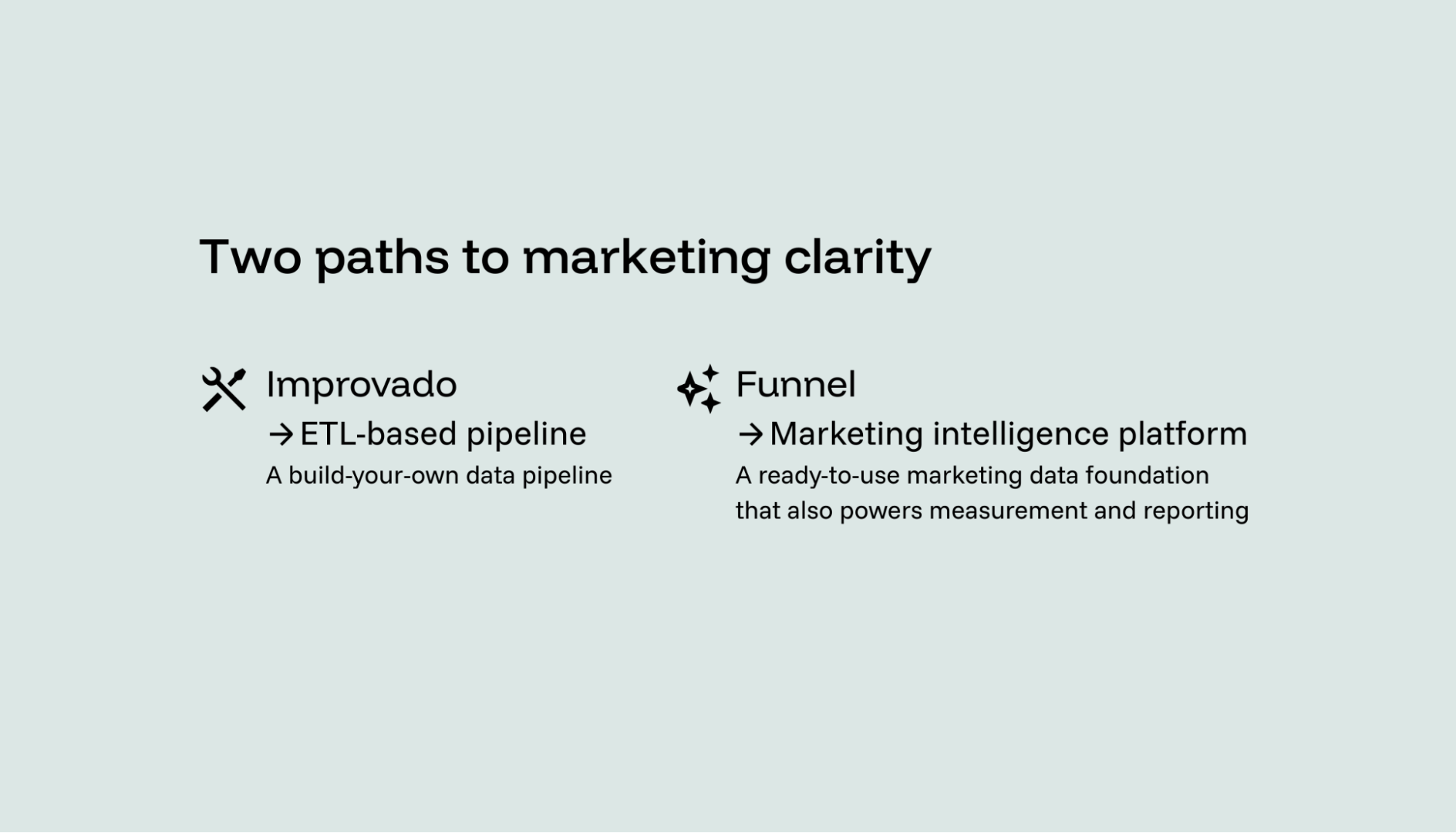
Funnel flips the model by storing, modeling and standardizing data inside a unified marketing foundation. Instead of reconnecting or rebuilding pipelines to accommodate a change, teams work from a centralized data hub that maintains all your modeled, reusable data.
This makes reporting faster, helps to streamline marketing analytics and enables scaling without the headaches. With built-in measurement and AI-enabled workflows, Funnel goes beyond data integration and gives teams a governed, structured, single source of truth.
|
Feature |
Funnel |
Improvado |
|
Data storage |
Stores raw data centrally, serves as a marketing data warehouse on its own |
Stores data in a warehouse Improvado manages for you or in the one you already use |
|
Transformation/ semantic layer |
Built-in semantic layer plus transformation that re-applies instantly to history because raw data is stored |
Pre-built data models to transform your data across channels |
|
Connector count |
Over 600 connectors plus guaranteed connector coverage |
500+ pre-built connectors |
|
Destinations |
27 data destinations |
18+ pre-built data destinations |
|
Built-in dashboards |
Native Funnel dashboards that export to Looker Studio (now Data Studio), Tableau & BigQuery |
From 1 to 4 dashboards depending on your plan; custom dashboards are an add-on |
|
MCP & AI |
Connects to any MCP-compatible tool |
Improvado MCP agent can access 187+ data sources |
|
Pricing model |
Predictable plans |
Quote-based with no public pricing |
|
Managed services dependency |
Self-serve and no code, fully managed connectors |
Leans on Improvado’s team and customization credits |
|
Implementation complexity |
Simple to set up for non-technical teams |
Requires a technical team, an average of 2 months to implement |
|
Whole-team usability |
Designed for the whole team, with no single-champion dependency |
Best suited for technical users or teams with developer support |
|
Measurement add-on |
Digital Measurement from $1,500, scales with monthly ad spend |
Measurement is 99.5% automated via AI agents with a paid add-on |
What Improvado does well
As a marketing ETL tool, Improvado prioritizes control. It gives teams full ownership over data extraction, transformation and delivery into a warehouse with the ability to create custom pipelines.
Built for technical data teams that prioritize flexibility
For engineering-heavy teams, Improvado offers the ability to tailor data workflows in a more granular way. You can customize how fields are mapped, how schemas are structured and how often data is refreshed to match your internal warehouse setup, which works well for companies that already manage their existing models and BI processes. It also supports custom SQL transformations, so data teams can apply their own business rules before the data lands in the warehouse.
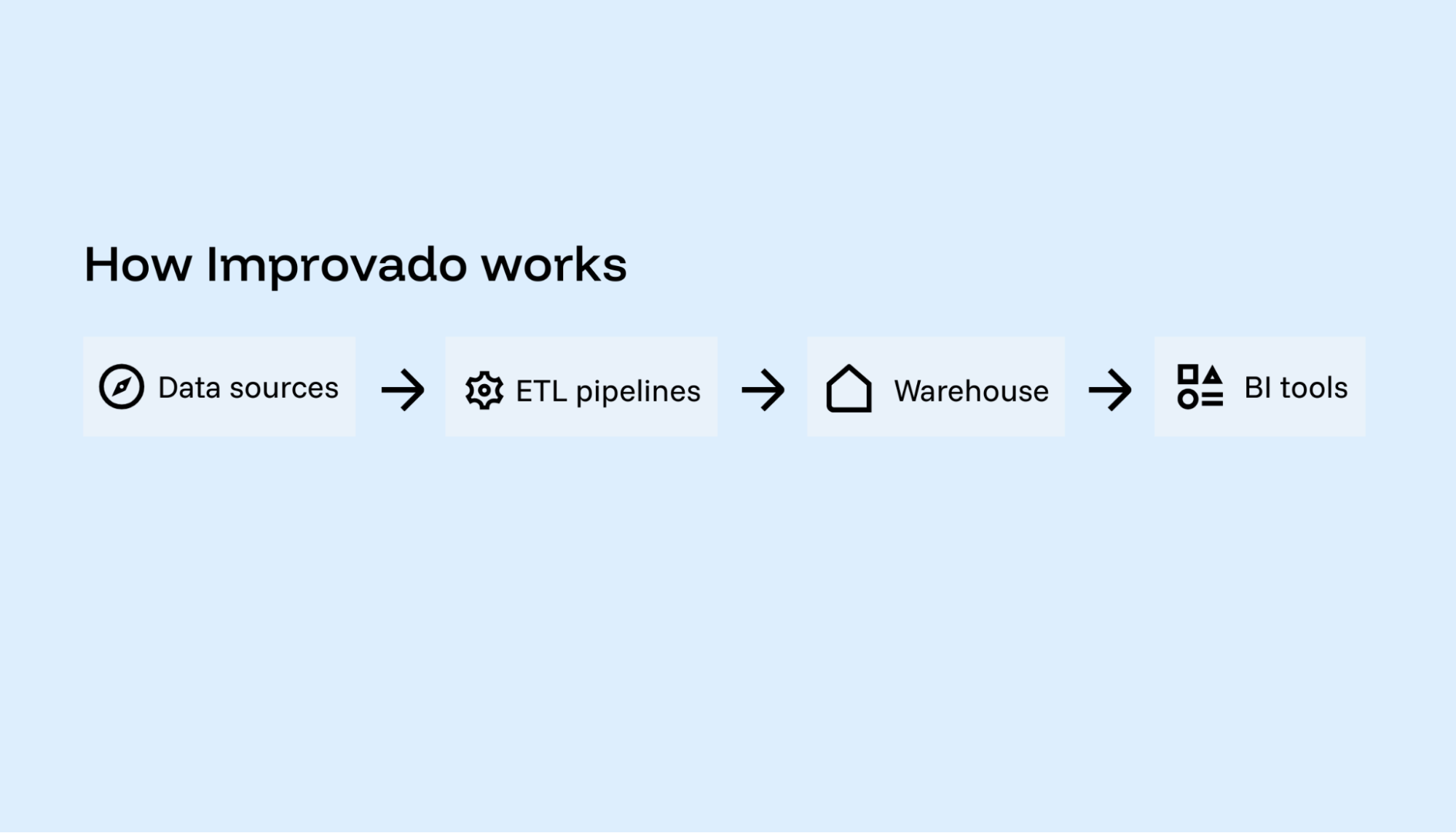
Improvado integrates into existing ETL or integration tools, too, making it convenient for companies that run multi-department data pipelines. Teams that need to blend marketing performance data with CRM, sales or financial sources can use Improvado to send everything into a central warehouse.
Because Improvado doesn’t store or model data within the platform, it relies on integrations with data-warehouse solutions like Snowflake, BigQuery and Redshift. Data teams can align marketing, sales and revenue data with the structures they already use, but they’re also responsible for maintaining the pipelines and updates over time.
Integrates with many marketing and sales sources
Improvado can pull data from 500+ connectors across marketing, CRM and sales systems into a central warehouse. Integrations can be customized or expanded through API-based connectors. This makes it possible for teams managing diverse or highly customized tech stacks to bring in channels or tools that aren’t natively supported.
Offers managed onboarding for enterprises
Improvado’s initial setup can be complex and technical, involving one to three months of work, so enterprise customers receive assisted onboarding from Improvado to help with early integrations and configurations.
Depending on which plan you’re on, you’ll have a certain number of credits to spend on Professional Services. You can use these credits for support, onboarding and ongoing pipeline management. This means non-technical teams can get help for issues such as troubleshooting breaks, adjusting transformations and keeping warehouse models aligned as APIs update, but how much support depends on the pricing tier.
The number of credits can feel limiting fast for teams without a dedicated software engineer to help with these issues. Lower tiers have no Professional Services at all, which means they’re on their own.
Key limitations
While Improvado offers flexibility for technical teams, its platform design comes with a few major trade-offs, which can cause problems for marketing and analytics teams.
Requires technical resources for setup and maintenance
Marketing teams don’t usually have the technical knowledge to set up and maintain a tool like Improvado on their own. It’s up to in-house engineers to monitor pipelines and fix breaks because the data connections aren’t managed. Adding new data sources often requires the help of the BI team and schema changes often trigger breaks that marketing can’t fix.
All of this can lead to ongoing bottlenecks, especially if you’re on a plan without credits for managed services, as described above. It also risks problems with broken integrations and missing data. The reality is that marketing is one of the fastest-changing data categories. APIs across ad platforms and analytics tools are updated frequently, often with little notice. Even small API updates can trigger pipeline breaks that need to be manually fixed. The State of API Reliability report shows that API downtime increased by over 60% year-over-year between 2024 and 2025.
What ends up happening is that marketing and analytics teams have to rely on engineering support to keep data flowing. Engineering and BI teams keep getting pulled away from other tasks just to make sure marketing gets the reports they need. The whole marketing analytics process ends up being far slower than it should be, and for those with managed services and Professional Services credits, this quickly eats into your credits.
Long implementation cycles
Custom pipelines take a long time to build. Depending on the complexity of your warehouse setup and data volume, it can take anywhere from one to three months to onboard Improvado.
The implementation process alone takes multiple steps: connecting data sources, defining schema and metrics, testing output accuracy and syncing data with BI tools. Any changes or schema adjustments during the process may extend the timeline since pipelines must be updated manually.
While enterprises with an internal data infrastructure may be able to handle this, agencies or marketing teams often suffer from delays that slow adoption and reduce early ROI.
Limited native measurement and marketing reporting capabilities
Since Improvado is built as an ETL tool, it stops after data moves into the warehouse. It doesn’t offer many options for native measurement or reporting tools.
The only measurement tool available natively is the AI agent, which automates 99.5% of analytics and reporting. It’s focused on day-to-day and ad-hoc stakeholder inquiries, so it generates answers to help demonstrate impact. However, you might choose to use your own measurement models in a separate tool for making budget decisions and large strategy changes.
To get more robust measurement, you would connect the data to external BI or analytics tools to analyze and visualize performance. Teams on the Growth tier get one dashboard for external tools, the Advanced tier gets two and Enterprise gets four. Custom templates are also paid add-ons.
While this setup does give flexibility, it often leaves marketers dependent on analysts to translate and measure performance outcomes beyond what the AI agent offers. Without more robust built-in metrics or marketing context, interpreting performance across channels usually demands more custom modeling and SQL work.
Volume-based pricing is unpredictable as teams scale
Pricing isn’t always transparent with Improvado. Because it’s custom and tied to volume, it scales with the amount of data processed, stored or transferred. This means that data-heavy brands get penalized for success.
Adding new channels, increasing campaign granularity or pulling deeper historical data can all drive up monthly costs. Every time pipelines are updated or reconfigured, the added processing volume can push prices even higher.
Several services and features require an additional investment and aren’t included in any plans. This includes the AI agent for measuring, custom dashboards, marketing intelligence for data warehousing and marketing data governance features. It’s also unclear how many credits for managed services or professional services you’ll need to build custom data pipelines and dashboards, so you won’t be able to predict costs until you’ve spoken to the sales team.
Data syncs up to four times daily on the advanced plan. As data volume grows, pricing can quickly become expensive and difficult to forecast. If you’re managing a large multi-channel budget or expanding your stack, this volatility makes long-term planning and budgeting much harder.
How Funnel differs
Funnel is a full-fledged marketing intelligence platform with a governed data hub that’s built to scale along with your team and your campaigns.
Built for marketing data from the ground up
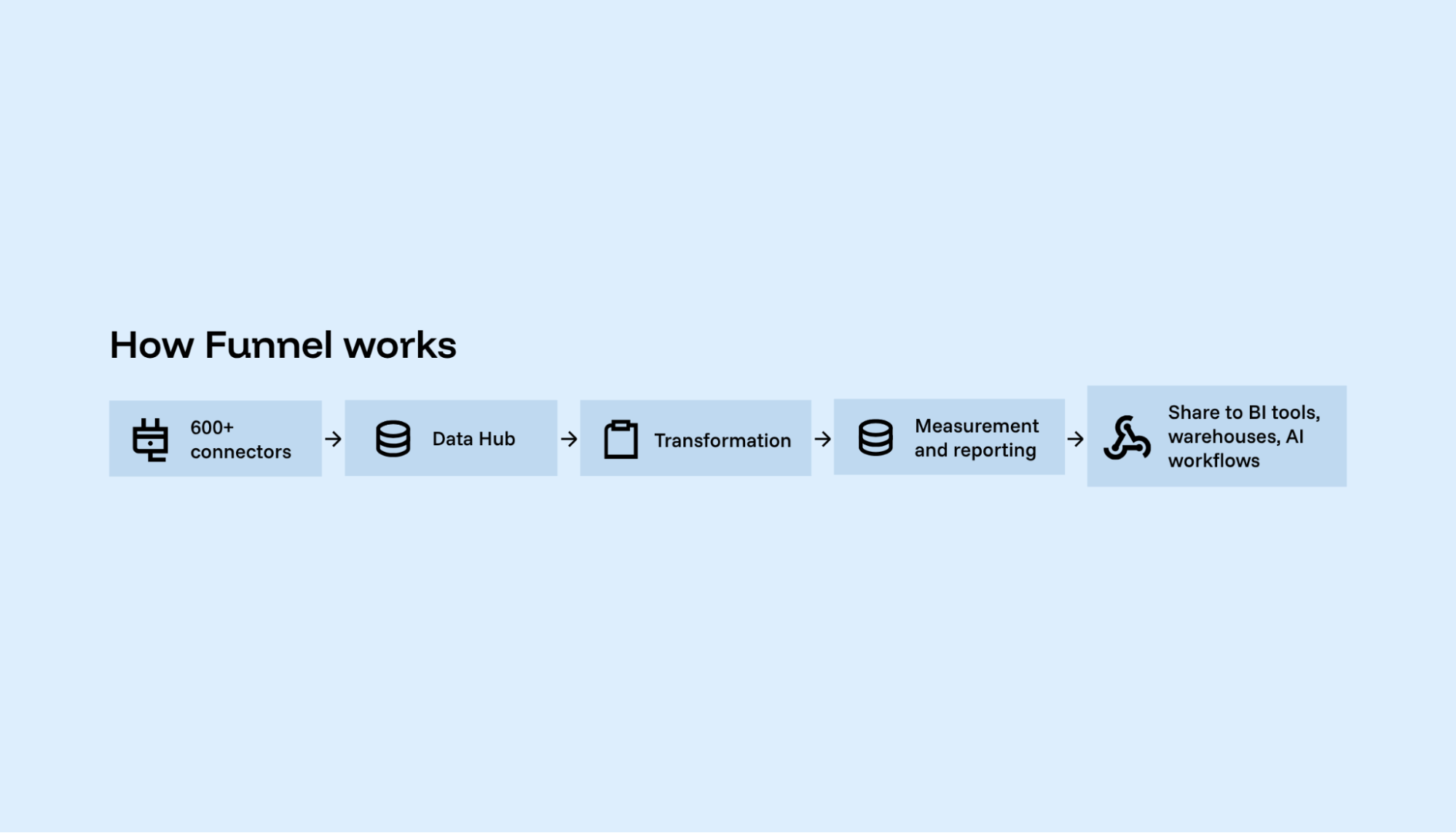
Instead of simply moving data into a warehouse, Funnel integrates, stores and normalizes data from 600+ data sources. Data is unified and governed directly in the Data Hub, giving marketers and analytics teams access to analysis-ready data.
Since everything lives in a centralized data hub, teams don’t need to rebuild transformations or re-map fields every time a channel updates. They can export that same modeled data to warehouses, BI tools or spreadsheets without rebuilding pipelines or use Funnel’s built-in reporting dashboards for data visualization.
Funnel also lets marketers activate normalized and modeled data from its unified data hub to help ad platforms optimize campaigns. With data activation, Funnel sends first-party conversion data back to ad platforms so algorithms learn which audiences to optimize for faster.
And it’s no-code, so marketing can self-service analytics instead of being engineering-dependent.
Enables collaboration between marketing and data teams
Funnel gives marketing and analytics teams a shared workspace built around the data hub. There’s one, single source of truth to work from, giving teams clean, consistent, refreshed data.
Data teams can manage governance, naming conventions, transformations and export rules in one place. The data is already standardized and stored centrally, so they don’t have to rebuild logic when APIs shift or metrics update.
At the same time, marketers get direct access to clean and trustworthy data. They can explore, filter and cross-compare channel performance without relying on SQL or engineering help.
There are fewer hand-offs and bottlenecks, like waiting days for a new data source to be added or for fixing inconsistent metrics. Everyone gets to focus on doing their best work instead of playing ping-pong with data requests.
Predictable pricing and faster time-to-value
There are no surprise fees with Funnel. Its flexpoints model is transparent and scales based on usage, not data volume. This avoids the “per-row” or “per-GB” billing models common with ETL tools, where costs spike as campaigns grow, new channels are added or seasonal data loads increase.
Funnel also delivers a much shorter time-to-value because marketers can control data setup without waiting on engineering support. That’s why, on average, it takes Funnel users less than 25 days to get fully implemented.
Funnel’s pricing plans are clear and easy to understand. The only add-on to factor in is Measurement, which scales with your monthly ad spend.
All this translates to shorter lead times, fewer dependency bottlenecks and predictable, stable costs.
Measurement built in
Funnel doesn’t stop at consolidating data; it brings advanced measurement directly into the platform. Marketing mix modeling (MMM), multi-touch attribution and incrementality testing are built on top of the data hub, so measurement models are fed clean, reliable data.
Teams can track short-term performance through attribution and understand long-term impact through MMM. Marketers can see what’s driving incremental lift, test “what-if” budget scenarios and identify the channels that deliver real growth without relying on additional tools or data teams.
The tight integration between data and measurement dramatically shortens the feedback loop. Insights move faster, and teams have the answers they need to make more confident decisions.
Understanding where Funnel and Improvado shine, it’s clear that they’re designed for different teams. Let’s look at who’s a good fit for each platform.
Who each platform is best for: Funnel vs. Improvado
Funnel and Improvado are built for very different teams and ways of working. Here’s a breakdown of who each platform is best suited for, based on how teams actually use their data.
Improvado: Best for technical, warehouse-led teams comfortable owning pipelines
Teams that are comfortable custom-building ETL processes and maintaining data pipelines as APIs, schemas or reporting needs change may find Improvado a good fit.
Here, marketing data is treated as one input among many. BI and data engineering teams integrate marketing data alongside sales, CRM and finance data for broader analysis.
Technical teams have the flexibility to design their own data models, define schema logic and control data governance. This works well for companies that already have established BI workflows and prefer to manage transformations and reporting logic within their warehouse. Enterprises that need deep customization across departments (and have the resources to maintain it) can operate this way comfortably.
That said, this approach requires ongoing technical responsibility and longer cycles from data to insight. For teams looking for a turnkey marketing intelligence platform, Funnel offers a faster, simpler path to impact.
Funnel: Built for marketing teams who want a unified, no-code intelligence platform
Growth teams require clear, governed and reusable data, not just custom pipelines. Measurement is also becoming essential, but it requires modeled, centralized data to generate insights that marketers can act on.
Funnel is built for marketing teams that want a single place to connect, clean and measure their data, without the pressure of becoming data experts. It’s a natural fit for teams managing performance across multiple channels, brands or accounts who need fast, reliable insights day to day.
These teams care about visibility and momentum. They want a clear, shared view of spend, ROI and performance across channels without having to wait on technical support or maintain pipelines. For marketing leaders and in-house teams focused on marketing effectiveness, Funnel supports confident decision-making by ensuring insights come from unified, trustworthy data. Agencies don’t have to rebuild reports, mappings or logic from scratch for every new client. They benefit from fast, repeatable setups, so reporting stays consistent even as clients and channels grow.
Funnel keeps marketing data accessible, reliable and ready for action, helping marketing focus on increasing ROI rather than just nailing down what it is.
Funnel vs. Improvado: feature-by-feature comparison
Here’s how Funnel and Improvado stack up across core capabilities:
Data integration and API coverage
Funnel has robust connections that cover the full marketing stack:
- Major ad networks, including Meta, Google Ads, TikTok and LinkedIn
- CRMs, including HubSpot and Salesforce
- Marketing analytics tools such as GA4 and Adobe Analytics
- Ecommerce systems, including Shopify and Amazon Ads
The connectors are easy to set up and secure, offering marketers GDPR and ISO-certified data handling. They’re continuously maintained by Funnel’s internal team. As APIs or platform fields change, Funnel handles those updates centrally, reducing the risk of broken connections or data loss.
Teams can also bring in data from sources that aren’t natively supported through API-based connectors or file uploads, or Funnel can build custom connections for you.
Improvado connects to marketing and sales data sources, including revenue, CRM and offline sales data integrations. Because it’s built as an ETL tool, getting everything set up can require more technical effort.
For teams comfortable managing data infrastructure, integrations can be extended via API or database-level connectors.
Transformation and normalization
Funnel automatically normalizes marketing data coming in from connected platforms. Your data is ready for cross-channel data analysis, measurement and activation. When exporting, data is already modeled and ready to use.
With Funnel’s no-code engine, teams can define custom rules through data mapping and the rules engine, without writing SQL. This makes Funnel ideal for multi-brand or multi-market advertisers that need consistent dashboards and comparable metrics across regions, channels and accounts.
While you have full control over transformations and schema design, Improvado takes a more engineering-led approach. Any change needs to be handled using SQL or scripts in your data warehouse or through Improvado’s API.
Data storage and refresh automation
With a data hub centralized in the cloud, Funnel automatically refreshes data on a daily schedule, so teams are always working with the latest numbers.
Marketing data can be exported to any BI tool, warehouse or visualization platform, such as Google Sheets, BigQuery, Power BI and Tableau. And because data lives sound in the hub, there’s no need to rebuild or reconfigure pipelines when adding destinations or adjusting reporting needs. Historical data remains intact even as platforms and APIs change.
Improvado, on the other hand, functions as a pipeline moving data into warehouses. That means data reliability depends heavily on how pipelines, schemas and warehouse logic are maintained.
While refresh schedules and update frequency are customizable, they must be managed by BI or data engineering teams. Data storage and historical reprocessing are handled downstream in the warehouse, which requires more manual work and oversight to maintain.
Visualization and reporting options
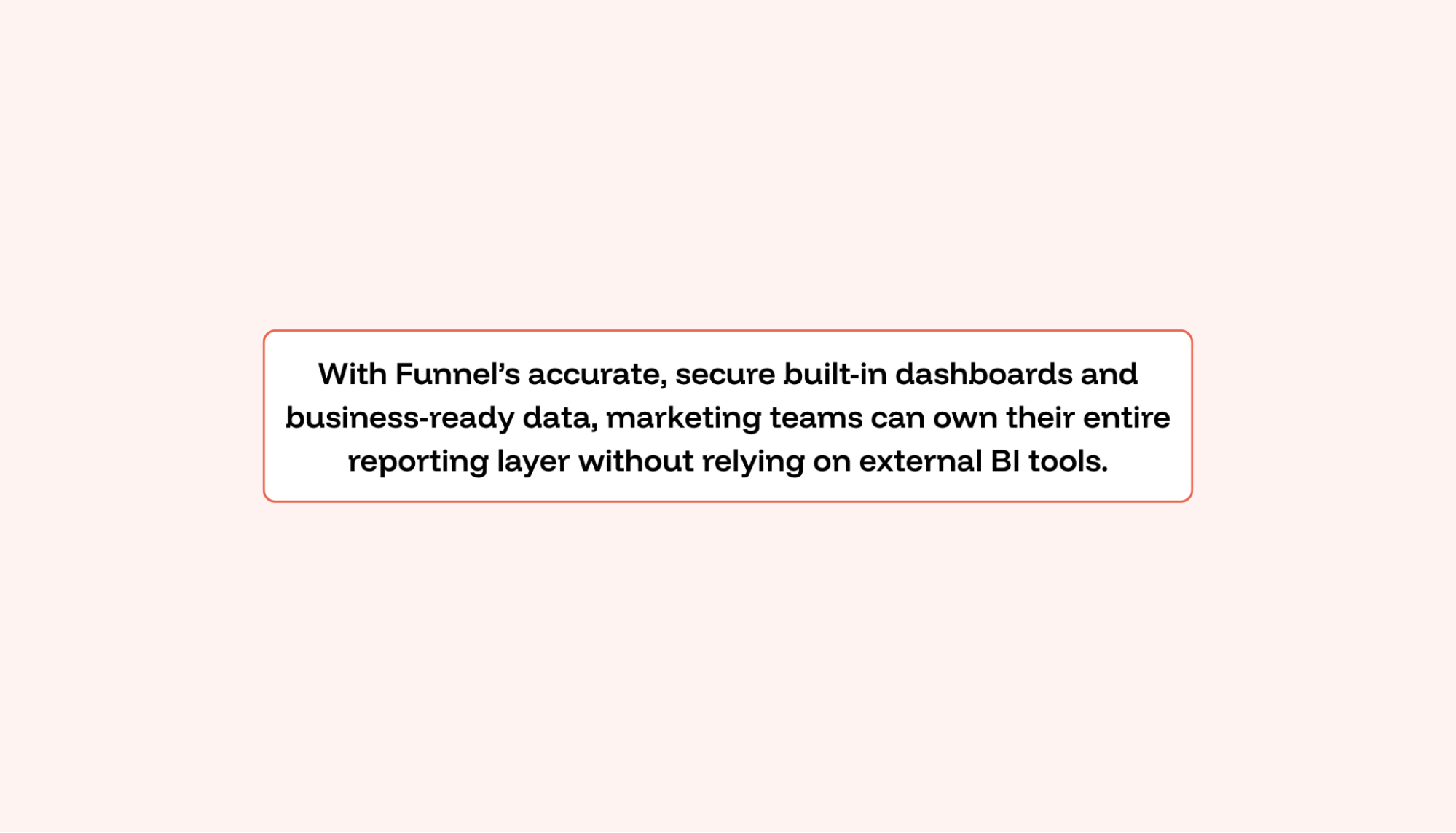
Funnel offers built-in dashboards and reporting, allowing marketers to explore and share insights without waiting for BI resources. Data arrives in the Data Hub already structured for reporting, so teams can work with standardized metrics, dimensions and campaigns across channels.
When external reporting tools are needed, Funnel connects seamlessly to data visualization tools, such as Looker Studio, Power BI, Tableau, Qlik and Google Sheets. Reporting stays consistent and aligned across teams because every report and export is pulled from the same centralized source.
The result is speed. Ria Money Transfer, for example, was able to move from data collection to performance insights far more efficiently and consistently after centralizing its marketing data in Funnel. They were able to deliver cross-channel reporting 10× faster.
By contrast, Improvado doesn’t offer native visualization or reporting tools. Teams can connect data to BI and visualization tools using prebuilt connectors, but there is no built-in dashboard layer. Reporting relies entirely on external BI tools and the models built on top of the warehouse.
Connecting dashboards to these tools is also limited. This makes the reporting process highly dependent on analysts or data engineers for setup and updates, or on Improvado’s managed services. For marketing teams that need deeper insights than what the AI offers, that often means longer turnaround times.
Measurement and forecasting
Funnel brings advanced measurement directly into your marketing workflow. Marketers can use triangulation, which combines multiple models instead of relying on a single method:
- Marketing mix modeling (MMM) for a macro, long-term view of channel impact
- Multi-touch attribution (MTA) for more granular, day-to-day insights
- Incrementality testing to measure causal lift and incremental outcomes
Because these models are built on the same normalized dataset inside the Data Hub, results are consistent and comparable. This reduces bias, improves confidence in ROI calculations and supports better forecasting and budget planning.
Teams aren’t bouncing between tools or reconciling conflicting outputs. Built-in measurement bridges the gap between data collection and decision-making: data ingestion → normalization → storage → measurement → optimization.
With Improvado, there are no built-in measurement and forecasting tools. Teams that want to run attribution, MMM or incrementality analysis must integrate external analytics or modeling tools and manage those workflows separately. And that involves additional setup, duplicated logic and longer cycles to turn data into insight.
Support and time-to-value
Funnel is designed to help teams get value quickly, without long onboarding cycles or heavy technical needs. From day one, users have access to guided onboarding, clear documentation and hands-on support through Funnel’s Help Center and Customer Success team.
No-code setup and automated data normalization remove much of the upfront work. On average, Funnel users are up and running in under 25 days.
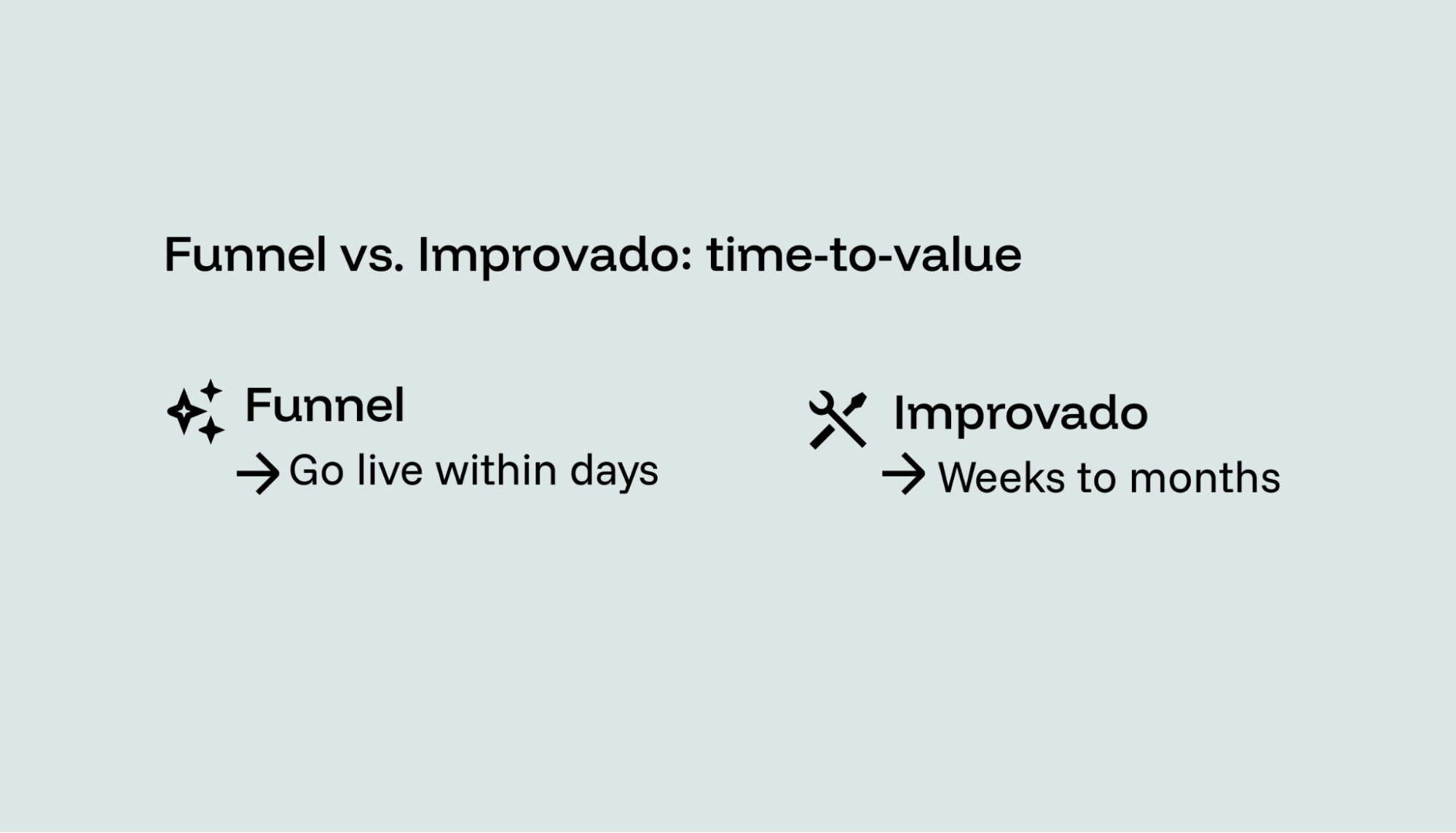
Improvado provides onboarding support to enterprises, but the setup process is typically configuration-heavy and closely tied to warehouse and pipeline design. Depending on data complexity and scale, onboarding can take months. There are longer lead times before teams can see usable insights.
After deployment, post-launch maintenance, schema management and error handling all fall on data or BI teams. It’s time and resource-intensive to scale properly.
Why Funnel is the better choice for marketing teams
Marketing data is uniquely complex. It’s spread across dozens of platforms, updated unevenly and constantly changing. A 2023 review of marketing analytics found that modern marketing is extremely data-intensive. Without a governed, single source of truth for marketing data, it’s hard to make sense of the noise.
Funnel is designed around how marketing teams actually work: fast, multi-channel and under constant pressure to prove impact.

Purpose-built for marketing effectiveness, not general ETL
Funnel is built as a marketing data hub from the ground up, not a generalized ETL system. With reliable, fully-managed connections, automatic transformation and no-code data visualization, it’s designed to handle the real complexity of marketing data.
While ETL tools like Improvado excel in technical customization, Funnel prioritizes accessibility and agility. Marketers can work directly with clean, governed data to monitor performance, compare channels and optimize campaigns.
By removing friction between data collection and decision-making, marketing teams rely on fewer hand-offs and can make faster, more confident decisions.
Unified data foundation that supports advanced measurement
At the heart of Funnel is a centralized data hub that acts as the foundation for all marketing data. Every data source flows through one unified layer where metrics, naming conventions and currencies are automatically harmonized.
Following the acquisition of Adtriba in 2024, Funnel extended this foundation with advanced measurement capabilities. Marketing mix modeling, data-driven attribution and incrementality testing are built on the same normalized dataset, making it easier for teams to validate results.
Marketing teams can analyze data performance, test scenarios and forecast ROI all within Funnel or export that data to other preferred BI tools. Funnel also activates modeled and value-based signal data back to ad platforms with conversion API connectors. Funnel creates an end-to-end marketing ecosystem that gives marketers control of everything from data collection to measurement in the same place.
It’s why more than 2,000 brands and agencies worldwide, including Samsung, The Home Depot, Dyson and Trivago, trust Funnel to power their marketing data.
Book a demo and see why marketing teams choose Funnel to turn complex marketing data into actionable insights.
FAQs about Funnel vs. Improvado
What is the difference between Funnel and Improvado?
Funnel is a marketing intelligence platform built for marketing teams to own without engineers. On the other hand, Improvado is a marketing platform that involves a technical setup and relies on managed support from Improvado’s team or in-house technical resources.
Is Improvado better for enterprise than Funnel?
Improvado is positioned strongly for enterprise with its large connector library and unified taxonomy. Its professional services and credit-based system, however, may make pricing unpredictable. Funnel serves enterprises through self-serve usability, a governed semantic layer and predictable tiered pricing.
Does Improvado require a data engineer?
Improvado doesn’t strictly require an in-house data engineer, but it’s built for and benefits from having technical users on the team. Otherwise, users rely on Improvado’s credit-based professional services. Some connector installs and database administration assume technical understanding, and solo or non-technical marketers report a steeper learning curve. Funnel is built for marketers, and non-technical team members can use it, making it easier for analysts, marketers and data to collaborate.
Is Funnel cheaper than Improvado?
Funnel offers transparent, tiered pricing plans that function on a flexpoint system based on usage and not data volume. This makes the pricing predictable and transparent. Improvado uses quote-based pricing, with several features being paid add-ons, so it’s harder to plan your budget.
When should I choose Funnel over Improvado?
Choose Funnel when you want your marketing team to own the data hub without relying on technical team members, engineers or a vendor professional services team. You should also consider Funnel if you want predictable, transparent pricing, a no-code setup and robust measurement capabilities.
What is the biggest difference between Funnel and Improvado for marketing teams?
Funnel allows marketers to run the platform end-to-end. It’s designed for whole-team usability, regardless of technical knowledge. Improvado is built for technical teams, and as such, it leans on technical resources and managed services when those technical resources aren’t available.