






Advertising platforms have become black boxes. Some of the optimization levers marketers once relied on are gone, and the algorithms now decide which audiences to target and how much to bid, based entirely on the signals they receive.
You might not be able to hand-pick audiences or tweak bids like before. But you can control the signal data that those systems learn from. That’s the promise of signal engineering: collect clean events, model the business value behind them and feed the right signals back into ad platforms so they optimize for what matters.
Signal engineering gives marketers control again by designing value-based, predictive conversion signals that help advertising platforms learn who to serve ads to and how to optimize bidding. These synthetic signals offer marketers a way to nudge AI-driven ad platforms to optimize for long-term business value rather than clicks and other short-term outcomes.
In this article, we map the loop from raw events to predictive, value-aligned signals, show where LTV modeling fits and explain how a reliable data foundation makes marketing data reliable, structured and ready for activation.
Ready to train the algorithm to think like your business?
What is signal engineering?
Because Meta, Google, LinkedIn and other ad platforms are increasingly relying on AI-powered optimization, performance marketers need to step up and train ad platform algorithms to ensure campaigns are being optimized for business goals. If you don’t train the AI, you’re not going to get the outputs you want.
Signal engineering is the practice of shaping raw marketing events into structured inputs that teach ad platforms what your business values and which audiences are likely to become loyal customers. It’s about identifying the right conversion events, understanding their impact on your campaign goal or business outcome and sending that information back to the ad platforms.
The data performance marketers have to work with to engineer the right signals is first-party conversion data in CRM and sales systems and data from on-site behavior and ecommerce transactions. Average order value, ebook downloads, subscription renewals: these are the events that lead to growth. So, you want those feeding into the algorithms.
Want to generate more B2B leads? Then, feed ad platforms demo requests and webinar attendance signals. Focused on sales? Teach the platforms to target high-value buyers by sending order values above a certain threshold as the conversion event. Instead of optimizing for quick wins, signal engineering lets you define the outcome that matters and turn that into a conversion signal the platforms can learn from.
The beauty of signal engineering is that you choose the data points to send: observed events like purchase or signup, or modeled values such as predictive LTV. Then, you feed them into Pinterest, Meta, TikTok and others through their conversion APIs.
The result is spending and targeting that focus on your target audience and align with your business goals.
Why are performance marketers turning to signal engineering right now?
Signal engineering is important for performance marketers today because teams simply don’t have the same level of control over ad optimization that existed before cookie depreciation and the subsequent signal loss.
Signal has diminished, causing the algorithms to start guessing who to serve ads to. As a result, campaign budgets end up being spent on low-quality leads, and the customers who are most likely to create value for your business are missed.
Also, the advertising ecosystem is shifting toward AI-driven optimization. Automation moved bidding and audience selection inside the platforms, so marketers don’t know what information the algorithms are using to optimize ads and bidding.
The reality is that only three levers remain for performance teams. They are budget allocation, creative and signal engineering. Marketers can apply measurement models to better allocate budget and optimize their media mix. Design decisions and creative assets make an impact, too, although optimization of creatives is partially done within ad platforms. Signal is the third lever. Signal engineering enables advertisers to leverage their first-party data to gain a competitive advantage on ad platforms.
To perform well in this new ad landscape, performance marketers must provide richer, more accurate signals back to platforms.
Why ad platforms need better inputs
Platforms now decide bids and delivery, but they only learn from what you send them or what a limited pixel can capture. Without strong inputs, the systems default to what’s easiest: cheap clicks and short-window conversions. That often means the budget goes to people who will not buy, or who buy once and never return.
Your lever of influence here is the signal and the timing.
Short conversion windows bias optimization toward fast, shallow outcomes. Predictive signals close that gap by estimating long-term value early. When you feed back chosen customer events and modeled values like predictive LTV through conversion APIs, you teach the algorithm to optimize for what your business wants.
There’s plenty of evidence that better inputs change outcomes. According to Think with Google, moving from basic offline import to Google Ads’ enhanced conversions for leads lifted Carwow’s attributed conversions by 7%, with average gains of 8% on search and 22% on YouTube. Internal studies conducted by Meta, TikTok and LinkedIn have found that better signals can increase conversions by 24%, lower cost per action by 15% and reduce cost per result by 13%.
In a world of privacy shifts and missing IDs, modeled signals supply the context that platforms lack so that you can spend toward true value, instead of vanity metrics. Once you have clean, reliable inputs, the next step is designing the signals themselves.
How to apply signal engineering
Signal engineering isn’t just uploading LTV data and purchase thresholds. The value lies in the timing, calibration and packaging of signals. Here’s an overview of how signal engineering for marketing works:
Collect high-quality first-party data
Your signal strategies start with the right data. Capture first-party events across web, app, POS and CRM with consent. Use server-side capture to reduce loss and improve control.
Data foundation and source types
Here are the types of data sources marketers use for signal engineering:
- Transactional: purchases, order value, frequency, subscriptions
- Behavioral: on-site events, sessions, feature engagement
- Declarative: demographics or firmographics, survey or loyalty data, device info, email domain
- Marketing engagement: email engagement, support logs, original attribution channels
Store your conversion data in one unified marketing data hub to streamline the process of sending signals back to ad platforms. Your data foundation should transform data so it’s unified and consistent. Standardize names, map entities, de-dupe and align time zones and currencies.
When data is unified, ad platforms get clear, consistent signals, which helps them learn what matters faster.
Prioritize events that predict value
Signal events should be early enough to fit the attribution window, frequent enough to teach the machine learning models and capable of predicting real revenue or retention.
For example, ‘purchase with a high order value,’ ‘likely to reorder within 30 days,’ ‘loyalty program activation’ and ‘return to product within 24 hours’ are all examples of signals that teach platforms to optimize for value. You can also model predictive LTV and other value-based data to help optimize for your goals.
Activate
Resend your structured signals to advertising platforms using conversion APIs. A conversion API connection that integrates with your data hub lets you set up an automatic flow of high-quality conversion data back to your ad platforms. These server-to-server paths move signal data quickly from your data ecosystem to Google, Meta, TikTok and others, which helps train models faster.
Now that you know how signal engineering works, let’s look at how to use strong signals to train the algorithms so they can help ad platforms find higher-quality audiences and reduce wasted ad spend.
Build predictive, business-aligned signals
Strong signal engineering steers your campaigns toward real value. Here’s how to design them so platforms learn who is likely to be profitable, instead of just who’s easy to convert.
Choose the right “value” target
Signal engineering means deciding what the bidder should chase.
For retail, profit or contribution margin often beats raw revenue. For subscriptions and marketplaces, predicted LTV within a sensible window (for example, 90 or 180 days) is a better north star. In B2B, a lead-quality or pipeline score tied to opportunity stage outperforms “form submit.” These targets keep optimization aligned with business outcomes instead of vanity conversions.
If, for example, you want to train Meta on high-value buyers, you wouldn’t send Meta every purchase event. Instead, you only send purchases from customers whose predicted LTV is above a certain threshold. Over time, Meta’s bidding system learns which audiences resemble high-value buyers, not just anyone who clicks.
Train the platforms
Turn your prediction into a conversion value that the platform can act on. You can do this by mapping scores or LTV to bounded values. Setting boundaries prevents spikes in value and gives the algorithm a stable range to learn from.
For example, if your model predicts that a new customer will be worth $180 over the next 90 days, you might map that to a scaled conversion value between 0–100. For instance, $180 becomes a value of 72. Mapping predicted LTV into a usable range helps keep the signal consistent.
You also want to cap extreme outliers so models learn safely. Sometimes, predicted values can spike — for example, a customer with unusually high repeat purchase behavior might produce an LTV prediction of $900. Instead of sending “900” to the ad platform (which would distort bidding), cap it at a maximum value, such as 100. This avoids over-weighting rare events that would push the algorithm in the wrong direction.
Calibrate and monitor
Run incrementality tests to track impact and identify ways to improve your signal strategy.
Incrementality testing is the practice of running controlled tests (such as geo or audience split tests) to measure the true lift a channel, campaign or signal creates. It separates real impact from activity that would have happened anyway.
For example, you might pause a signal in one region but keep it active in another. If the active region shows higher marginal ROAS or better conversion quality, you have evidence the signal is genuinely improving performance.
Signal engineering gives performance marketers back a powerful lever for campaign optimization. However, not every team needs to dive into sophisticated predictive models to get value from the process. Rather, the goal is to start using your first-party conversion data so ad platforms start spending your ad budget more effectively now. From there, your team can adopt a more mature model for signal engineering.
Signal engineering maturity model
A clear path helps teams move from pixels to predictive value, one step at a time.
- Level 1–2: Basic pixel tracking and ad-hoc custom events
- Level 3: Systematically identifying and implementing high-intent signals as proxies for value
- Level 4: Predictive LTV-based bidding and value optimization
- Level 5: Fully integrated, dynamic (and if possible near real-time) signal strategies informing business decisions
Funnel helps teams activate their conversion data every step of the way. Here’s how.
How Funnel helps teams engineer better signals
Signal engineering works when inputs are clean, structured and deployable. Funnel gives teams the data foundation and the activation rails to make that happen.
Data quality and normalization
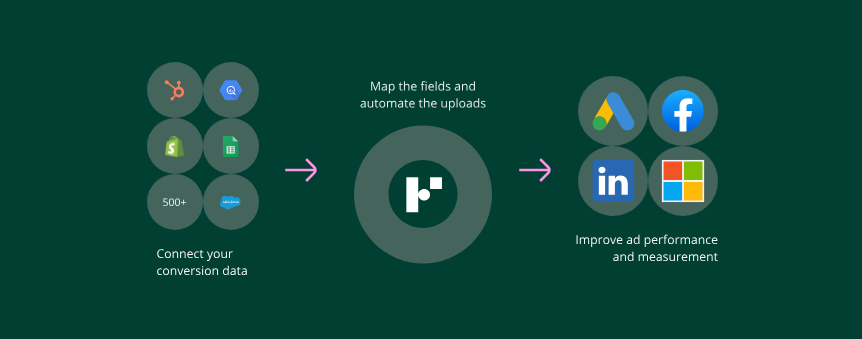
Funnel pulls data from all your sources and normalizes it. The data model is designed for marketing, so it deals with errors and data discrepancies automatically. The data connections are fully managed, so you don’t have to worry about data loss every time an API gets updated, and historical data is preserved.
From normalized data to predictive signals
Your marketing data is clean and structured, so you have trustworthy data ready for modeling. Use the unified dataset to model business value: profit, predicted LTV or lead quality.
Reliable CAPI delivery
Send conversion data back to advertising platforms through conversion APIs to Google, Meta, TikTok and others. Funnel offers streamlined server-to-platform signal transport.
We currently have conversion API (CAPI) connections with seven platforms.
|
Platform |
Conversion API |
Key features |
|
Facebook Ads |
Conversions API |
Website events, offline events |
|
Google Ads |
Enhanced Conversions |
Store sales, enhanced conversions for web and app |
|
LinkedIn Ads |
Conversions API |
Lead generation, website conversions, offline events |
|
Microsoft Ads |
Offline Conversions |
Import offline conversions, enhanced conversions |
|
TikTok Ads |
Events API |
Website events, offline events |
|
Snapchat Ads (Beta) |
Conversions API |
Web, app and offline conversions |
|
Pinterest Ads (Beta) |
Conversions API |
App installs, in-app actions and offline sales |
You can set up your CAPI connections and get started in Funnel quickly. Simply add the conversion APIs of your choice as destinations for your Funnel data, choose the events you want to send and let Funnel handle the rest. Your data is already structured and aligned, so you can send consistent, high-quality signals back to your platforms without any extra tools.
Start building your signal engineering system for more effective campaigns
Signal engineering is becoming a core capability for modern performance teams. With clean data, well-calibrated models and reliable delivery paths, advertisers can shape platform optimization around long-term business value, not short-term click signals.
When the machine learns from better signals, budgets shift toward real growth. Start turning your marketing data into smarter signals with Funnel.