






Supermetrics offers a handy way to pull channel data into Google Sheets, Data Studio and other reporting and data visualization tools. It’s a useful option for teams looking to automate marketing data integration and reporting.
But as you add more clients, markets and channels, those light workflows can cause problems like slow dashboards and broken connections. You end up spending more time fixing Google Sheets than answering performance questions.
If that sounds like something you’re experiencing, you’re not alone. Some teams are searching for Supermetrics alternatives that can handle bigger, messier marketing data. Also, recent pricing increases have given scaling users another reason to reconsider their setup. As data volume and reporting needs grow, teams seek out a more centralized way to store historical data, standardize metrics and govern how that data is used across reporting and analysis.
When a simple switch from Sheets to data warehouses like BigQuery means rebuilding every report (and losing historical data in the process), plugin-based setups can feel pretty fragile.
In this article, we break down the leading Supermetrics alternatives, highlight what they do well and who they suit, and show how Funnel fits if you’re ready to move to a more scalable marketing data hub.
Why teams are looking for Supermetrics alternatives in 2026
In 2026, the biggest drivers causing teams to search for Supermetrics alternatives are scaling costs and the need for a stronger marketing data foundation across reporting, measurement and AI.
Scaling now creates more cost pressure
The entry price for Supermetrics has increased, giving scaling teams another reason to reassess their setup.
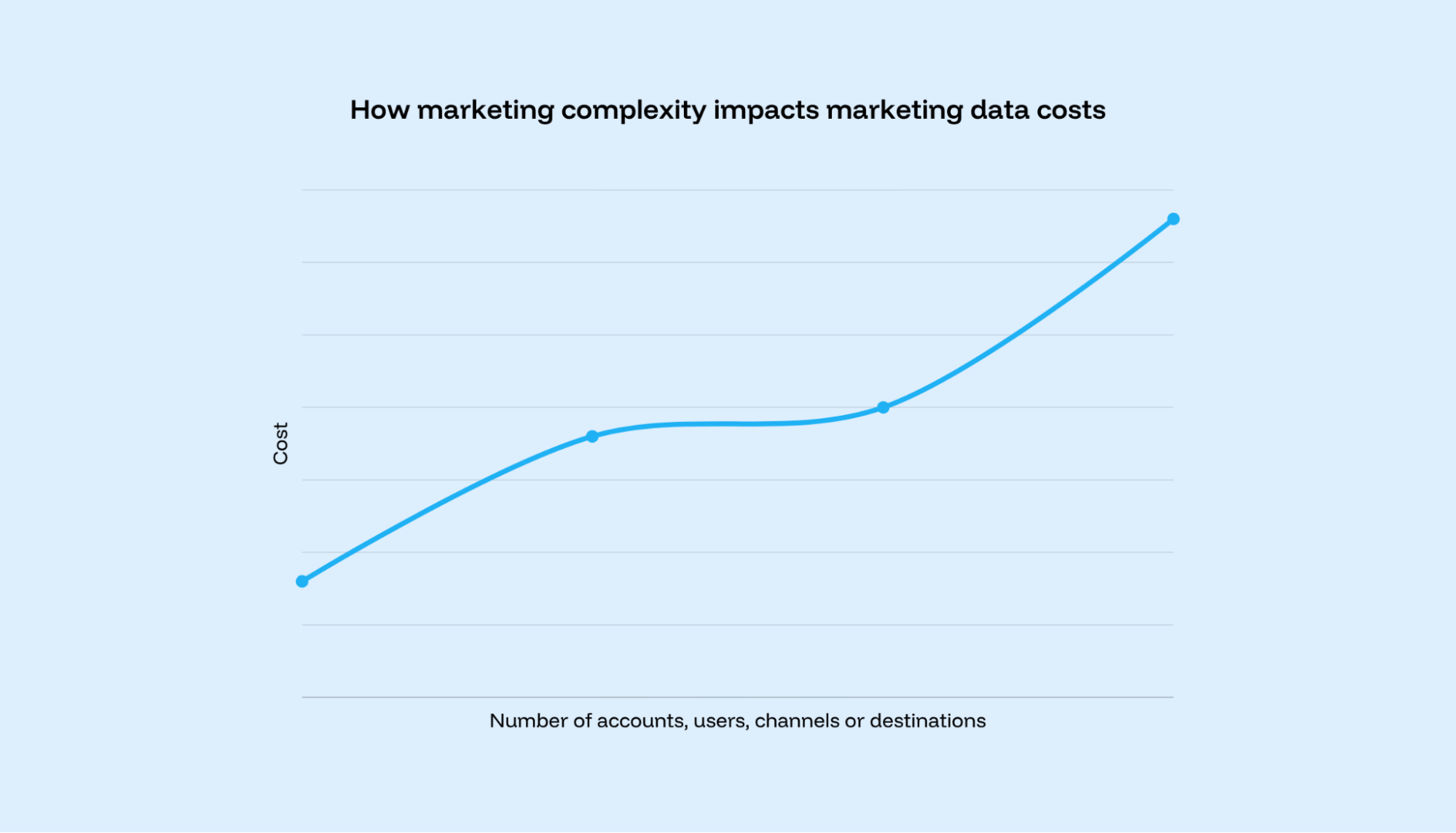
Costs continue to rise as teams add more accounts, users, data sources and reporting destinations, especially when complex reporting needs push them toward higher-tier plans or add-ons.
AI and agentic workflows depend on a central marketing data foundation
AI has raised the stakes for marketing data quality. When data is moved directly into individual reports, teams have to maintain the same formulas, naming rules and metric logic in multiple places. That makes it harder for AI tools to work from consistent, trusted information.
It’s an even bigger issue if teams use AI to ask questions, compare performance or support agentic workflows. To get useful answers, marketing data needs to be stored, standardized and governed centrally so it can be reused across dashboards, warehouses, measurement tools and AI workflows.
What to look for in a Supermetrics alternative
When you're reviewing Supermetrics alternatives, go in with the mindset of “which setup gives my team reliable, long-term control?” and pay attention to the following areas:
Scalability
Supermetrics is a great first step for teams that want to pull a few data source connectors and focus on data aggregation into Google Sheets or simple dashboards. But that setup can crack under the pressure as you add more brands and campaigns. As more data flows, dashboards get heavy and slow, and you run into API limits or brittle formulas that are hard to maintain across clients.
Analysts talk about the “flywheel effect” of a good data product. You invest once in clean, reliable data, and then every new use case (reporting, transformation, measurement or activation) gets cheaper and faster because you reuse the same foundation instead of wiring up new data processes for every report or client.
A McKinsey analysis found that when one company reused a single data product across several analytical solutions, its projected costs were about 30% lower than the cost of building separate pipelines for each one. That is the kind of setup you want from a Supermetrics alternative.
Data coverage, connector reliability and historical storage
In many Supermetrics setups, data is pulled from the source and pushed straight into your chosen destination. Supermetrics doesn’t act as the long-term home of that data; the reliability of each report depends on how well each individual connection is set up and maintained.
A stronger alternative will manage the connectors, which means that it monitors APIs, adapts to schema changes, handles rate limits and preserves raw data. It should also support historical backfills when new fields or accounts are added. You should be able to reuse stored data if you switch dashboards, warehouses or reporting tools.
That way, if APIs change or older fields disappear, you can keep reporting continuity without rebuilding past performance from scratch or managing every fix yourself.
Usability for non-technical users in marketing reporting
On the label, Supermetrics lets non-technical users pull their own data. In practice, users still spend a lot of time cleaning tables, fixing naming and maintaining formulas in every sheet or dashboard. Any change in business logic means touching multiple reports by hand.
Look for an alternative that makes modeling accessible without SQL. Marketers without technical skills should be able to group campaigns, map channels, standardize currencies and define metrics in a no-code interface. Day-to-day tweaks shouldn’t depend on your dev or data teams.
Data governance
Once you are working across multiple clients and markets, governance stops being optional. You need shared rules for currencies, naming conventions, time zones and metric definitions so numbers mean the same thing in every report.
A good Supermetrics alternative will give you a central data model: you define those rules once, in one place, and apply them across all accounts and destinations. At the same time, it should keep client data separated with proper workspaces and user permissions, so teams only see what they’re meant to see.
The result is one trusted version of each metric, fewer “which number is right?” conversations, and more confidence in the reports you send to clients and leadership.
Measurement readiness
Supermetrics’ core job is to move incoming data from your channels into a destination. That is useful for basic reporting, but on its own it doesn’t give you what you need for more advanced measurement like marketing mix modeling, multi-touch attribution or incrementality testing.
Those methods all depend on a single, consistent data set: the same channel and campaign naming conventions, shared metric definitions, aligned time zones and enough clean history stored in one place. If each channel is just dropped into its own sheet or dashboard with different naming and time frames, you have to do a lot of manual work before you can even start modeling.
A more future-ready setup treats measurement as a layer on top of a central data hub. Your marketing data is stored, harmonized and governed there first, then used by whatever tools you choose. When you're ready to run marketing mix modeling, build an attribution model, test incrementality or plug into AI, you already have the structured input those methods need.
AI and MCP readiness
Supermetrics now offers a Claude/MCP integration for conversational querying. While it’s a useful new feature, AI can only offer actionable information if the data underneath it is contextualized.
But Supermetrics doesn’t have native data storage. If an LLM is querying a live pipe with no stored history, it lacks the context needed to compare trends, explain performance changes or answer cross-channel questions consistently.
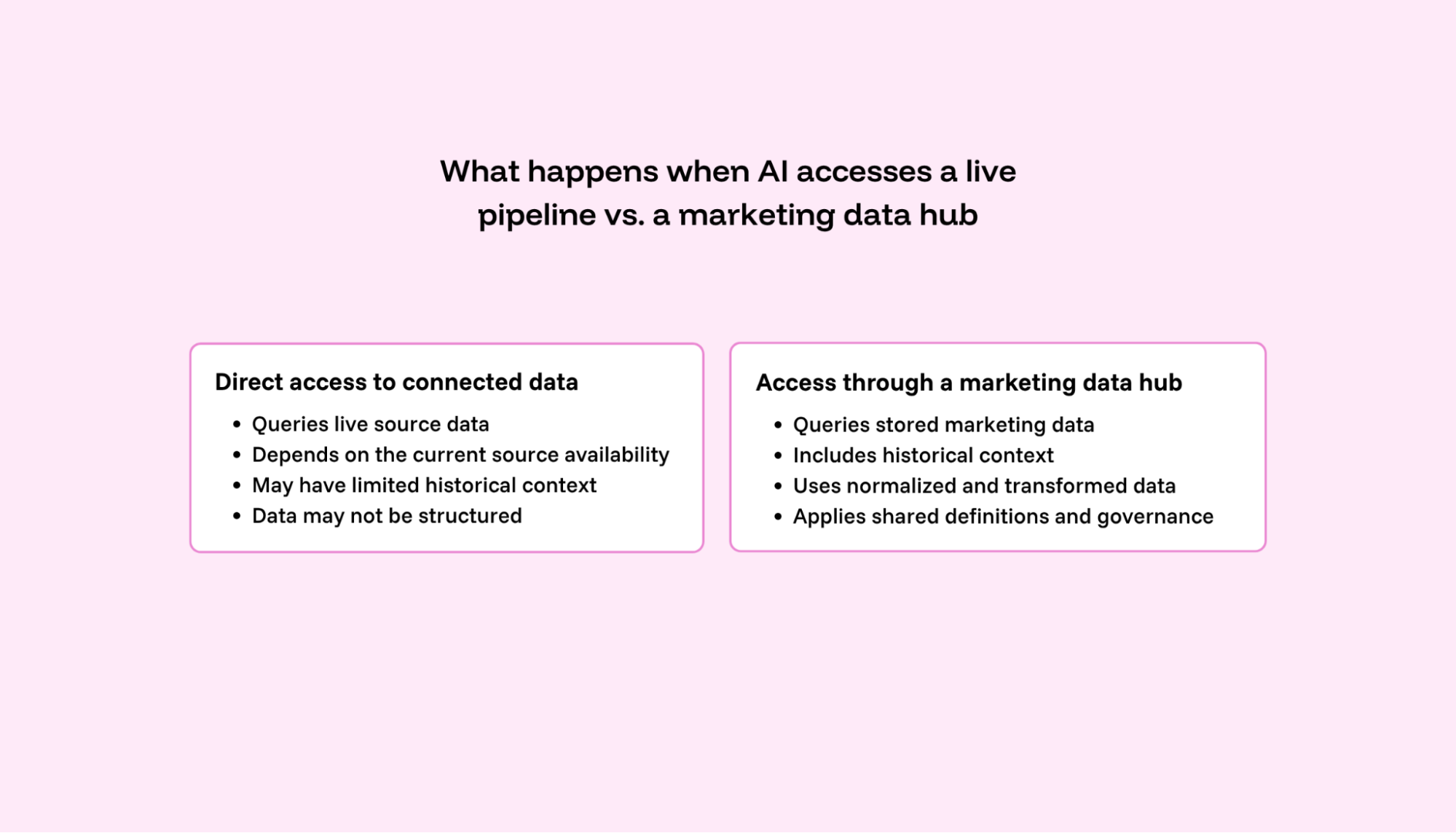
For example, it may be able to answer a question about current performance, but struggle to explain year-over-year changes if that history was not stored and standardized. Teams need to consider what data AI can actually access, not just whether an integration exists.
A stronger alternative gives AI access to transformed and governed data with shared metric definitions and stored historical context, so it can work from the same trusted data foundation used for reporting and measurement.
Pricing predictability, free plan options and trials
Finally, look at how pricing scales with you. For example, with Supermetrics, you pay per destination and add-on, and many similar tools price by data volume or rows. That can make every new client, connector or export feel like a separate line item to justify; otherwise, your bill explodes.
A more predictable model will give you a set amount of connections and users. If you need more, then you simply add more.
The top Supermetrics alternatives for 2026
There’s no single best Supermetrics alternative for everyone. The right fit depends on how complex your marketing is, who owns the data work and how far you want to go beyond basic reporting.
Below, we break down the leading options for 2026, what they do well, where they struggle and which teams they suit best.
1. Funnel: Best marketing intelligence platform for scaling teams
Funnel is a marketing intelligence platform built for teams that need a trusted marketing data foundation. It pulls performance data from 600+ marketing, analytics and sales platforms into a central Data Hub, where it’s stored, harmonized and governed before being used across reporting, measurement and AI workflows.
Your team can send data to dashboards, BI tools and warehouses, or analyze data using Funnel’s built-in dashboards. For deeper analysis, Funnel’s advanced measurement tools work from the same prepared data, so teams don’t have to reconcile dashboard numbers with measurement results.
Ideal users
Funnel is best for scaling agencies and brands that need reliable marketing data across multiple channels, markets and clients. It's especially great for marketers who want no-code control and advanced measurement capabilities, and data teams that want a governed, reusable data product they can plug into their wider stack.
Strengths
No-code setup for marketers
Marketers can group campaigns, map channels, standardize naming conventions and define metrics in a point-and-click interface instead of relying on SQL or custom scripts.
Collaborative workspace for data teams
Data teams can define naming conventions, roles and workspaces, then let marketers self-serve within those guardrails, so governance and agility are aligned.
Large connector library
Funnel maintains 600+ ready-made marketing connectors and offers a Custom Connect program for large data volumes, so you can bring in local or niche platforms without maintaining scripts yourself.
Data Hub as the foundation
All marketing data is stored, modeled and governed in one place, rather than relying only on live source connections. Historical data is preserved even if APIs or schemas change, and non-destructive transformations let you change logic later without losing history or breaking reports. Teams have one prepared data layer to use across dashboards, warehouses, measurement tools and marketing workflows.
Advanced measurement capabilities
On top of the Data Hub, Funnel offers advanced marketing measurement such as marketing mix modeling, data-driven attribution and incrementality testing, so teams can move from reporting to impact measurement without adding extra tools.
MCP access to governed data
Funnel’s MCP interface exposes a governed, stored and semantically structured data layer, meaning AI tools can work from the same prepared data that teams use for reporting and measurement. Shared metric definitions, naming conventions and transformations help produce more consistent answers, while historical context allows AI to compare performance over time and answer broader cross-channel questions.
Predictable pricing
Funnel uses Flexpoints, which are a set amount of connectors, accounts and destinations at your disposal within your subscription, with options for custom pricing. If you need to add more, you simply move up a tier. Pricing doesn’t change, which means you’ll never have to worry about usage eating into your budget.
Limitations
Funnel is primarily focused on marketing and revenue data. Broader enterprise data (finance, ops, product, etc.) will still live in your existing BI or data warehouses. Furthermore, if you only need a couple of simple, static dashboards, a lightweight reporting tool may be cheaper and easier.
2. Adverity: Best for data teams who prefer technical control and are comfortable with complex data transformation
Adverity is an ETL that gives data and analytics teams a lot of control over how pipelines are set up, monitored and modeled.
The platform features lean toward engineering-driven workflows, so it fits best in environments where analysts and IT already own the data stack and have enough technical expertise.
Ideal users
Adverity suits organizations that want to centralize marketing data but expect data teams to handle schema design, transformations and monitoring. It’s a better fit for enterprises or larger in-house teams than for agencies that need marketers to be agile and self-serve.
Strengths
Flexible, powerful pipelines
Adverity has a massive library of pre-built connectors for marketing and pushes data into warehouses and BI tools, with solid scheduling and monitoring controls.
Fine-grained control
Data teams can define transformations, naming conventions and data models in detail, which is appealing if you want tight control over how data lands in your warehouse.
Enterprise-style governance
Role-based access, auditing and permissions support stricter governance requirements in data processing.
Limitations
- Requires technical configuration and has a steep learning curve for non-technical users, according to G2 reviews.
- Can involve slower ingest times and longer setup cycles, especially when pipelines need reprocessing.
- Does not include built-in marketing measurement capabilities like marketing mix modeling or attribution.
- In-platform data visualization is limited and relatively inflexible, so most teams still rely on external BI tools.
- Needs ongoing technical maintenance to manage schema changes, failed loads and API updates.
3. Fivetran: Best for (certain) data-warehouse-centric orgs
Fivetran is an ELT tool that moves data from any source to any destination. The focus is on data movement and reliable pipelines.
It’s built for engineering-led stacks rather than marketer-first workflows, so it’s not the best choice for non-technical teams.
Ideal users
Teams that already run analytics through data warehouses (BigQuery, Snowflake, Redshift, etc.) and use SQL or dbt to model their data. Engineering-led teams choose Fivetran if they want fully managed data movement into data warehouses and are fine with marketers getting data insights on request or via a BI tool.
Strengths
- Strong automated ELT pipelines with a large connector library (frequently praised on G2 for this benefit).
- Fully managed data movement, so engineers spend less time maintaining custom scripts.
Limitations
- Requires a data warehouse and SQL/dbt skills for transformations. There’s nothing here for non-technical users to work with directly.
- Pure data movement: no native dashboards, visualization or marketing measurement features.
- Because marketers and business users can’t work directly in the tool, even small changes, like updating transformations or adding new ad accounts or platforms, can turn into ticket requests.
4. TapClicks: Best for basic, templated client dashboards
TapClicks is a data management platform designed to streamline workflows. It’s mainly chosen by smaller agencies that just need to create dashboards and send clients something visual.
It’s there to get numbers on a screen quickly, rather than handle complex modeling or multi-market setups.
Ideal users
Smaller agencies with a modest client list and a handful of main channels, where the job is mostly to show results clearly.
Strengths
- You can get something on screen quickly using the out-of-the-box dashboard templates.
- Works fine for simple, channel-level performance views where you’re not joining a lot of data or modeling it.
Limitations
- There’s very little depth when you need richer transformation or modeling across platforms, brands or regions.
- No built-in support for advanced measurement.
- Teams can hit a ceiling when data volume increases.
5. Improvado: Best for enterprise data automation
Improvado is aimed at enterprise teams that require a broad connector coverage and are comfortable with a heavier technical setup.
While it does well on the automation and pipeline management side of things, you'll still need hands-on configuration, and engineers usually end up involved in onboarding and long-term maintenance.
Ideal users
Enterprises that already have technical resources in place and want to centralize marketing data pipelines at scale. Users need to be comfortable with a technically demanding setup.
Strengths
- It can handle big datasets and complicated pipelines well, though reviewers say it can be slow to get started, and the onboarding process gets fairly heavy at times.
- Often used where automation and pipeline management are a priority, and the team can support a more technical stack.
Limitations
- Often requires someone with more technical skills to keep everything running smoothly, which can be a hurdle for marketing teams.
- Pricing comes up a lot in reviews, with several users noting that costs rise quickly once usage expands.
- Doesn’t offer its own measurement layer or simple reporting tools for marketers.
- Marketers will need to rely on data teams, rather than self-serve.
6. Whatagraph: Best lightweight reporting tool for small agencies
Whatagraph is mainly used by small agencies that need quick, simple reporting and don’t want to deal with heavy data modeling yet.
Users often call out the clean interface, the easy setup of dashboards and graphs and the fact that it only takes a few clicks to build a report. That’s attractive when your main goal is to show performance, send scheduled email reports and move on to the next client. However, the trade-off is that the tool starts to struggle as reporting gets more complex or as the number of clients and data sources grows.
Ideal users
Whatagraph is great for boutique agencies that need straightforward performance reports for a handful of clients and channels. It’s also a good fit for teams that care more about a simple visual overview and basic multichannel tracking than deep data modeling.
Strengths
- The interface is easy to grasp, so putting a report together doesn’t take long.
- Dashboards combine charts, graphs and multiple channels in one place.
- Scheduled email reports and simple sharing make it easy to send recurring updates to clients.
Limitations
- Scaling the setup gets harder as you add more clients or data.
- The tool offers very limited data transformation and modeling compared with full BI or ETL tools.
- Reviewers mention bugs, problems setting up connections and pricing that feels too high for the features they get.
7. Windsor.ai: Best for simple, connector-based pipelines with flexible destinations
Many teams use Windsor.ai to pipe marketing and analytics data into Google Sheets, BI tools or a data warehouse without getting engineers involved. G2 reviewers praise Windsor.ai as it saves them hours compared with exporting data manually, and they like the broad set of connectors on offer.
However, the same reviews also point to issues: some connectors don’t always behave, non-technical users need time to get used to it and usage-based pricing can jump as they add more sources.
Ideal users
Windsor.ai is a good fit for small teams that want automated data flows into Google Sheets, Looker Studio or warehouses without building their own pipelines. It’s also used by analysts and growth teams who prefer plugging in a connector instead of managing ETL code.
Strengths
- Teams report getting data into Google Sheets or Looker Studio in under an hour and cutting down manual reporting work.
- Supports 300+ data sources (Google Ads, Meta, GA4, HubSpot, Salesforce, Shopify, etc.) and multiple destinations, including BI tools and cloud warehouses.
- Supports scheduled refreshes, incremental loading and basic in-app transformations. Several reviewers also mention fast and helpful customer support.
Limitations
- Users mention connector issues on some platforms, like missing fields, rate-limit delays or data that doesn’t fully match the source.
- People say there’s a noticeable learning curve for those who aren’t as experienced technically.
- Pricing is usage-based, and multiple reviewers note that costs rise once they add more data sources or larger datasets, with a few unhappy about refunds and plan handling.
8. Airbyte: Best open-source option
Airbyte is a fair fit for teams that want an open-source pipeline that they can run in their own environment and customize as they go.
Reviews often mention how flexible it is, with a big connector catalog and the option to self-host, but they also describe unstable data connectors, error-prone syncs and a learning curve that usually means someone technical has to own the tools.
Ideal users
This Supermetrics competitor makes the most sense for engineering-led teams that want to build and tune their own pipelines. It’s not really set up for marketers or anyone looking for low-maintenance reporting.
Strengths
- Open source and self-hostable, so your own team controls the data and infrastructure. That’s helpful for companies that want everything to live in their own environment rather than a vendor’s cloud.
- Offers a big connector catalog.
- Reviewers praise Airbyte's flexibility, hybrid deployment options and strong data-sovereignty control.
Limitations
- Users mention incomplete data connectors, with missing fields and occasional sync errors.
- When a sync fails, teams say it can take time to track down the issue. Also, support times are inconsistent.
How to choose the right Supermetrics alternative
If Supermetrics is starting to feel stretched, the next step is to pick a platform that actually matches how your team works today, your size, skills, data complexity, measurement needs and
Budget.
|
Platform |
Best for |
Data storage & transformation |
AI/MCP |
Pricing model |
|
Funnel |
Scaling teams that need a fast setup and marketing-ready data |
Central Data Hub with no-code transformations and governance |
MCP access to stored, governed and semantically structured data |
Plan + capacity-based pricing |
|
Supermetrics |
Direct data delivery into reports and warehouses |
Destination-based data delivery with transformation and data blending features |
Claude/MCP integration for conversational querying |
Pricing varies by destination, data sources, users and accounts |
|
TapClicks |
Basic reporting and templated dashboards for small client sets |
Dashboard-focused data preparation |
AI features available through TapAI |
Custom/package-based pricing |
|
Whatagraph |
Basic reporting and templated dashboards for small client sets |
Dashboard-focused data preparation |
Whatagraph IQ included |
Plan-based pricing tied to data sources and reporting needs |
|
Fivetran |
Warehouse-first, SQL/dbt-heavy analytics stack |
Warehouse-based modeling and governance |
Support AI workflows through warehouse or platform AI features |
Usage-based pricing |
|
Adverity |
Warehouse-first, SQL/dbt-heavy analytics stacks |
Loads data into your warehouse for modeling and governance |
AI workflows depend on your warehouse stack |
Custom pricing |
|
Improvado |
Enterprise automation with BI tools integration and pipeline control |
Enterprise data preparation and pipeline control |
AI agent for marketing analytics |
Custom pricing |
|
Windsor.ai |
Simple connector-based data flows into Google Sheets/BI tools/data warehouses |
Lightweight data delivery into selected destinations |
Limited native MCP or governed AI positioning |
Tiered SaaS pricing |
|
Airbyte |
Open-source, self-hosted pipelines with full engineering control |
Destination-based storage and modeling |
MCP and AI-agent infrastructure, not marketing-specific |
Self-managed or cloud pricing |
Your team size and structure
Supermetrics is light and works well when you just need a few straightforward dashboards. As your organization grows, you’ll start to care more about governance, reliability and consistent modeling.
Small agencies (1-10 clients)
Best fit: Whatagraph or TapClicks
- Both offer templated client dashboards with minimal configuration and fast time-to-value.
- They’re better suited for teams that need output (dashboards) rather than deeper data infrastructure.
- Limitations: few data connectors, little data transformation, and they don’t include advanced measurement.
Mid-size to large agencies (10-200+ clients)
Best fit: Funnel
- Multi-client data governance with standardized naming conventions, permissions, folders and custom dimensions.
- Larger agencies will easily hit Supermetrics limits, especially when Looker Studio dashboards break under heavy data loads.
- Funnel users like Havas France and Power Digital show that the Data Hub can support 50+ users working across 50+ clients on a daily basis.
Enterprise brands with internal data teams
Best fit: Adverity or Fivetran
- Built for SQL workflows and more complex ETL pipelines.
- Strong fit if you already use a warehouse-first stack like BigQuery, Databricks or Snowflake.
- Limitations: longer onboarding, higher implementation cost and heavy reliance on engineering.
Your technical capability
The skills you have in-house will have a big impact on which data tools are realistic.
No engineers or limited data ops?
Choose Funnel
- No-code transformations (custom dimensions, metrics, mapping).
- Marketers can own the model and self-serve without writing SQL or code.
- Data teams can still plug into the Data Hub if needed.
SQL/dbt-heavy environment?
Choose Fivetran
- Warehouse-first pipelines that rely on SQL transformations.
- Fits teams already comfortable managing schemas, testing and dbt models.
Dedicated analytics and engineering teams?
Choose Adverity
- Powerful and flexible, but requires technical configuration.
- G2 reviews describe a steep learning curve and long setup cycles.
- Not very suitable for marketers who need self-serve workflows.
Your marketing data complexity
Supermetrics sends raw data straight into Google Sheets or dashboards. That’s workable for simple reports, but it creates problems when you add more channels, markets and brands.
Multi-channel, multi-market, multi-brand needs
Choose Funnel
- Stores, organizes and standardizes data automatically.
- Takes care of connector updates and schema changes for you.
- Supports 500+ connectors, including niche/local platforms via custom connectors.
Simple paid media reporting
TapClicks or Whatagraph
- TapClicks or Whatagraph work well when most of your reporting lives inside client dashboards.
- They’re fine for small client rosters with straightforward KPIs.
Your measurement goals
If you only need basic channel reporting, most tools in this list can cope. As soon as you want marketing mix modeling, attribution, or incrementality testing, the gap between them gets clear.
Need key features that support advanced measurement?
Funnel is the only option in this comparison with advanced measurement capabilities.
- Funnel Measurement runs on top of the same integrated Data Hub, so your models use the same governed, analysis-ready data you rely on for reporting.
- It combines marketing mix modeling, digital attribution, and incrementality testing to give cross-validated, less biased insights into media performance.
- Models update daily, so you get always-on results and a short time-to-first-insight.
- Incremental performance reporting covers online and offline, paid and organic channels, and lets you drill into each channel with incrementality and non-marketing effects taken into account.
- AI-powered media optimization helps you find the true incrementality of your media spend and suggests where to increase or decrease budget based on marginal CPA and ROAS.
- With Funnel Activate, you can also send conversion data back to ad platforms for value-based bid optimization.
- Scenario planning and forecasting tools let you run what-if analyses and compare the projected impact of different media plans before you move money.
Tools like Adverity, Fivetran, TapClicks and Whatagraph don’t include their own measurement layer. If you want to dig deeper, you’ll need separate tools and data science resources to reach this level of insight.
No advanced measurement needs
Choose based on reporting workflows
- Whatagraph/TapClicks works for simple dashboards.
- Adverity/Fivetran works for heavy SQL pipelines.
Your AI and conversational analytics requirements
If you only need to ask AI quick questions like “which campaign spent the most this week?” direct conversational access may be enough. But if you want AI to compare performance, explain changes or answer cross-channel questions, the underlying data needs enough history, structure and governance to support those answers.
Need AI to deliver more reliable marketing insights?
Funnel is the strongest fit when teams need AI to support marketing decisions with trustworthy insights.
- Funnel’s MCP interface gives compatible AI tools access to data stored in the Funnel Data Hub
- Answers are grounded in historical context, standardized metrics and the same prepared data used for reporting and measurement.
Only need quick answers from connected data?
Choose based on how much conversational analysis you need
- Improvado or Adverity work if you want AI-assisted analysis within broader marketing data workflows.
- Fivetran or Airbyte work if you already prepare and govern data in your own warehouse.
Your budget and pricing tolerance
Many Supermetrics competitors introduce more complexity and costs as you grow. It can get to the point where forecasting costs gets difficult.
Need predictable and transparent pricing?
Choose Funnel
- Funnel’s connector-based Flexpoints model charges for capacity instead of rows, so costs are easier to predict as you add campaigns or clients. You can even ballpark spend before you commit with their cost estimator.
Able to tolerate volatile or consumption-based billing?
Fivetran or Improvado
- Row-based or usage-based pricing can spike significantly with large datasets.
While all of these alternatives can help marketers move and use their data, only Funnel offers an all-in-one marketing intelligence platform. It enables collaboration between marketing and data, supports advanced measurement and feeds AI workflows contextualized data, on top of being a reliable, easy-to-use marketing data integration solution.
Why teams switch from Supermetrics to Funnel
Most teams don’t start out looking for a full marketing intelligence platform. They start with a connector. Supermetrics pulls channel data into Google Sheets or dashboards, and that works fine at first.
However, problems become apparent when more clients, channels and stakeholders rely on those reports. Dashboards slow down, sheets break and every change means more manual fixes. That’s usually the moment teams realize they don’t just need another connector; they need a platform like Funnel that can store, transform and govern their marketing data at scale.
Here are some real cases of teams that made the switch to Funnel.
When scaling breaks a connector-based workflow
At Arm Candy, the first setup was Supermetrics feeding huge Google Sheets. It worked until it didn’t. As datasets grew, they ran into timeouts, broken formulas and gaps in historical data.
According to their team, the Supermetrics API “went out every single day.” When that happened, client-facing dashboards broke, and someone had to dive back into Sheets to work out what had failed and how to fix it. It was time-consuming and chipped away at client confidence.
Switching to Funnel meant they no longer relied on live pulls into Google Sheets. Now, their marketing data is ingested, stored and transformed inside Funnel, so reports stay up even when an ad account or platform has a wobble. For Arm Candy, that change almost eliminated broken reports as a day-to-day problem.
Moving from manual maintenance to reliable operations
The operational impact was pretty direct: Arm Candy saved about 12 hours a week that had previously gone into reporting alone.
Instead of rebuilding and maintaining complex Sheets formulas, the team now uses standardized dimensions and mapping inside Funnel. When they change business logic, they do it once in the model, not in every single report.
Because the data is stored in Funnel, they can keep working even if a platform connection drops for a while. That stability is now the base layer for their proprietary planning tool, Cyris, rather than something they have to work around.
When agencies need collaboration
Power Digital experienced a similar situation. As they added more clients and channels, their Supermetrics and Sheets setup started to break more often and became harder to manage.
After they switched to Funnel, the team cut manual reporting work by up to 75%. Instead of spending days assembling client reports, they can now turn them around in under an hour. Users on the marketing analytics team can work independently inside Funnel without leaning on engineers for every change.
Automated data ingestion, a broad connector set and a shared, governed model give them one place to work from, rather than lots of separate files and scripts.
One place for data transformation, advanced measurement and data visualization
Supermetrics does its job as a connector for data extraction, but it stops there. It doesn’t give you the kind of central, well-modeled dataset you need for marketing mix modeling, data-driven attribution or other advanced measurement techniques.
Power Digital has talked about how demand for deeper analytics has spread across all its clients, not just the biggest ones. To support that, they needed clean, structured data they could trust.
Funnel’s Data Hub provides that layer, so teams can move from “getting data into a dashboard” to running MMM, attribution and other advanced analysis on top of the same governed source of truth.
Find the right Supermetrics alternative for your team
At the end of the day, choosing the right Supermetrics alternative really comes down to how you work right now and how far you want to go. If you’re a small agency with a handful of clients and simple dashboards, tools like Whatagraph or TapClicks can be enough with their quick setup, basic reports and little to no maintenance.
If you already live in BigQuery or Snowflake and have engineers running dbt, Fivetran or Adverity can slot into that stack and give you tight technical control.
But where teams tend to struggle is when the client lists grow, channels multiply and simple connector/spreadsheet combos start to show cracks. Reports break, metrics don’t quite match and every “small change” turns into another round of manual fixes. In this situation, Funnel makes the most sense, as it integrates smoothly with external tools. It gives you a proper data foundation: a Data Hub that stores and harmonizes your marketing data, AI features like Data Chat to surface insights faster, Funnel Activate to push clean, first-party signals back into ad platforms and a Data Guarantee so you can rely on what you’re seeing.
If you want a marketing intelligence platform that supports better decisions, steadier reporting and a shared source of truth for both marketers and data teams, Funnel might be your perfect fit. Book a demo today to get started.
Frequently asked questions
What are the best alternatives to Supermetrics?
Funnel is your top choice if your team needs a centralized marketing data hub with storage, transformation and governance.
Adverity and Improvado suit more complex enterprise workflows. Fivetran and Airbyte are better for warehouse-first technical teams. TapClicks and Whatagraph work for teams with simpler reporting needs.
Is Funnel a good Supermetrics alternative?
Yes, especially for scaling agencies and brands that want one platform to manage marketing data across teams, markets and destinations. Funnel is a stronger fit when reliability, shared governance and long-term scalability matter more than lightweight reporting alone.
Why are teams leaving Supermetrics in 2026?
More teams are reassessing Supermetrics because of the significant pricing increases. Growing accounts, users, channels and reporting requirements mean higher costs and more maintenance.
Teams in 2026 want a platform that’s easier to scale and maintain as marketing data becomes more complex. Many are looking for a centralized way to store data, standardize metrics and reuse prepared data across multiple tools.
What is the difference between Supermetrics and a marketing data hub?
While Supermetrics works as a data integration platform for connecting, preparing and delivering marketing data into reporting and analytics destinations, a marketing data hub stores, structures and governs it centrally.
The same prepared data is reused across reporting, measurement and AI workflows, so metrics stay consistent and teams don’t have to rebuild the same logic across tools.