






Imagine running three promotions at once across six channels while your demand curve looks like a ski slope.
That’s an average Tuesday in retail.
Marketing mix modeling (MMM) promises to untangle all of this. The catch is that most MMM tools were built for tidier industries: stable demand, clean channels, predictable calendars.
But retail is none of those things. Seasonal spikes, stacked promotions and the messy reality of reconciling online and in-store data push most MMM models past their limits.
The good news is that complexity is exactly where better modeling pays off most. Nail it with the right tool, and all that messiness becomes the thing your competitors can’t replicate.
Below, we break down the best MMM tools for retail and e-commerce brands, and what you can do to ensure your data is ready for MMM.
Why MMM is harder for retail and e-commerce
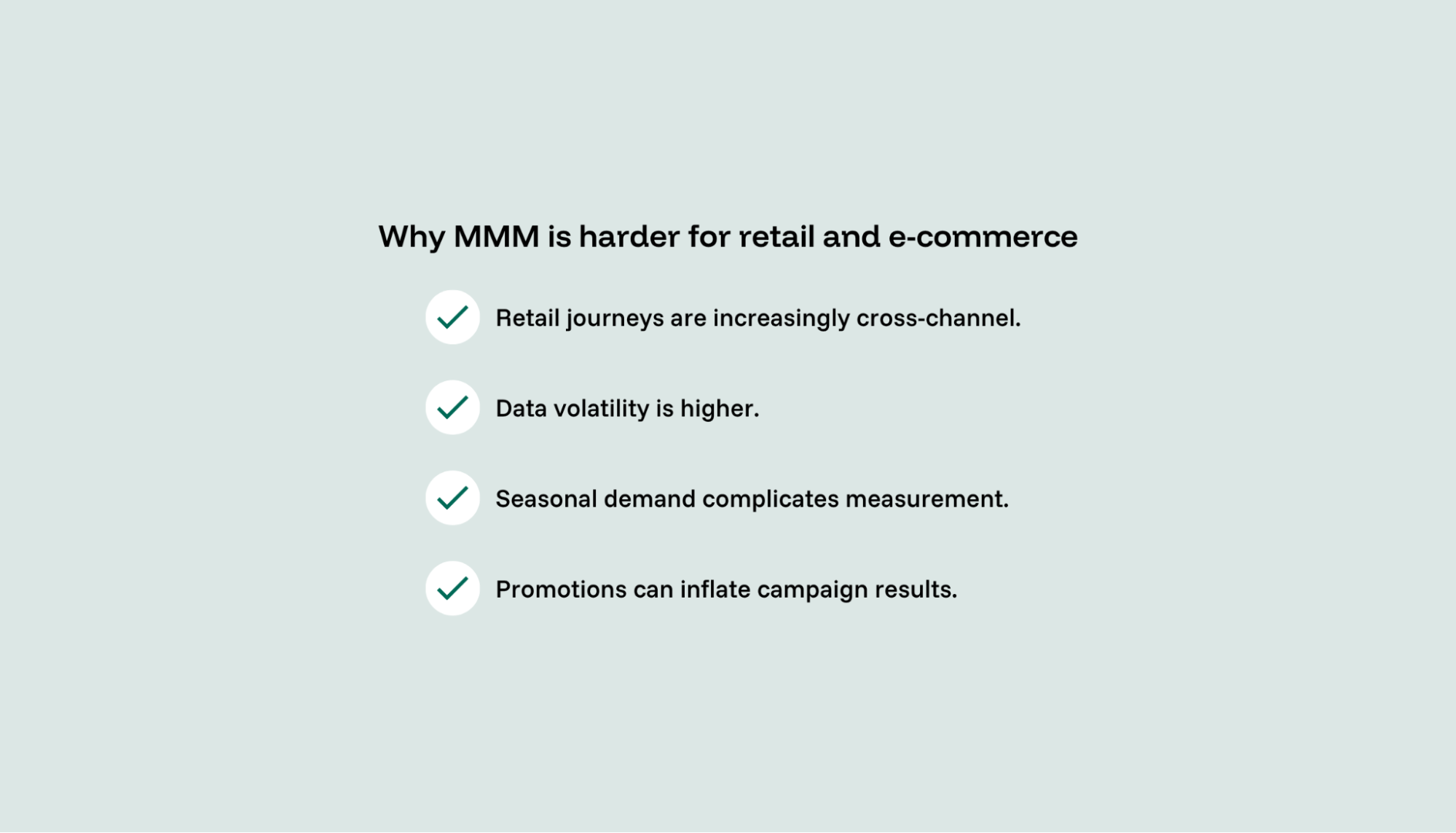
Marketing mix modeling works by identifying patterns between marketing activity and business outcomes. For retail and e-commerce brands, those patterns are much harder to isolate because demand, customer behavior and sales channels are constantly changing.
Retail journeys are increasingly cross-channel
Retail brands don’t operate in a single channel, and neither do their customers.
Before making a purchase, customers often bounce between devices, channels and platforms. They might discover a product through an ad, compare options on a marketplace, visit a store to see it firsthand and complete the transaction online days later.
Understanding how those customer journey interactions contribute to revenue is one of the biggest challenges in retail measurement today. So much so that nearly 68% of marketers say they lack up-to-date visibility across channels. When every platform tells a different story, it’s hard to know what's genuinely influencing customer purchases.
Data volatility is higher
Retail moves fast. Inventory levels fluctuate, pricing changes, products launch and margins shift. What looked like a winning channel last quarter can suddenly perform very differently.
The problem for MMM is that it relies on historical data. When teams don’t update models regularly, they base decisions on outdated assumptions and less reliable insights. Instead of helping you decide what to do next, MMM ends up explaining the past.
Seasonal demand complicates measurement
One month, you’re riding a Black Friday surge. Next month, you’re trying to maintain momentum after the holiday rush. Add weather patterns, seasonal shopping habits and clearance sales into the mix, and demand can look completely different from one period to the next.
The challenge for MMM is separating the impact of your marketing from demand that would have happened anyway.
Promotions can inflate campaign results
Discounts and promotions can make campaigns look more effective than they really are.
Imagine you’re running a paid social campaign during a 30% sitewide sale. Sales jump, ROAS looks fantastic and the natural reaction is to increase media spend. But how much of that performance came from the campaign itself, and how much came from the discount?
This is where retail measurement gets complicated. Promotions create a surge in demand, but they can also make it harder to understand what's actually influencing customer purchases.
What do the best MMM solutions for retail brands have in common?
Choosing the best marketing mix modelling solution for retail really comes down to one thing: whether it can keep up with the messy, fast-moving reality of retail data.
Captures business context
The strongest MMM solutions can account for promotion timing, discount levels, pricing changes, inventory availability and seasonality alongside marketing data. Without that context, it’s easy to overestimate marketing impact or give too much credit to campaigns that happened to run during peak buying periods.
Supports ongoing decision-making
Look for solutions that support automated data collection, regular model refreshes and ongoing analysis. The goal is to support current decisions, not produce a report that's outdated by the time it's delivered. Your team needs to be able to adjust budgets and marketing strategy investment decisions while your campaigns are still running.
Works as part of measurement triangulation
Marketing mix modeling for retail is great for understanding long-term channel impact and budget allocation, but naturally, you want answers to more granular questions:
- Which campaign performed best?
- Which promotion drove the biggest lift?
- Which channel influenced the sale?
Marketing mix modeling can’t answer those questions on its own, especially at that level of precision. Teams using advanced marketing measurement should look for software that combines MMM with incrementality testing and multi-touch attribution (MTA), creating a measurement triangulation framework that balances strategic planning with tactical optimization.
The top MMM solutions for retail and e-commerce brands in 2026
Here’s a shortlist of marketing mix modeling software that’s suited to retail complexity.
1. Funnel
Best for: teams that want to combine MMM with attribution and incrementality for a complete view of performance.
Funnel provides the data and measurement layer needed to run MMM effectively in real-world environments. It connects and standardizes data across platforms, creating a consistent dataset that can be used to model performance across online and offline channels, from e-commerce and marketplaces to retail media and in-store activity. This makes it easier to separate signal from noise and understand what’s actually driving results.
Funnel automates data collection and normalization, so your team can move directly into analysis. It also supports continuous measurement, allowing models to be updated more frequently and used for forward-looking planning, not just static reporting.
It’s especially useful if you:
- Are working across e-commerce, marketplaces, retail media and in-store channels.
- Need to keep track of performance across different platforms or regions.
- Want to validate MMM insights with testing and attribution.
2. Meta Robyn
Best for: teams with the right technical skills, including R programming knowledge.
Robyn is Meta’s open-source MMM framework and is often the starting point for technical teams looking to build MMM capabilities in-house.
Its appeal comes from balancing flexibility with automation. Teams can customize models around their own business requirements while using built-in features for model tuning, optimization and refreshes.
For retail and e-commerce brands, Robyn's support for calibration with incrementality tests is particularly valuable. The MMM supports calibration against incrementality tests and other measurement approaches, helping teams build greater confidence in their findings.
The trade-off is that Robyn expects a certain level of technical maturity. It isn’t something most marketing teams can deploy and manage on their own. Organizations with analytics or data science resources tend to get the most value from it, especially if they want the flexibility to tailor models to their own retail environment.
3. Nielsen
Best for: enterprise retail brands.
Nielsen approaches MMM from a different angle than many newer platforms. Instead of flexibility or experimentation, it focuses on helping brands understand how marketing contributes to business outcomes at scale.
For retailers, that often means evaluating trade-offs across a complex media mix. Should more budget move into retail media? Is TV still driving incremental value? How much of a sales increase came from marketing versus broader market conditions? Nielsen’s modeling capabilities help answer those types of questions.
The platform is especially popular among larger retailers that operate across multiple markets and need measurement frameworks that remain consistent across teams, brands and channels.
4. Analytic Partners
Best for: brands building MMM capabilities from the ground up.
Analytic Partners takes a more hands-on approach than many of the other solutions on this list. Rather than simply giving teams a platform, it combines measurement technology with consulting support, data science expertise and strategic guidance.
That can be particularly valuable for retailers that are early in their MMM journey. Building a model is only part of the challenge. Interpreting results, getting buy-in from stakeholders and turning insights into budget decisions often prove just as difficult.
Analytic Partners focuses heavily on forecasting and scenario planning, helping teams move beyond understanding what happened to exploring what could happen next. The platform also looks beyond marketing variables alone, bringing together data from areas like sales, operations, pricing and finance to provide a broader view of business performance.
For retailers that want a partner to guide implementation and help embed MMM into decision-making processes, Analytic Partners offers a more supported path than many self-serve solutions.
5. Recast
Best for: e-commerce brands focused on forecasting and planning.
Recast offers forecasting and scenario planning tools that allow marketers to test different budget allocations before spending a dollar, helping teams make faster decisions with more confidence. The platform continuously validates model accuracy. It combines MMM with incrementality testing, making it particularly attractive to performance-focused e-commerce brands.
Recast also handles many of the challenges that make retail measurement difficult, including promotions, seasonality and changing channel performance over time.
For DTC and e-commerce teams that need answers quickly and regularly adjust budgets based on performance, Recast offers a helpful, forward-looking approach.
How data integration affects MMM quality for retail brands
Marketing mix modeling is only as reliable as the data behind it.
For retail and e-commerce brands, that creates a challenge before the modeling even starts. Marketing data is spread across ad platforms, retail media networks, marketplaces, e-commerce platforms, analytics tools and offline channels like POS systems. Each source uses its own naming conventions, structures data differently and reports performance through its own lens.
Promotions, pricing changes and inventory data add another layer of complexity. These variables can have a major impact on sales, but they often sit outside marketing reporting altogether.
When data is fragmented, inconsistent or missing key business context, the quality of the model suffers. Reports don’t align, insights contradict each other and confidence in decision-making starts to drop.
Before MMM can deliver reliable insights, brands need a centralized data layer that brings everything together. It should connect marketing and sales data from multiple sources, standardize and clean data automatically and make it readily available for modeling.
The easier it is to create a consistent view of performance across channels, products, promotions and sales data, the easier it becomes to trust the results. Better inputs lead to better models, clearer insights and more confident budget decisions.
NXTRND case study: Why more data doesn’t automatically mean better measurement
NXTRND, a fast-growing football gear brand, ran into a challenge that’s familiar to many e-commerce businesses. Sales came from both Shopify and Amazon, while marketing performance lived across multiple advertising platforms. Each channel told a slightly different story, making it difficult to understand what was actually driving revenue.
The team started by bringing their marketing spend and sales data together into a single view. That improved visibility across the business, but it still didn’t answer the most important question: which channels were generating genuinely incremental revenue?
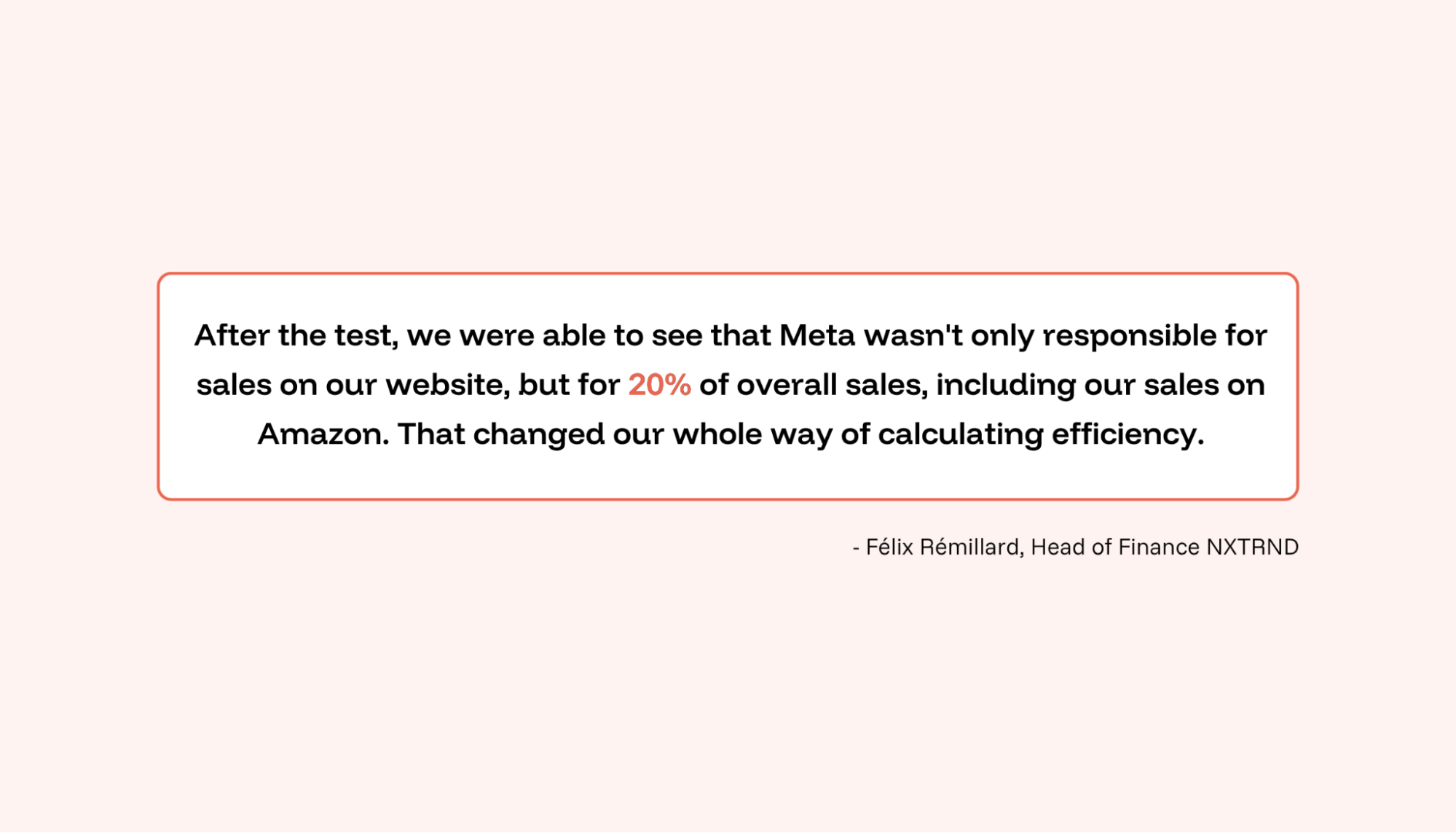
The breakthrough came when NXTRND paired centralized data with incrementality testing.
The results challenged some long-held assumptions. Testing showed that a significant portion of Amazon ad spend was cannibalizing organic sales rather than generating new demand. At the same time, Meta campaigns were creating far more value than platform reporting suggested, driving 20% of the company’s total revenue through a cross-platform halo effect that extended beyond Shopify and into Amazon sales.
Armed with that insight, NXTRND reduced spend on lower-impact campaigns and reinvested the budget into top-of-funnel initiatives that were driving measurable growth.
The lesson is simple: bringing data together is an important first step, but visibility alone doesn’t solve measurement. The real value comes when retail brands can combine integrated data with the right measurement framework to understand what’s actually influencing revenue.
Frequently asked questions
What is the best MMM tool for e-commerce brands?
The top marketing mix modeling tool depends on what you’re trying to solve.
If you have a data science team and want to build models in-house, a framework like Robyn may be a good fit. Enterprise retailers often look at providers like Nielsen or Analytic Partners for benchmarking, planning and strategic support.
For many e-commerce brands, the bigger challenge isn’t the model itself. It’s getting clean, consistent data into the model and validating whether the results are actually correct. That’s where a marketing intelligence platform like Funnel can add significant value. By centralizing data across channels and combining MMM with attribution and incrementality testing, teams can build a more complete view of performance rather than relying on a single measurement method.
Can small e-commerce brands use MMM?
Yes. You don’t need a massive budget or an enterprise measurement team to benefit from MMM.
For smaller brands, the focus should be on building a clean, unified dataset and starting with simpler models. Combining MMM with incrementality testing can also help validate results and improve confidence in your decisions as you grow.
How often should retail brands run MMM?
Retail moves quickly, so annual or infrequent updates often aren’t enough.
As a general rule, fast-moving retail and e-commerce brands should refresh MMM monthly, while quarterly updates are the minimum for most businesses. Anything slower can make it harder to account for promotions, seasonal shifts, inventory changes and evolving customer behavior.