






It’s Monday morning; the client report is due, and your dashboard has chosen this exact moment to fall apart. You thought things couldn’t get any worse. But then, new data refuses to load, and something sets off a chain of #VALUE! errors across tabs. In a panic, you try to work around the issue by manually downloading data from the platforms, which means you’re starting from scratch and scrambling to put a report together.
When your setup is simple, a tool like AgencyAnalytics can honestly feel great. You can connect a few main marketing channels, create some great-looking dashboards, schedule reports and everyone’s happy enough.
But the challenges start piling up as your agency grows. Clients ask for new platforms that the interface cannot support, so your team ends up stitching reports together outside the tool. Then, a larger account comes in with heavy data volumes, and their dashboards crawl to a halt, sparking quiet questions about whether your agency can handle the scale.
Funnel is built for that next stage. It provides the solid marketing data foundation that scaling agencies need. You can connect every platform your clients rely on and automatically blend the data to deliver clear cross-channel reports. Because Funnel stores and organizes the data for you, large volumes are handled smoothly, dashboards stay responsive and your team can focus on delivering insights instead of manually patching reporting gaps.
In this article, we’ll dig into how Funnel and AgencyAnalytics differ, what that means in your day-to-day work and when it makes sense to move beyond dashboard-only tools.
AgencyAnalytics vs. Funnel: two approaches to marketing data analysis
Funnel and AgencyAnalytics both live in the “client reporting” world, but they’re built on very different assumptions.
AgencyAnalytics is first and foremost a dashboarding tool. You connect live to a handful of platforms, pull numbers straight into dashboards and send good-looking reports to clients. There’s no real data hub underneath; the dashboard is the product.
In contrast, Funnel offers a governed marketing data foundation: collecting, storing and structuring all your marketing performance data in the Data Hub, then using that same, cleaned dataset to power dashboards and support advanced measurement if required.
Here's how AgencyAnalytics compares to Funnel, at a glance:
|
|
Funnel |
AgencyAnalytics |
|
Data integration depth |
Central Data Hub that collects, stores and unifies marketing data before reporting. |
Live connections that pull data straight into dashboards; no dedicated data hub. |
|
Connector coverage |
600+ marketing and sales connectors, plus custom connectors for niche needs. |
80+ integrations that cover core ad, analytics and SEO platforms for standard client reporting. |
|
Data modeling & harmonization |
No-code modeling to standardize metrics, dimensions, currencies and date logic once and reuse everywhere. |
Per-dashboard calculated metrics and basic field tweaks focused on what appears in that specific report. |
|
Reporting & insights |
Dashboards and client Portals sit on top of the same governed model and can also feed business intelligence tools and warehouses. |
Built-in dashboards and templates designed for quick, client-ready reports. |
|
Measurement |
Built on stored, unified data, so advanced measurement is possible when it’s required. |
Limited to in-dashboard performance views. |
|
Data activation |
Sends cleaned, modeled data back into media platforms via activation features (e.g. conversion APIs). |
Reporting only, no native way to push data back to marketing channels. |
|
AI capabilities |
Data Chat for AI-assisted data exploration, plus machine learning models for measurement. |
No dedicated AI layer for data modeling or governance. |
The data foundation: Where the difference really starts
Every reporting stack sits on some kind of data foundation, even if you never see it. Somewhere, your channel data is being collected, shaped and handed off to the dashboards your clients log into.
In a simple setup, you can get away with a light foundation, but as your clients and use cases get more complex, it may not be enough. If you have a proper data hub underneath, you can reuse the same structured dataset everywhere. But if you don’t, every new question means another export, workaround or manual data fix.
Funnel key features
Funnel collects and stores all your marketing data in a unified, governed foundation. Inside the Data Hub, currencies, date formatting and naming conventions are standardized and data errors like missing or outdated values are fixed before anyone even starts building reports.
The connectors are centrally monitored and updated by Funnel, so if an API updates, it’s fixed, so you don’t have to worry about data loss or broken dashboards. Even if a source goes offline for a while, your historical data remains safe in Funnel, and new data is automatically added once it’s available again.
AgencyAnalytics key features
AgencyAnalytics reads data from platforms in real time and loads it directly into dashboards. That’s fine when you’re looking at a few standard channels and nothing much changes. As complexity grows, reports start to get risky. An API update, a field change or a temporary outage can result in missing metrics, changing numbers or extra work checking exports before a report goes out.
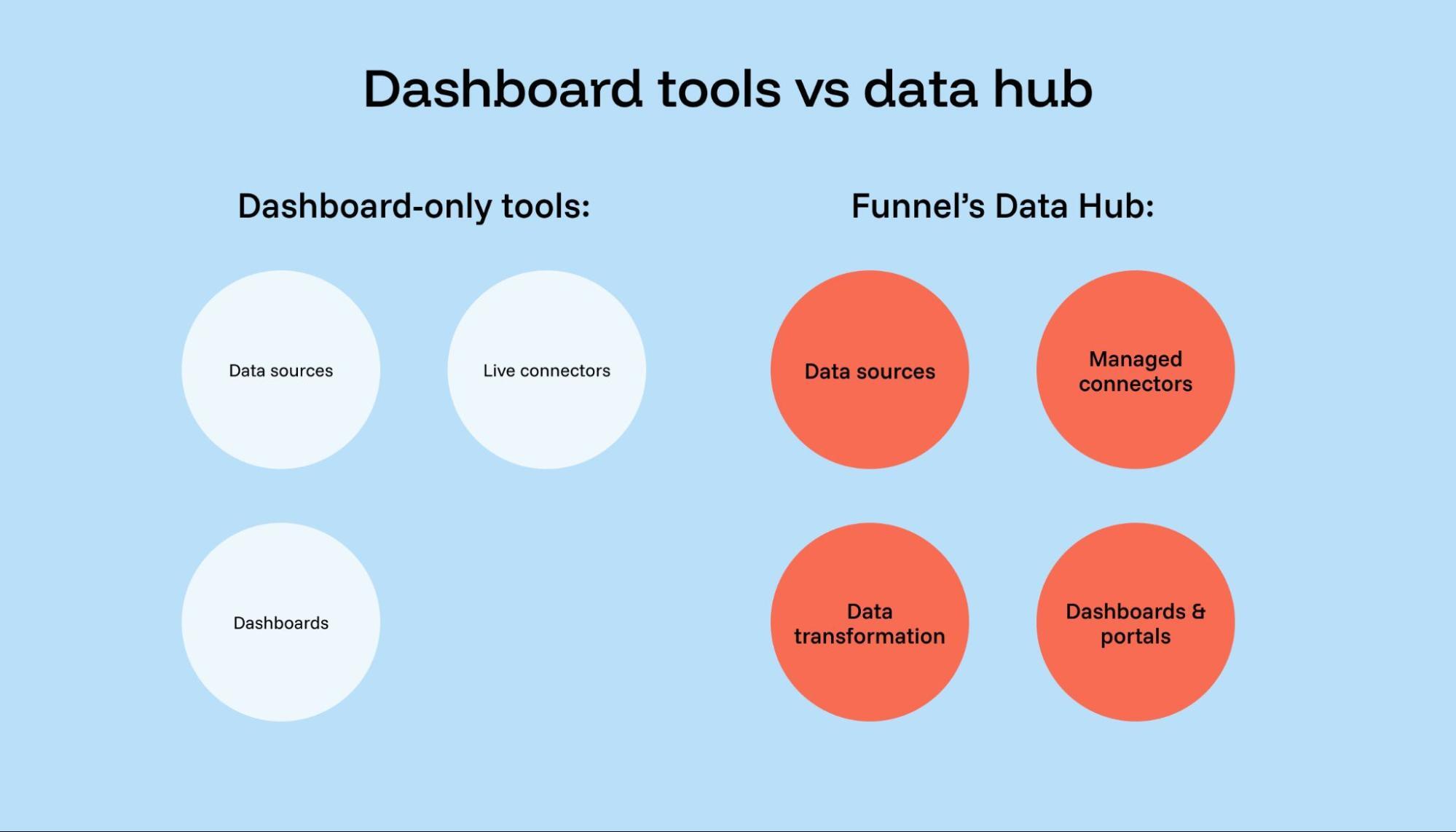
Having a solid foundation gives you more than just a good-looking chart. A stored, unified data layer is what lets you move from “what happened in this account last week?” to “what’s really happening across all our clients?” The next sections delve into how that difference manifests at scale.
AgencyAnalytics vs. Funnel: Who is each platform really for?
Now that we’ve established how AgencyAnalytics and Funnel differ at the core, it’s best to think about what job your agency needs this platform to do right now.
If your main objective is to show clients what happened last week across a few big channels, AgencyAnalytics fits that brief perfectly. It suits small to mid-sized, price-sensitive agencies that need good-looking dashboards, scheduled PDF reports and a simple way to keep clients updated. Most clients have similar, low-complexity setups, and you’re not yet trying to blend CRM data and offline conversions or dig deeper into the why behind performance with advanced measurement. In that case, AgencyAnalytics does exactly what it says on the tin.
If your day-to-day is getting more complex, Funnel could make a lot more sense for you. Let’s say you’re managing 10+ clients, budgets are getting serious and the questions get tougher.
At that point, you’re not just delivering reports, you’re defending retainers and planning what to do next. Funnel gives you the marketing data foundation and reliable connections for that stage, and it’s built to support advanced measurement later if you need it.
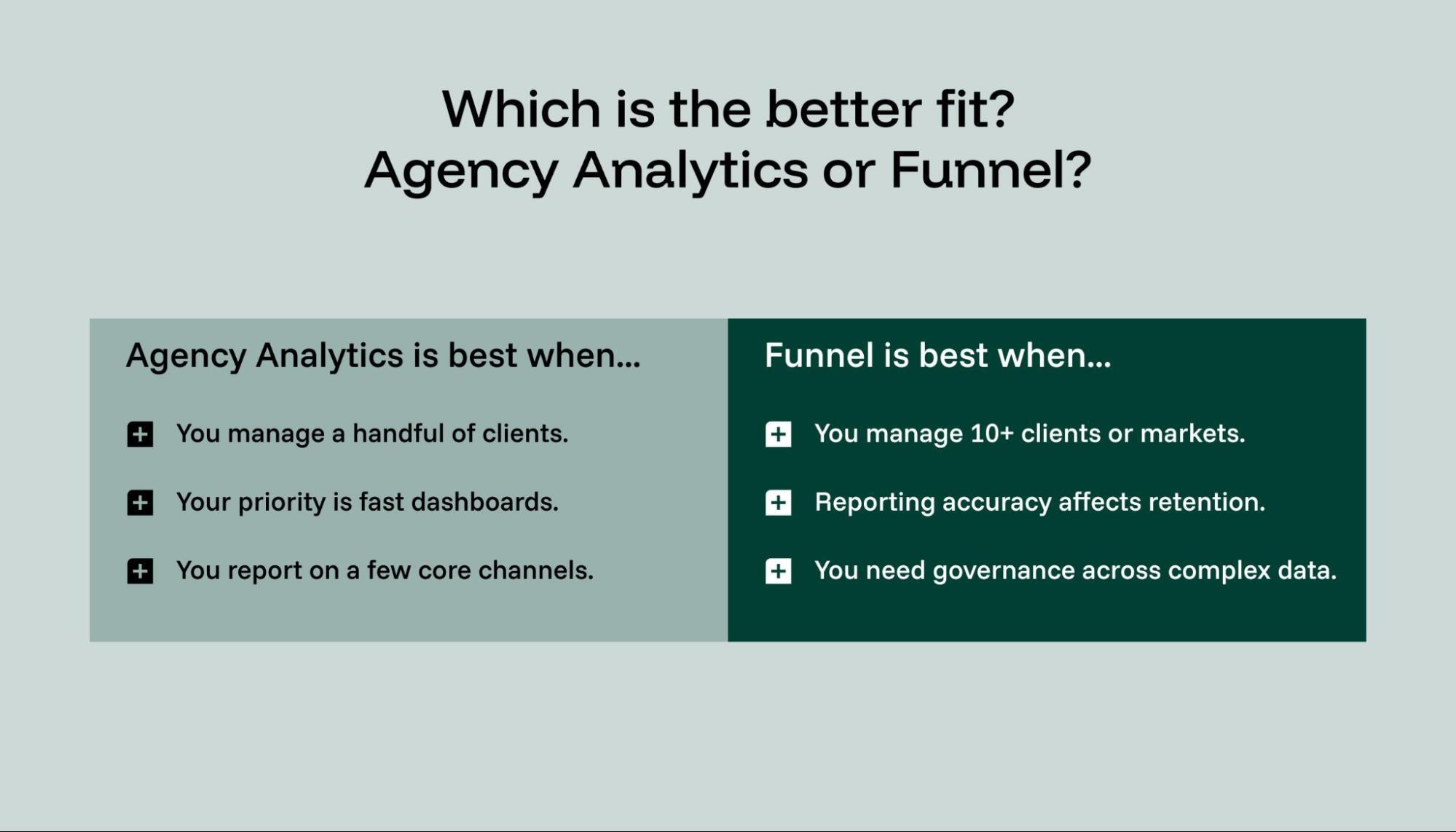
AgencyAnalytics is a strong fit when reports are the deliverable. Funnel is the platform you choose when reporting accuracy, client retention and data governance become business critical.
Deep dive: scaling marketing intelligence with Funnel vs. AgencyAnalytics dashboarding
In the next sections, we’ll look at what happens when you put AgencyAnalytics, as a dashboard-first marketing analytics tool, and Funnel, a full marketing intelligence platform, under pressure in the real-life scenarios you'll face in your agency as you scale.
Operational scalability and workflow resilience
When you add pressure to something, you hear a creak long before the snap.
The AgencyAnalytics creak happens when you’re juggling dozens of dashboards. That’s because every new account adds more apps, data sources and people logging in at once. As a result, load times creep up, dashboards time out and someone hits refresh three times because they can’t tell if it’s the API being slow or the tool itself stalling.
G2 reviews say the buckling under pressure is a common occurrence with AgencyAnalytics. Sure, people like how easy it is to create reports, but they also mention timeouts, unclear limits and the need for workarounds when setups get heavier. It’s not that AgencyAnalytics is “bad,” on the contrary, it’s just made for quick data visualization.
When you hit AgencyAnalytics limits, you’ll likely enter “spreadsheet mode” to find a workaround. Maybe a client asks a slightly complicated question, or a connector doesn’t quite give you what you need, so your team:
- Exports data into Google Sheets or Excel
- Pulls extra fields from a data source
- Patch everything together with lookups and manual fixes
So now you have two reporting stacks on your hands: the “official” dashboard, and the real numbers living in a spreadsheet. Every new client, market or channel adds more one-off logic and more chances for something to go wrong at exactly the wrong time.
With Funnel, you can avoid that setup entirely.
Funnel’s Data Hub pulls in marketing performance data from 600+ connectors, file imports and custom sources before it ever reaches a dashboard. All of that data is stored and organized centrally, so you’re not rebuilding the same logic over and over again in different reports.
Inside the Data Hub, your team cleans up naming, maps metrics and standardizes dimensions in a no-code interface. Once you’ve done that work, you can reuse it across clients, markets and destinations instead of maintaining slightly different versions everywhere.
Better yet, because Funnel manages the connectors, platform changes and API updates are handled once, centrally. As such, data keeps on flowing, dashboards stay usable and you’re not waking up to surprise gaps on a client’s report.
And since the modeling lives in the Data Hub, adding new clients or channels doesn’t trigger another round of spreadsheet gymnastics or “can you fix this report?” Slack messages. You simply just plug them into the structure you already have.
The net effect: onboarding channels and markets are quicker, your workflow stays roughly the same and you get more time using the data you know you can trust.
Reporting at scale
Once data is flowing reliably, the next challenge is keeping reporting coherent across a big portfolio. You want QBR decks and dashboards to tell the same story, use the same KPI logic and still leave room for client-specific nuance. That’s where governance and templating start to matter more than automated reporting.
How AgencyAnalytics handles the reporting process
In AgencyAnalytics, every dashboard slowly turns into its own little world. Each has its own calculated metrics, naming tweaks and small exceptions. Because there’s no central modeling layer underneath, any time you change a KPI definition, you have to track down every place it appears and update it by hand.
That’s annoying with a handful of accounts. Beyond that, it becomes a trust problem:
- “Pipeline” or “qualified lead” might be defined slightly differently per client.
- Multi-client views are harder to believe, because the same label doesn’t always mean the same calculation.
- Before big presentations, teams often export everything to spreadsheets to reconcile numbers across dashboards and make sure they actually line up.
How Funnel makes reporting consistency the default
With Funnel, you define core metrics and dimensions centrally, standardize naming and handle normalizations like currencies and time zones in one place. That governed model feeds:
- Client dashboards, which are easily shared through client-facing Portals
- Data visualization tools like Looker Studio or Power BI
- Exports into your data warehouse or Google Sheets
On top of that shared layer, you use templates to package reporting like a product. You roll out one structure across dozens of clients, group multiple dashboards into a branded Portal per client and still leave space for commentary and a few custom tiles without breaking the core logic.
That’s exactly how B2B agency Sparkforce uses Funnel. Their team blends ad and CRM data in the Data Hub, then pushes consistent, full-funnel metrics into client-facing dashboards.
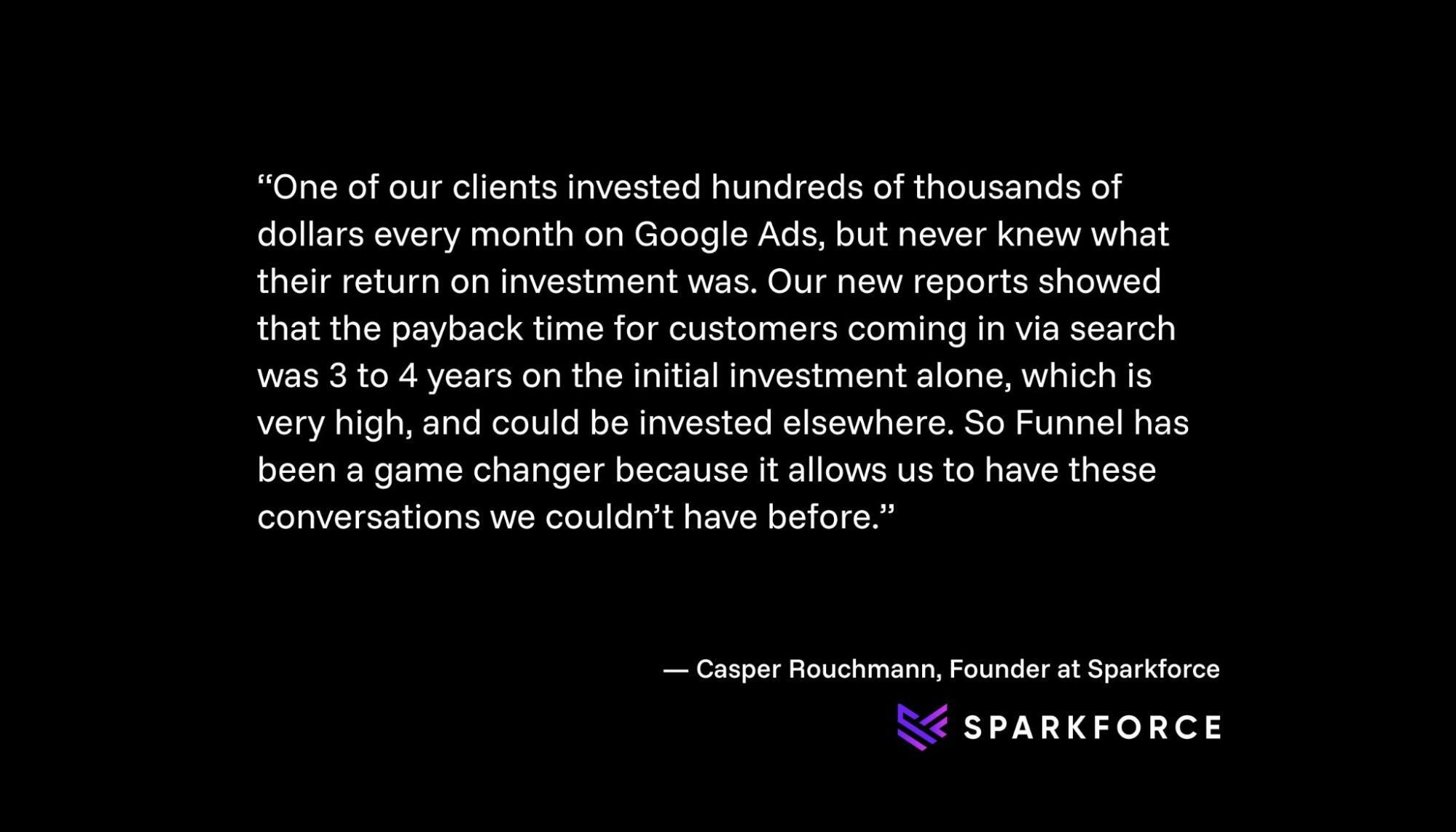
It’s how they were able to show one enterprise client that search customers took three to four years to pay back the initial Google Ads spend, and use that insight to redirect budget into more efficient channels. Because definitions live in Funnel, the report their account team uses and the numbers the CMO takes to the board, stay aligned.
Beyond the customizable dashboards
Once reporting is consistent and leaders trust the numbers, the conversation naturally shifts. It’s less of “how did we do last month?” and more “what should we change next quarter?” and “where does the next dollar of budget actually go?”
How AgencyAnalytics handles “what happened?”
AgencyAnalytics provides campaign metrics, attractive dashboards and scheduled PDFs. It does a solid job of keeping clients in the loop on what happened: channel-by-channel performance, trends over time and a clean summary that lands in the inbox.
But when you try to answer deeper questions, you hit the limits. There’s no built-in support for advanced marketing measurement work and no way to push cleaned or modeled data back into ad platforms to optimize campaigns.
So if you want to understand true channel contribution, test budget scenarios or give platforms better conversion signals, you’re back in spreadsheets or separate tools. AgencyAnalytics remains a one-way view of performance, not a way to change how budgets are allocated or how platforms bid.
How Funnel turns reporting into a full marketing intelligence platform
Think of Funnel as a single, tidy “master version” of your clients' marketing data. You set the rules once, like what counts as a “qualified lead,” and everything you build from that data uses the same rules.
As a result, your dashboards, reports, exports and data you send back to ad platforms all match, rather than each having slightly different definitions. And if a client ever needs deeper analysis (like advanced measurement), Funnel already has the clean, consistent data foundation for that work.
For your clients, they get the same story wherever they look, which means your team spends less time explaining and more time discovering insights and strategizing on what to do next.
Accuracy and governance: can you trust what you’re seeing?
It doesn’t matter how many dashboards you’ve built; what matters is whether everyone trusts the number, and whether you feel confident presenting them.
How AgencyAnalytics handles data accuracy
In AgencyAnalytics, the dashboard shows whatever the live connector sends at that moment, which can lead to problems down the line. If Meta changes an attribution window, Google Ads renames a field or a source stops sending a metric, those changes flow straight into the reports your clients see.
Day to day, that can mean:
- Numbers changing between two exports of “the same” report
- Slightly different versions of a KPI across clients that should be aligned
- Extra time spent checking against native platforms before anything goes to a client or CFO
There’s no semantic layer or stored, governed copy of the data underneath, so platform changes are felt directly at the dashboard level.
How Funnel builds a single source of truth for data accuracy
With Funnel, all marketing performance data lands in the Data Hub first, where it’s stored, cleaned and made analysis-ready before anyone builds a chart.
On top of that stored data, Funnel gives you a governed model and support for semantic layer principles, so you define metrics and dimensions once. You decide how to calculate “qualified lead,” “pipeline value” or “net revenue,” and those definitions then feed dashboards, BI tools and warehouse exports. Adjust the model's logic and it updates everywhere the metric appears.
Once data lands in Funnel, it stays available even if a platform or API later changes or stops exposing the same history. You don’t lose the ability to run year-over-year comparisons just because a source moved the goalposts.
When you combine accuracy and governance, the number in your client’s dashboard matches the one in the QBR deck, historical reports don’t rewrite themselves after an API update and you can walk into renewal and budget conversations knowing there’s one version of the truth – and it lives in Funnel.
AgencyAnalytics vs. Funnel: Which should you choose?
At this point, it’s helpful to look forward to what your agency needs today and the ambitions you have to grow it in the next few years.
Stick with AgencyAnalytics for now if:
- You mainly need straightforward dashboards for a smaller group of clients.
- Most reporting comes from the main ad and analytics channels, with simple KPIs and little custom logic.
- Dashboards are there to keep clients informed week-to-week, rather than to feed deeper planning, measurement or data operations.
For that, AgencyAnalytics does its job perfectly well: fast setup, clean charts, scheduled PDFs and a predictable workflow.
Start planning a move to Funnel if:
- You manage many clients or markets, and you’re fighting to keep numbers consistent across the board.
- Your data mix is getting messy with multiple channels — CRMs, ecommerce platforms, maybe some offline signals — and you know that it will only get more complex.
- Accuracy and governance actually matter because reports feed hard decisions.
- Your team spends too much time fixing broken reports, reconciling numbers or rebuilding the same logic in different tools.
If that sounds like your current situation, you’re in the territory where agencies typically start looking at Funnel or other AgencyAnalytics alternatives. You can explore that landscape in more detail in our guide to AgencyAnalytics alternatives, but the short version is: Funnel is built for the point where reporting moves beyond “a deliverable” and becomes the core basis for growth.
Fast start vs. long-term scale
It’s also worth being honest about how these tools feel on day one and how long it will take to get started.
AgencyAnalytics is built for speedy onboarding. You can get going right away. You sign up, connect a few platforms, drag some widgets into place and you’re sending clients their first dashboards in no time. Pricing is easy to understand, and for simple setups, you see value fast. That’s a big part of why it’s so popular with smaller, price-sensitive agencies.
However, with Funnel, you’re not just setting up dashboards; you’re putting a marketing data foundation in place: Data Hub, reporting and activation working together with an architecture that supports advanced measurement later if needed. Therefore, the platform will ask a bit more of you up front: like deciding on KPI definitions, mapping sources and agreeing on how you want to standardize things across clients.
It will take a little longer to onboard, but once that’s done, the payoff shows up in all the places we’ve discussed: fewer manual fixes, cleaner portfolio views and better conversations about where to invest next.
Transform marketing data into intelligence, not just dashboards
When your agency is smaller, a tool like AgencyAnalytics can feel like a lifesaver. Just plug in a few channels, create your dashboards, send the weekly reports and move on with your day.
But you'll start to feel a headache when the stakes go up and you're managing more clients, bigger budgets and messier setups. Suddenly, you’re chasing missing metrics and spending too many late nights fixing spreadsheets. At that point, the problem isn’t the dashboard; it’s that the data underneath it was never built to carry more weight.
Funnel is a foundation built to carry real weight. It’s a marketing intelligence platform with an integrated Data Hub. That’s what lets you standardize KPIs, trust the numbers and use data to defend budgets and keep clients.
If that’s the stage you’re in, or have ambitions to head toward, it’s worth seeing what life looks like on the other side.
See how Funnel can scale your reporting: book a demo.
FAQs
Is AgencyAnalytics good for multi-client reporting?
Yes, as long as your setup stays fairly simple. If you’re pulling from standard ad and analytics sources, using out-of-the-box widgets and a few custom dashboards, AgencyAnalytics does a perfectly decent job.
You can clone templates, automate reports and keep a smaller client list updated without too much friction. The cracks appear when you start layering in custom metrics, extra sources (like CRM or offline) and different models per client. That’s when consistency starts to slip and you end up fixing edge cases by hand.
What are AgencyAnalytics’ limitations for scaling agencies?
Most of the limits come from architecture. AgencyAnalytics doesn’t have support for semantic layer principles or a central data model, doesn’t sync to a warehouse and its connector library is lean compared with platforms like Funnel. As setups get more complex, teams lean on spreadsheets and one-off workarounds to close the gaps.
Does AgencyAnalytics support attribution or marketing mix modeling?
No. AgencyAnalytics can show you campaign metrics and basic ROI-style numbers, but it doesn’t offer built-in support for advanced measurement such as marketing mix modeling (MMM), data-driven multi-touch attribution or incrementality testing. If you want to answer questions about true channel contribution, long sales cycles or “what happens if we move budget?” you’ll need to plug in other tools or build your own models outside the platform.
Does AgencyAnalytics offer data warehousing or permanent data storage?
No, and that’s an important distinction. AgencyAnalytics relies on live API calls from the platforms each time a dashboard loads. Data isn’t stored in a warehouse-style layer you control, so if an API changes, a field disappears or a platform stops exposing certain history, you don’t have a native backup.
That’s very different from Funnel’s Data Hub, where data is stored, governed and kept available over time, even when source systems move the goalposts.