






Your data team has spent months perfecting a single source of truth. All the gold is there: customer lifetime value, churn risk scores and audience segments based on every click and purchase. It’s neatly modeled and sitting in your warehouse.
But none of the data is in the tools your marketing team uses. Your warehouse has become a locked vault, while your operational tools are running on fumes.
The wall between having great data and actually using it is known as the activation gap. Reverse ETL is the bridge designed to fix it. Instead of just pulling data into a warehouse, it pushes that modeled data back out into the platforms where it can actually perform.
And bridging the gap has many advantages; it kills off the cycle of manual CSV uploads and custom API scripts that break, so teams can finally stop acting like data entry clerks and focus on strategy.
But the real payoff of reverse ETL is personalization at scale. You can trigger a high-value discount in Klaviyo the moment a user’s LTV score crosses a specific threshold, or automatically pull churn-risk customers out of expensive retargeting ads in Meta.
Below is a breakdown of how reverse ETL works and how it differs from a standard ETL process. We also look at four use cases that you can include in your marketing strategy.
What is reverse ETL?
Reverse ETL is how you move transformed, modeled data out of your data warehouse and back into operational systems like CRMs, ad platforms and marketing tools. The objective is to take the data your team has cleaned and modeled inside the warehouse and push it into your marketing apps. Tech leaders at Microsoft note that reverse ETL is the critical bridge that automates the flow of modeled records from analytical systems directly into operational tools.
This architecture became the industry standard between 2021 and 2022 because cloud warehouses evolved into the default home for unified customer records. But centralized storage was only half the battle; data left in a warehouse sits stagnant, locked away in BI tools rather than driving revenue. Reverse ETL platforms emerged because companies require an automated pipeline to push insights to execution tools.
The reverse ETL process
Here’s what the reverse ETL process looks like:
- Source: the data warehouse, data hub or lakehouse where modeled data is kept.
- Model: the SQL query or table that defines what to sync, for example, "customers with LTV above $500 who haven't purchased in 60 days."
- Sync: the schedule and logic, including how often data moves and how the pipeline handles changes in records.
- Destination: the operational tool where the data ends up, such as Meta, Google Ads, Salesforce or Iterable.
Reverse ETL vs. ETL vs. data integration tools
Standard ETL (extract, transform, load) pulls raw data from your ad platforms, CRMs and e-commerce systems and loads it into your cloud warehouse. Reverse ETL does the exact opposite: it takes that cleaned warehouse data and pumps it back into the frontline tools marketing and sales use.
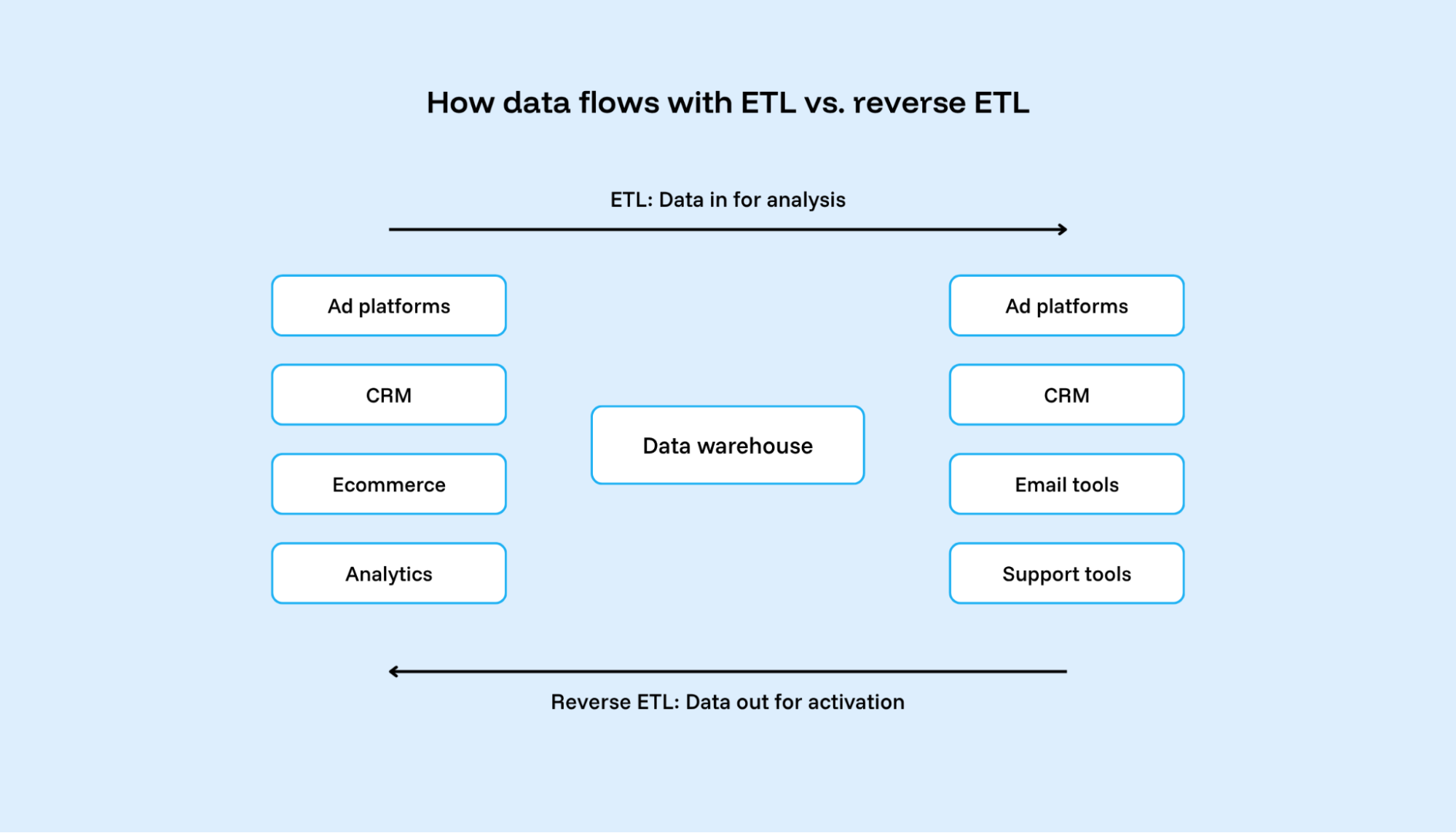
Both have different operational purposes.
- Standard ETL feeds analysis. So it routes data into your warehouse because your reporting dashboards require centralized, structured data to run accurate charts.
- Reverse ETL feeds activation. It routes data out of your warehouse because your ad campaigns and email sequences require live custom audiences inside the tools that execute them.
Make sure not to confuse these processes with general data integration. Data integration is simply the broad umbrella category that covers both directions. ETL is integration moving in. Reverse ETL is integration moving out.
Similarly, reverse ETL differs from point-to-point automation tools you may use, like Zapier. While Zapier easily triggers a single action between two apps, it breaks under heavy marketing volume because it lacks a centralized data engine. Reverse ETL uses your warehouse as its source of truth, which helps it to handle complex, large-scale data tasks that point-to-point tools can’t execute.
Why marketing teams need reverse ETL
Your cloud data warehouse holds your richest customer data, including everything from raw purchase histories and behavioral signals to offline events and calculated lifetime value scores. But your data only has value if your team can act on it.
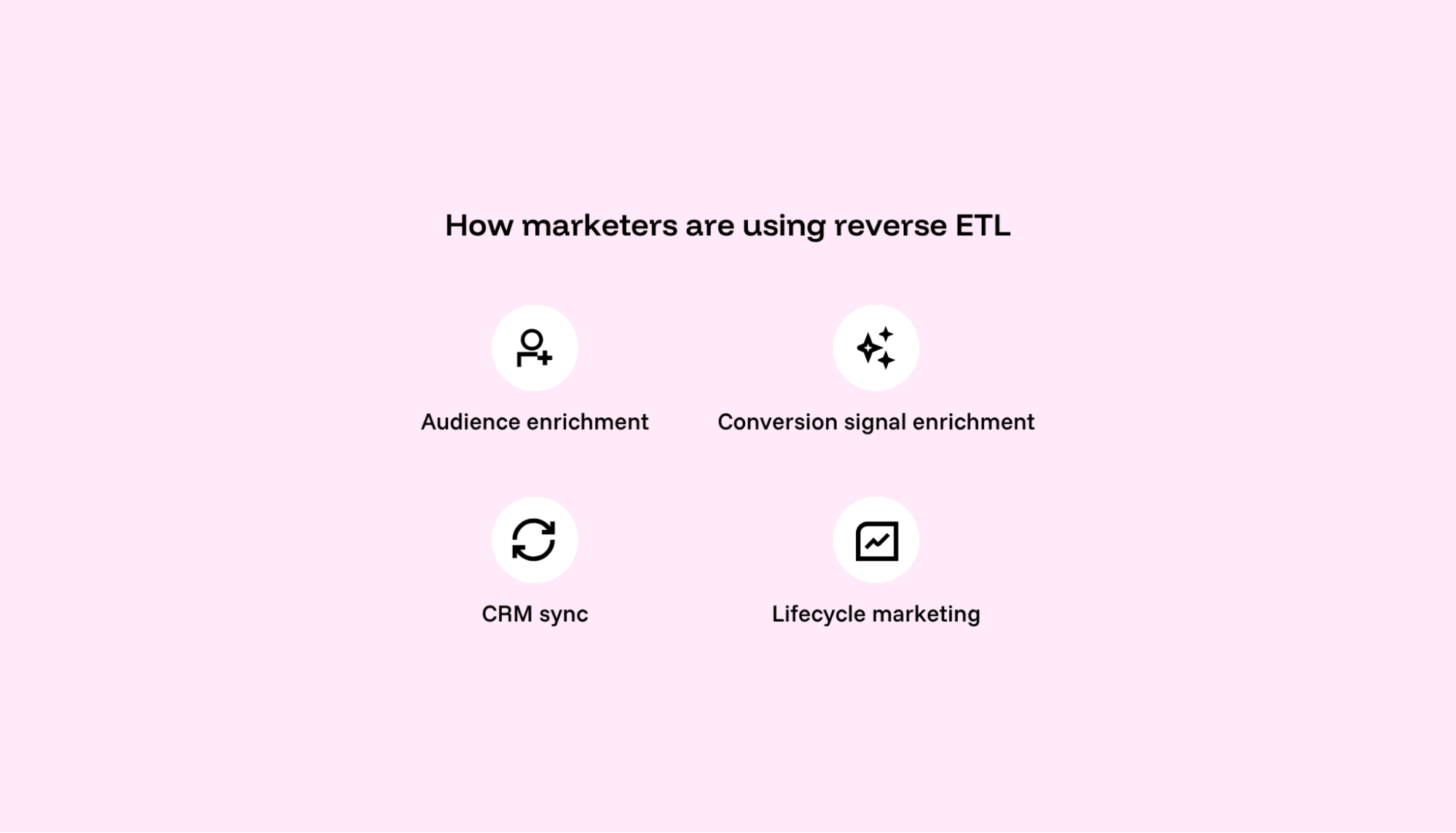
Here’s how reverse ETL helps to enrich data:
1. Audience enrichment for paid media
Reverse ETL syncs your warehouse-built custom segments to your ad platforms for precision targeting, exclusions and lookalike modeling. You can deploy high-impact segments like:
- High-LTV customers serve as your hyper-accurate lookalike seed audiences because the data tells the ad network's algorithm what your most profitable acquisitions look like.
- Recent purchasers act as your master exclusion lists, because you should never waste your ad budget serving conversion ads to customers who already bought your product.
- Abandoned carts power retargeting sequences because pulling these signals from the warehouse fills in the gaps from browser cookies.
- High-churn risks feed specialized retention campaigns that automatically trigger personalized win-back offers before the user drops off your radar.
As you can see, these segments draw on far more data than ad platforms can access natively because your warehouse holds the full customer history. A standard Meta pixel only tracks the isolated conversions Meta captured on your site. But a warehouse-built audience accounts for lifetime value, offline retail purchases, subscriptions and cancellations: the metrics that dictate real profit. As such, when advertisers feed Customer Match list signals back into their campaigns, they see an average 5.3% increase in conversions.
2. Conversion signal enrichment
Pixel tracking has become more fragmented over the past decade due to ad blockers and iOS privacy controls. So, how do you give the bidding algorithms a better signal to optimize so your budget isn’t wasted? Reverse ETL helps by pushing warehouse-stored conversion events to ad platforms through server-side conversion APIs.
The warehouse holds the unified record of every conversion, whether that’s an online purchase, an offline transaction, a CRM stage change or a subscription renewal. Reverse ETL takes the events and sends them to the ad platforms in a format their bidding algorithms can use.
The main benefit of conversion signal enrichment is that your data stays durable. The server-side conversion data isn't blocked by browsers or apps, so it stays accurate even when the customer journey spans devices, channels and offline touchpoints.
But for this approach to work, the underlying data has to be clean and well-modeled. A strong data foundation, with unified, governed marketing data, makes signal engineering reliable.
3. CRM sync and lead scoring
When you have data silos, your sales reps may waste hours cold-calling dead accounts or cherry-picking the wrong leads because they’re guessing who is ready to buy. But it’s a tough ask to get them to learn SQL so they can log into a central data warehouse to check user metrics. Reverse ETL connects teams to data by loading deeply modeled warehouse data into native Salesforce or HubSpot fields.
For example:
- Predictive churn scores are fed into account records, so your customer success reps know exactly which high-risk accounts to call before a subscription is canceled.
- Propensity-to-buy metrics flag your hottest trial users in real time, so your sales reps can sort their daily outreach by pipeline priority rather than guessing who is ready to buy.
- Verified customer lifetime value populates inside your contact views because your account executives require a clear view of an account's total historical spend before negotiating a contract renewal.
The real benefit is pure speed and execution. Because your CRM fields update with customer behavior every single morning, your team stops guessing and starts reacting. They can effectively prioritize their outreach to lock in revenue before a competitor beats them to the punch.
4. Campaign optimization and lifecycle marketing
Your lifecycle marketing engines, whether you use Marketo, Iterable or Klaviyo, are only as good as the data you feed them. When you rely solely on standard web pixels, your automated email campaigns run blind to offline store purchases, sales pipeline updates and backend data calculations.
Reverse ETL moves your warehouse data into your email tools, so your automated campaigns respond to customer behavior in real time. For example, you can isolate dormant, high-LTV profiles with aggressive retention offers before they churn, and eject recent buyers from active acquisition tracks, because nothing ruins a customer experience faster than a 20% discount code sent to someone who paid full price an hour ago. The system can also dynamically route onboarding paths based on real-time calculations: high-propensity users get sent to a sales rep, while lower-value leads go through self-service content loops.
In practical day-to-day use, reverse ETL eliminates the need for manual CSV uploads and weekly list maintenance. But the real business benefit is that your marketing campaigns stay aligned with your business goals. The "high-value customer" definition your finance team tracks on their dashboard is the same data point that triggers your email sequences, which creates better alignment between marketing and finance.
How reverse ETL fits into your data infrastructure
A modern marketing data stack has three layers:
1. Ingestion and data integration
Pulls data from ad platforms, analytics, CRMs and ecommerce into the warehouse.
2. Warehouse and data transformation
Cleans, joins and models customer data into unified records.
3. Export and data activation
Moves modeled data out to operational tools to help with forecasts and making decisions, or pushes it to ad platforms to improve campaign performance
Reverse ETL is in the third activation layer. But its success depends on the layers underneath it, because clean, well-modeled data in the warehouse is the only thing that makes a reverse ETL pipeline useful. Without it, the pipeline just delivers bad data to your ad tools faster.
The wider marketing stack is consolidating around the warehouse for the same reason. According to MarTech's 2025 State of Your Stack survey, more than 56% of organizations now integrate their martech stack with a cloud data warehouse or data lake to create a unified data layer.
What sits underneath everything is your data integration layer, the system that collects, normalizes and stores marketing data before any activation happens. From there, activation can run through a dedicated reverse ETL tool, direct platform integrations or tools already in your stack with built-in activation features. Which activation tool you choose matters less than the data foundation feeding it, which is why there’s more of a focus on building the modern data stack around the warehouse or a marketing-specific data hub as the central source of truth.
What to look for in a reverse ETL tool
On paper, every reverse ETL solution may look identical because they all claim to sync data to your marketing apps. But a reverse ETL tool that works for a small marketing team doesn't always work for an enterprise stack, and depending on your data volume, it could trigger API lockouts and spike your cloud bills.
Here are the questions you should ask when you evaluate vendors for their reverse ETL capabilities:
- Does it natively support our existing data warehouse (Snowflake, BigQuery, Redshift or Databricks) without custom code?
- Does the vendor connect to our full marketing stack and business tools?
- Does it offer incremental updates and mirror syncs, or will it force full refreshes that could spike our data warehouse bill?
- Can it match our sync cadence with hourly batches or near real-time streams?
- Does it accurately match warehouse records to user emails or customer IDs?
- Does it catch and notify us about schema drift, API rate limits and duplicate entries?
- How is the data governance? Can it enforce field-level permissions and user consent rules inside the pipeline?
Of course, a dedicated reverse ETL tool isn't the only path. Some teams use direct platform integrations; others rely on tools already in their stack that include activation features. The right choice depends on how many destinations you need to reach, how often you need to sync and what your team already knows how to operate. But what’s more important than activation is the data feeding into it: clean, unified, governed data is what makes any approach work.
Reverse ETL is only as good as the data under it
Too many marketing teams treat the data warehouse like an archive. Data goes in and gathers digital dust. But with marketing under pressure to do more with less in an age of signal loss and tightening privacy rules, a passive warehouse is a liability. First-party data is the most reliable fuel you have, and using it means you need to turn the warehouse into an engine for growth.
Reverse ETL is one way to do that. There are platforms that handle activation natively, and what you choose should be dictated by your existing stack and team habits.
But whichever path you take, the fundamentals remain the same: clean, governed, first-party data doesn't just appear out of nowhere. Your activation tools are only as good as the foundation underneath them. Fix the foundation first, and the rest of your tech stack falls into place.
Frequently asked questions
What is reverse ETL?
Reverse ETL moves transformed, modeled data from a data warehouse back into operational tools like CRMs, ad platforms and email systems. The goal is to let teams act on warehouse data inside the apps they use every day.
What's the difference between reverse ETL and ETL?
ETL moves data into the warehouse for analysis. Reverse ETL moves modeled data back out for activation. Together, they form the full data loop.
Do I need reverse ETL for marketing?
You need it if warehouse-built segments and scores need to show up in your ad platforms, CRM and email tools. If those tools already get the data they need natively, you may not. Reverse ETL becomes useful once the warehouse contains customer data that operational tools don't yet access.
What's an example of reverse ETL in marketing?
One example of reverse ETL in marketing is when a high-LTV customer segment gets pushed from your warehouse into Meta Custom Audiences and used as a lookalike seed for new acquisition campaigns. Another example is when a churn risk score calculated in Snowflake gets written into Salesforce, so customer success teams see at-risk accounts directly in their pipeline.