



 Talk to sales
 Log in



Marketing analytics is the practice of collecting, managing and analyzing marketing data to measure performance and make better decisions about where to invest your budget. It covers the full cycle from raw data collection through to actionable insight.
Marketing data analysis is a bigger world than it was just a few years ago, making a solid understanding of what you can do with your data more critical than ever. This discipline now spans AI-assisted analysis, cross-channel measurement and predictive modeling, going way beyond basic performance tracking.
In this guide, we cover how marketing analytics works, the four types you need in your toolkit, how AI is changing the discipline and how to get started with your analytics process.
Why is marketing analytics so important for future marketing efforts?
Marketing analytics tools may be one of the most powerful solutions in a modern marketer's stack.
With a robust marketing analytics process, you can begin to predict future actions your customers will take and align your marketing efforts. But more on this in a bit.
Basically, marketing analytics solutions allow you to measure marketing performance, leverage data from consumer behavior to shape a target audience, or from customer behavior to gain insights into customer lifetime value (CLV), and marketing initiatives across multiple channels to create a more holistic picture of your sales and marketing funnel, improve future campaigns and, ultimately, improve future return on investment (ROI).
However, this discipline has become even more important as both buyer journey complexity and analytics technology have evolved. Customer journeys now span dozens of touchpoints across channels, which means no single platform’s built-in analytics gives you the full picture. At the same time, AI-assisted analysis has compressed the time from raw data to actionable insight. What used to take a team of analysts a week can now surface in hours. The challenges are greater, but so are the possibilities of what you can do.
What is the normal marketing analytics process?
We can break down a typical marketing analytics process into four phases:
These four phases correspond to four recognized types of marketing analytics: descriptive, diagnostic, predictive and prescriptive. Each phase builds on the one before it, so let’s go through each one in order.
What happened?
The primary phase is about collecting data you're currently generating and analyzing past data. This can include historical data from a year or two ago, or even something as recent as yesterday's actions. In this phase, marketing analytics helps marketers simply organize data.
In 2026, most of this phase is automated. AI-powered tools handle data collection, normalization and pipeline maintenance continuously in the background.
The marketer’s role is now to validate that the right data is flowing into the right places instead of performing the whole phase manually.
Why did it happen?
In the second phase, analyzing data further, marketers measure data and try to extract insights from their analysis. They aim to understand why customers converted or left a cart full before leaving the site. At this stage, it's about drilling into the data to gain insights, learn customer preferences and determine the "why."
In this stage, AI-assisted diagnostic tools can now surface correlations that human analysts might miss. For example, it could flag that a drop in conversion rate coincided with a creative rotation, and not with the audience segment shift as the team had assumed originally.
What will happen next?
Remember when we spoke about seeing the future? In the third phase, savvy marketers with a robust data analytics process gain real insights. They can lean on historical data and trends uncovered in their analysis process to begin modeling potential future behaviors. Factors like seasonality or broader consumer trends can be factored into these models to adjust sales forecasts, marketing KPIs and more.
Machine learning has made predictive analytics far more accessible than it was even two years ago. What once required a dedicated science team can now run through marketing analytics platforms with built-in modeling. This means marketing teams, not just data scientists, can forecast outcomes and test budget scenarios before committing spend.
What can I do with this marketing data?
With reliable customer data, detailed insights and a view of what customers will do next, you can begin to make business decisions that anticipate your customers' (and the market's) next moves.
This is where prescriptive analytics meets execution. In 2026, agentic AI systems go beyond recommending a course of action. They can execute it, too. Agentic AI takes action autonomously within human-defined guardrails.
For example, an agentic measurement system might detect diminishing returns on a paid social campaign, recommend reallocating budget to a higher-performing channel and initiate the shift automatically, subject to specific guardrails the marketing team has set. This closes the loop between insight and action in a way that wasn’t possible at scale before.
Types of marketing analytics
The four phases above map to four recognized types of marketing analytics. Each type serves a different purpose, uses different methods and answers a different question. The following table showcases how they compare.
|
Type of marketing analytics |
Question it answers |
Common methods |
Example in practice |
|
Descriptive |
What happened? |
Dashboards, KPI reporting, data aggregation |
Monthly campaign report showing spend, impressions and conversions by channel |
|
Diagnostic |
Why did it happen? |
Drill-down analysis, segmentation, correlation analysis |
Discovering a conversion rate drop was caused by a creative change, not an audience shift |
|
Predictive |
What will happen? |
Machine learning, regression modeling, trend analysis, marketing mix modeling (MMM) |
Forecasting Q3 revenue impact of increasing paid social spend by 20% |
|
Prescriptive |
What should we do? |
Optimization algorithms, scenario modeling, agentic AI |
Automated budget reallocation triggers when a campaign hits diminishing returns |
Most marketing teams operate primarily in the descriptive and diagnostic tiers. The shift to predictive and prescriptive is where AI and clean data infrastructure make the biggest difference.
GEO and the new discovery measurement challenge
Generative engine optimization (GEO) is the practice of structuring your content so it’s accurately represented in AI-generated summaries. These summaries can span from ChatGPT and Perplexity to Google’s AI overviews.
GEO creates a new measurement category: tracking how your brand appears in AI-generated answers, monitoring citation frequency and understanding which content formats get extracted. For marketing analysts, GEO adds a new layer to the measurement stack. It’s a layer that requires structured, authoritative content as input and entirely new KPIs as output, including citation rate and answer accuracy.
A maturity framework
The four phases of a marketing analytics process can also be thought of as tiers in maturity growth.
Most, if not all, modern marketers can say they have some handle on phase one — capturing and analyzing performance data. This is the bedrock upon which more advanced analytics are built and performed.
Some marketers may also be able to draw actionable insights from their data — particularly if they use data aggregation tools like Google Analytics, business intelligence software such as Power BI, Tableau and Looker, or a marketing intelligence platform built for data-driven decisions. The latter, in particular, can more easily achieve an automated holistic view of all their channels, leading to the predictive capabilities that allow teams to forecast outcomes and model scenarios before committing budget.
This is where we separate the wheat from the chaff. Once you get to the third and fourth tiers of the maturity framework, these tiers require connected data infrastructure, statistical modeling capabilities and increasingly, AI-assisted analysis to run scenario planning and optimization at scale. You’ll be able to inform your next marketing campaign and strategy using the data from the previous ones. In a smart and reliable way, that is.
A superpower for marketing teams
Think about it. The ability to reliably plan and deliver marketing campaigns in direct response to specific shifts in marketing spending can feel almost like a superpower. It is not something all marketing teams have.
An example of predictive and prescriptive analytics
Let's take social media ads as an example. With predictive marketing data analytics (our third tier of maturity), we may want to determine what will happen if we spend $1,000 versus $100,000 a month on TikTok. In this case, we may want to know if we will see the same return on investment at both levels. We also want to know if the high spending affects the customer journey.
With prescriptive analytics, you can answer these questions, which brings us to prescriptive analytics (our fourth tier). We can predict that TikTok will drive more video views and social media engagement, but Facebook will drive more clicks. That means we can start optimizing TikTok and Facebook ads for views and clicks, respectively.
As you will understand by now, this means we can better predict and plan our marketing efforts.
An example of marketing analytics for agencies and in-house marketers
Now that we've got the basics and advanced phases of analytics maturity down, let's take some time to walk through a typical example agency and in-house marketers are likely to experience: the quarterly budget review.
Yup. It's time to ask for more money from your CMO or your client. How will you know how much to ask for, though? Also, how do you determine and justify how it will be spent?
Time for marketing analytics to save the day!
Think back to the four questions that marketing analytics help us answer. First, determine what happened with your current marketing spending levels. Take a look at how you performed against your KPIs. Identify any gaps or surpassed goals.
Perhaps you identify that you are short of targets, but one particular channel (maybe YouTube Ads) is driving the most conversions despite a smaller share of the budget. That could be a great insight to highlight.
With predictive and prescriptive analytics, you could model the outcome of an increase in spending solely for this platform, or an increase in overall budget to account for the greater focus on YouTube ads. You could also identify that our YouTube Ads conversions carry a higher profit margin, so long as all other channels receive current spend allocations.
Boom! Now, you have a solid business case to ask for a specific increase in budget.
In 2026, AI-assisted tools can run these scenario models in minutes instead of days. You can use them to generate forecasts, visualize the outcomes and even draft the budget case for stakeholder review. The analytical process hasn’t changed, but the speed and accessibility have.
Marketing analytics vs. business intelligence vs. marketing intelligence: what’s the difference?
These three terms often get used interchangeably, but they serve different purposes and answer different questions.
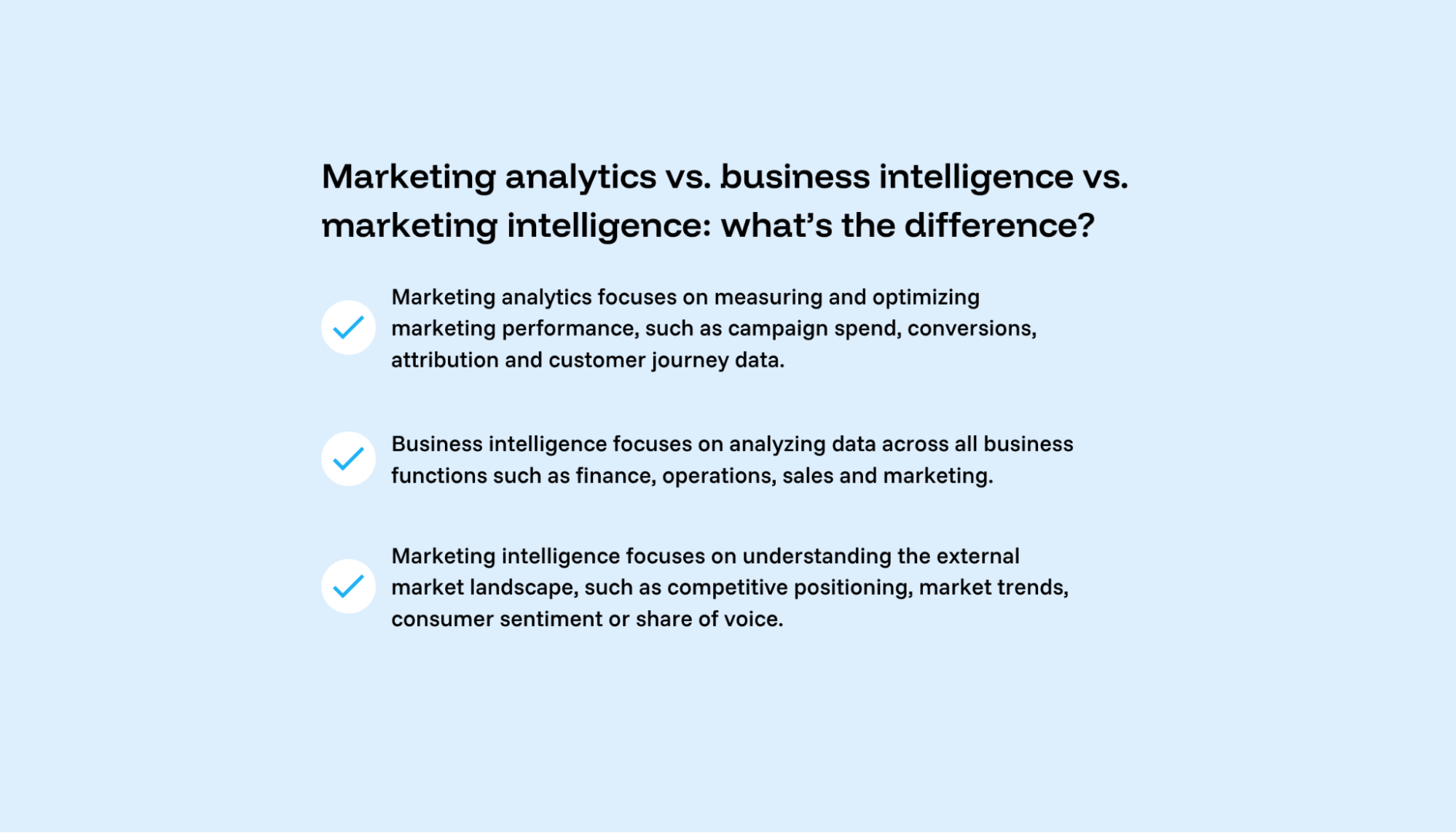
As defined earlier, marketing analytics focuses specifically on measuring and optimizing marketing performance, such as campaign spend, conversions, attribution and customer journey data. It answers the question: are our marketing efforts working, and how do we improve them?
Business intelligence (BI) is a broader discipline covering tools and practices used to analyze data across all business functions such as finance, operations, sales and marketing. Common tools used in this discipline include Power BI, Tableau and Looker. Marketing analytics often feeds into BI systems, but BI alone doesn’t address marketing’s unique measurement challenges like cross-channel attribution or media mix optimization.
Finally, marketing intelligence is used to understand the external market landscape, such as competitive positioning, market trends, consumer sentiment or share of voice. Where marketing analytics looks inward, marketing intelligence looks outward. It answers the question: what’s happening in the market? For example, in 2026, marketing intelligence now also includes GEO monitoring.
How these three principles connect
A mature marketing organization uses all three of these principles together:
- Marketing analytics optimizes campaigns.
- Marketing intelligence informs strategy.
- Business intelligence connects marketing performance to broader business outcomes.
The common thread is that all three depend on clean, connected and reliable data as their foundation. Without that clean layer, your team runs the risk of making business decisions based on flawed data.
The role of data infrastructure in analytics quality
Analytics quality is bounded by data quality, and data quality is bounded by infrastructure. For example, if your data is siloed across platforms, inconsistently formatted or manually stitched together in spreadsheets, even sophisticated analytics tools will produce unreliable results.
So how should data infrastructure support data quality? In marketing analytics, data infrastructure means three things: automated connections to all your marketing platforms, consistent data transformation (currency conversion, naming normalization, metric alignment) and a single source of truth that feeds both your analytics tools and your BI layer.
Achieving these three things is why many marketing teams are investing in marketing intelligence platforms. These provide purpose-built infrastructure that sits between ad platforms and analytics tools. It handles collection and transformation so analysts can focus on analysis instead of data plumbing.
How do you start using marketing analytics?
So, you know you want to become so savvy that you can gain all of the analytical superpowers, but you need to figure out how to get started. As we covered above, the quality of your analytics is limited by the quality of your data infrastructure, so that’s where to begin.
Thinking back to our tiers of maturity, you'll want to ensure that the base levels are solid and can be built upon. That means you'll need to have robust data collection and analysis systems in place. So, first make sure you can get all the data from your social media marketing, campaigns, website analytics and other important platforms into one place.
Marketing analytics tools
If you have coding skills or don't mind outsourcing to your BI team, try exploring data warehouses like Google BigQuery and Snowflake. In 2026, the options range from code-heavy warehouse setups to no-code marketing intelligence platforms to AI-native platforms that combine data integration with automated analysis. So, if your coding skills are less than those of a master developer (or you don't want to wait around for your BI team to answer your service ticket), you may want to explore a marketing intelligence platform like Funnel.
Depending on your capabilities and business model, each option can begin to build the foundations that can take you to the "magical" third and fourth tiers of marketing analytics maturity. Overall, marketing analytics software is not the holy grail to good data analysis yet - but it might well be the foundation you need to get going.
How does data transformation fit into marketing analytics?
We mentioned earlier that a core part of our analytics foundation is collecting and transforming your data. This is a critical element in our foundation.
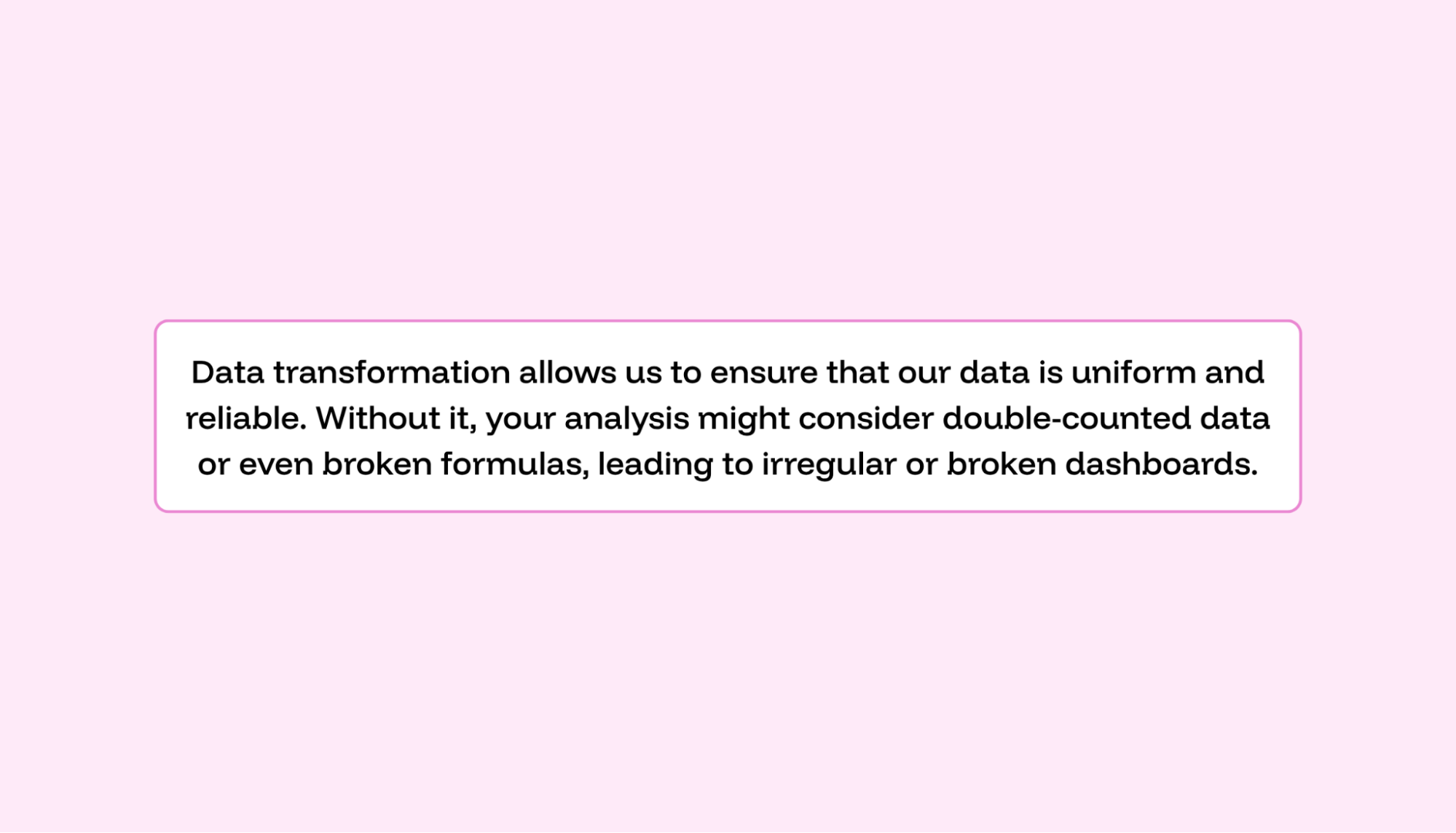
Data transformation allows us to ensure that our data is uniform and reliable. Through transformation, multiple data formats, currencies and text formatting are normalized and made consistent.
By taking the time to transform and map our data properly, we ensure that our analysis and insights are accurate. Otherwise, we might draw false insights that lead to incorrect predictions and business decisions.
Much more than just stats and performance tracking
As you can see, the state of marketing analytics in 2026 encompasses much more than the simple capacity to track your digital marketing efforts and performance. Sure, that data collection is still an integral piece of the pie, but there is now so much more that we can consider. Ideally, collecting the data and analyzing it, real-time analytics leads to new choices regarding your marketing channels and investments. Which leads to better overall marketing performance, too.
Marketers and analysts have AI-assisted analysis, agentic systems and new measurement challenges like GEO that didn’t exist two years ago. What hasn’t changed is the fundamental philosophy and requirements of the field. Clean, connected data remains the prerequisite for every tier of analytics maturity.
To learn more and see other examples of advanced marketing strategies and tips come to life, check out our latest Funnel video about marketing analysts (and how to become one!).
FAQs about marketing analytics
What is marketing analytics?
Marketing analytics is the process of collecting, transforming and analyzing marketing data to measure campaign performance and improve results. This discipline spans four types: descriptive, diagnostic, predictive and prescriptive. The goal, regardless of analytics type, is to turn data into decisions that grow the business.
What does a marketing analyst do?
A marketing analyst collects and interprets data from campaigns and channels to evaluate performance, identify trends and recommend actions. In 2026, the focus is on what analysts can do with AI-assisted tools and predictive analytics. This has shifted the role from data preparation to strategic interpretation of this data.
What is the difference between marketing analytics and data analytics?
Data analytics is a broad discipline applied across any business function. On the other hand, marketing analytics is a specialized application of data analytics focused on campaign effectiveness, channel attribution and return on ad spend (ROAS). Data analytics is the wider discipline, while marketing analytics niches down.
What tools are used for marketing analytics?
Common categories of tools used for marketing analytics include platform-native analytics (Google Analytics, Meta Ads Manager), BI platforms (Power BI, Tableau, Looker), data warehouses (BigQuery, Snowflake) and marketing intelligence platforms (Funnel.io).
Why is marketing analytics so important?
Marketing analytics is important because, without it, budget decisions rely on intuition rather than reliable data. However, with a solid marketing analytics process in place, you can identify which channels drive growth, predict the impact of budget changes before making them and continuously optimize your marketing mix based on evidence rather than assumptions.