






Windsor.ai is a data connector that extracts marketing metrics from ad platforms and moves them to a destination. Funnel is a marketing data hub that collects, stores, prepares, contextualizes and shares data in a central system before moving it onward to a report. While Windsor.ai focuses on data transfer and attribution, Funnel provides a data foundation with native storage and advanced data transformation.
If you’re trying to release your team from the trap of manual spreadsheet updates and finally automate your marketing reports, you probably have Windsor.ai and Funnel.io on your shortlist. Windsor.ai has likely caught your eye because it offers a lower price tag. It’s a smart first stop when you want to see if a budget-friendly option fits your workflow. But you probably need to know how the capabilities stack up before you sign a contract.
The choice depends on your current data needs and where your team plans to go. A data connector easily solves data extraction tasks. A marketing data hub, however, gives you room to scale when you add a data warehouse, onboard more clients or connect dozens of new channels. In this guide, you’ll learn how Windsor.ai and Funnel stack up against each other and which one is best depending on your current and future setup.
Windsor.ai vs. Funnel.io at a glance
Windsor.ai is a no-code connector platform built for extract-and-load work. It pulls data from 350+ sources and sends it to BI tools, spreadsheets, warehouses and AI assistants, with built-in multi-touch attribution.
Funnel is a marketing data hub. It connects, stores and models marketing data from more than 600 sources in one place, then reports on it or forwards it. The stored, modeled data is the product, rather than the connection alone.
If you're new to the category, start with what a marketing data hub does and come back for the head-to-head.
|
Windsor.ai |
Funnel |
|
|
Category |
No-code connector platform with built-in attribution. |
Marketing data hub that stores and models your data centrally. |
|
Connectors |
350+ |
600+ plus the Data Guarantee. If a source isn't available, Funnel builds it. |
|
Storage and modeling |
Retains up to 10 years of history on paid plans. Modeling is light in-app. The durable, large-scale store lives in your own warehouse. |
Stores and models source data natively in the Data Hub with one shared set of metric definitions. Reporting holds steady when a source changes its API. |
|
Transformation |
Basic in-app. Heavier transformation happens at your destination, and you own the logic. |
In-app modeling plus shared metric definitions in the Data Hub. |
|
Destinations |
Data Studio, Power BI, Tableau, Excel, Sheets, BigQuery, Snowflake, Redshift, S3, PostgreSQL, MySQL, Azure SQL, Azure Blob, Databricks and Microsoft Fabric on all plans. |
Sheets and Data Studio on Starter. Power BI, Tableau and warehouse export on Business plans and up. |
|
Built-in dashboards |
No native dashboards. Templates for external BI tools. |
Native Funnel dashboards plus templates. |
|
AI and MCP |
Free Windsor MCP to ChatGPT, Claude and others. |
Funnel MCP on all plans. It exposes the modeled Data Hub with your metric definitions. |
|
Pricing model |
Fixed tier by sources and unlimited user accounts. Warehouse and database destinations are billed by monthly active rows. |
Plan plus Flexpoints capacity. Connectors, accounts and destinations consume Flexpoints. No charge for rows or data volume. |
|
Measurement |
Multi-touch and data-driven attribution included. |
Funnel Measure add-on with marketing mix modeling, multi-touch attribution and incrementality testing. |
|
Support |
Live chat on all plans. Dedicated multilingual account manager on Enterprise. |
In-app support; priority in-app for Business and Enterprise SLAs. Teams in Stockholm, Boston and Sydney. |
Where Windsor.ai fits in your data stack
Windsor.ai can work well with several data integration setups.
Direct delivery from ad platforms to your dashboard
Windsor works as a lightweight data pipeline, so it’s great for teams with small data volumes. It authenticates with each ad platform's API, extracts the metrics and loads them straight into Data Studio (formerly Looker Studio) or Google Sheets with no database in between. So if you run three or four channels and check performance once a day, Windsor gives you what you need while saving you from messing around with manual spreadsheets.
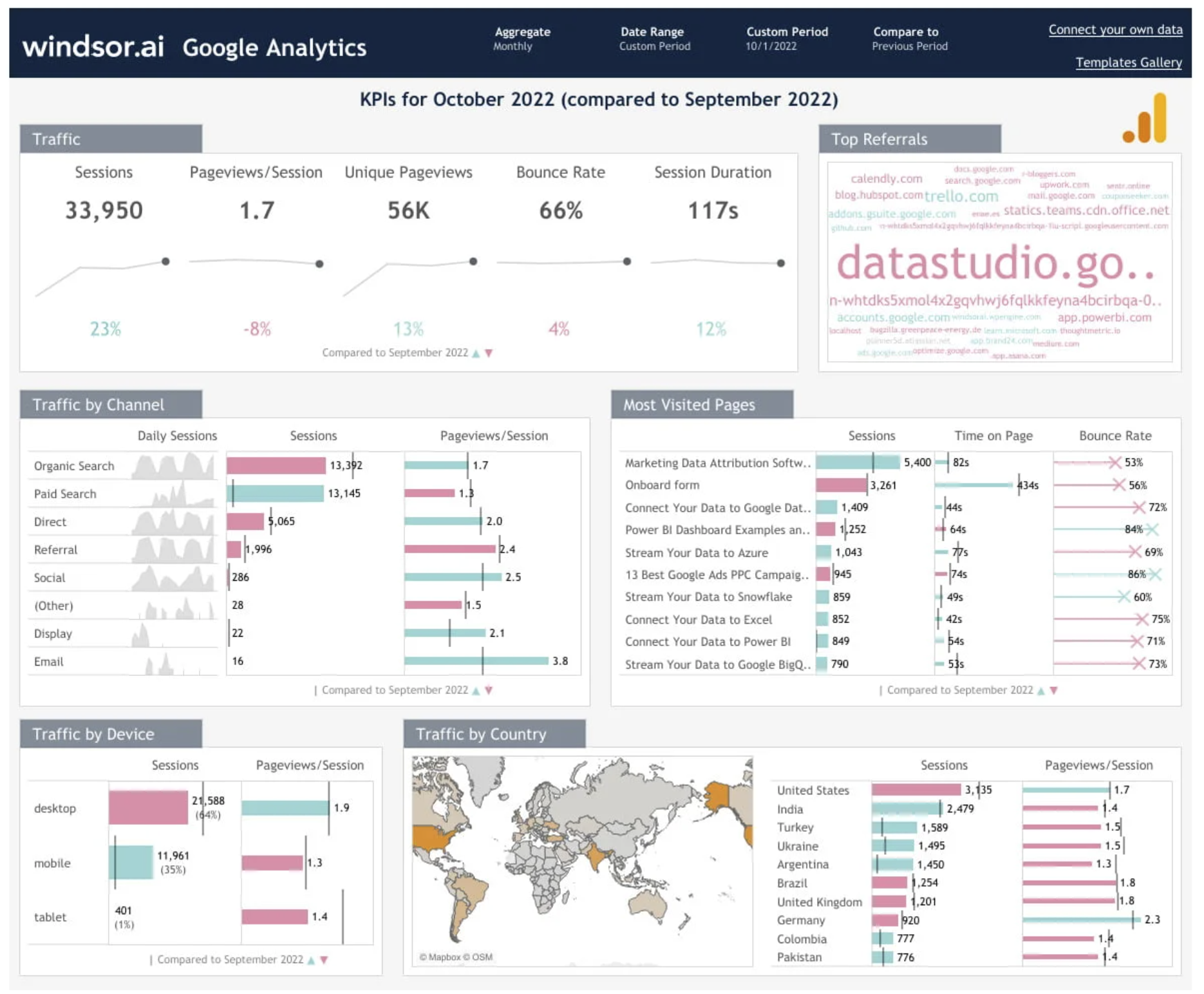
Source: Windsor.ai
Your main focus is on attribution
Normally, calculating Return on Ad Spend (ROAS) is a headache because ad platforms like Meta know how much you spent but not what users bought, while Google Ads tracks sales but not ad costs. To see the full picture, you have to manually download spreadsheets and join them together using a formula or SQL.
Windsor has automatic data blending, so you get pre-calculated ROAS and keyword-level insights without the manual effort.
You can access all data sources on every plan
You can access all of Windsor's 350+ connections even on a basic plan. If you’re part of an early-stage team, you can easily test new acquisition channels without upgrading to an enterprise plan.
Deliver marketing source data to your own warehouse
Teams with data analysts who write their own SQL can use Windsor as a pass-through. It delivers unmodeled rows to BigQuery, Snowflake or dbt on all plans, and you keep full control of the transformation logic. But one caveat applies. Data warehouse destinations are billed based on monthly active rows, so costs increase as your data volume grows.
Optional data refresh speeds
Windsor updates your data on different schedules depending on your plan: once a day on Basic, hourly on Standard and every 15 minutes on Professional. If you need to shift ad budget dynamically throughout the day, the 15-minute sync provides the near-real-time data you need to make those decisions. If you only look at your reports once a day, the basic plan handles the job.
Where Windsor.ai hits its ceiling
None of the following limitations make Windsor.ai a bad tool, but there are some trade-offs growing teams typically run into within a year.
Your definitions get trapped inside separate dashboards
Windsor moves your source marketing data from A to B, but it lacks a central hub to standardize your metrics. The result is that you have to write the rules for campaign groups, currency conversions and cost per acquisition (CPA) in your dashboards. While that may seem fine at first, if two analysts configure a Data Studio filter slightly differently, the same metric will show two different numbers. Your team then spends time auditing spreadsheet logic instead of fixing underperforming campaigns.
Attribution tracks clicks but can’t prove what caused a sale
Windsor's native attribution tracks digital click paths well, but the models can't account for offline media, brand strength or wider economic conditions. Windsor also doesn’t have marketing mix modeling to forecast budget changes or incrementality testing to isolate true lift, so it can't prove an ad caused a sale.
Growing your tech stack may force you to rebuild
A point-to-point connector doesn’t centralize your data logic, so growth means building it all again. If you want to add a data warehouse, launch new channels or onboard extra clients, you’ll need to rewrite and re-verify every formula in the new destination. The configuration work is essentially done twice.
How Funnel works differently
Funnel reverses the standard data pipeline process. It first stores and structures your marketing data, then creates a single dataset that all your reports, dashboards and AI tools read from simultaneously.
Built-in data integration
When Funnel collects your marketing data, it stores it at the source level, which helps your dashboards load faster and keeps your historical data intact. If a platform reads straight from the platform, without storing the data in a hub, an API change can break your reports or lead to data loss.
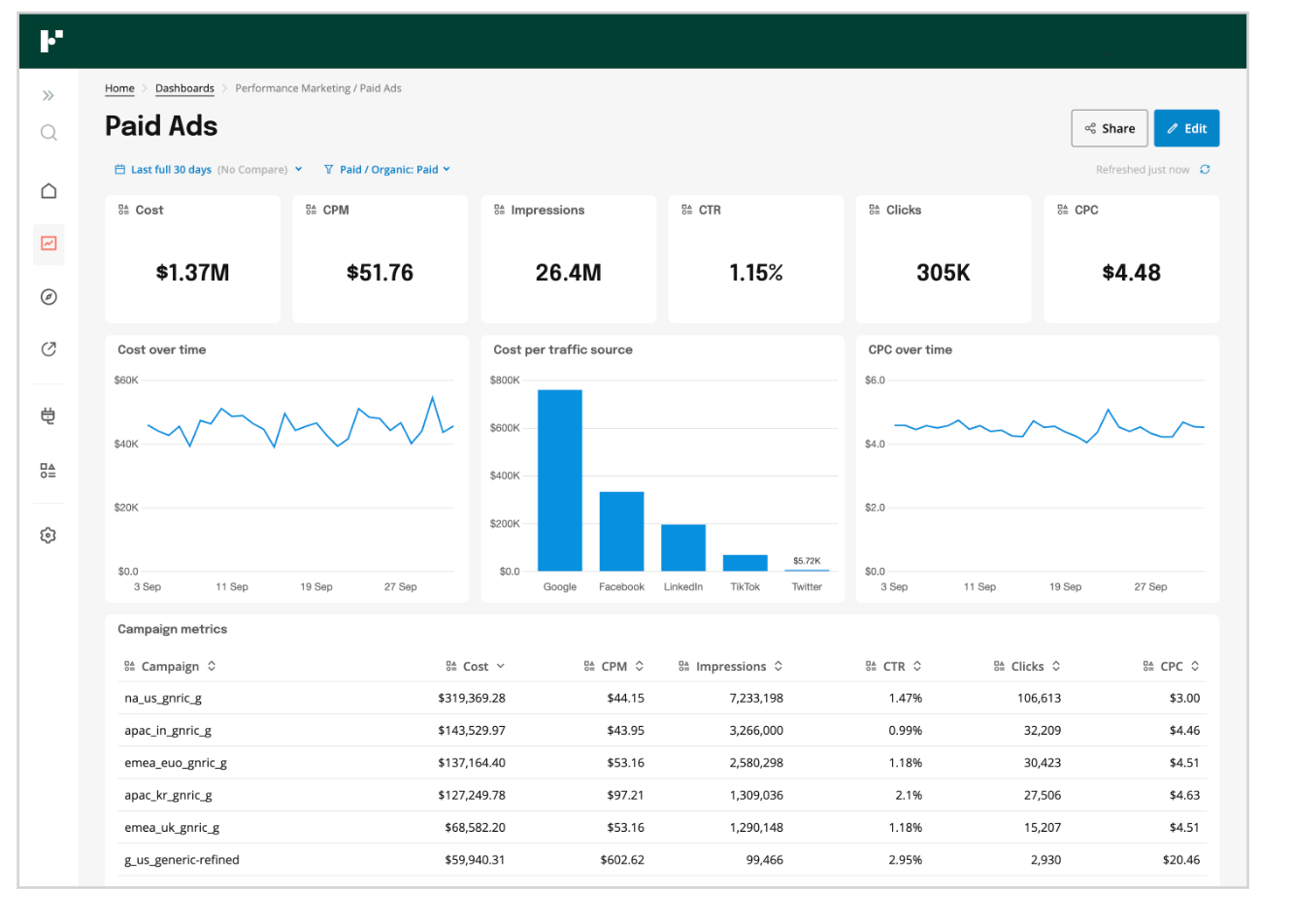
Data normalization
Funnel normalizes your source data, so you can define custom metrics like campaign groups, and every report will inherit them.
600+ managed data connectors
Funnel's team maintains your connections and ships updates when a platform changes an API. The advantage here is that your reports remain live without anyone on your side needing to fix them. Sources outside the catalog are covered by the Data Guarantee: if a connector you need doesn't exist, Funnel builds it.
Flexible data destinations and BI tools
Send your data to Data Studio, Power BI, Tableau, BigQuery, Snowflake or another platform your team uses. Funnel also includes its own built-in dashboards, so you can report without a separate BI tool, which is great for non-technical users.
AI-powered analytics
Ask an AI chatbot to summarize your marketing performance, and it can easily fabricate fake conversion metrics or invent ad spend numbers. This happens because platforms like Windsor feed the LLM raw, unmapped files. The chatbot guesses the data's context and fails.
Funnel eliminates the risk with Funnel AI and a Model Context Protocol (MCP) server, which exposes a fully structured data model to Claude and ChatGPT. The result is that AI reads clean, unified data definitions rather than a chaotic mess of raw files, so your chatbot can produce accurate AI insights you can be confident about.
Advanced measurement
Ad platforms generally inflate their performance to claim credit for conversions. The Funnel Measure add-on cross-references your data sources to give you the objective truth about your real ROI. Funnel Measure comes in two plans to help you build a measurement system.
Digital measurement combines platform metrics, marketing mix models and data-driven attribution. With Advanced Measurement, which is good for teams with a complex marketing mix, the tier covers offline marketing channels, linear TV and incrementality tests. It isolates your true business growth, so you never waste spend on audiences who intend to buy your product anyway.
The total cost comparison between Funnel and Windsor.ai
True cost efficiency isn't about the lowest monthly subscription; you need to know that the tools you're buying don’t come with a hidden tax of manual maintenance and unpredictable scaling fees.
Entry price favors Windsor
If your team only needs to connect to one data source and doesn't need to retain historical data, you can take advantage of Windsor's 30-day free plan or Free Forever plan. The pricing structure increases with the number of monthly active rows.
Each new use case adds unbilled labor
Basic connectors don't store your data definitions; your team has to manually recreate and verify every single formula in every dashboard. Constant manual upkeep can turn into a massive bottleneck and a point of failure. Every time a platform updates its API, your team is left to fix it.
Row-based billing scales with your data
Windsor bills warehouse and database destinations by monthly active rows, so the delivery bill rises with event volume, and volume is hard to forecast a year out. Funnel charges by plan and Flexpoints rather than rows. Connectors, accounts and destinations consume capacity, and data volume incurs no extra cost, which keeps long-term spend predictable.
Re-migration is the biggest line item
A connector works fine for a small operation. Costs land when you outgrow it, because the move to a larger data infrastructure drags every formula, schema override and workflow along with it. Funnel absorbs new channels, warehouses and BI tools on top of the data it already stores, so expansion is a configuration change rather than a rebuild. It's the platform you grow into rather than the tool you grow out of.
Which tool is right for you?
Your choice between these two platforms comes down to your data volume and access to data engineers.
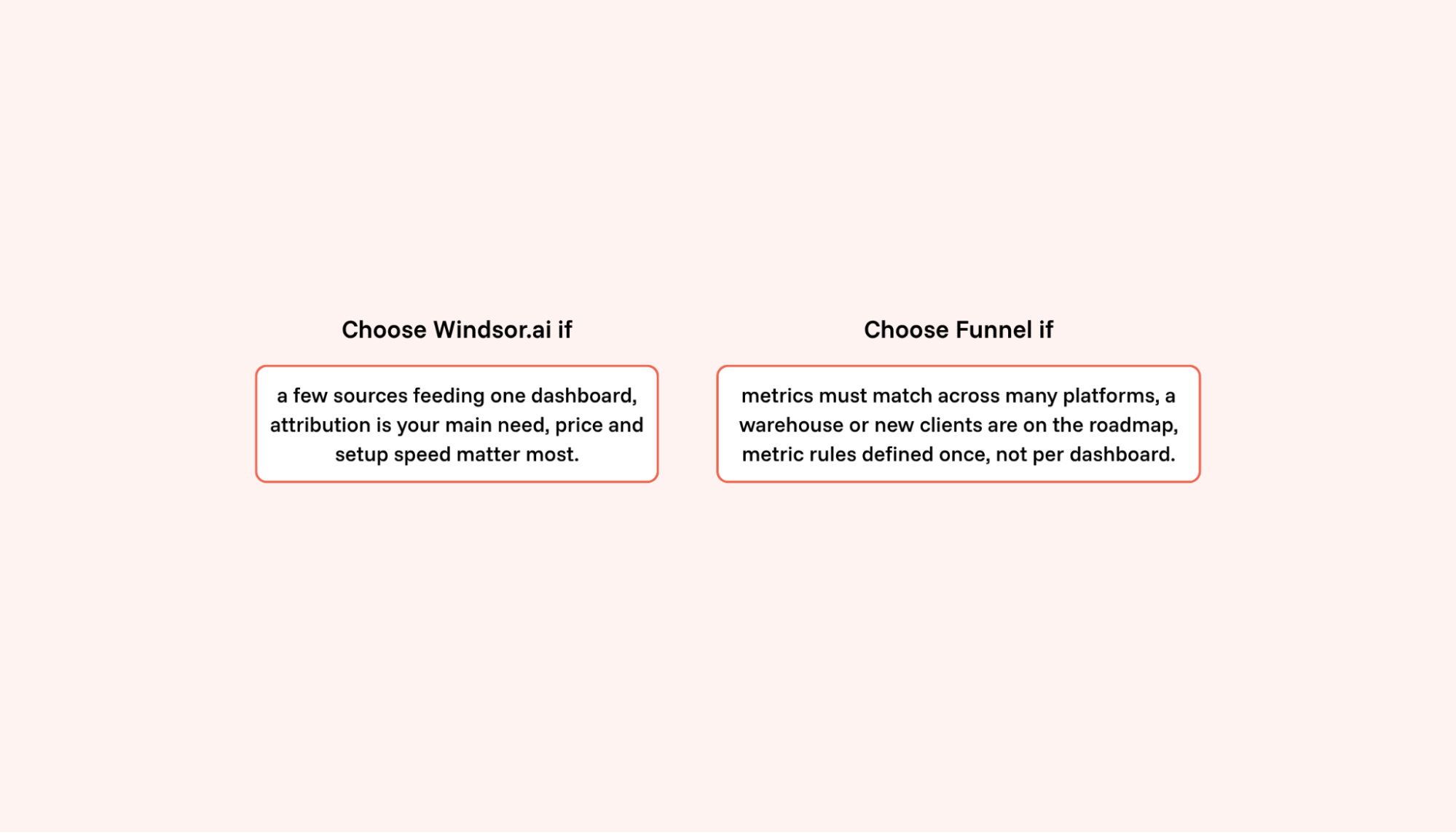
Windsor.ai is the right call if:
- You only need to push a handful of core ad channels into a few basic dashboards like Data Studio or Google Sheets.
- You want an out-of-the-box tool to automatically handle attribution.
- You own your warehouse and your modeling, and you just need reliable delivery.
- You need a budget-friendly connector that you can configure and launch fast.
Funnel is the right call if:
- You need to pull data from dozens of different platforms and require the metrics to match perfectly across every single report.
- You want to define your campaign groups, currency conversions and CPA formulas once rather than rewriting them inside separate dashboards.
- You need an independent database that automatically stores your historical marketing data and insulates your reports from breaking when ad networks change their APIs.
- You plan to migrate to an enterprise data warehouse, adopt advanced measurement or onboard new client accounts within the next year and want a foundation you won't outgrow.
If you’re evaluating options beyond Windsor and Funnel, you can read our deep dive on Funnel vs. Supermetrics or the best Supermetrics alternatives to see how the broader data connector market compares.
The final verdict, look beyond this quarter
The real cost of a connector tool is the rebuild you face when you eventually outgrow it. If you have two or three sources feeding a dashboard, Windsor gets the job done for a low monthly cost. But every formula, metric rule and cross-channel definition you build downstream stays trapped in that setup. If you want to add a data warehouse, scale your client list or launch new channels, you’ll need to start over.
Funnel is built for the team you're becoming. The same stored, modeled data that powers your reporting today handles measurement, BI and AI workflows later. No migration, no history lost. Rebtel made that exact move. The telecom company outgrew a reporting tool that gated connectors behind pricing tiers, rebuilt its reporting on Funnel and later connected the same setup to Snowflake within two hours.
See how Funnel compares for your team. Get a demo.
Frequently asked questions
Why is Funnel the best Windsor.ai alternative?
Windsor.ai is a data connector. It moves marketing data from ad platforms to destinations such as dashboards and warehouses, with built-in attribution. Funnel is a marketing data hub. It stores, prepares and shares your data from one central system. Native storage and shared metric definitions are the core differences.
Is Windsor.ai cheaper than Funnel?
Windsor.ai features a lower entry price than Funnel, but your final bill depends entirely on your data architecture. Windsor charges a monthly subscription, but it scales as your data volume grows. Funnel runs on a more expensive yet more predictable Flexpoint system that charges based on data connections.
Does Windsor.ai store marketing data?
Windsor.ai retains up to a decade of history on paid plans. However, it doesn't centrally model your marketing data. The cross-channel calculations happen in your warehouse or BI tool. Funnel stores and models marketing source data natively, so your history and metric rules survive platform API changes.
Can Windsor.ai replace Funnel for a growing marketing team?
For a small setup with a few sources and simple dashboards, yes. Teams that add a warehouse, more clients or advanced measurement usually hit the connector ceiling. At that point, they rebuild their reporting logic on a new platform. Funnel is designed to prevent that rebuild.
What does Funnel offer that Windsor.ai doesn't?
Funnel.io offers native data storage and modeling, shared metric definitions across every report, more than 600 managed connectors backed by the Data Guarantee, built-in dashboards, Funnel AI and a measurement add-on with marketing mix modeling and incrementality testing.