



 Get in touch
 Log in




Marketing teams and agencies rely on accurate, unified data to create reports that drive confident decisions. Many teams start with a connector tool like Supermetrics to pull data from marketing channels and prepare it for analysis.
At first, that might be enough. The problem is that plugin-based setups are inherently fragile because their infrastructure isn’t designed for large data volumes and complexity. When data scales, they start to show their cracks. Data refreshes start breaking, reporting slows down and time gets wasted on things like manual data pulls, tasks your connector tool was supposed to do for you.
Supermetrics primarily acts as a pass-through integration tool, not a permanent storage solution, so you still have to maintain datasets off-platform. It pulls data from marketing channels and pushes it to destinations such as Google Sheets or Looker Studio.
Funnel stores and models data centrally, helping you turn insights into business impact and future-proofing your marketing. It’s the go-to marketing intelligence tool that grows with you.
If you’re considering a move to a data integration platform that supports scaling and lets you govern and measure data in one place, Funnel might be a better fit. If you only need a connector tool and aren’t running into issues with data loss, timeouts or broken dashboards, Supermetrics can work. Let’s compare Funnel versus Supermetrics to help you decide which platform can help your team today and support tomorrow’s growth.
At a glance: Funnel vs. Supermetrics
Supermetrics and Funnel move marketing data, helping teams demonstrate marketing ROI and make more informed decisions about things like campaign optimization and budget allocation. But under the hood, these two solutions are very different.
Supermetrics
What Supermetrics is: Supermetrics is a connector-first tool. Its goal is to easily move marketing data from point A to point B so it can be used for analysis. There are transformation features you can apply, but data isn’t automatically normalized and harmonized across channels. There’s no measurement layer. Data storage is not permanent. And things start to fall apart as data volumes grow.
Where Supermetrics is strong: Supermetrics works well for simple reporting. Setup is fast, and it’s easy to add connectors.
Funnel
What Funnel is: Funnel is a full-stack marketing intelligence platform that helps growing and already well-established large agencies and brands centralize, clean and measure their data with speed and confidence. It’s built to scale without the fragility or manual effort of plugin setups.
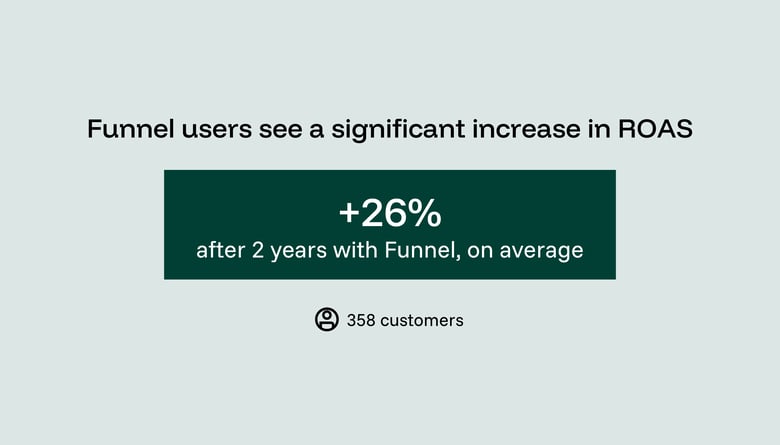
Why Funnel is strong: Funnel helps you maintain one set of definitions across your reporting, so your team spends less time figuring out why numbers look off. It also makes it easier to spot what’s working to confidently allocate budget.
Where Supermetrics works well for smaller teams
Supermetrics can be a practical fit for smaller teams. Here’s why:
Easy-to-use data source connectors
Supermetrics is built to get the data into your reports with minimal blockers. Marketers can connect common ad platforms without much help, which makes it a solid choice for simple setups in Google Sheets or Looker Studio.
Automated reporting
Supermetrics can refresh data on a schedule, which is helpful if you send the same report every week or month. As such, you’re more agile because you spend less time exporting files and copying numbers into decks.
Fast setup
Supermetrics builds working reports with minimal hassle. It simplifies testing new channels or launching quick dashboards.
Where Supermetrics falls short as you scale
With higher data volumes and greater complexity, marketers start to run into issues with a Supermetrics setup.
Connector coverage can limit growth
Supermetrics covers 150+ of the leading marketing platforms, but scaling brings new niche data sources, like regional ad networks, affiliate tools or a new ecommerce setup. When a connector is missing, teams have to patch the gap with CSVs and manual uploads.
Plugin-style “pass-through” setups break more often
Supermetrics pulls data straight into the destination during each refresh, which means the destination holds the data, not Supermetrics. When an API changes or the destination hits a limit, the refresh can fail and leave gaps, so you end up losing time filling in the blanks rather than answering questions on performance and strategy.
No stored history unless you add on Supermetrics data storage
By default, Supermetrics acts as a pass-through rather than a storage locker. The platform extracts data from your ad platforms and moves it directly to your reports, but it doesn't keep a backup copy for itself.
This setup creates a risk: if a data refresh fails, you get a gap in your historical data. Because ad platforms only keep data for a short time, you might not be able to go back and fix those gaps if you don't catch them immediately. To solve this, you have to buy Supermetrics Storage as an add-on, which gives you a dedicated place to save your history safely.
API, schema and rate-limit changes can also break reports
Platforms constantly change their APIs and schemas, so metrics can get renamed, removed or split into new fields. Rate limits add another failure point, since platforms cap how many requests you can make in a short window, which can lead to partial or blank data loads.
Looker Studio as a data destination can hit scale limits
Supermetrics is regularly used with Looker Studio. But Looker Studio is a data visualization tool, not a data storage tool, so extensive reports can slow down or fail when there are lots of rows, charts or unique values. Extract Data can help, but extracted data sources have a size cap (up to 100 MB), so big datasets may not extract or refresh.
Supermetrics pulls your data live into Looker Studio every time you hit refresh. And if you trigger too many requests, you’ll run into API quotas and limits. This breaks your dashboards or serves partial data, forcing you to troubleshoot instead of taking action.
Switching reporting tools can mean starting over
Smaller teams start with Google Sheets or Looker Studio as their data destination. Later, the team matures and moves the data into BigQuery or a data warehouse to handle bigger reporting needs. With this kind of setup, that move can mean rebuilding the connections, the cleanup and the dashboards. Historical data can also get lost because ad platforms may not let you pull the same data again months later.
No shared governance means reports stop matching
Everyone makes small choices when they build reports; one person uses a different time zone. Another groups campaigns in a different way. Over time, naming and metric rules change across clients and regions, which causes the team to lose time arguing over what the “right” definition is.
If these issues would throw a wrench in your team’s marketing analytics efforts, Supermetrics might not be the right fit. Funnel is an alternative that supports scaling while also future-proofing your data stack.
How Funnel works to your advantage as you scale
With Funnel, you have a reliable foundation of clean, unified data, managed connections and shared governance to support collaboration between marketing and data teams.
Comprehensive data coverage
Funnel supports 600+ data connectors, including major ad platforms and the long tail of regional tools. When your channel mix changes, your setup doesn’t need a patchwork of manual workarounds fixes.
The Data Hub stores your data, so you keep your history
Funnel includes a native Data Hub that automatically archives your data. Because it stores raw data, your history stays safe if an ad platform deletes it. Having raw data in your foundation also provides flexibility because you can switch or add new reporting tools fast without having to manually re-fetch years of data.
Managed connections that don’t break dashboards
Funnel manages API changes and schema updates for you in the background and even supports retroactive adjustments. So if definitions change, historical data and reports stay consistent. Your team won’t lose time to firefighting just because an API update dropped.
Shared governance across teams and clients
Funnel’s Data Hub creates one set of rules for your data. You standardize naming conventions, metrics and time zones in one place. As a result, every dashboard, export and team then uses the same definitions.
Built-in dashboards that can handle real reporting needs
Funnel includes built-in dashboards, so you can report directly from the same governed dataset. Dashboards load fast, no matter how many data sources you connect, because you aren’t forcing a dashboard tool to carry more and more weight as you grow.
Advanced measurement without extra tools
Funnel supports advanced measurement techniques like marketing mix modeling (MMM), data-driven multi-touch attribution and incrementality testing. So, you can dive deeper into what channels have an impact and what to do next without having to add more tools to your stack. The output is one consistent view you can use to plan, spend and prove impact for more complex use cases and marketing mixes.
Platform vs. plugin
Supermetrics pulls data into a report. Funnel provides a Data Hub as your reporting source of truth. You set rules once, like how you group channels, name campaigns, select time zones and define high-quality conversions. Funnel then delivers that single dataset to every destination.
Now that you know how Funnel and Supermetrics differ, let’s look at what types of users are a good fit for each.
Who are Supermetrics and Funnel best for?
Supermetrics is a good fit for small teams with simple reporting needs. It works best when you track a handful of channels in one or two markets and push data into a single destination like Google Sheets or Looker Studio. If your reporting needs stay straightforward, Supermetrics can be enough.
Funnel is a better fit when reporting has to scale to include multi-market, multi-channel reporting across brands, regions or clients, where you need consistent definitions and less manual cleanup. Funnel is also the better fit for advanced measurement work, which you may need for more complex marketing mixes and client use cases.
A detailed comparison of Funnel vs. Supermetrics
At the end of the day, choosing the proper reporting setup really comes down to how you work right now and how far you want to go. By now, you’ve learned how Funnel and Supermetics work under the hood. Next, we’ll deep-dive into how they perform under pressure for brands and marketing agencies.
|
Category |
Funnel |
Supermetrics |
|
Core focus |
Marketing intelligence platform |
Data connector and reporting tool |
|
Scalability and reliability |
Scales with you, handles large datasets |
Struggles to handle large amounts of data |
|
Data coverage and quality |
Comprehensive and built on Funnel’s Data Hub |
Unstable and limited connectors |
|
Measurement and attribution |
Built-in multi-touch attribution, MMM and incrementality testing |
Requires external tools |
|
User collaboration |
Seamless, multi-user dashboards |
Limited to single-user or small-team collaboration |
|
Data source connectors |
600+ |
150+ |
|
Pricing predictability |
Flexpoints prevent cost spikes |
Fixed-tier pricing |
Scalability and reliability
The strongest reporting setup builds a compounding advantage. When you invest once in clean, reliable data, every new use case gets easier.
Reporting, transformations, measurement and activation all become more cost-effective because you reuse the same foundation instead of rebuilding logic for every report. McKinsey found that reusing a single data product across several analytical solutions can cut costs by 30% compared with building separate pipelines each time. That is the flywheel effect teams need once reporting becomes business-critical.
Supermetrics is a solid first step for lightweight reporting, but the workflow is destination-led. As you add campaigns and clients, moving parts multiply, meaning more filters, more refresh jobs and more chances for failure. In marketing data, something fails all the time. Platforms rename fields, deprecate metrics and change breakdown logic.
Funnel is built to handle the pressure of complex setups. Instead of pushing raw data straight to a destination, Funnel ingests your data into the Data Hub. Here, it is stored, cleaned and kept up to date before it ever hits a dashboard. As such, it protects your data from API issues and rate limits, so you spend less time troubleshooting and have more time to analyze data.
What’s the net result? Supermetrics gets you to a dashboard fast. Funnel keeps dashboards stable as your client list, markets and data volume grow. The Data Hub protects your historical data, so you’re not scrambling to rebuild reports when a platform changes or a destination setup needs to change.
Data coverage and quality
As your marketing grows, you add new channels and tools. But if your reporting setup does not automatically pull them in, your team is forced into manual workarounds like spreadsheets. When spend sits in one place and conversions in another, you make decisions without the whole picture. Reporting becomes a "hash-together" job that is brittle and hard to maintain.
To prevent bottlenecks, you need comprehensive connector coverage. Funnel helps you capture the whole picture with over 600 data connectors and in-house custom builds. In comparison, Supermetrics offers 150 data connectors and relies on outsourced solutions for custom builds. Crucially, it’s important to note that Funnel’s connections are fully managed. If a platform updates its API or a connection fails, Funnel handles the fix, so your team doesn't have to.
But coverage is only adequate when paired with quality. Supermetrics pulls data live and introduces performance risks and dashboard interruptions. Funnel’s Data Hub stores your historical and raw data in-house before delivery. This allows for automatic normalization and blending across platforms (aligning campaign names, dates and currencies) so you can gain greater clarity and improve data delivery performance.
What’s the net result? Supermetrics provides a basic bridge for standard data sources but puts the responsibility of patching connector gaps and API maintenance in your hands. Alternatively, Funnel delivers full coverage with a managed infrastructure. You won’t ever have to choose between adding a new channel and maintaining stability.
Measurement and attribution
If you’re allocating a big budget across channels, reporting only gets you so far. It can tell you what you spent and what you earned, but it cannot tell you what actually drove the result. Marketing teams get stuck in last-click attribution, which rewards the channel at the very end of the journey while ignoring the ones that actually created the demand. As a result, upper-funnel spend gets cut.
Advanced measurement helps you avoid the last-click trap. Methods like marketing mix modeling (MMM) and incrementality testing allow you to see the actual impact of your spend by finding what drives marginal impact rather than just last-click credit. However, these methods are only as good as the data feeding them. They depend on a single, consistent dataset: shared metric definitions, aligned time zones, stable naming conventions and clean historical data stored in one place.
This is the fundamental split between Supermetrics and Funnel. Supermetrics acts as a bridge to move raw data from your channels into a destination. This is useful for basic reporting, but because each channel is essentially dropped into its own silo, you are forced to do the heavy lifting of manual harmonization before you can even begin modeling. To get to MMM or incrementality, Supermetrics users typically require multiple vendors and additional tools to patch the gaps.
Funnel treats measurement as a layer on top of a central Data Hub. Your marketing data is stored, harmonized and governed there first. Because you are working with a foundation of "business-ready" data, you can access Funnel’s built-in measurement and attribution in one place. The result is a setup where you can move from raw numbers to actionable impact measurement without the "cleaning tax" or the need for a bloated tech stack.
What’s the net result? Supermetrics moves data but leaves the harmonization and complex modeling to other tools or manual work. Funnel provides the built-in measurement framework and governed data foundation to prove marketing impact and allocate budget with total confidence.
User collaboration
True collaboration is impossible when different departments are working from different numbers. When marketing, sales and finance teams rely on separate data silos, they spend more time figuring out whose spreadsheet is "correct" than they do driving growth.
Supermetrics functions primarily as a data connector. While it allows you to share data access between users, the actual collaboration typically happens at the destination. Because Supermetrics lacks a centralized environment for data transformation, business logic like naming conventions and metric definitions must be manually maintained across every report. If your business logic changes, a team member has to touch every dashboard by hand to keep them aligned.
Funnel provides a centralized workspace where marketing and data teams collaborate on the same cleaned and standardized dataset before it ever reaches a destination. By doing the heavy lifting (data collection, cleaning and normalization) automatically, Funnel ensures that every user is working from a single source of "business-ready data."
Funnel’s setup is particularly powerful for aligning users regardless of technical expertise. Data teams can define governed workspaces, naming conventions and roles. Marketers can self-serve using a point-and-click interface: they can group campaigns, map channels and define KPIs without ever writing a line of SQL or waiting for a developer. This allows for total agility within a governed framework, so your team can focus on discovering insights rather than fixing broken formulas.
What’s the net result? Supermetrics shares data access, but leaves the collaborative "cleanup" to your individual team members. Funnel provides a centralized, no-code hub that keeps everyone aligned on the same numbers, assuring that as your team scales, everyone stays on the same page.
Pricing predictability
Marketing budgets are tighter than ever. Gartner recently found that 59% of CMOs don’t have the funding they need to execute their strategies. When every dollar is under the microscope, the last thing you need is a usage-based bill that spikes just because you had a successful month.
Put head-to-head, the different pricing plans of Supermetrics and Funnel diverge significantly. Supermetrics typically prices by destination and add-ons. For a growing agency or brand, this can make every new client, connector or export feel like a separate line item to justify. If you aren't careful, your bill can explode as your data volume or destination list grows.
Funnel prioritizes predictability through "Flexpoints." Think of Flexpoints as your Funnel currency for measuring capacity. They are used for virtually all tasks and features like connectors, data sources, dashboards and conversion API destinations. Instead of paying per row or per destination, you have a set amount of Flexpoints at your disposal within your subscription. If you need to scale, you simply move up a tier. This ensures your usage never eats into your budget unexpectedly.
What’s the net result? Both have vastly different pricing plans. Supermetrics pricing penalizes success. Funnel’s Flexpoint model keeps costs predictable.
Why marketing teams and agencies switch from Supermetrics to Funnel
Making the switch to a full-stack marketing intelligence platform starts when a simple data connector stops being "good enough." While Supermetrics is a fine starting point for moving data into a sheet or Looker Studio, scaling turns your highly-skilled team into "data janitors" who spend more time fixing reports than analyzing them.
You eventually reach a point where you don't just need a pipeline, you need a managed infrastructure that stores, cleans and governs your data first. Here’s how three teams made the switch from Supermetrics to Funnel, and what they achieved.
Power Digital Marketing
“We were relying on Supermetrics to feed Google Sheets, which we then transformed and connected to Looker Studio. The data refreshes were constantly breaking, and the process was not efficient at all,” says Mattan Romano, Associate Director of Business Analytics.
Before switching, the team spent 12 hours every month just cleaning data and maintaining broken pipelines. Since adopting Funnel, Power Digital has cut manual reporting work by 75%. Instead of spending days assembling client reports, they now turn them around in under an hour. This shift allows their analytics team to work independently without needing engineers for every data change.
Arm Candy
When datasets grew, Arm Candy ran into timeouts, broken formulas and gaps in historical data. According to their team, the Supermetrics API went out "every single day," chipping away at client confidence.
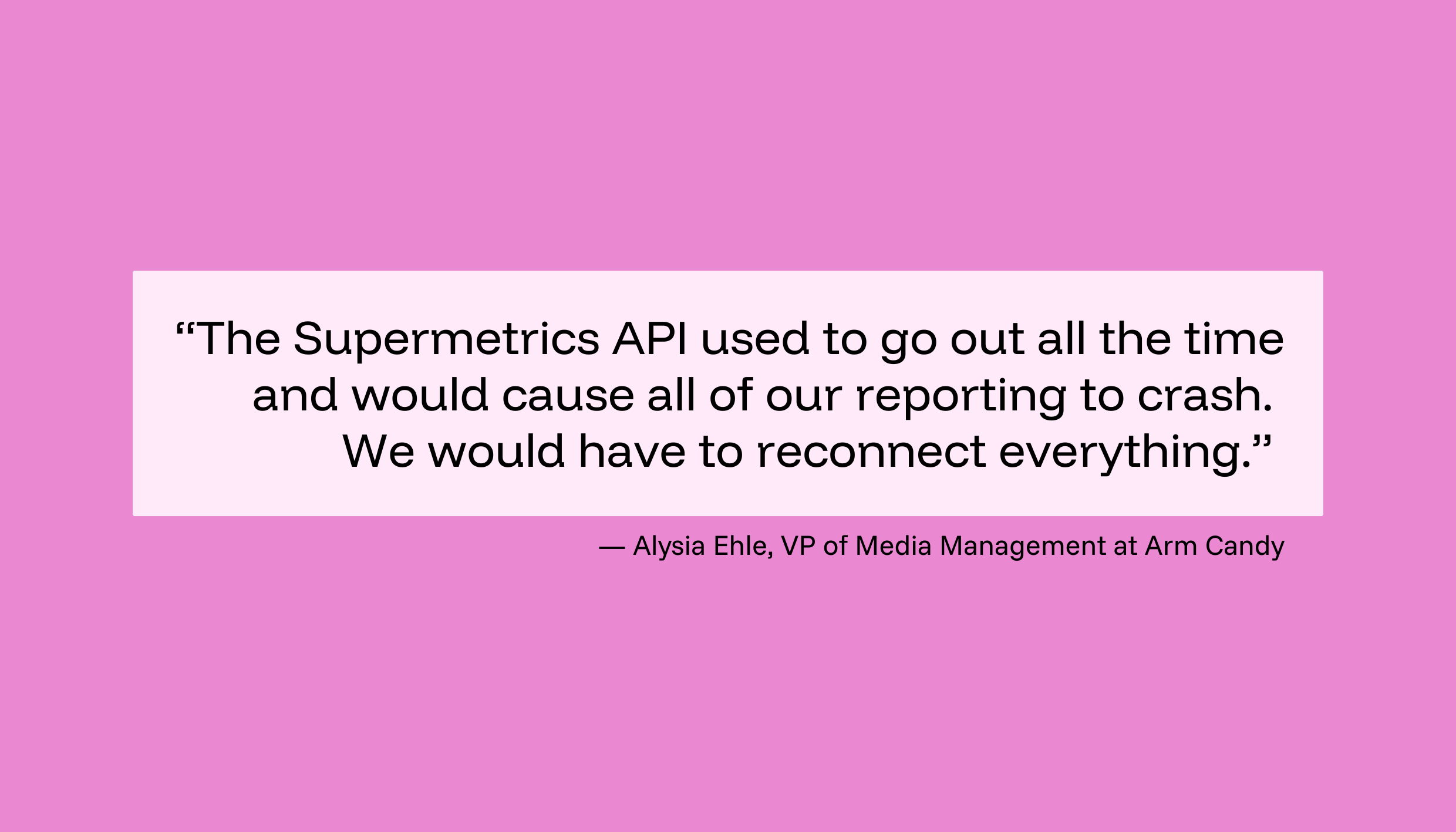
Moving to Funnel saved the agency 12 hours of maintenance every week. Because their data is now stored and transformed inside Funnel rather than pulled live into Sheets, their reports stay up even when a platform changes. This stability serves as the foundation for their proprietary planning tool, Cyris.
Havas France
Havas France faced a massive scalability challenge with over 50 client teams requiring tailored reporting. Originally, data collection and cleaning were done manually in Excel, with a single recurring report taking upward of three hours to generate.
With Funnel, Havas now powers reporting for over 50 clients from one centralized, governed platform. The agency has replaced manual maintenance with a standardized automation process that allows 50+ teams to collaborate on the same dataset without breaking reports. They’ve eliminated 12+ hours of weekly maintenance and ensured that every team is working from the same reliable numbers.
Unify your marketing insights with Funnel
Choosing between Supermetrics and Funnel depends on where your agency or brand is today and where it’s headed. Supermetrics is a capable bridge for small teams needing to move data from A to B with simple reporting. But when your data volume grows, the bridge buckles.
Funnel offers more than the bridge; it provides a managed infrastructure that stores, cleans and governs your marketing data. By centralizing your insights in a unified Data Hub, you eliminate manual maintenance and empower your team to discover insights and confidently allocate budget.
So, if you're an agency scaling to 50+ clients or an in-house marketing team maturing to advanced measurement, Funnel provides the stability you won't outgrow.
Ready to see how easy it is to migrate? Book a demo today to discover how Funnel can unify your marketing insights and give you back hours of your week.