



 Get in touch
 Log in




Your best-performing channel might be where you're wasting the most money.
It sounds counterintuitive, but it's a pattern that constantly plays out in marketing teams. A channel looks great in dashboards with strong return on ad spend (ROAS), low cost per acquisition (CPA) and consistent conversions, so the natural instinct is to scale it. More budget flows in. And then efficiency erodes without anyone noticing until the damage is done.
Marketing teams rarely detect channel saturation in real time. Instead, they discover it retrospectively, after a campaign has already absorbed significant budget and delivered diminishing returns on ad spend.
The problem isn't a lack of data; marketers are drowning in performance metrics. The problem is that the metrics most teams rely on don't indicate when media channels have passed the efficient-spending point.
In this article, we break down why saturation hides in plain sight, the early warning signs teams miss and how modern measurement approaches can reveal where diminishing returns emerge in the media mix before the budget is already spent.
Why high-performing marketing channels attract overspending
If you've ever sat in a budget meeting, you know the end result is usually to put more money behind the various marketing channels that appear to be working. And it feels obvious because why wouldn't you double down on the winners?
The problem lies in common frameworks like the 70/20/10 split. While allocating 70% of your budget to proven channels seems disciplined, in practice, it concentrates spend on whichever channel performed best last quarter. Paradoxically, the channel that performed best last quarter is likely the one closest to its ceiling. It has already captured the easy demand and exhausted the pool of fresh, high-intent users. When you pour more money in, each additional dollar earns less than the one before it, even if the channel still looks healthy on paper.
A primary cause of this blind spot is using average ROAS as one of your key performance indicators, without looking at other KPIs that focus on marginal impact, like incremental sales. Imagine your paid search account is humming along at a 4.0 average ROAS. Now, look only at the last $50,000 of spend: the bids that pushed you into broader, less relevant keywords just to keep scaling. That specific slice might actually be running at a 0.6 ROAS. You are losing money on those clicks, but because the headline ROAS averages everything together, the loss disappears into the rounding.
Think of the gap between average and marginal returns as eating a chocolate cake. Your first slice is pure bliss, but by the time you're staring down a fourth slice, the regret has already set in. It’s a classic case of diminishing joy, and marketing spend behaves the same way. Since platforms are hard-wired to harvest your easiest conversions first, you essentially pay a premium to reach a shrinking pool to win your next customer.
The danger here is funding a budget that works against itself. Lower-funnel channels that are already saturated keep getting fed, while upper-funnel channels with real room to grow are starved because they look less efficient. Ultimately, you end up funding the channel that can’t grow at the expense of the one that could.
What marketing channel saturation actually means
The word saturation gets thrown around rather loosely, but in measurement, it's the precise moment your next dollar of spend fails to pay for itself. It's about identifying diminishing returns: knowing where your marginal return slips under 1.0 and the benefits gained on additional spending start trending down. It's the point where you're effectively trading a dollar for ninety cents.
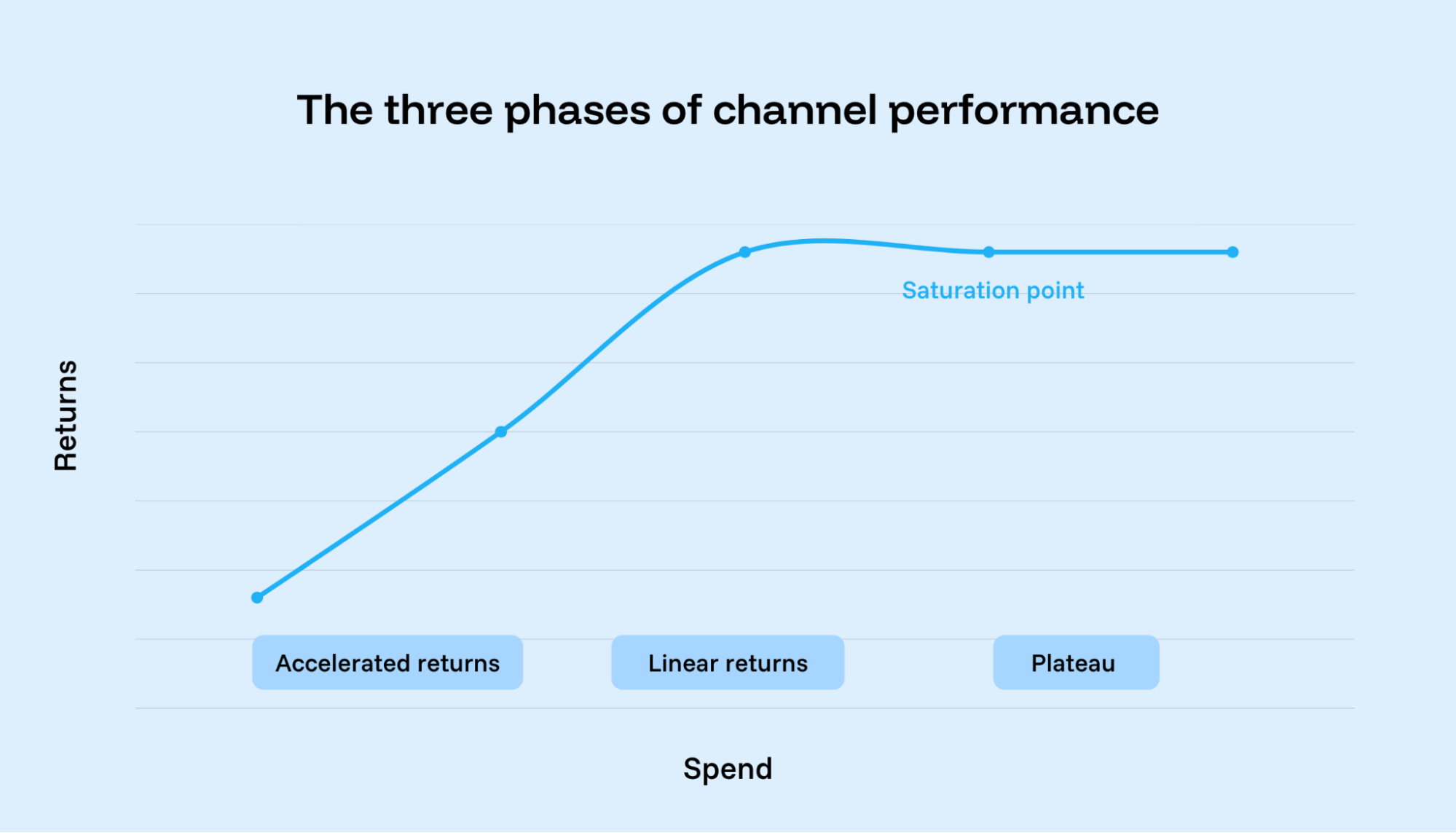
If you were to graph this, you’d see a concave curve. At first, the line climbs aggressively, but as media investment increases, the arc begins to sag until it eventually runs flat.
Channels usually move through three stages on the way there.
The accelerated phase
The initial phase is your honeymoon period, where the new channel feels like magic. Every win is effortless because the audience and creatives are fresh, and the algorithms are busy cherry-picking the low-hanging fruit.
The linear phase
Eventually, your campaign performance settles into a predictable rhythm, and efficiency stabilizes to the point where a 10% spend hike generally nets a 10% bump in results. At this point, you have a pretty good idea about what will happen with every additional dollar spent.
While you may feel safe in this phase, the predictability can lead to unwarranted confidence in your current marketing efforts.
The plateau
But scale has a limit. Eventually, you run out of new people to talk to. Instead of finding fresh prospects, the platform just shows your ads with the same message to the same users over and over. You keep feeding the machine, but the sales numbers don’t budge, so you pay a higher price for the same results.
Digital channels, specifically paid social, hit this wall much faster than traditional media. The audience pool you can reach is smaller, and the auction systems running paid social and paid search are designed to find your best prospects first. So once you've shown ads to those high-intent users, you're left scaling into people who are less likely to convert at a higher cost.
Why marketing saturation is usually discovered too late
So if saturation is well documented, well understood and most marketers have heard the term, why does it keep catching even the most advanced teams off guard?
It isn't down to a lack of judgment. The digital advertising and tracking tools you use every day just aren't built to spot it. Nothing on the average dashboard asks the question that’s important to identify saturation: would those conversions have happened anyway, even if you hadn't run Google Ads?
Attribution won't help you here. It tells you which touchpoint a conversion passed through, which is genuinely useful for plenty of things, just not this one. And nowhere is the gap more obvious than in retargeting.
You'll often see retargeting come back with an 8x or 10x ROAS in your dashboard, and on paper, it looks like the best thing you've got. But think about who you're really paying to reach. Someone who has already added items to their cart or visited your pricing page. They were likely already going to convert without seeing an ad.
Johnson, Lewis and Nubbemeyer analyzed 432 field experiments across the Google Display Network, covering 2.2 billion user observations, and found that users who incrementally drive to a site are noticeably less likely to convert than users who'd visit anyway. A 10% lift in site visits typically translates to only a 5 to 7% lift in conversions. The same study found that nearly a third of campaigns showed negative carryover, meaning the ads weren't generating new sales at all. They were just pulling forward purchases that would have happened anyway. So when your dashboard hands a 10x ROAS to a retargeting campaign, a meaningful share of that "performance" is timing, rather than impact.
Cross-device tracking makes it even worse. Someone clicks a display ad on their phone at lunch, picks it up on their laptop after dinner and converts there. To your attribution data, that's two different people, and the channel looks like it reached twice as many users as it actually did.
What this all adds up to is teams hitting diminishing returns way earlier than they realize. None of this is an argument for ditching attribution, though. It's still great for the everyday stuff like comparing creative, troubleshooting audiences and optimizing pacing. The problem comes when you ask it to do a job it wasn't built for. To spot saturation, you need a tool that can see cause and effect, and marketing attribution can only see correlation. Tools like Google Analytics, with their simplified attribution models, will keep the illusion going long after a channel's stopped pulling its weight.
Pile all of this on top of itself, and you end up with a dashboard that keeps showing green while the underlying economics fall apart. By the time the slow-moving indicators catch up, like customer acquisition cost (CAC) rising, ROAS declining and a reduced pipeline, the advertising spend is already booked, and you've moved from being able to prevent the problem to having to clean it up.
Leading indicators of marketing spend saturation
If you know where to look, saturation actually gives you a fair amount of warning. The signals are in your data long before your total performance drops, but they stay hidden if you only focus on your high-level averages.
To catch it, you have to look at the edges of your spending.
Watch your efficiency signals
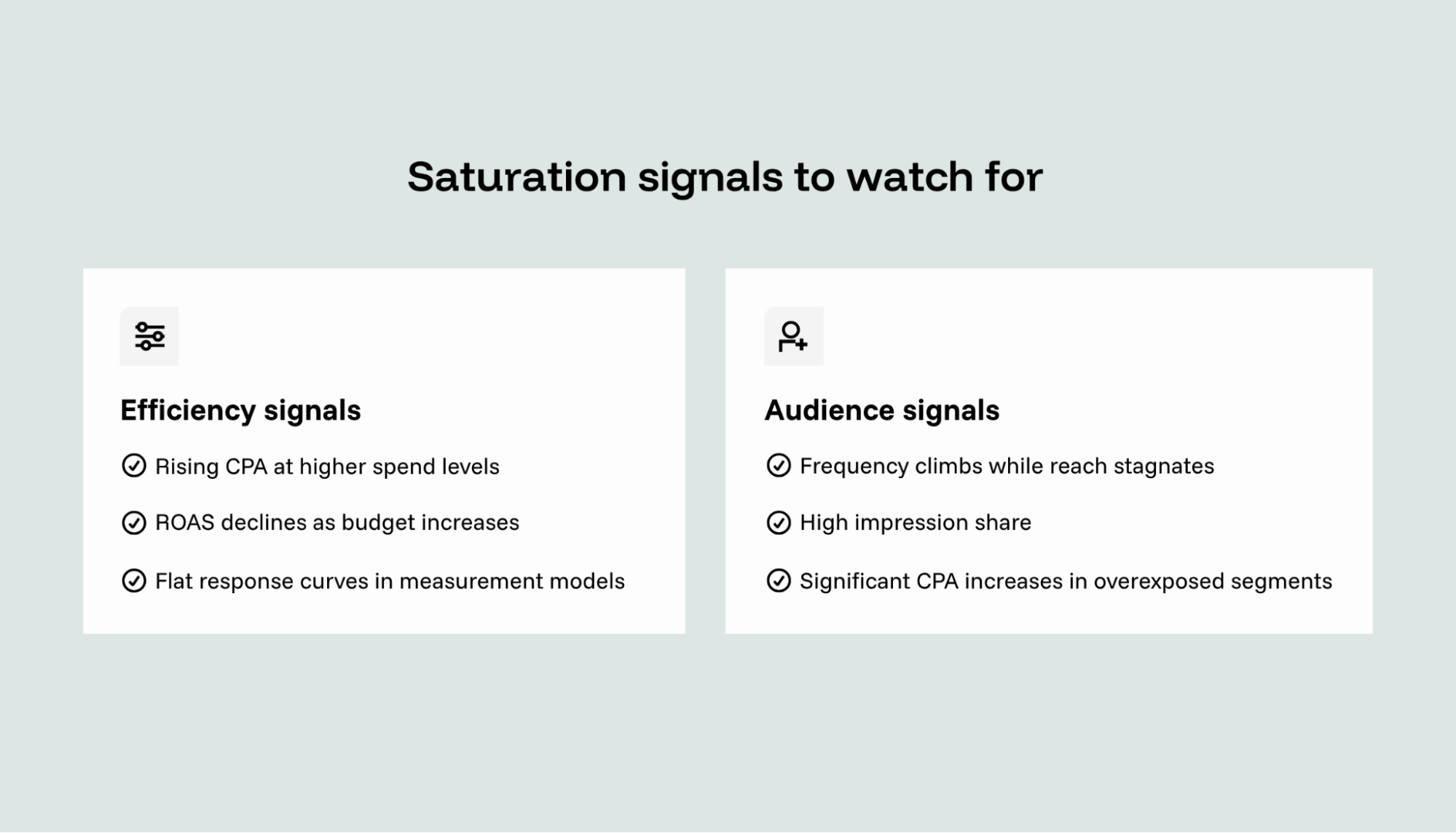
The first place to look is your marginal performance. Average CPA stays healthy because the cheap, early wins subsidize the expensive clicks at the top of your spend. But as you scale, the CPA on those last few thousand dollars will climb before the total average moves.
ROAS works the same way in reverse. Your headline number might look great because the most efficient spend is subsidizing everything else. To see what's really happening at the margin, decile your spend by week or campaign and look at the ROAS of just the top 10%. If that slice is well below your target, or below breakeven, the channel is telling you it can't absorb the budget you're giving it. A flattened response curve in your marketing mix model says the same thing: you're buying more impressions without buying any more sales.
Check your audience signals
The second warning sign is in how the platform delivers your ads. If your frequency is climbing while your reach stays flat, you’ve hit a wall. It means the algorithm has run out of new people to find and has resorted to badgering the same users over and over.
You’ll see the same thing when your impression share hits its ceiling on important keywords or audiences. When a platform has nowhere left to grow, it starts bidding more aggressively just to stay in front of an audience that has already tuned out. This is where ad fatigue sets in, and you’ll see CPAs in these overexposed segments jump by 25-35%.
Catch these signals early, and you've got the green light to stop pouring money into a plateau and move that budget into a channel that still has room to grow.
How measurement methods reveal diminishing returns in marketing
Your dashboards tell you what happened, but these three measurement methods will tell you what it means.
1. Marketing mix modeling (MMM)
Marketing mix modeling (MMM) is not just for legacy brands anymore; about 49% of marketers have adopted it because privacy shifts made user-level tracking so unreliable. Unlike a standard report, a modern MMM build produces saturation curves for every channel. It essentially maps out your spend so you can see if your next dollar is going to drive growth or land in the plateau zone.
2. Incrementality testing
While MMM draws the curve, incrementality tests are your reality check. You’re essentially playing devil’s advocate here. To run a test, you need to hold back a slice of the audience and keep the ads running for everyone else. If your holdout group converts just as well as the people you’re paying to reach, the channel has hit a saturation point.
3. Triangulation
But none of these tools is the silver bullet for data-driven decision making:
- Marketing mix modeling sees the strategy but misses the tactical nuances.
- Attribution sees the tactics but often hallucinates the cause.
- Incrementality nails the cause but only provides a "snapshot" in time.
For organizations building toward this approach, our guide to unified marketing measurement walks through how to start advanced measurement.
Rethinking budget allocation once it's clear additional investment doesn't make sense
Detecting the tipping point is only half the battle in making informed decisions about resource allocation; the real work lies in what you do next. It helps to remember that saturation is a signal, not a failure. Your goal shouldn't be to avoid it at all costs, but rather to spot it early enough to move your marketing budget and avoid wasting resources. If a saturated channel is only returning 0.5 on the margin but another is giving you 2.5, you need to reallocate. Keep moving money until the marginal returns even out; that’s how you know your media mix is optimized.
But before you abandon a channel entirely, test if there are still pockets of efficiency. New audiences, fresh creatives or different campaign structures can sometimes unlock a second wave of accelerated returns within the same channel. Saturation at the channel level doesn't always mean saturation at every segment within it.
Build flexibility into your marketing spend to maximize ROI:
- Set monthly or bi-weekly reallocation checks.
- Define threshold rules that trigger reallocation. When the marginal efficiency falls below a target, the budget is adjusted.
- Reserve 5% to 10% for testing new channels; this is how you find the next channel worth scaling before competitors do.
The change in mindset and culture is just as important as your marketing strategy, so don't think of diminishing returns as something to fix. Treat them as a sign that it's time to innovate. That might mean reallocating budget across channels, developing fresh creative or exploring new channels altogether.
A channel hitting saturation is just a sign that it did its job well
You found the audience, converted them, scaled up and then kept going. But a lot of teams don't notice when they've hit the ceiling because their dashboards report averages and attribution takes credit for conversions that would've happened anyway, causing a blind spot. And the only way to see past it is measurement that separates correlation from cause.
Marketing teams that build and interpret measurement systems can identify diminishing returns early by combining MMM, incrementality tests and multi-touch attribution. You can reallocate marketing investments before waste accumulates and find the next channel to scale, while your competitors are busy doubling down on yesterday’s winners.