



 Get in touch
 Log in




Which campaigns are actually driving growth, and which are just noise?
As a marketer, you’ve probably run into a similar problem: dashboards don’t match, reports conflict and multiple channels seem to claim credit for the same conversion.
Despite having more data, tools and technology than ever before, marketing teams still struggle to turn marketing efforts into clear, actionable insights. According to Funnel’s 2026 Marketing Intelligence Report, 72% of in-house marketers say they have plenty of data, but using it to make confident decisions remains a challenge.
In other words, there’s plenty of information, but most marketers aren’t successful at making sense of it. Without a unified measurement approach, teams end up optimizing the wrong channels, chasing misleading marketing metrics and defending results they don’t fully trust.
This guide shows how to fix that by connecting the dots across attribution, incrementality and marketing mix modeling. We’ll show you how to build a marketing measurement framework that’s reliable, easy to digest and helps turn messy data into insights you can trust.
Marketing measurement: more than just tracking performance
Marketing measurement is often confused with performance tracking, but the two aren’t the same. And that confusion is where many problems start. Tracking clicks, impressions and conversions tells you what happened. It doesn’t tell you why it happened or whether your marketing strategies caused the result.
Successful marketing measurement goes deeper. It connects marketing efforts to business outcomes like revenue, pipeline and customer acquisition cost. It’s the key to understanding what’s really improving your marketing effectiveness.
That distinction matters because most teams never get there.
Our research shows that more than two in five marketers are simply documenting performance without analyzing why their marketing efforts worked or what to do next. They’re reporting on marketing, not measuring it.
And when measurement stops at reporting, decision-making breaks down:
- Budgets get allocated based on incomplete data
- Channels get over- or under-valued
- Teams optimize for visibility, not impact
This is why modern marketing measurement isn’t about a single dashboard or tool. It’s about building a system that can answer the questions that matter:
- Which channels are moving the needle?
- Which marketing campaigns influence revenue, not just conversions?
- Where should we invest more, and where should we pull back?
- What should we do next?
To answer those questions, you need more than one method. You need multiple perspectives working together.
Measurement vs. reporting vs. analytics: what's the difference?
Most teams think they’re measuring marketing when, in reality, they’re pulling platform reports, flagging last week's performance spike in a Slack message and calling it a day.
That's not a criticism. It's just what happens when there's no clear distinction between three things that get lumped together: reporting, analytics and measurement.
When those are blurred together, you risk making decisions on incomplete logic. That’s why knowing the difference is so important.
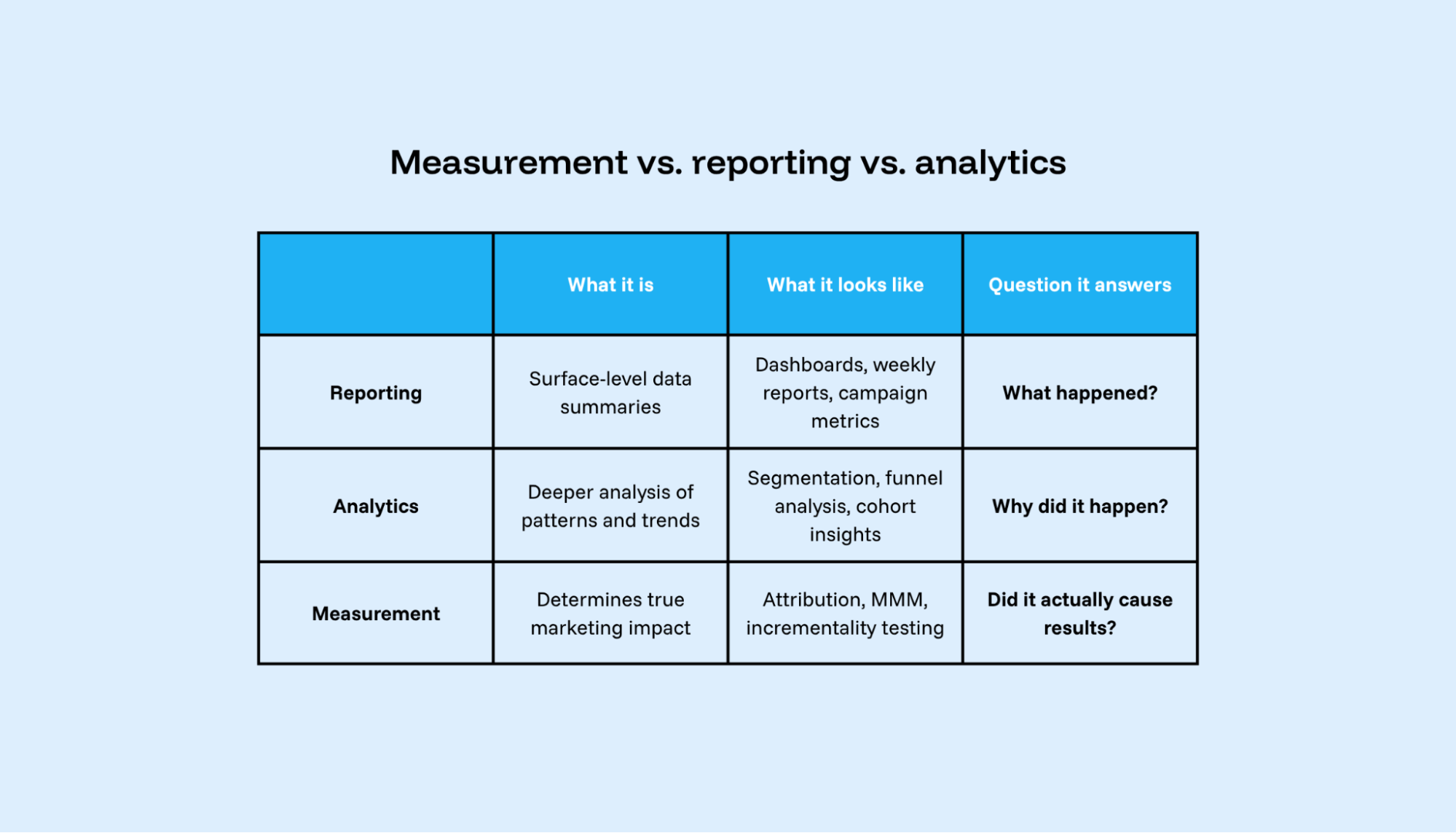
Reporting: What happened?
Reporting is the surface layer. It’s your dashboards, weekly updates and campaign summaries. It tells you what happened with marketing metrics like clicks, conversions, spend and ROAS.
Reporting is necessary. But on its own, it’s incomplete.
Reporting’s shortcoming is that it creates the illusion of clarity. Numbers look precise, charts look clean and everything feels measurable. But without context, those numbers don’t tell you what’s moving budget efficiently across channels. This is why so many teams end up chasing vanity metrics or over-optimizing channels that simply look good on paper.
Analytics: Why did it happen?
Analytics moves beyond surface-level reporting. It’s a deeper analysis of patterns and trends.
This is where teams start digging into the data by breaking down performance by target audience, channel, funnel stage or time period to understand what’s driving changes.
That might mean mapping where users drop off across the journey (often through funnel analysis) or looking at how different groups behave over time (through cohort analysis).
Analytics helps you answer questions that explain performance:
- Why did conversions spike last week?
- Why is one channel outperforming another?
- Where are users dropping off in the funnel?
- Are newer users behaving differently from earlier ones?
For example, you might notice that users acquired through one channel convert quickly but drop off after the first interaction. Then, users acquired through another channel convert more slowly but show stronger retention over time. Those patterns only emerge when you move beyond surface-level reporting and look at behavior across the journey.
But even here, there’s a limit. Marketing analytics shows relationships, not proof. Just because two things move together doesn’t mean one caused the other.
Measurement: Did marketing cause the result?
Measurement asks the difficult questions, like:
Did this activity actually drive incremental results, or would those conversions have happened anyway?
This incremental lift is the difference between performance and revenue impact.
For example, your paid social campaign shows strong conversions in-platform. Reporting says it’s a top performer. Analytics shows certain audiences and creatives are driving results.
But marketing measurement challenges these findings.
- Are those conversions new, or were those users already going to convert?
- Is paid social generating demand or just capturing it?
- What happens if you turn the campaign off?
Without answering those questions, it’s easy to overvalue channels that sit close to the conversion and undervalue the ones that influence it earlier in the journey. Some brands discover that channels they assumed were driving conversions were benefiting from demand created elsewhere. This only becomes visible once they move beyond surface-level reporting and start measuring true impact.
This is how marketing budget misallocation happens. Your team decides to scale what looks efficient and cut what looks weak. And over time, performance stalls.
Marketing measurement is what corrects that. When done right, it doesn’t just show you what performed. It shows you what’s driving conversions, generating demand and influencing revenue.
And in today’s world, that means using marketing measurement frameworks designed to isolate impact. Attribution, incrementality testing and marketing mix modeling (MMM) each look at performance from a different angle. Collectively, these methods are what turn marketing data into decision-making confidence.
Attribution: understanding the customer journey
Attribution is where most marketing teams start. It tracks how users interact with your brand across marketing channels and assigns credit to the touchpoints that drive conversions.
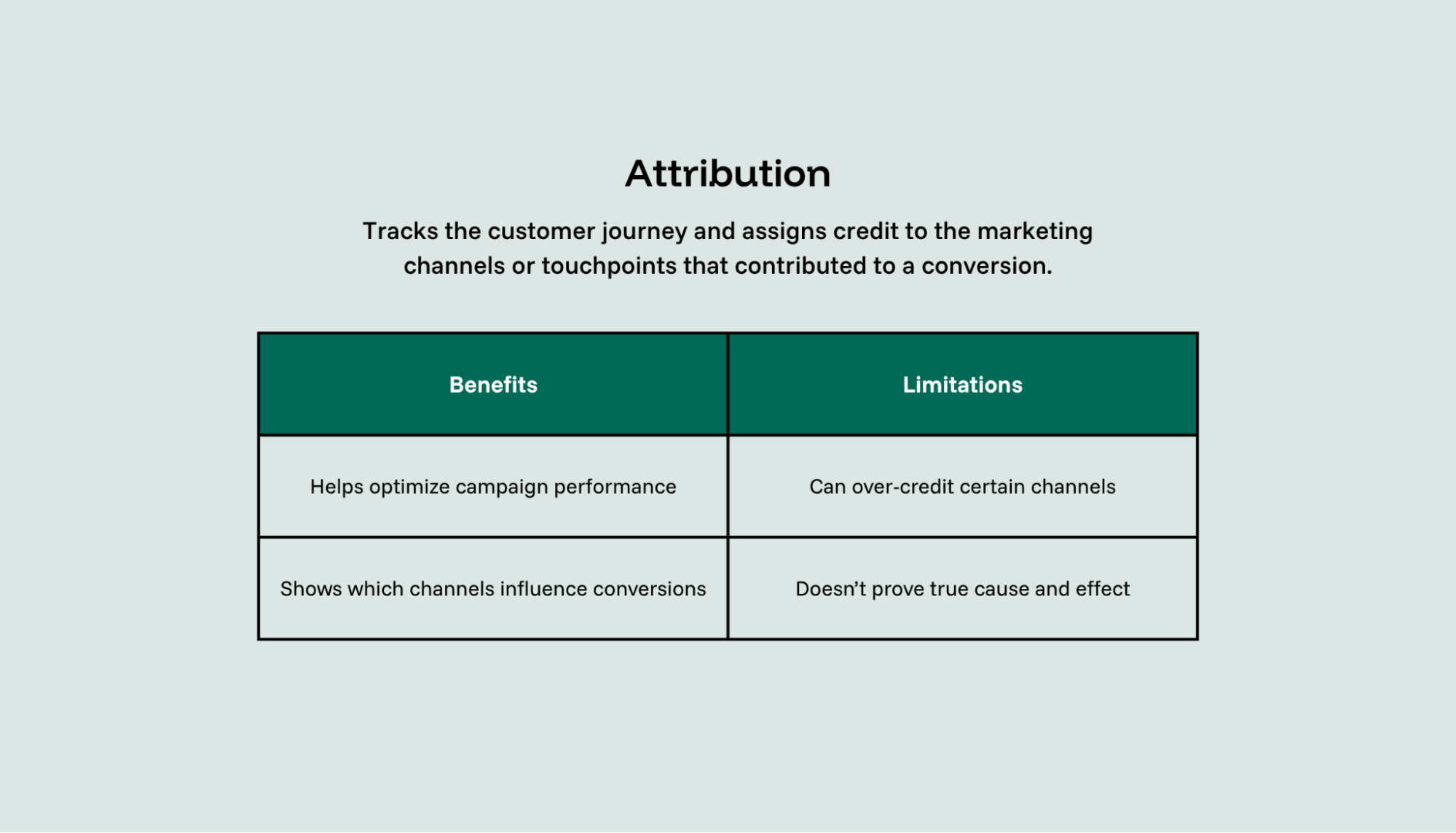
This involves mapping user journeys. For example, a user sees a paid social ad. They later search your brand on Google, click a paid search ad and convert.
Marketing attribution models help you connect the dots and understand how different channels appear along the path to conversion.
Typical touchpoints include:
- Paid search
- Social ads
- Email campaigns
- Organic traffic
Learning about the impact of multiple touchpoints is what makes attribution so valuable. It gives you visibility into the customer journey, not just the final click.
Where attribution works well
Attribution is particularly useful for campaign-level decisions.
It helps answer questions like:
- Which channels are assisting conversions?
- Which campaigns are consistently appearing before a sale?
- Where should we shift budget in the short term?
For example, you might notice that paid social rarely drives the final conversion but often occurs early in the journey. This suggests it plays more of an awareness role than a closing one.
That kind of insight is hard to get from reporting alone.
Where attribution falls short
The challenge is that attribution tools don’t measure impact. They measure participation.
Just because a channel appears in the journey doesn’t mean it caused the conversion. And depending on the model you use, you can get completely different answers. Most multi-touch attribution models (especially last-click) tend to over-credit channels closest to the conversion while underestimating the influence of earlier touchpoints.
NXTRND, a football equipment brand that sells through Shopify and Amazon, discovered how misleading channel attribution can be when conversions happen outside the platform being measured.
Their Meta campaigns appeared less efficient because performance was being evaluated against direct website sales. But customers who first discovered the brand on Meta often went on to purchase through Amazon, creating a blind spot in the reporting.
When NXTRND ran holdout tests, the picture changed completely. The tests showed that Meta was responsible for 20% of total company revenue, including sales that attribution wasn't capturing. They also uncovered wasted Amazon ad spend that was largely cannibalizing organic sales.
What looked inefficient in attribution data turned out to be one of the company's most important growth drivers.
NXTRND's experience shows what can happen when attribution only captures part of the journey:
- Lower-funnel channels look more efficient than they really are.
- Upper-funnel channels look less valuable than they actually are.
At the same time, attribution depends heavily on trackable user-level data, which is becoming harder to rely on as privacy restrictions increase. With the decline of third-party cookies and stricter data regulations, marketers have less visibility into individual user journeys.
That makes it even harder to accurately track touchpoints across channels and even easier for attribution models to miss or misrepresent what’s actually happening.
Incrementality: measuring true marketing impact
While attribution tells you which channels came before the conversion, incrementality asks whether removing any of them would have changed the outcome. It's essentially a causality tool. Incrementality testing uses experiments to determine whether your marketing created new demand or simply captured existing demand.
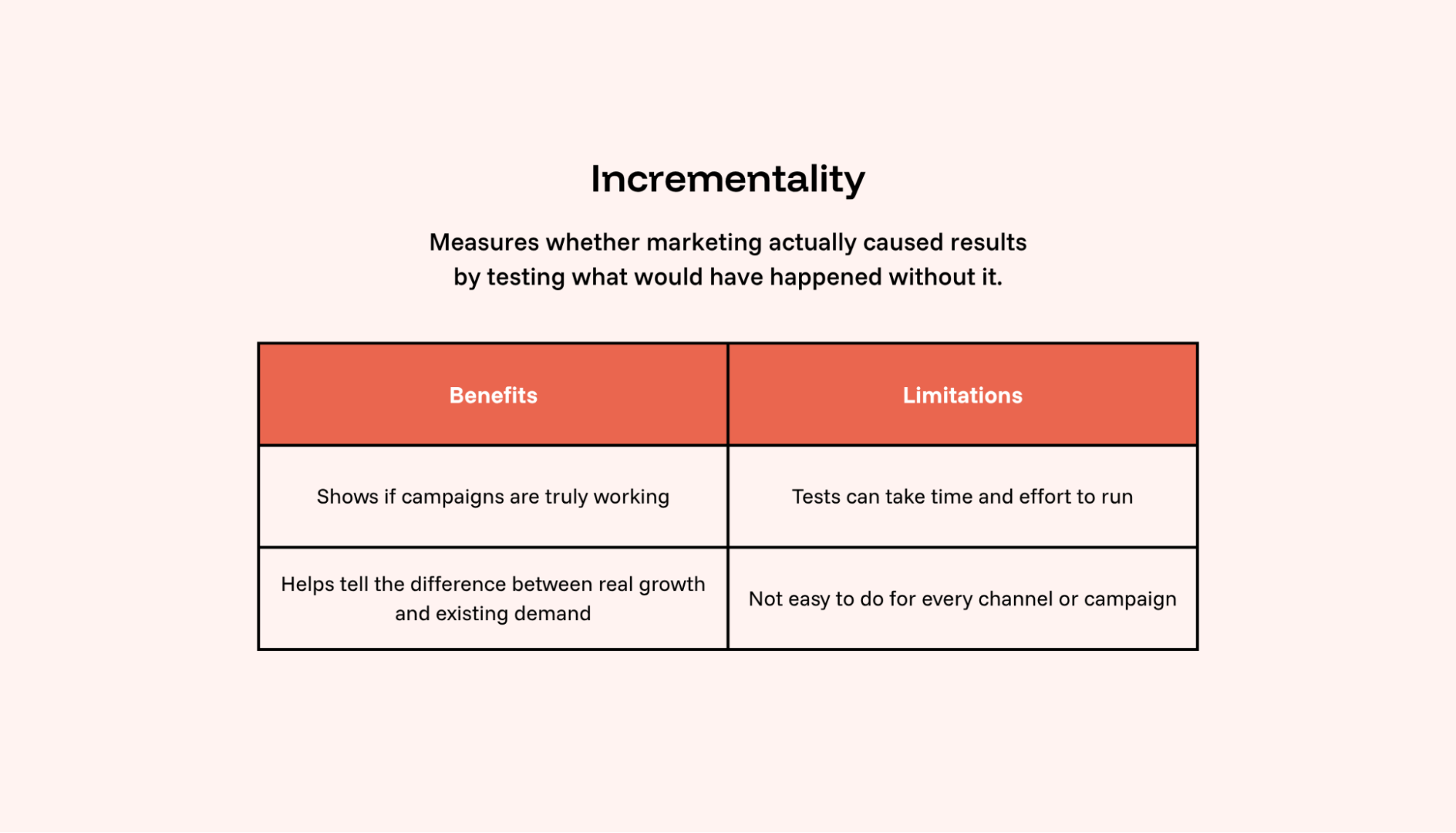
Instead of relying on reported conversions, it tests what happens when something changes. This usually involves setting up controlled experiments, such as:
- Running geo-holdout tests where one region sees a campaign and another doesn’t
- A/B testing different target audiences, creatives or channels
- Pausing a channel entirely to see what happens to conversions
This matters more than most teams realize. Only a small portion of advertising spend is actually effective, meaning a large share of the budget can go toward campaigns that look profitable but aren’t driving real growth. Incrementality is designed to cut through that because they focus on marginal lift.
Let’s say you pause paid social in one market while keeping it active in another. If conversions drop in the paused region, you have a clearer signal that the campaign was driving incremental value, not just appearing in the journey.
Attribution might show that paid social was involved. Incrementality shows whether it actually made a difference.
Where incrementality works well
Measuring advertising incrementality is one of the most reliable ways to validate marketing performance.
It helps answer questions like:
- Is this campaign generating new demand or just capturing it?
- What’s the true lift from this channel?
- If we stop spending here, what actually happens?
This is especially valuable when performance looks strong on paper, but something feels off.
For example, Uber ran incrementality tests on its performance marketing and discovered that a major paid channel was delivering almost no incremental value. Reporting made it look like it was driving growth. In reality, those conversions would have happened anyway.
Without testing, that spending would have continued.
Where incrementality falls short
The challenge is that incrementality is harder to scale than other measurement methods.
Running controlled tests takes time, budget and coordination. You need enough data for results to be reliable, and not every channel can be tested cleanly.
It also answers very specific questions rather than broad ones. You might understand the impact of one campaign or one channel in a given market, but that doesn’t automatically give you a full picture across your entire marketing mix. That’s why it’s useful to combine incrementality tests and attribution with MMM so you get a top-down view of channel performance.
Marketing mix modeling: the big-picture view
Marketing mix modeling shows you how different marketing activities contribute to business outcomes over time. Instead of tracking individual users, it uses aggregated data and statistical modeling to measure how channels influence outcomes such as revenue, pipeline and sales.
Understanding the difference between MMM and attribution is key to knowing which questions each one can answer and when they work better together. Marketing mix modeling doesn’t rely on user-level tracking. Instead, it looks at patterns across time.
.png?width=1999&height=1143&name=Marketing%20mix%20modeling%20(MMM).png)
Marketing mix modeling typically incorporates factors like:
- Seasonality
- Economic conditions
- Pricing and promotions
- Brand and upper-funnel campaigns
By factoring these in, MMM helps separate what’s driven by marketing from what’s driven by external forces.
Where MMM works well
This measurement method is best suited for strategic marketing decision-making.
It helps answer questions like:
- How much should we invest in each channel?
- Which channels are driving long-term growth?
- What happens if we increase or decrease spending in certain areas?
One example is Tallink Silja Line, a Baltic Sea travel operator, which struggled with attribution data that favored lower-funnel channels. After adopting MMM, their team was better able to see how different channels contributed to business outcomes.
Using those insights to guide budget decisions, the company improved return on ad spend by 50% within six months. Those insights ultimately became an input into annual planning, helping shape long-term budget decisions rather than just short-term channel adjustments.
That’s the kind of decision-making MMM enables. Not just optimizing campaigns, but reshaping how your marketing budget is allocated for growth.
Where MMM falls short
The trade-off is that MMM isn't built for tactical decisions. Marketing mix modeling analysis doesn’t tell you which campaign to tweak tomorrow or which creative to pause. Instead, it works at a higher level, like looking at trends over weeks, months or longer.
It also requires strong data foundations.
Marketing mix modeling relies on consistent, high-quality data over time. In many cases, models are built using multiple years of historical data to produce reliable results. Without that data, outputs can be misleading or overly simplified.
Unified marketing measurement: the power of combining methods
Marketing doesn’t happen in one place, and it doesn’t behave in one way. It plays out across channels, over time and under the influence of factors you can’t always see or control. Trying to explain all of that with a single measurement approach will always leave gaps.
Rely too heavily on attribution, and you risk overvaluing the channels that sit closest to the conversion while missing everything that builds demand earlier on.
Focus only on incrementality, and you get clean answers, but only in isolated pockets where you’ve been able to run tests.
Lean on MMM alone and you understand the bigger picture, but lose the ability to act quickly at a campaign level.
Individually, each method fulfills its intended purpose. But none of them promise to give you the full picture alone. They’re more powerful when used together. That’s why modern marketing measurement is moving toward a more holistic approach.
Imagine you’re running marketing campaigns across TikTok, Meta, Google Search, YouTube and podcasts. You’re investing across the funnel, trying to drive both immediate conversions and long-term growth. The question isn’t just what performed. It’s how to understand the true impact of each channel and determine what to do next.
- Attribution might show that users often discover your brand on TikTok, come back later through Google and convert via paid search. That’s useful. It helps you understand the journey and optimize campaigns. But it won’t fully capture the impact of channels that are harder to track, like podcasts or YouTube viewed on TV.
- Incrementality testing gives you a clearer signal. By pausing campaigns in certain regions or audiences, you can see whether those conversions would have happened anyway. That helps you validate impact. But you can’t run those tests everywhere, all the time, so you’re still only seeing part of the picture.
- Marketing mix modeling fills in another layer. By analyzing data over time and factoring in things like seasonality, pricing and market conditions, it can show how different channels contribute to revenue overall. It might reveal that YouTube and podcasts are driving demand that shows up later in search, even if they don’t appear in attribution data. That’s critical for planning budgets. But it won’t tell you what to tweak tomorrow.
Each method gives you a different lens on the same system.
This is where triangulation comes in.
Triangulation: why three beats one
Triangulation isn’t about choosing the “best” method. It’s about combining them to get closer to the truth.
When you look at performance through multiple lenses, you can start to cross-check what you’re seeing. If attribution shows a channel is involved, incrementality can test whether it’s actually driving results and MMM can confirm whether that impact holds over time. That’s how you reduce guesswork and move toward data-driven decision-making.
It also helps guard against overconfidence, since every method has blind spots. Attribution struggles with untrackable channels and privacy limitations. Experiments can’t cover every scenario. Marketing mix modeling works at a higher level and depends on historical data. When you rely on just one, you’re exposed to its weaknesses.
When you combine them, those weaknesses start to cancel each other out.
What you end up with is a more complete view of your marketing. Not fragmented insights from different tools, but a connected understanding of how channels interact, where demand is created and how it turns into revenue.
Of course, none of this works if your data is still fragmented.
To make this kind of system possible, you need a way to bring all your data together, standardize it and make it usable across different types of analysis. Marketing intelligence platforms act as a central layer that automates data collection, cleans and normalizes your data and makes it ready for deeper analysis, advanced measurement and agentic AI.
With data integration, marketing measurement stops being a collection of disconnected reports and starts becoming a system. And that’s really the shift. Not ‘better’ dashboards, not more tools. Rather, it’s a more complete way of understanding which marketing efforts are actually driving growth. The goal isn’t to find a single answer, but to see the full picture.
How you should be measuring marketing
Your team should use measurement to orchestrate marketing, not just report it. When done right, it informs creative decisions, validates budgets and creates a feedback loop that drives long-term marketing success.
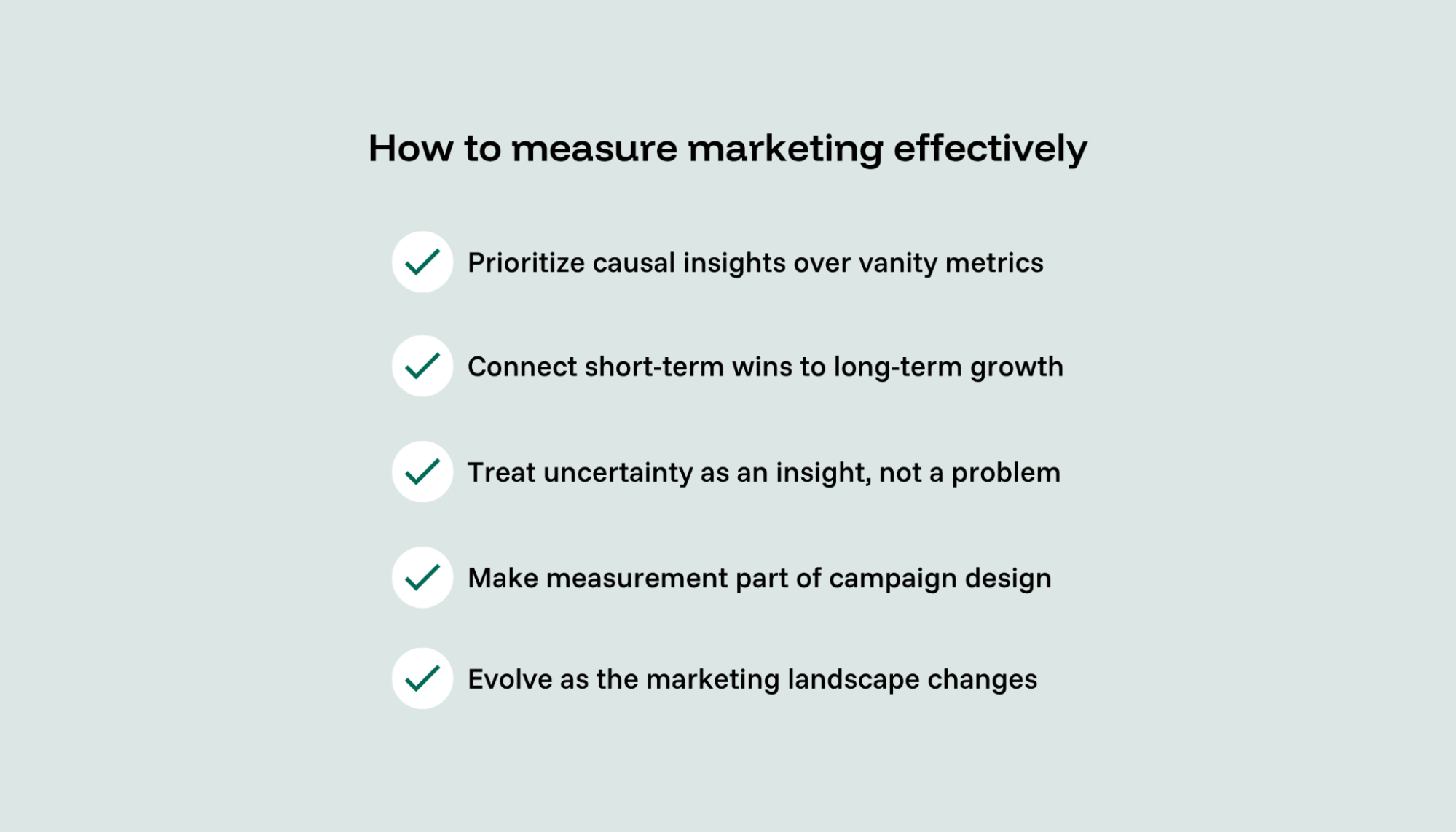
Prioritize causal insights over vanity metrics
Clicks, impressions and platform-reported conversions show activity. What matters is understanding whether your marketing is creating new demand. Focusing on causal impact helps you invest in what actually contributes to growth.
Connect short-term wins to long-term growth
Day-to-day performance still matters, but it needs context. Attribution helps you optimize campaigns in the moment, while MMM shows how those efforts contribute to revenue over time. Linking the two creates a clearer picture of how short-term actions build long-term results.
Treat uncertainty as an insight, not a problem
Marketing measurement won’t always give you one clear answer. Differences between models or unclear results are often the most useful signals. They highlight where further testing can help you understand what’s really happening.
Automate data flows so humans focus on insights
A lot of effort still goes into collecting and preparing data. Automating those steps makes it easier to keep data consistent and up to date. It also gives teams more time to interpret results and take action.
Make marketing measurement part of campaign design
Measurement is most effective when it’s built in from the start. Setting up tracking, defining success metrics and planning experiments early makes it much easier to understand impact once campaigns are live.
Evolve as the marketing landscape changes
Privacy shifts, platform updates and changing customer behavior continue to affect how marketing is measured. Combining different approaches and adapting over time helps maintain a reliable view of performance.
Why measurement often fails (and how to fix it)
Sharing marketing measurement results should be simple. But when data is spread across platforms and defined in different ways, it rarely is. Without an effective marketing measurement strategy, teams end up working from multiple versions of the truth. One report shows growth, another shows decline and neither fully explains what’s going on.
Fragmented data
Most marketing teams are working from siloed data. Paid media sits in ad platforms, revenue in a CRM and offline activity is tracked somewhere else entirely.
Each source tells part of the story, but none of them shows the full picture. Attribution might point in one direction, MMM in another and neither fully lines up. Bringing that data together with unified marketing measurement changes everything. When data is integrated, standardized and consistently updated, teams can work from a shared view instead of trying to reconcile conflicting numbers.
This is where having a unified, governed data layer starts to make a real difference.
By centralizing their marketing data, brands like Sephora reduced data processing costs by 75% and gave teams across 35 markets access to the same trusted view. It’s a clear example of what happens when teams stop working from fragmented data and start working from one source of truth.
Over-reliance on one method
It’s tempting for teams to lean heavily on a single measurement approach. For many teams, that’s attribution. It’s accessible, it’s familiar and it gives clear answers.
Marketing mix modeling takes more effort to run. So when time and resources are tight, teams tend to put it on the back burner. A more reliable approach combines them. Looking at marketing performance through multiple lenses helps build a more balanced understanding of what’s happening and gives you more confidence in your marketing decisions.
Lack of context or baseline understanding
External factors don't care about your campaign schedule.
Seasonality, pricing changes, product launches and broader market conditions all influence results. Without accounting for these factors, campaigns can appear stronger or weaker than they really are. That’s where context matters.
When baseline factors and external influences are built into your measurement, results become easier to interpret. Marketing mix modeling plays a key role here, but the real value comes from making that context visible across your entire measurement system.
Insights don’t drive action
Even when teams have the right data, it doesn’t always lead to decisions.
Your team reviews reports and updates dashboards, but campaigns keep running as they are. Marketing measurement becomes something that explains performance after the fact, rather than something that actively shapes it.
The teams that get the most value from measurement close that loop. Insights don’t sit in reports. They feed directly into how campaigns are run, influencing budgets, creative and targeting. Marketing and data teams can focus on improving strategy and innovating rather than wrestling with numbers and trying to make reports make sense. They can pivot faster and experiment with confidence, knowing they have a framework in place to guide them.
Measurement systems aren’t future-proof
The way marketing is measured is constantly evolving. Privacy restrictions limit tracking, platforms change how data is reported and customer behavior continues to shift.
Systems that rely too heavily on one type of data or one method can quickly become unreliable. What holds up better is a flexible system designed for change.
Combining aggregated and user-level data, using server-side tracking and layering in approaches like MMM makes it possible to maintain visibility even as tracking becomes more limited. The result is a marketing measurement setup that adapts as platforms and privacy standards evolve.
Stop guessing, start knowing
Attribution, incrementality and MMM are only as useful as the data behind them. When that data is fragmented, each method produces a different version of the truth. When it’s unified, those marketing measurement frameworks start to align.
A marketing intelligence platform makes this possible by creating a single source of truth for marketing data and enabling different measurement methods to work together within it. With reliable data pipelines, automated transformation and integrated analysis, teams can validate performance across multiple lenses instead of relying on a single perspective.
That’s what turns marketing measurement into something that supports growth, where decisions are backed by aligned insights, not competing reports.