






Every Monday, someone on your team logs into Google Ads, Meta and LinkedIn, pulls the data into a spreadsheet and finds out that the numbers don’t match. To replace that manual work, marketing teams choose one of four types of software: lightweight data connectors (Supermetrics, Windsor.ai), agency reporting tools (AgencyAnalytics, Whatagraph), general data pipelines (Fivetran, Airbyte) or enterprise marketing intelligence platforms (Adverity, Improvado).
Each tool fixes a different problem. But most stop at moving or displaying data. Funnel is a marketing data hub: it collects, stores, prepares and makes marketing data available to every report, model, workflow and tool that depends on it. You get one trusted foundation, instead of a different data setup for every use case.
You’re probably here comparing Funnel alternatives because of one of these situations: you need a marketing data tool for the first time. Your contract is up for renewal, and you want to know if the cost still makes sense. Or Funnel is on your shortlist, and you want to back up your choice.
Whichever describes you, the right alternative depends on the tool category, because categories solve different problems at different price points and team sizes.
In this article, you’ll learn what each Funnel.io alternative does well, the shortfalls and why teams with many platforms and complex marketing data choose Funnel. If an alternative fits your use case better, we’ll say so.
What’s a marketing data hub and why is it important?
Marketing data has more jobs than it used to. The data that fills your Monday dashboard now trains a marketing mix model, feeds conversion signals back to ad platforms and grounds the AI tools your team is starting to use. Every one of those jobs depends on data that's consistent and complete.
But consistency is harder to come by than it sounds. According to MarTech's 2025 State of Your Stack survey, 62.1% of marketers use more martech tools than they did two years ago. Nielsen's Annual Marketing Report found that 69% of marketers say digital media and audience fragmentation make it hard to reach their audiences. More tools mean more disconnected data.
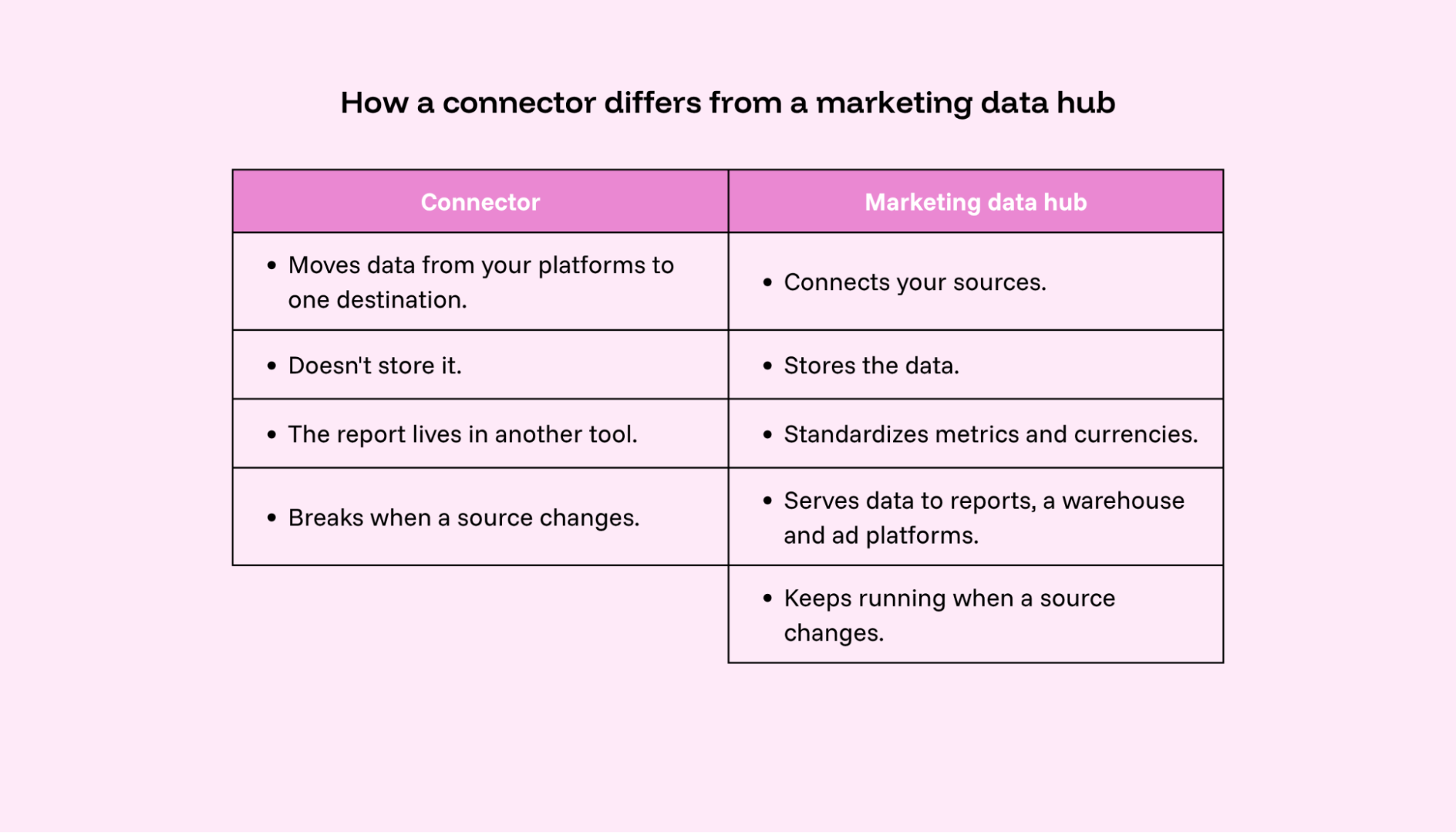
A data connector solves part of the problem. It moves data from point A to point B, but it leaves the information unstructured and unprepared, forcing your internal team to perform manual cleanup.
Funnel is a marketing data hub that manages the whole pipeline with:
Managed data connections
When an ad platform changes its API, the hub updates the connector, which prevents your reports from breaking.
Data governance
Every day's source-level data is stored from the moment you go live, so if an API breaks or you switch BI tools, the historical record is still there.
Non-destructive transformation
Rules are applied on top of the raw data, so if you change a channel group or a definition, it applies across your full history.
One foundation, many outputs
Your dashboards, measurement models and warehouse all read the same numbers, so a metric means the same thing in every tool that uses it.
The different types of Funnel alternatives and what each is best for
The data integration market is split into five categories; here’s a breakdown with brand examples of each.
|
Category |
Example tools |
Best for |
Limitations |
Pricing model type |
|
Marketing data hub |
Funnel |
Teams with 5+ marketing channels that need one governed source feeding reports, measurement and a warehouse |
Higher entry point than a single-purpose connector |
Subscription scaled to usage |
|
Lightweight connectors and pipes |
Supermetrics, Windsor.ai, PorterMetrics |
Small teams moving data into Google Sheets, BI tool or warehouse |
No native storage, history lost when a source breaks |
Scaled to connectors and destinations |
|
Agency reporting tools |
AgencyAnalytics, Whatagraph, DashThis |
Agencies producing branded client reports |
A reporting layer, shallow blending |
Per dashboard, client or data source |
|
General data pipelines |
Fivetran, Airbyte |
Data engineers loading many sources into a warehouse |
No marketing normalization, technical to run |
Consumption-based, or open-source self-hosted |
|
Enterprise marketing intelligence |
Adverity, Improvado |
Large enterprises with a budget for a managed setup |
Heavy implementation, often paired with a separate BI tool |
Enterprise contract, demo required |
Lightweight data source connectors and pipes
Best fit: Small teams with a few marketing channels that require raw data transport rather than active management.
Supermetrics, Windsor.ai and PorterMetrics extract your data from ad platforms and transfer it into spreadsheets, BI tools or cloud data warehouses. There’s minimal system setup required, and the low entry price makes software utilities in this category a common first purchase for growing marketing departments. Supermetrics operates over 100 connectors to your chosen destination, while Windsor.ai has more than 350 sources.
However, basic data pipelines lack persistence because these tools don’t store your information; an API failure or a sudden change in internal reporting requirements can corrupt or destroy your historical records. Additionally, because a connector only executes data delivery, your team must still build, clean and blend datasets within a separate destination tool. Pricing models typically scale based on the total number of active connectors and destination endpoints you use.
Agency reporting tools
Best fit: Agencies that need templated, client-facing dashboards where presentation is more important than deep data analysis.
These platforms exist to make your client calls easier, and their entire value sits in the presentation layer: think white-label client portals, automated PDF distribution and good-looking dashboards. Though some extend beyond that, for example, AgencyAnalytics bundles built-in SEO features like rank tracking and site audits. Whatagraph focuses on visual layouts and has added a data storage option with exports to Google BigQuery and no-code data transformations.
Everything in these tools points to one output: the report. The data they store exists to render their own dashboards, so it can't easily feed BI and analytics tools. Say a client asks for marketing mix modeling next year, or your ops team wants campaign data in Snowflake next to revenue. The reporting tool can't serve either because the data lives within a product built to display it. You'd export what you can, usually to a single destination, and rebuild the rest manually.
General data pipelines (ETL and ELT)
Best for: Data engineering teams that load raw data into a warehouse and want full control of the transformation.
Fivetran and Airbyte move large volumes of data into cloud warehouses, and reliability at scale is their core strength. Fivetran is fully managed and warehouse-first, with 700+ connectors. Airbyte is the open-source alternative, with 600+ pre-built connectors you can run self-hosted or in the cloud to avoid vendor lock-in.
ETL pipelines deliver the data as each platform sends it. For example, Meta formats spend one way, Google another and each platform has a different definition of what they classify as a conversion. The knock-on effect is that your team has to write and maintain the models that reconcile all of it before a marketer can read a report. For a data team, control is an advantage, but for a marketing team without an engineer, the data reaches the warehouse and stops there, reducing autonomy to self-serve.
Enterprise marketing intelligence platforms
Best for: Enterprises that prefer a managed, services-led rollout.
Marketing intelligence platforms like Adverity and Improvado serve enterprises with services-led deployments built for heavy transformation and governance. Many teams also pair the platform with a separate BI tool for the reporting itself. Adverity offers 600+ native connectors with AI-driven data harmonization. Improvado offers 500+ connectors, with professional services included, so your onboarding is handled by a dedicated customer success manager.
A services-led rollout means the vendor's team configures the platform around your business. A high connector count is important in this instance because it dictates your setup speed; if your channels aren't native, you’ll lose time waiting for the vendor to code custom integrations from scratch. Once it's live, the setup typically lies with the one person who learned it during implementation. The problem is that if that person leaves, the configuration keeps running, but nobody in-house knows how to change it, leaving you with only the vendor as a fallback.
Why teams with complex marketing data choose Funnel
Subscription prices are deceptive. The real cost of a data tool is felt later in manual maintenance, broken reports and the high friction of switching.
A connector forgets, a hub remembers
As soon as you connect your marketing data hub, the historical data gets stored. It’s there whether you need it for a dashboard, a measurement model or a leadership conversation.
The real audience for marketing data is rarely just the marketing team; it’s your CFO asking why spend went up last quarter. When the data is governed and consistent, those conversations change.
Leah Spalding, Senior Manager of Digital Marketing at Anthropologie, explained the positive impact of using Funnel’s Data Hub: "The trust our finance team has in the marketing team has grown exponentially. Because we can answer their questions in real time and provide full visibility into our spending, they have given us more dollars to grow the business."
Credibility like that is what gets marketing budgets protected.
It’s expensive to start cheap
Teams buy tools they don't keep. Only 56.4% of purchased martech tools are actually used, according to The CMO Survey.
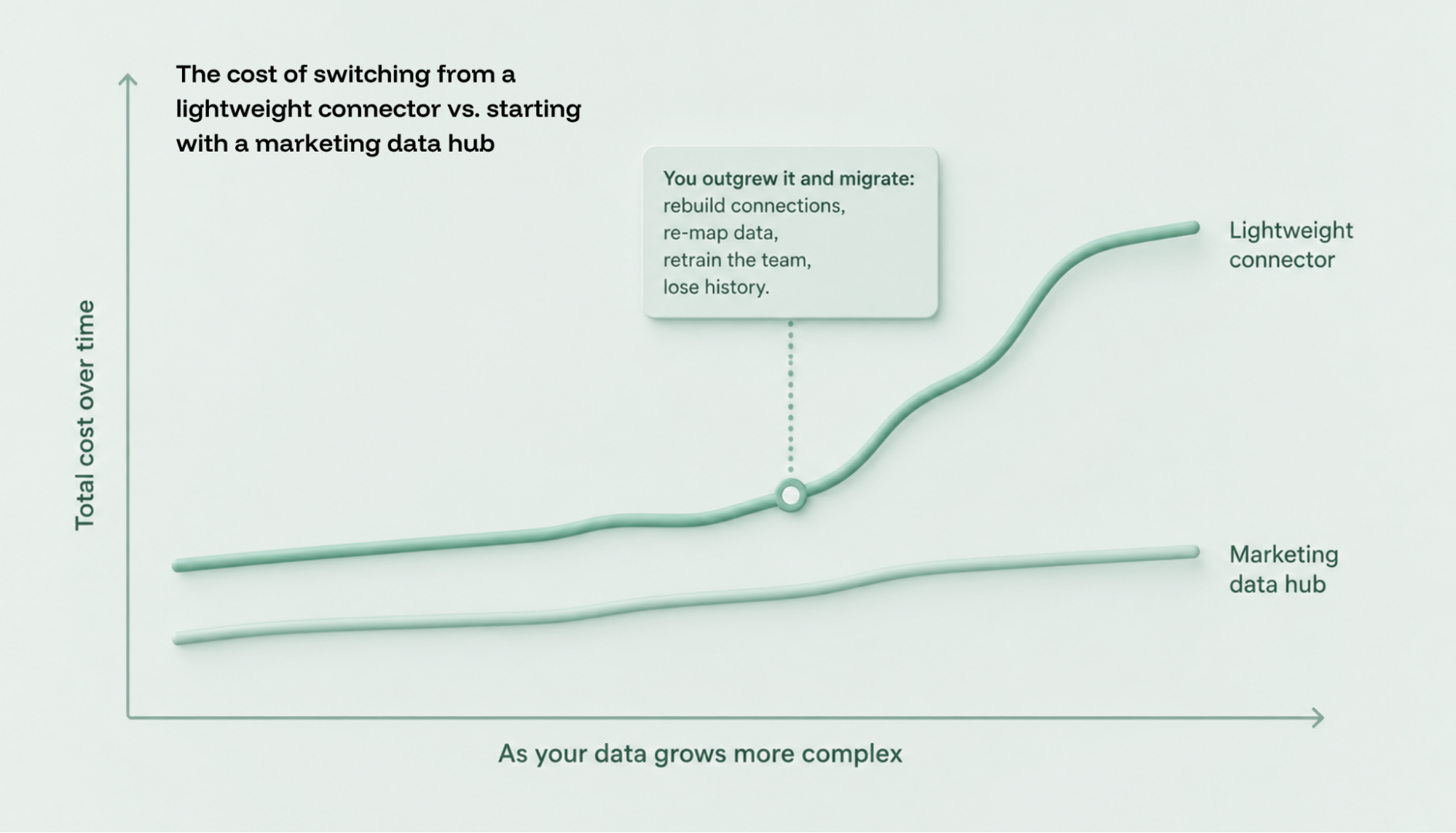
While your upfront subscription bills are usually transparent, the cost of everything built around it rarely is. When teams buy a lightweight connector, they also buy the ongoing work of maintaining what surrounds it, like manual reconciliation, fixing spreadsheets and rebuilding pipelines to add a new channel. And those costs compound the more complicated your data setup gets.
So by the time you decide to switch, that migration carries its own bill of resources needed to re-authenticate ad accounts, rebuild channel groups and conversion rules, retrain the team and accept that the history in the old tool usually doesn't migrate.
With Funnel, you define your rules once and reuse them as you add platforms, so it's a tool you grow into rather than out of. So while Funnel is a higher entry point than a single connector, it can save you in the long run.
Biased numbers can influence the real budget
You want to move your budget to the best-performing channels, but platforms count the same conversion differently, and they’re inherently biased because they get to grade their own homework.
The team at Deuba, a leading German online retailer, suspected their last-click model was giving them a distorted picture. When they moved to a more complete view of their marketing data because Funnel normalized the numbers, they found social media conversions had been underrepresented by as much as 80%. Paid search had been getting credit that belonged elsewhere.
Mark Prediger, Head of Online Shops & Marketing, explained: "Transitioning from a last-click attribution model to a holistic measurement approach has given us the power to accurately measure the real ROI of every marketing move."
Measurement without a data engineering project
Advanced measurement models all require a data foundation that many teams simply don’t have. To run marketing mix modeling, you need consistent historical spend across every channel; for multi-touch attribution, a unified view of the customer journey; and for incrementality testing, a reliable baseline. Teams try to move beyond last-click reporting but immediately hit a wall because their data is too fragmented to model until someone manually builds the infrastructure.
With Funnel, that foundation is already built. Measure, Funnel's measurement add-on, sits directly on top of the Data Hub and uses the same governed marketing data that already feeds your reports and dashboards. There's no separate ingestion project and no parallel pipeline to maintain.
After moving from last-click reporting to causal measurement on that foundation, Tallink Silja Line improved ROAS by 50% while reducing budget by 16%.
None of the alternatives in this article offer this capability. A connector moves the data but doesn't store or govern it. An agency reporting tool surfaces the numbers but can't model on them. A general pipeline can move the data but leaves the marketing-specific normalization and the entire measurement layer for someone else to build.
No single point of failure
A spreadsheet pipeline stays with whoever built it. An enterprise platform lives with the one engineer who knows how to run it. If that person is in a meeting or on vacation, everyone else has to wait. If they leave the company, there’s an even bigger problem.
When a platform requires a technical champion to function, the whole team inherits that dependency. Journey Further, a performance marketing agency with 180 specialists, grew into that dependency because their earlier reporting setup required coding skills that existed in the team but not across it. After they moved to Funnel, over 50 analysts could work with data without waiting on a technical gatekeeper, and the team saved more than 500 analyst hours each month by removing the bottleneck between the data and the people who needed it.
With Funnel, a marketer can answer their own questions, and the data team gets clean tables in the warehouse without babysitting APIs.
Adding a channel isn't a project
With a lightweight connector, adding a new marketing channel means adding a new maintenance obligation. A new API to authenticate. New fields to map. New definitions to reconcile with the channels already running. At a certain scale, that work becomes the job.
Digicel manages marketing across 12 brands and 26 markets. Before Funnel, the team spent the first half of every week assembling the previous week's numbers, by which point the budget had reallocated, and the data was outdated. As such, end-of-month reconciliation alone took four to five days. Nick Cudahy, Director of Group Media Performance & Growth, described what changed: "Before Funnel, we were 100% looking in the rear-view mirror. Now we're looking out the front window to see what's coming."
When the data layer handles new sources, the team's time goes to marketing performance and strategy. And the platform doesn't run out of room as you grow: in 2025, 11% of the world's digital ad spend ran through Funnel, which serves more than 3,000 customers.
Built for AI workflows
AI has made it faster than ever to build dashboards, run analysis and generate answers from marketing data. Speed doesn't fix the input, though. If the underlying data is fragmented or incomplete, AI produces confident-sounding answers built on a shaky foundation.
Funnel gives AI tools and agents one governed source of marketing data to work from, with consistent definitions and historical continuity, plus the business context needed to make outputs trustworthy.
Funnel AI is built into the Data Hub. With it, marketers ask questions of their data directly, with no CSV exports and no waiting on a data team. It works within your Funnel environment, grounded in your sources, custom metrics and workspace context. MCP, a read-only interface, lets external AI platforms and agents query and understand Funnel data. Teams building AI workflows don't need to pipe data to yet another tool, because the trusted foundation is already there.
Your marketing always needed accurate data. Now your AI does too. As more decisions get handed to automated workflows and agents, the cost of bad input data rises.
When Funnel isn't the right fit
Every architecture has its limits. Funnel is designed for teams managing complex, multi-channel ecosystems, which means it’s a poor match if you fall into these scenarios:
- If you are an individual contributor pulling data from just two or three sources into a single spreadsheet, a lightweight connector is more efficient and economical.
- If you manage a handful of clients who only require basic, templated reports, a visual agency dashboard is a better purchase.
- Below a certain threshold of budget and channel volume, you don’t have enough data to justify the cost of a data hub.
- If your budget is tight, a cheap connector gets you off the ground immediately. But the trade-off is future friction; you must accept that you’ll eventually pay a tax in time and data loss when you outgrow that tool and have to rebuild your system.
How to choose the right Funnel alternative
Choose Funnel if you meet the following criteria:
- You introduce new marketing channels too quickly to configure and connect them manually.
- Your marketing team, data team and multiple clients all require identical, reconciled metrics.
- You cannot risk broken dashboards or lost historical records when a third-party API connection fails.
- You’ve already outgrown a basic data connector and want to avoid another disruptive software migration.
- Marketers must generate reports without IT support, while your data engineers need clean tables without constant API maintenance.
- You want to run your reports, downstream analysis and data warehouse feed from a single source rather than three separate tools.
If these scenarios don’t describe your current workflow, go for the category that matches your immediate needs.
Choose the tool you won't have to leave
Any of the four Funnel alternatives may work for your team today. However, your research may not reveal the true cost of software ownership. Your primary expense is more than just the monthly subscription; it could show up a year later when you outgrow a basic tool and need to migrate your data. Or, you might start high and realize that the tool was better suited to your engineering team. At that point, you might end up losing historical records, and you have to re-create connections, map data again and retrain your staff.
Marketers choose Funnel because it adapts as their operations scale. You can add new platforms and data destinations without switching software. So go for a tool for where your business is headed, rather than just where it is today.
FAQs
What are the main alternatives to Funnel.io?
Lightweight connectors (Supermetrics, Windsor.ai), agency reporting tools (AgencyAnalytics, Whatagraph), general data pipelines (Fivetran, Airbyte) and enterprise marketing intelligence platforms (Adverity, Improvado) are the main Funnel alternatives.
Is Supermetrics a good alternative to Funnel?
Yes, it can be a good alternative for small teams that only need data moved into a spreadsheet, BI tool or warehouse. It doesn't store data, so history can be lost when a source breaks.
How does Funnel differ from Fivetran?
Fivetran moves raw data for data engineers and leaves marketing normalization to your team. Funnel normalizes the data and stores it in a governed hub marketers can use directly.
What is the difference between a marketing data connector and a marketing data hub?
A connector moves data, then stops. A hub also stores and standardizes it, so every report, model and destination has the same numbers.
When is Funnel not the right choice?
It’s not the right choice for one person pulling a few sources into a spreadsheet, a very small agency running simple branded reports or an SMB with low ad spend and minimal platforms.
How does Funnel compare to Improvado and Adverity?
Both are enterprise platforms with services-led rollouts and heavier implementations. Funnel is a no-code hub marketers run themselves, with measurement built on the same foundation.